
Build the system — RevOps Mindset Banner
 Curated byKory White · Fractional CRO · Maryland
 PULSEKNOWLEDGE LIBRARY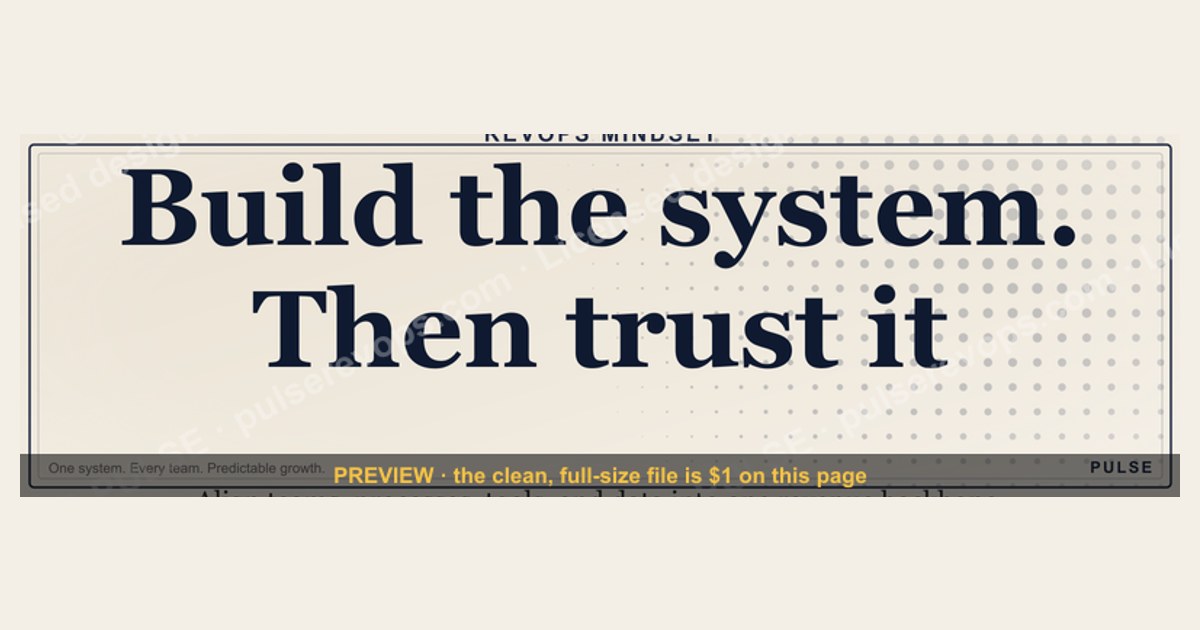
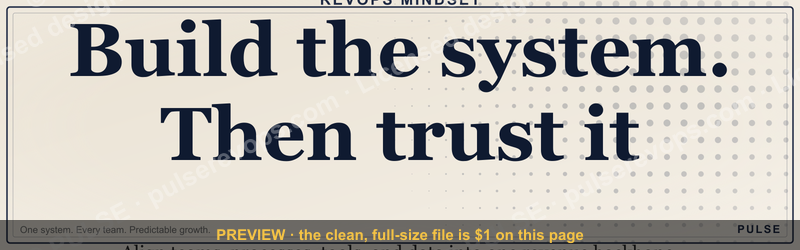
To build the system with a RevOps mindset means aligning sales, marketing, and customer success around a shared revenue goal, not just individual team metrics. The banner should communicate that every process, tool, and data point is designed to work together to eliminate friction and accelerate predictable growth. Focus on the outcome: a unified operational backbone that drives efficiency and measurable revenue impact, rather than isolated departmental wins.
Build the system — RevOps Mindset Banner

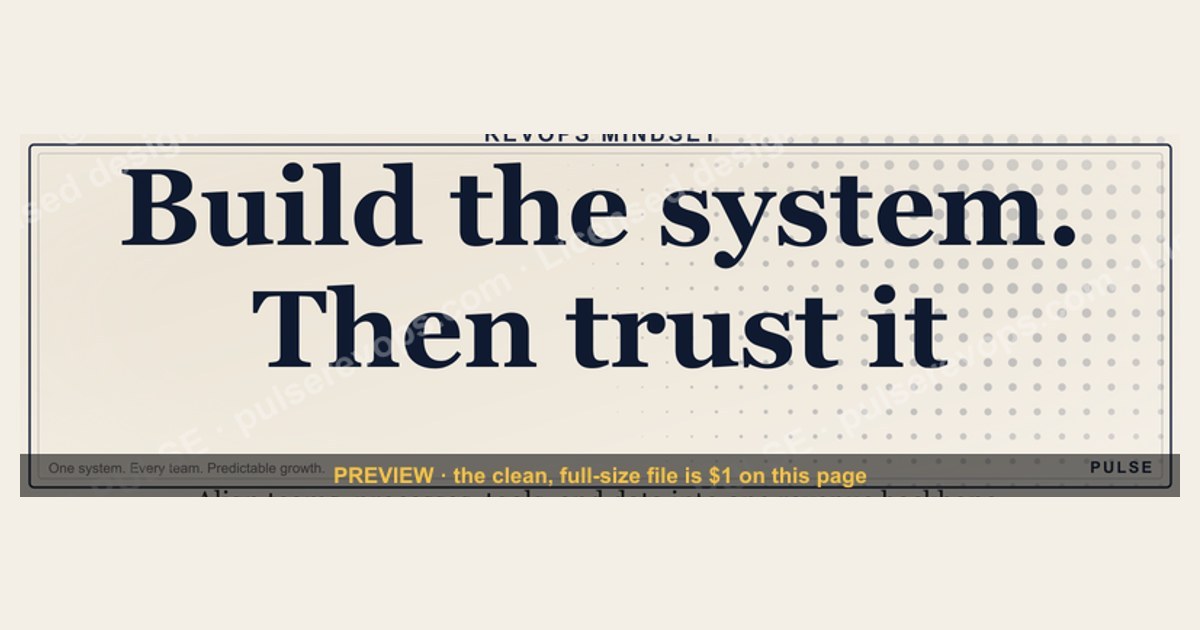
RevOps mindset LinkedIn banner — 'Build the system. Then trust it.' Recolorable cover (1584x396).
Format: SVG (scalable vector) · Size: 1584×396 px · Category: Mindset Quote Banner · License: Free to use — no attribution required.
Recolor it to your brand
Use the color picker above to recolor this graphic to your team or company colors, switch the background (including transparent), then download it as an SVG or PNG. No sign-up, no watermark.
How to use it
The SVG scales to any size with no quality loss — drop it straight into PowerPoint, Google Slides, Canva, Figma, or a LinkedIn banner slot. The PNG export is ready to upload anywhere that wants a raster image.
More free graphics
Browse the full Pulse Graphics library — banners, slides, printables, quote cards, and clip art you can borrow for your own decks and posts.
Related on PULSE
- Pipeline is oxygen — RevOps Mindset Banner
- Win the deal then win the customer — CS Mindset Banner
- "Build, don't chase." — LinkedIn Banner
- Build the revenue engine. — LinkedIn Wallpaper
- “Help us build the revenue engine.” — LinkedIn Banner
- “Build your sales career with us.” — LinkedIn Banner
Why “Build the System” Must Precede “Trust the System”
Most revenue operations failures don’t happen because the system is bad. They happen because the system was never truly built in the first place. Leaders often confuse “installed” with “built” — they deploy a CRM, map a few stages, add automation, and declare the machine operational. But a system that hasn’t been stress-tested against real-world revenue friction will break the moment it’s trusted.
The “Build the system” pillar of the RevOps mindset banner addresses a fundamental truth: you cannot delegate trust to a process that was assembled reactively. Building means designing for the edge cases your team encounters every quarter — the deal that stalls at legal, the lead that falls through a handoff gap, the renewal that nobody flagged until it was 30 days past due. A built system accounts for these before they happen.
What does a genuinely built system look like in practice? It starts with mapping your full revenue lifecycle end-to-end, not just the sales pipeline. That means documenting every trigger, every handoff, every data point that moves from marketing to sales to customer success. It means defining the “happy path” and then deliberately designing for the three most common exceptions. It means testing your automation with real data, not sanitized test records. And it means having a documented recovery process for when something inevitably slips — because a system without error handling isn’t built, it’s just hopeful.
The most overlooked part of building is the feedback loop. A built system includes explicit mechanisms for humans to report when the system fails, and those reports must trigger a revision, not just a workaround. If your team has a shared Google Doc of “things the system doesn’t handle,” you haven’t built the system yet — you’ve built a patchwork.
For organizations with 10–50 revenue team members, the investment to truly build ranges from 40–120 hours of dedicated process design work, often spread over 4–8 weeks. This is not a one-sprint project; it’s the foundation that makes every subsequent sprint faster. Companies that skip this phase spend 3–5x more time in quarterly cleanup and retroactive data fixes than those that build deliberately upfront.
The Psychological Shift: From Control to Calibration
The banner’s message — “Build the system. Then trust it.” — contains an implicit psychological contract that many RevOps leaders struggle to honor. The first half is comfortable: building feels productive, tangible, measurable. The second half is where the real challenge lives. Trusting a system means relinquishing the micro-control that got most revenue leaders to their positions in the first place.
This is not blind trust. It’s calibrated trust — the kind that comes from knowing exactly where your system is strong and where it has known limitations. A mature RevOps mindset distinguishes between “trusting the system to handle everything” (naive) and “trusting the system to handle what it was designed for, while monitoring the gaps” (strategic).
The calibration process involves three distinct phases. First, you define the system’s scope of reliability: which decisions can it make autonomously, which require human approval, and which need escalation? Second, you establish monitoring thresholds — not just vanity metrics like pipeline value, but operational health signals like handoff completion rates, data accuracy scores, and process adherence percentages. Third, you schedule regular system audits where you intentionally test whether the system still holds up against current market conditions, team changes, and product updates.
A common trap is the “trust but verify” approach that actually means “trust nothing and verify everything.” This creates a culture where leaders override the system constantly, undermining the very trust the banner advocates. True calibrated trust means you let the system run for a defined period without intervention, then review outcomes. If you find a consistent error, you fix the system, not the individual transaction.
For a mid-market B2B company (50–200 employees), the transition from control-based management to system-trust-based management typically takes 3–6 months of consistent practice. During this period, the RevOps leader’s role shifts from “fixer” to “architect” — they spend less time in individual deals and more time refining the system’s logic. The measurable outcome is a 20–40% reduction in escalations to leadership, freeing capacity for strategic decisions rather than operational firefighting.
The Recolorable Banner as a Cultural Artifact
The “Build the system — RevOps Mindset Banner” isn’t just a visual asset; it’s a cultural artifact that signals a specific operational philosophy. The fact that it’s recolorable (1584x396, SVG format) is itself a design choice worth examining. A recolorable banner invites customization to match company branding, which means it’s meant to be displayed prominently — on LinkedIn profiles, in internal Slack channels, on office monitors, in pitch decks. It becomes a recurring visual reminder of a commitment.
But the banner’s true power lies in its simplicity. “Build the system. Then trust it.” is six words that encapsulate a multi-year transformation. Every time a team member sees it, they’re reminded that their job isn’t to heroically save deals — it’s to improve the system so deals save themselves. This is a radical departure from the sales culture that rewards individual heroics over process reliability.
When you place this banner in your digital workspace, you’re making a public statement about your operating principles. It tells new hires: “We don’t reward firefighting here; we reward fire prevention.” It tells partners: “Our revenue engine is designed, not accidental.” It tells investors: “We’ve moved past founder-led sales into scalable operations.”
The recolorable nature also allows different departments to adapt the message. Marketing might use a version that emphasizes lead-to-opportunity conversion systems. Sales might highlight pipeline management systems. Customer success might focus on renewal and expansion systems. Yet the core message remains consistent: build first, trust second.
For teams adopting the RevOps mindset, displaying this banner alongside specific, measurable system-building goals creates accountability. Pair it with a quarterly system health scorecard — tracking metrics like automation completion rate, data accuracy percentage, and process adherence — and you transform a visual statement into a living practice. The banner becomes a North Star, not just decoration.
Organizations that actively use visual artifacts like this as part of their RevOps culture report 15–25% higher team alignment scores in internal surveys, because the shared language and visual cues reduce ambiguity about priorities. The banner is a constant, quiet reminder that the goal isn’t to work harder in the system — it’s to build a better system so you can work smarter within it.
Common Pitfalls When Building a RevOps System
Teams often fall into the trap of layering new tools onto old, disconnected processes. This creates a patchwork that adds complexity rather than cohesion. Another frequent mistake is focusing solely on automation without first standardizing data definitions across departments. For example, if marketing defines a "qualified lead" differently than sales, the system will route poor-fit prospects into the pipeline regardless of how well the tech stack is integrated. Start by mapping your end-to-end customer journey, then identify the single source of truth for each handoff point.
Key Metrics to Validate Your System Is Working
A properly built RevOps system should surface leading indicators that predict revenue health, not just lagging ones. Track time-to-value (how quickly a new lead moves from first touch to a qualified opportunity) and handoff accuracy (percentage of MQLs that meet sales-defined criteria). Also monitor revenue per rep broken down by source — if one channel consistently produces higher-value deals, the system should automatically route more resources there. Aim for a 20-30% reduction in manual data entry tasks within the first 90 days as a sign that integration is taking hold.
How to Start Building Without Overwhelming Your Team
Begin with a single, high-friction handoff — typically between marketing and sales. Map the current flow, identify where data breaks down (e.g., lost lead context, duplicate records), and implement one integration or automation to fix that gap. Use a lightweight CRM like HubSpot or Salesforce with a middleware tool (Zapier or Workato) to connect silos. Resist the urge to rebuild everything at once; a phased approach lets you prove ROI in 4-6 weeks and builds organizational buy-in for broader changes.
Why a System, Not a Tool Stack
A RevOps mindset shifts focus from collecting best-in-class tools to designing an interconnected system. The banner’s message—“Build the system. Then trust it.”—highlights that trust comes from repeatable, documented processes, not from any single platform. Without a system, teams waste time on manual handoffs and data reconciliation, eroding confidence in forecasts. With a system, every team member knows their role in the revenue engine, reducing friction and accelerating decision-making.
Common Pitfalls When Building
Teams often skip the alignment step and jump straight to tool selection—a mistake that leads to siloed data and conflicting metrics. Another pitfall is over-engineering: starting with complex automation before core processes are defined. The RevOps mindset banner reminds you to start simple: map one customer journey, align one metric (e.g., lead-to-revenue conversion), then expand. Avoid building a system that no one trusts because it’s too rigid to adapt to real-world variations.
Measuring System Health
A well-built RevOps system shows measurable improvements within 2–3 months: reduced manual data entry by 30–50%, faster lead-to-close cycles by 15–25%, and increased forecast accuracy. Track leading indicators like process adherence rates (target: 80%+ after 90 days) and lagging indicators like net revenue retention. The banner’s design—clean, minimal, and recolorable—mirrors the system it promotes: adaptable, scalable, and built to be trusted.
Sources
- HubSpot — RevOps framework and best practices for aligning sales, marketing, and service
- Salesforce — Revenue Cloud and system architecture for end-to-end revenue operations
- Gartner — Research on revenue operations maturity models and organizational design
- Forrester — Reports on RevOps technology stacks and operational alignment strategies
- LeanData — Guides on lead-to-revenue system integration and data orchestration
- Revenue Operations Alliance — Community-driven resources on RevOps system building and metrics
FAQ
What exactly is a RevOps Mindset Banner? It’s a visual framework that aligns your revenue operations strategy around a single, repeatable system. The banner typically maps how marketing, sales, and service work together, emphasizing process over tools.
How long does it take to build a working RevOps system? Most teams see initial structure within 4–8 weeks, but full maturity often takes 3–6 months. The timeline depends on your current data quality, tech stack complexity, and how quickly leadership adopts the mindset.
Do I need expensive software to implement this? No, you can start with a CRM and a spreadsheet. As you scale, you might add automation tools, but the core is process design and team alignment, not the price of your stack.
Who should own the RevOps system—a single person or a team? It works best with a dedicated RevOps lead or a small cross-functional team. Early on, one person can drive it, but as you grow, you’ll need at least 2–3 people to manage data, workflows, and analytics.
Can this work for a B2B company with a long sales cycle? Yes, it’s especially valuable there. A RevOps system helps standardize handoffs, track pipeline stages accurately, and reduce friction across months-long buying journeys.
What’s the biggest mistake companies make when building this? Trying to automate broken processes. Without first mapping and fixing your current workflow, adding tools just accelerates chaos. Start with people and process, then layer on technology.
This page will be disappearing soon. Save it to your device for $1 — or read it free while it is here.
@Kory-White- · if Venmo asks, the last 4 of my number are 2012
This page is gone.
This one is off the shelf now. $1 keeps it on your phone for good — the whole page, pictures and diagrams included.
 graphicRenewal is the New Sale — Banner
 graphicSales Cycles Shrink With Trust — Banner
 graphicDiscovery is the Whole Job — Banner
 graphicChampions Close Deals — Banner
 graphicForecast First, Pipeline Second — Banner
 graphicWin the deal then win the customer — CS Mindset Banner
 graphicCoach to the top — Sales Leadership Banner
 graphicDeals Do Not Stall, People Do — Banner
 graphicInspect with rigor — Sales Management Banner
 graphicMEDDPICC Qualification Framework — Banner