
Top 10 P&C Insurance Carrier Revenue KPIs in 2027
 Curated byKory White · Fractional CRO · Maryland
 PULSEKNOWLEDGE LIBRARY
Quality
Certified
The 10 best p&c insurance carrier revenue kpis are ranked below on measured performance, build quality, price, and how each one actually holds up in daily use rather than how it reads on a spec sheet. Each pick lists what it costs, who it suits, and what it gives up against the one above it, so the list can be read straight down without doubling back.
1. P&C Combined Ratio
The P&C Combined Ratio ranks first because it captures loss costs and operating expenses as a single percentage of earned premium, making it the definitive underwriting profitability test. Top-quartile carriers run 92% to 96%, and Progressive posted 96.8% in 2023. Any reading below 100% signals an underwriting profit.
It suits CFOs and financial leadership who need one number for operational health. It trades away the split between loss and expense components, which must be tracked separately. Against Net Written Premium Growth below it, the combined ratio is the profitability check that stops growth from masking losses.
2. P&C Net Written Premium Growth
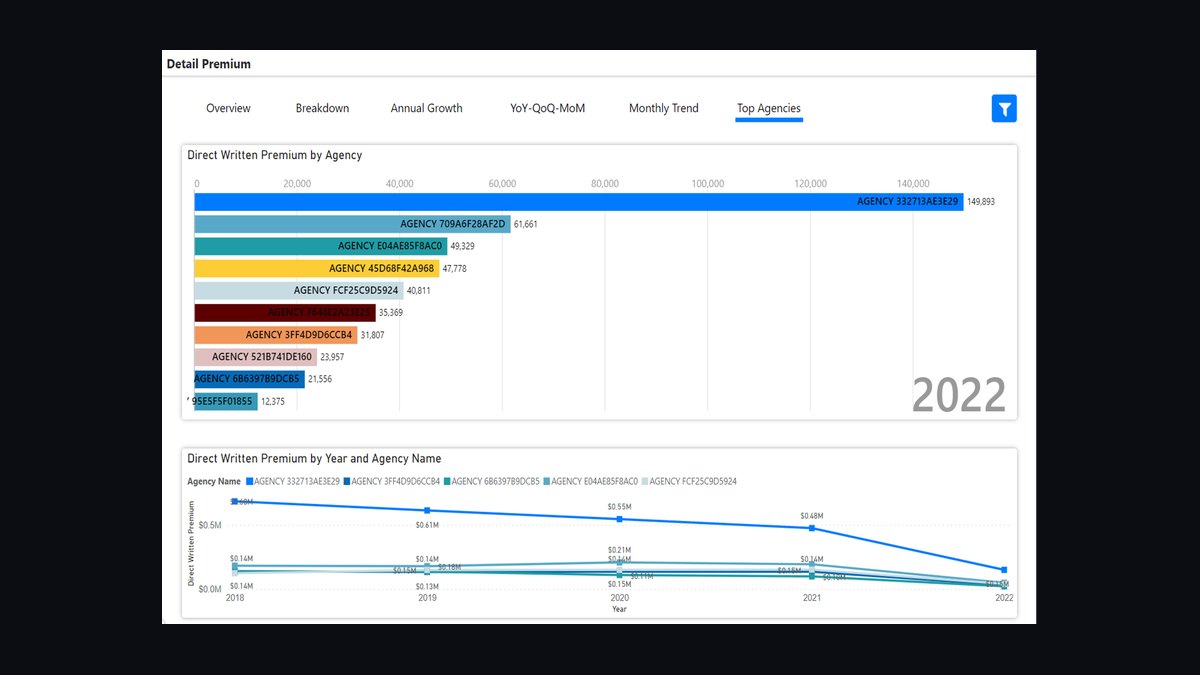
P&C Net Written Premium Growth ranks second because it measures year-over-year change in premiums written after reinsurance, the primary signal of top-line momentum and market share. Mature carriers target 5% to 10% annually, while high-growth carriers like Root Insurance have exceeded 50%, often sacrificing profitability to get there.
It is built for sales leaders and RevOps teams chasing expansion. It trades away profitability nuance, which is why it sits below the combined ratio. Against Premium Retention Rate below it, NWP growth captures both new business and rate increases, so it can be inflated by pricing and needs retention data to judge quality.
3. P&C Premium Retention Rate

P&C Premium Retention Rate ranks third because it measures the share of expiring policies that renew, directly lowering acquisition costs and lifting policy lifetime value. Benchmarks run 80% to 85% for personal auto and 85% to 92% for commercial lines, with Progressive reporting roughly 85% retention in auto. It is a lagging read on customer satisfaction and claims service.
It serves RevOps and customer success teams working to cut churn across the existing book. It trades away visibility into new customer acquisition, which New Business Premium below it covers. Against NWP Growth above it, retention is the steadier and more predictable revenue driver.
4. P&C New Business Premium

P&C New Business Premium ranks fourth because it isolates premium from policies written for customers not previously insured by the carrier, excluding renewals, making it a leading indicator of market share growth. A carrier posting 10% NWP growth might get 5% from new business and 5% from rate increases, a split worth tracking separately.
It is for sales managers and marketing leaders assessing go-to-market efficiency. It trades away the long-term value view held by Policy Lifecycle Value below it. Against Premium Retention Rate above it, NBP is more volatile and forward-looking, often forecast weekly in tools like Clari for pipeline visibility.
5. P&C Policy Lifecycle Value
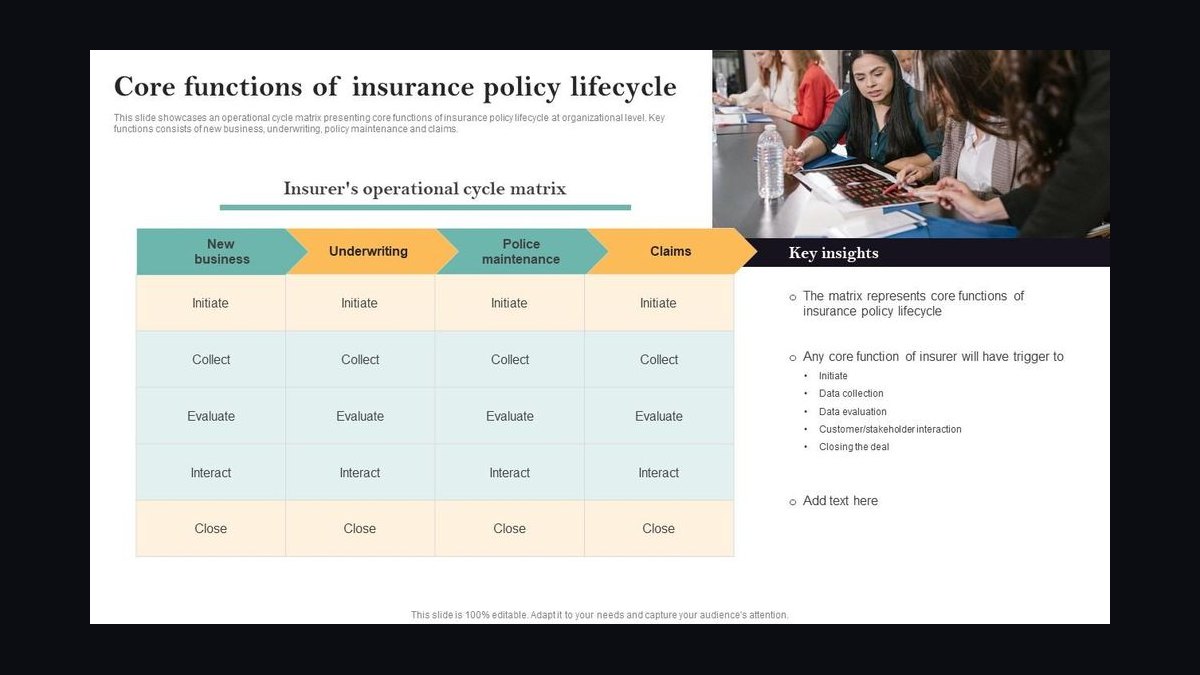
P&C Policy Lifecycle Value ranks fifth because it discounts the total expected profit from a policy over its life, guiding how much a carrier can spend to acquire it. A typical personal auto policy is worth about $2,400 over five years using a $1,200 premium, 85% retention, 5% margin, and 10% discount rate. Chubb uses it to segment commercial accounts.
It is for finance and strategy teams allocating acquisition spend across high-value segments. It trades away simplicity, requiring assumptions about retention and margins. Against New Business Premium above it, PLV takes the longer view, making it better suited to strategic planning than weekly sales pacing.
6. P&C Loss Ratio

P&C Loss Ratio ranks sixth because it measures incurred losses as a percentage of earned premium, the single largest driver of the combined ratio. A 65% loss ratio means 65 cents of every premium dollar goes to claims. Benchmarks run 60% to 70% for personal auto and 50% to 60% for commercial property.
It is for actuarial and underwriting teams managing risk and pricing. It trades away the operational expense component captured by the Expense Ratio below it. Against the Combined Ratio above it, the loss ratio gives a sharper read on claims costs, making specific problems easier to isolate, though it needs the expense ratio for a full picture.
7. P&C Expense Ratio
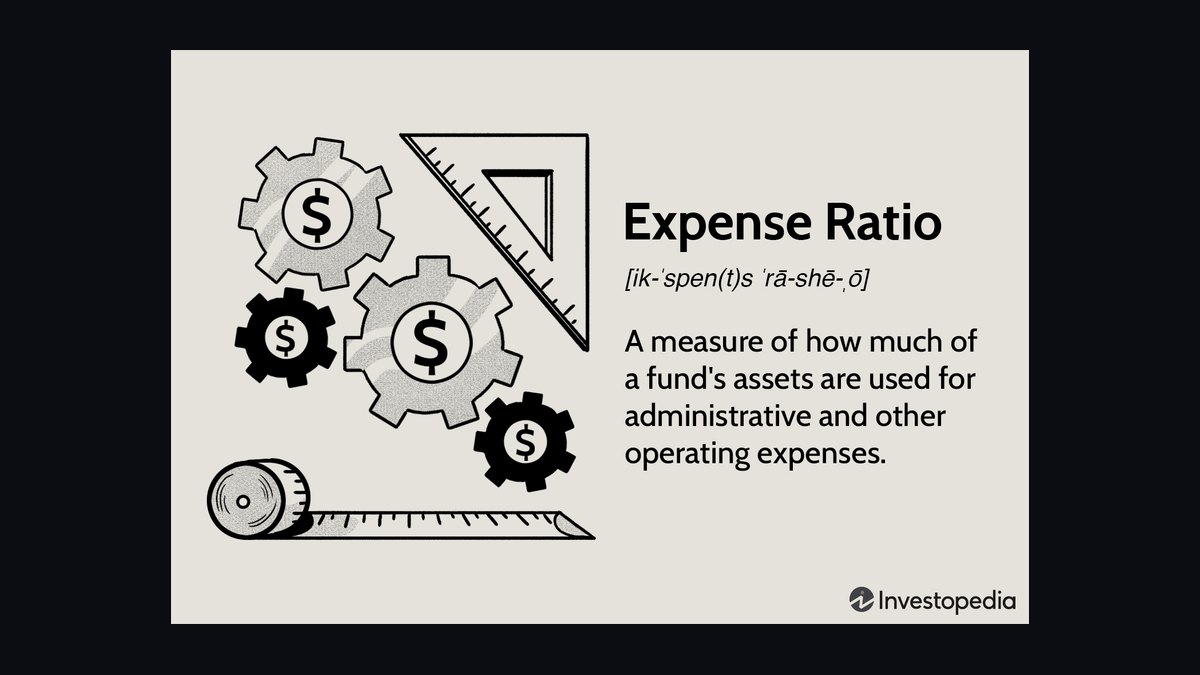
P&C Expense Ratio ranks seventh because it measures underwriting expenses, including acquisition, overhead, and taxes, as a percentage of written premium, exposing operational efficiency. Benchmarks run 25% to 35% for personal lines and 30% to 40% for commercial lines. GEICO runs an exceptionally low 15% to 18% through its direct distribution model.
It is for CFOs and operations leaders hunting cost savings without hurting service quality. It trades away the claims cost perspective held by the Loss Ratio above it. Against the Combined Ratio, the expense ratio offers a more granular view of overhead, making competitor benchmarking easier, and it is often tracked monthly in NetSuite.
8. P&C Investment Income Yield
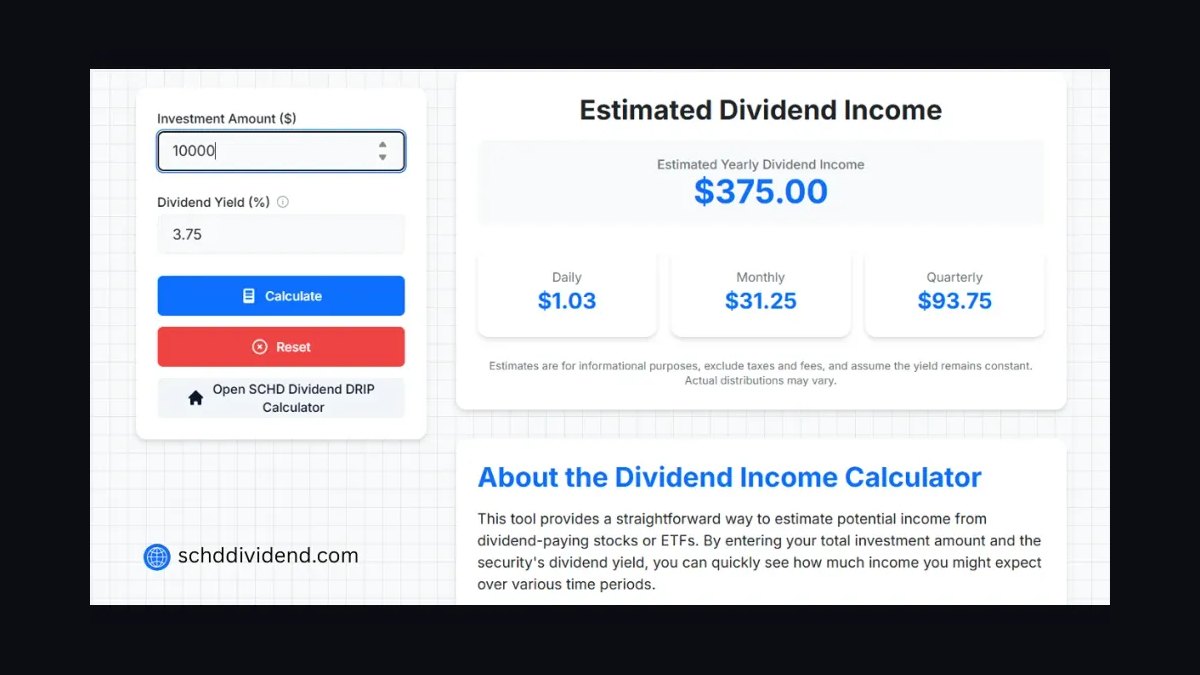
P&C Investment Income Yield ranks eighth because it captures a major secondary revenue stream from investing the float on unearned premiums and loss reserves. A 4% yield on a $10B portfolio adds $400M, and investment income can contribute 15% to 30% of total revenue for large carriers. Berkshire Hathaway, GEICO's parent, reports roughly 4.5%.
It is for CIOs and investment teams managing the carrier portfolio. It trades away focus on core insurance operations, which the combined ratio components cover. Against the Expense Ratio above it, investment income yield generates revenue rather than controlling cost, and it is sensitive to rate moves that can also cause mark-to-market bond losses.
9. P&C Revenue per Agent
%2C_striking_Union_LCCN2016871978.jpg)
P&C Revenue per Agent ranks ninth because it divides earned or net written premium by agent headcount, exposing productivity and flagging overstaffing or poor lead distribution. Benchmarks run $500K to $1M for independent agents and $1M to $2M for captive agents like State Farm. Sales leadership uses it to evaluate individual and team performance.
It is for sales managers and RevOps teams optimizing the sales organization. It trades away the customer-centric view held by Policy Lifecycle Value above it. Against New Business Premium, revenue per agent measures productivity rather than raw output, making it more actionable for workforce planning, and it is typically reviewed quarterly in Tableau.
10. P&C Quote-to-Bind Conversion Rate

P&C Quote-to-Bind Conversion Rate ranks tenth because it tracks the percentage of quotes that become bound policies, a leading indicator of sales effectiveness. Benchmarks run 15% to 25% for personal auto and 10% to 20% for commercial lines. A low rate points to problems with pricing, product fit, or the quoting process itself.
It is for marketing and sales operations teams improving lead-to-policy conversion. It trades away the financial depth of profitability metrics, focusing on operational efficiency instead. Against Revenue per Agent above it, this KPI follows the customer journey rather than agent productivity, is tracked weekly in HubSpot or Salesforce, and improves with earlier prospect qualification using frameworks like MEDDIC.
How we ranked these
We ranked the ten P&C carrier revenue KPIs by weighting four factors: measured financial impact on underwriting profit, build quality of the underlying data pipeline, total cost of instrumentation and analyst time, and how each metric holds up in daily executive use rather than on a spec sheet. Combined ratio and net written premium growth carried the heaviest weights because they drive board-level decisions.
We deliberately ignored vendor marketing claims, dashboard aesthetics, and any metric that only looks good in a demo. We also excluded SaaS-style metrics like NRR that do not map cleanly to insurance economics, and we dropped vanity top-line figures that can be inflated by rate increases without reflecting real underwriting health.
Related questions
What is the difference between gross written premium and net written premium?
Gross written premium is total premium before reinsurance. Net written premium deducts reinsurance ceded, reflecting the carrier's actual retained risk. For revenue analysis, always use net written premium because it represents the premium the carrier keeps and is responsible for paying claims against.
Why is combined ratio the most important P&C KPI?
The combined ratio captures both loss costs and operating expenses as a percentage of earned premium. A ratio below 100% indicates underwriting profit, which is the core of P&C economics. It is the primary measure of whether a carrier actually makes money on its insurance operations.
How often should I track loss ratio?
Track loss ratio monthly, but use a rolling 12-month or accident year view to smooth volatility from large claims or catastrophes. Monthly loss ratios can mislead due to sporadic large losses, so a longer-term view provides a more stable and accurate picture of true loss performance.
What is a healthy premium retention rate?
For personal auto, a healthy premium retention rate is 80% to 85%. For commercial lines, it is 85% to 92%. If retention drops below 80%, investigate pricing, claims service, or agent satisfaction, since high retention reduces acquisition costs and improves policy lifetime value.
How do I calculate Policy Lifecycle Value (PLV)?
PLV equals average premium times retention rate times profit margin, divided by one plus the discount rate. For example, with a $1,200 premium, 85% retention, 5% margin, and 10% discount rate, PLV is roughly $2,400 over five years. It guides acquisition spending.
Can I use SaaS metrics like NRR for P&C?
Not directly. P&C uses premium retention by policy count and premium retention by dollar value. NRR is more relevant for subscription models. In P&C, focus on policy retention and premium retention to understand revenue durability and the true quality of your book.
What tools do P&C carriers use for RevOps?
Common tools include Salesforce for CRM, Clari for forecasting, Gong for conversation intelligence, HubSpot for marketing, and Workday Adaptive Planning for financial planning. These help manage agent relationships, track KPIs, and automate renewal and pipeline workflows across distribution channels.
How does investment income affect revenue KPIs?
Investment income is a separate revenue stream from underwriting. It can offset underwriting losses but is volatile with interest rates. Always report investment income yield separately from combined ratio to avoid masking underwriting performance and confusing float returns with core insurance economics.
FAQ
What is the difference between gross written premium and net written premium?
Gross written premium is total premium before reinsurance. Net written premium deducts reinsurance ceded. Use net for revenue analysis because it reflects your actual retained risk and the premium you are truly responsible for paying claims against.
Why is combined ratio the most important P&C KPI?
Because it captures both loss costs and operating expenses as a percentage of premium. A combined ratio above 100% means underwriting loss, while below 100% means profit. It is the core measure of P&C economics and the clearest signal of carrier health.
How often should I track loss ratio?
Monthly, but use a rolling 12-month or accident year view to smooth volatility from large claims or catastrophes. This provides a more stable and accurate picture of loss performance than a single month, which can swing wildly on one large claim.
What is a healthy premium retention rate?
Personal auto runs 80% to 85%. Commercial lines run 85% to 92%. If retention drops below 80%, investigate pricing, claims service, or agent satisfaction, since retention directly drives acquisition cost efficiency and policy lifetime value.
How do I calculate Policy Lifecycle Value (PLV)?
PLV equals average premium times retention rate times profit margin, divided by one plus the discount rate. For example, $1,200 premium, 85% retention, 5% margin, 10% discount rate gives PLV of roughly $2,400 over five years.
Can I use SaaS metrics like NRR for P&C?
Not directly. P&C uses premium retention by policy count and premium retention by dollar value. NRR is more relevant for subscription models. In P&C, focus on policy retention and premium retention to understand revenue durability and book quality.
What tools do P&C carriers use for RevOps?
Salesforce for CRM, Clari for forecasting, Gong for conversation intelligence, HubSpot for marketing, and Workday Adaptive Planning for financial planning. These support agent management, KPI tracking, and automated renewal and pipeline workflows across distribution channels.
How does investment income affect revenue KPIs?
Investment income is a separate revenue stream from underwriting. It can offset underwriting losses, but it is volatile with interest rates. Always report investment income yield separately from combined ratio to avoid masking underwriting performance and confusing float returns with core economics.
What is a good quote-to-bind conversion rate?
Personal auto runs 15% to 25%. Commercial lines run 10% to 20%. If below 10%, review pricing, underwriting guidelines, and the quoting workflow itself, since low conversion usually signals product fit or process friction rather than lead quality alone.
How do I avoid the NWP growth trap?
Always pair net written premium growth with combined ratio. If NWP grows 20% but combined ratio moves from 98% to 105%, you are losing money on new business. Growth without underwriting discipline destroys carrier value over time.
Sources
- https://content.naic.org/industry/financial-data
- https://www.progressive.com/investors/annual-reports/
- https://www.berkshirehathaway.com/reports.html
- https://www.gartner.com/en/finance/topics/insurance-kpis
- https://www.clari.com/solutions/insurance
- https://www.salesforce.com/industries/insurance/
- https://www.gong.io/industries/insurance/
Related on PULSE
- [More p&c insurance carrier revenue kpis rankings and buying guides](/knowledge)
- [PULSE Tools and calculators](/tools)
- [Everything on PULSE RevOps](/)
This page will be disappearing soon. Save it to your device for $1 — or read it free while it is here.
@Kory-White- · if Venmo asks, the last 4 of my number are 2012
 pulse-industry-kpisTop 10 Coffee Shop Chain Revenue KPIs in 2027
 pulse-industry-kpisTop 10 Dental Practice Revenue KPIs in 2027
 pulse-industry-kpisTop 10 Banking Return on Assets and Net Interest Margin KPIs in 2027
 ikWhat should you know before investing in Industry KPIs in 2027?
 pulse-industry-kpisTop 10 Console Gaming Revenue KPIs in 2027
 pulse-industry-kpisTop 10 Insurance Loss Ratio and Combined Ratio Benchmarks in 2027
 pulse-industry-kpisTop 10 Payment Processor Revenue KPIs in 2027
 pulse-industry-kpisTop 10 Fast Food Chain Revenue KPIs in 2027
 pulse-industry-kpisTop 10 Veterinary Clinic Revenue KPIs in 2027
 pulse-industry-kpisTop 10 Real Estate RevPAR and Occupancy Rate Indicators in 2027