
Best LED lighting schedule for low-light aquatic plants like Java moss?
 Curated byKory White · Fractional CRO · Maryland
 PULSEKNOWLEDGE LIBRARY
Quality
Certified
Run low-light aquatic plants like Java moss on an 8-hour photoperiod delivering roughly 15–30 µmol/m²/s PAR at the plant surface, with a 20–30 minute dimming ramp at each end. Keep the dark period unbroken. If algae appears, shorten to 6–7 hours before touching intensity, and hold any change two full weeks.
The outcome you should expect
The honest outcome of a correct low-light schedule is *slow, boring, reliable growth*. Java moss (*Taxiphyllum barbieri*) is not a plant that rewards you with a visible change overnight. On an 8-hour photoperiod at 15–30 µmol/m²/s, healthy moss in a stable, moderately fertilized tank typically extends somewhere in the range of half a centimeter to a centimeter and a half per week — and that number swings hard with temperature. At 72–75°F it grows noticeably faster than at 80°F, where the plant's respiration cost starts eating into net carbon gain. A tank running warm for a betta or discus will look "stuck" on the exact schedule that produces lush growth in a cooler shrimp tank, and the light is not the variable to blame.
What you should expect visually, in order: within the first 7–10 days, no change at all, possibly a little melt at the tips if the moss was recently shipped or moved. Between weeks two and four, new growth appears as brighter, slightly yellow-green tips against the older darker material — that color contrast is the single most reliable indicator that the schedule is working. By week six to eight, a portion tied to driftwood or mesh should be visibly filling in and starting to lose the "just-tied" geometry. By month three you should be trimming.
What you should *not* expect is the dense, tight, dark-green carpet you see in aquascaping competition photos. That look comes from high light, injected CO₂, and aggressive weekly trimming — a completely different operating regime that also comes with a completely different algae risk profile and maintenance load. Under a low-light schedule, Java moss grows looser and longer, with more space between fronds. That is the correct outcome for the inputs, not a failure.
The second outcome worth naming is the algae baseline. A correctly run 8-hour low-light tank will still have algae. You should expect a thin green film on the front glass every 7–14 days, some soft green dusting on hardscape, and possibly a light brown diatom phase in the first two months of a new tank that resolves on its own. What you should *not* see is black beard algae colonizing the moss tips, stringy green filaments woven through the fronds, or blue-green slime sheeting over the substrate. Those three are signals that something structural is off — usually duration, usually not intensity.
Third: the energy and maintenance outcome, which is worth stating plainly because it is often the real reason people ask about schedules at all. A small planted-tank LED strip typically draws somewhere between 8 and 30 watts. Running one 8 hours instead of 12 saves four hours of that draw per day. At a 20-watt fixture and typical residential electricity rates, that is a difference measured in single-digit dollars per year — real, but not the point. The maintenance saving is the point: shorter photoperiods mean less glass scraping, fewer water changes chasing an algae bloom, and less of the "tear it down and restart" cycle that drives people out of the hobby. The schedule is a stability lever far more than a cost lever, and anyone selling it primarily on electricity savings is selling the wrong benefit.
What drives that outcome
Photoperiod works the way it does because photosynthesis is not a linear function of light. A plant fixes carbon up to a saturation point, past which additional photons do nothing useful and eventually do active harm through photoinhibition — the plant spends energy on protective pigments and repair instead of growth. Java moss saturates *early*, at intensities most aquarium fixtures exceed at half power. This is the whole reason low-light plants are forgiving in one direction and fragile in the other: they tolerate dim conditions indefinitely, and they degrade under bright ones.
The algae dynamic runs on a different curve, and that mismatch is the mechanism behind almost every low-light tank failure. Algae — particularly filamentous green algae and cyanobacteria — respond to *total daily light integral*, meaning intensity multiplied by duration. They keep converting extra light hours into growth well past the point where the moss has stopped benefiting. So every hour you add beyond the moss's requirement is an hour that feeds the competition and not the plant. This is why duration is the first knob to turn and intensity is the second: cutting hours removes algae's advantage without pushing the moss below its compensation point, while cutting intensity risks dropping the moss under the threshold where it produces more than it consumes.
The third driver is nutrient and carbon balance. Light sets the *rate ceiling*, but nitrogen, phosphorus, potassium, iron, and dissolved CO₂ set whether the plant can actually reach it. In a tank with light but no available nitrogen, the moss cannot build tissue with the energy it captures — so the energy and the unused nutrients both end up available to algae instead. This is the classic "I reduced my light and the algae got worse" paradox: the limiting factor was never light.
Fourth: the dark period is not passive. During darkness the plant runs respiration, repairs photosystem damage accumulated during the day, and resets circadian timing that governs when enzymes are produced. An unbroken dark block matters more than its exact length. A tank lit 8 hours, dark 4, lit 2 more, dark 10 is a materially worse environment than one lit 8 and dark 16, even though the totals are similar. The "siesta method" — splitting the photoperiod into two blocks with a midday dark gap — has adherents and does work for some tanks, but it works by reducing algae's continuous access to light, not by helping the plants, and it is not the schedule to start with when you're troubleshooting.
Finally, spectrum matters less than most product marketing suggests, but it is not irrelevant. Plants absorb most strongly in the blue and red bands. A fixture heavy on blue with little red can drive algae growth disproportionately, which is part of why old-style actinic-heavy reef lighting is a poor fit over a freshwater moss tank. A general-purpose 6500K "daylight" white LED contains adequate red and blue for a low-light plant and renders the tank in a way that looks natural to the eye. Chasing exotic spectra is a late-stage optimization; getting duration and intensity right captures the vast majority of the available benefit.
Benchmarks and realistic ranges
Here are the numbers worth anchoring to, with honest caveats about how much variance sits behind each.
Photoperiod. 8 hours is the default. The workable band is 6–10. Below 6 hours, most low-light aquatic plants begin to lose lower tissue as the plant sheds what it cannot support. Above 10, you are reliably in algae territory unless the tank is heavily planted with fast growers that are soaking up the surplus nutrients. Established, densely planted tanks tolerate longer photoperiods than new sparse ones, and a new setup should start at the low end — 6 hours for the first month — then step up.
Intensity. 15–30 µmol/m²/s at the plant surface is the low-light band. Under 10, growth stalls and lower moss browns out. Over 40–50, you are in medium-light territory where Java moss will still survive but will increasingly compete with algae for the surplus. The critical detail: PAR is measured *where the plant is*, not at the water surface. Light attenuates fast through water — roughly, a fixture producing 60 µmol/m²/s just under the surface might deliver half that at 18 inches down, and tannins, suspended particulates, or a dirty lens knock it down further. Moss tied to driftwood mid-column sits in a very different light field than moss on the substrate floor.
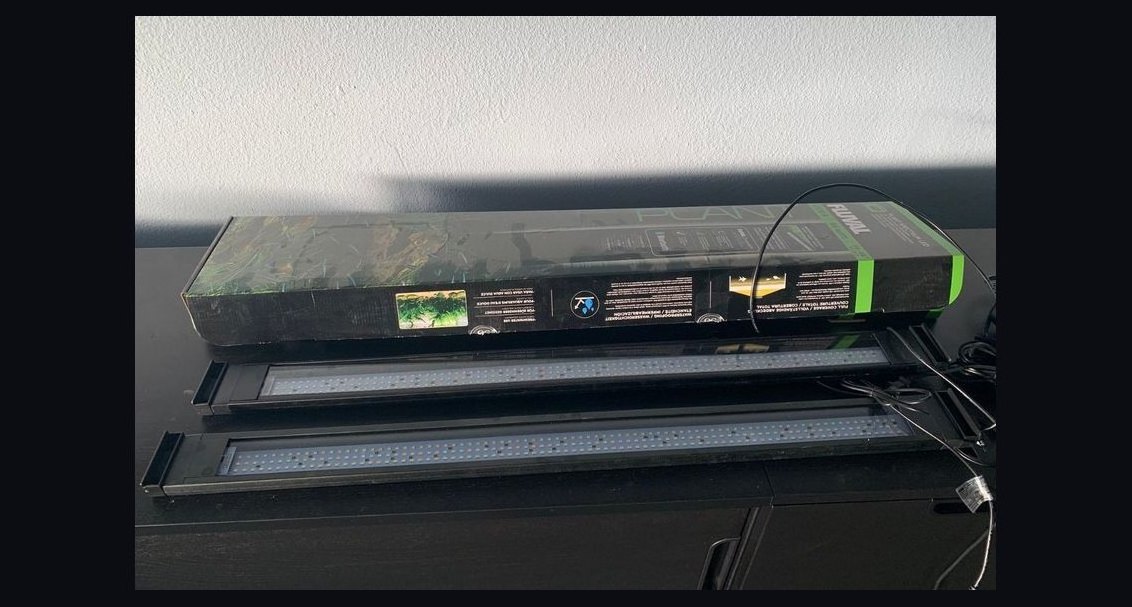
Fixture height and dimming. Most planted-tank LED strips mounted 6–12 inches above the water on a standard 10–29 gallon tank overshoot low-light requirements at full output. Dimming to somewhere in the 20–40% range is normal. If your fixture has no dimmer, raising it, adding floating plants, or placing a layer of window screen mesh over the lid are all legitimate ways to cut intensity — inelegant, effective, and free.
Measurement. A dedicated PAR meter is a genuine scientific instrument and priced accordingly; it is overkill for one tank. Smartphone-based apps calibrated for aquarium LEDs get you within a usable margin for hobby purposes — enough to tell 20 from 60. If you own neither, the practical proxy is the plant itself: light yellow-green new tips, no bleaching, no algae on the moss = you're in band.
Growth rate. Roughly 0.5–1.5 cm per week under the conditions above, with wide variance. Under 0.25 cm/week sustained over a month means something is limiting — check temperature and nitrogen before touching light.
Adjustment cadence. Two weeks minimum between changes, and change one variable at a time. Java moss responds slowly enough that a one-week evaluation window tells you nothing but noise. Most people troubleshoot themselves into a much worse position by making three changes in ten days and losing the ability to attribute any effect.
Temperature. 68–78°F is the comfortable band, with growth best toward the lower end. Above 82°F the plant struggles regardless of how well the lighting is dialed in — this is the single most common hidden variable in "my moss won't grow" cases in warm-water community tanks.
Fixture replacement. LEDs dim gradually rather than failing outright. Over a multi-year span, output decline is real but slow, and for a low-light tank it is largely irrelevant — you have margin in the direction the fixture is drifting. Replace when a fixture visibly dims, flickers, or develops dead diodes, not on a calendar.
Risks, edge cases, and failure modes
The most common failure is treating an algae outbreak as a light-intensity problem. Cyanobacteria — the blue-green slime that sheets over substrate and smells earthy — is not primarily a light phenomenon. It thrives in low-flow, high-organic dead zones and frequently appears in tanks with *perfectly reasonable* lighting schedules. Dimming the light will not fix it. Improving circulation, siphoning the affected substrate, and cutting the organic load will. Conversely, black beard algae on moss tips genuinely does correlate with excess light and unstable CO₂, and shortening the photoperiod is a reasonable first move there.
Second failure: the death spiral of over-adjustment. The pattern is recognizable — someone cuts to 6 hours, sees no improvement in five days, cuts to 4, adds a chemical treatment, changes the fertilizer, and moves the fixture, all inside two weeks. Now nothing is attributable and the tank is genuinely worse. Java moss operates on a two-to-four-week feedback loop. Respect that, or you're not troubleshooting, you're just stirring.
Third: mismatched plants under one schedule. A tank containing both Java moss and a light-hungry carpeting species is running an unsolvable optimization. Set the schedule for the moss and the carpet stretches, pales, and eventually rots at the base. Set it for the carpet and the moss gets colonized by algae. There are only two real answers: pick one lighting regime and choose plants that fit it, or physically zone the tank — moss in the shade of hardscape and under floating plants, demanding species directly under the fixture in open water. The zoning approach works, but it requires actually designing the layout around light, not retrofitting.
Fourth: livestock constraints override plant preferences. This is the edge case people forget. Shrimp — particularly during molting — and shy fish like kuhli loaches or many tetras are stressed by abrupt full-brightness switches. This is exactly why the ramp exists, and it's arguably a bigger benefit than the plant-side effect. Similarly, nocturnal species need genuine darkness; a "moonlight" blue LED left on overnight is a fish-keeping choice, not a plant-keeping one, and it costs you the clean dark block. If you keep both moss and animals that need dim conditions, the low-light schedule is a happy alignment — one of the few places in the hobby where two constraints point the same direction.
Fifth: ambient room light. A tank near a window gets a photoperiod you didn't program. Direct sun on the glass for even an hour a day can push a tank into algae bloom regardless of what the timer says, and seasonal variation in that ambient contribution is a real cause of "my tank was fine all winter and crashed in June." If the tank gets meaningful ambient light, account for it — shorten the programmed photoperiod, or curtain the window.
Sixth: the CO₂ trap. Java moss does not require injected CO₂, and adding it to a low-light tank is usually solving a problem you don't have. But the *inverse* edge case is real: in a heavily stocked tank with strong surface agitation, dissolved CO₂ can run low enough that even a low-light plant is carbon-limited. Symptom is a plant that looks healthy, isn't melting, but simply doesn't extend. Liquid carbon supplements are an option, with a caveat worth stating plainly — some mosses and several other sensitive species react badly to them at label dose. Start at half dose if you go that route.
Seventh: mechanical damage misread as a lighting problem. Moss shredded by a powerhead outflow or grazed hard by a large pleco looks a lot like a plant in decline. Check flow and check who's eating it before rewriting the schedule.
A practical rollout plan
Treat this as a four-to-eight week protocol rather than a setting you type in once.
Week 0 — establish the baseline. Before changing anything, write down what you currently run: hours on, hours off, fixture model, dimming setting, height above water, and whether the tank gets window light. Take a photograph of the moss from a fixed position — same angle, same distance, ideally with a ruler or a piece of hardscape in frame for scale. This photo is the only honest way you will later know whether anything changed. Memory is worthless here; the growth is too slow.
Week 1 — set the schedule and stop. Program 8 hours on, with a 20–30 minute ramp on each end if your controller supports it. If it doesn't, a plain mechanical or smart timer running a hard on/off at 8 hours is perfectly acceptable — the ramp is a nice-to-have, not a requirement, and its main beneficiary is livestock. Set intensity to roughly 20–30% on a typical planted-tank strip over a standard-depth tank. Then don't touch it. Feed the tank normally, do your usual water changes, and let two weeks pass.
Week 3 — first read. New photo from the same position, compared side by side with the baseline. You're looking for one thing: lighter-colored new growth at the tips. If it's there, you're done — hold the schedule and move to maintenance mode. If there's no new growth and no algae, the tank is under-driven: add either one hour or a small intensity bump, not both. If there's new growth *and* algae, cut one hour and hold.
Weeks 4–6 — one variable, one direction. Repeat the two-week loop. The discipline that makes this work is changing exactly one thing per cycle and writing down what you changed and when. A three-line note in a phone app is enough. The people who solve these tanks are not the ones with better equipment; they're the ones who can answer "what did you change and when" without guessing.
Maintenance mode — monthly and seasonal. Once the schedule holds, the recurring work is small. Wipe the fixture lens and the inside of the lid; a film of hard-water spray and condensation measurably cuts output over months and produces a slow decline that's easy to misattribute. Trim the moss when it gets shaggy — trimming actually improves the interior of a moss mat by letting light and flow reach material that would otherwise rot underneath. Re-shoot the fixed-position photo. And revisit the schedule twice a year if the tank gets ambient light: the same programmed photoperiod behaves differently in December than in June, and a one-hour seasonal trim in summer heads off the bloom before it starts.
Scaling the same approach. If you run several tanks, the protocol generalizes without modification — set them all to a common baseline, stagger the on-times by an hour or two so you can actually observe each one during its lit period, and keep one shared log. The staggering matters more than it sounds: the failure mode with a rack of tanks is that they're all lit while you're at work and dark when you're home, so nobody looks at them until something is visibly wrong. The same logic applies to a paludarium or riparium where emergent growth sits above the waterline and receives dramatically more light than the submerged portion — those setups usually need either separate fixtures or a deliberate shade structure, because a single schedule cannot serve both light fields.
Related questions
Does Java moss need CO₂ injection?
No. Java moss grows without injected CO₂ and is one of the standard choices precisely because it doesn't need it. Injection speeds growth but adds equipment, cost, and an instability risk. Only consider carbon supplementation if growth stalls in a heavily stocked, high-agitation tank.
Can Java moss survive with no lighting schedule at all — just room light?
Sometimes, in a bright room away from direct sun. Growth will be very slow and often leggy, and the uncontrolled ambient photoperiod makes algae unpredictable. A cheap timer and a modest LED cost little and remove the biggest variable you can't otherwise control.
Should I use the siesta method for a low-light tank?
Not as a starting point. Splitting the photoperiod into two blocks with a midday dark gap can suppress algae in some tanks, but it complicates troubleshooting and its benefit is inconsistent. Get a single unbroken 8-hour block working first; treat siesta as a later experiment.
What LED color temperature is best for Java moss?
A general-purpose 6500K daylight white is the sensible default — adequate red and blue content, natural-looking rendering. Heavily blue-shifted fixtures, including reef-oriented lighting, tend to favor algae over low-light freshwater plants. Spectrum optimization matters far less than getting duration and intensity right.
How long before I know whether a schedule change worked?
Two weeks minimum, four weeks for confidence. Java moss's growth response is slow enough that anything you observe inside a week is noise. Change one variable, photograph from a fixed position, and wait — resisting the second change is the hardest and most valuable part.
FAQ
How many hours per day should the light be on for Java moss?
Eight hours is the reliable default for low-light aquatic plants. The workable range runs 6–10 hours: start new or algae-prone tanks at 6, and only push toward 10 in a mature, densely planted tank where fast-growing species are consuming the surplus nutrients. Consistency day to day matters as much as the exact number — a timer beats manual switching, because a photoperiod that swings between 7 and 11 hours produces the pale, stringy growth people usually blame on the fixture.
Is a ramp-up and ramp-down actually necessary?
It's a nice-to-have, not a requirement. A 20–30 minute fade at each end reduces the startle response in shrimp and shy fish, and it makes the tank more pleasant to watch. The plants themselves are largely indifferent — Java moss will not fail on a hard on/off timer. If your fixture supports ramping, use it; if buying a controller solely for that feature, spend the money on a decent dimmable fixture instead.
My Java moss is turning brown at the base. Is the light wrong?
Usually not. Browning at the base of a dense mat is most often self-shading and detritus accumulation — the interior of the mat is dark, has no flow, and is rotting. Trim the mat back by roughly a third, rinse it, and re-attach the healthy top growth. If the browning is at the *tips* rather than the base, that's more likely a light or nutrient issue and worth investigating separately.
Will a shorter photoperiod kill my algae?
It weakens algae's competitive position; it rarely eliminates an established outbreak by itself. Shortening the photoperiod slows new growth, but you still have to physically remove what's there and fix whatever provided the surplus — usually excess nutrients from overfeeding, insufficient water changes, or dead zones with no circulation. Treat duration as one lever among several rather than the cure.
Does a moonlight or night LED hurt low-light plants?
It costs you the clean unbroken dark period, which is the part of the cycle where the plant runs repair and resets its circadian timing. Whether that produces a measurable difference in a moss tank is debatable, but there's no plant-side benefit to running one. If you want a night light for viewing or for nocturnal fish, keep it genuinely dim and brief rather than treating it as a second photoperiod.
Can I use the same schedule for a shrimp tank, a betta tank, and a paludarium?
The submerged low-light logic transfers cleanly between a shrimp tank and a betta tank — both benefit from a shorter photoperiod and a gentle ramp. A paludarium is a different problem, because emergent growth above the waterline receives far more light than the submerged portion; the same fixture delivers two very different light fields. Those setups generally need either a separate fixture for the emergent zone or a shade structure over the water.
Sources
- Missouri Botanical Garden — Taxiphyllum barbieri plant profile
- University of Florida IFAS — Aquatic and invasive plants center
- Royal Horticultural Society — Pond and aquatic plant guidance
- U.S. Department of Energy — LED lighting basics and efficiency
- USDA National Agricultural Library — Controlled environment and plant lighting research
- Cornell University Controlled Environment Agriculture — Light and photoperiod resources
- NOAA — Harmful algal blooms and cyanobacteria overview
- U.S. Geological Survey — Nonindigenous aquatic species database
- Michigan State University Extension — Aquatic plant management
Related on PULSE
- [Top 10 LED Grow Lights for Emergent Aquatic Plants in Paludariums (2027)](/knowledge/pt0056)
- [Top 10 Low-Light Aquarium Plants 2027](/knowledge/pt0147)
- [Top 10 aquarium moss varieties 2027](/knowledge/pt0296)
- [Top 10 Zoo Med Aquatic Products 2027](/knowledge/pt0432)
- [Top 10 T5 HO Reef Lighting 2027](/knowledge/pt0427)
- [Top 10 saltwater reef lighting 2027](/knowledge/pt0278)
This page will be disappearing soon. Save it to your device for $1 — or read it free while it is here.
@Kory-White- · if Venmo asks, the last 4 of my number are 2012
 petsTop 10 Aquarium Water Change Schedules in 2027
 pulse-petsTop 10 aquarium lighting systems 2027
 pulse-petsTop 10 fish acclimation methods 2027
 pulse-petsTop 10 10-Gallon Aquariums 2027
 pulse-petsTop 10 desktop aquarium kits 2027
 pulse-petsTop 10 best aquarium sand types 2027
 pulse-petsTop 10 Corydoras Pygmaeus Schooling Catfish 2027
 petsTop 10 step-by-step aquarium water change procedures in 2027
 pulse-petsTop 10 Rainbow Shark Semi-Aggressive Fish 2027
 pulse-petsTop 10 Aquarium Air Pumps 2027