
What is the best way to house train a puppy in 2027?
 Curated byKory White · Fractional CRO · Maryland
 PULSEKNOWLEDGE LIBRARY
Quality
Certified

House training a puppy works best with three things running together: a fixed feeding and water schedule, a correctly sized crate or pen whenever the puppy is unsupervised, and immediate outdoor rewards within three seconds of elimination. Take the puppy out every one to two hours, clean accidents with an enzymatic cleaner, and never punish.
What house training actually is and why the fundamentals matter
House training is not obedience. It is the process of teaching a puppy two separate things at once: where elimination is allowed, and how to hold it until they get there. Those are different skills with different biological limits, and most owners fail because they only work on the first one.
The "where" part is conditioning. Puppies form a substrate preference — a learned association between a surface texture and the act of eliminating — usually between eight and sixteen weeks. Grass, gravel, wood chips, concrete, carpet, hardwood, puppy pads: whichever surface gets repeated successful reps becomes the default. This is why a puppy raised on newspaper in a shelter pen will often seek out paper, magazines, or bath mats in your house. They are not being defiant. They are following the surface they were trained on, and you are asking them to switch.
The "how long" part is physiological and mostly outside your control. The general veterinary rule of thumb is that a puppy can hold their bladder roughly one hour per month of age, plus one, during calm waking periods — so an eight-week puppy is around two to three hours at absolute best, a four-month puppy around four to five. Overnight is different because the metabolism slows during sleep; many puppies sleep longer than their daytime capacity would predict. That rule is a ceiling, not a target. If you actually wait the full window every time, you will have accidents, because bladder capacity is not the only variable — excitement, cold weather, drinking, and play all compress it.

There is a third layer people skip entirely: den instinct. Dogs are reluctant to eliminate where they sleep. That instinct is the entire engine behind crate training, and it only works if the crate is sized so the puppy can stand, turn around, and lie down flat — nothing more. Give a puppy a crate with a spare square of floor and they will designate a bathroom corner, and once they have done that a few times, you have trained the opposite of what you wanted. Most wire crates ship with a divider panel for exactly this reason; you move it back as the puppy grows.
Why the fundamentals matter more than any product: house training is one of the most common reasons dogs under two years old are surrendered to shelters. It is a solvable problem that becomes unsolvable when owners drift — inconsistent schedules, punishment after the fact, too much unsupervised freedom too early. The best predictor of a four-month timeline versus a ten-month timeline is not breed or intelligence. It is whether the household ran the same routine every single day for the first six weeks.
The step-by-step process, from day one to full freedom
Here is the actual sequence. Run it in order and resist the urge to skip ahead when things go well for three days.

Week one — establish the physical setup. Before the puppy comes home, place the crate somewhere the family lives, not an isolated laundry room. Isolation makes the crate a punishment; proximity makes it a den. Choose exactly one outdoor potty spot and commit to it, because residual scent is the strongest cue you have. Buy an enzymatic cleaner before you need it. Standard household cleaners break down the visible mess but leave uric acid crystals, which the puppy can still smell and which mark the spot as a legitimate bathroom.
Week one to four — run the cadence. Meals at fixed times, typically three per day for a puppy under four months, spaced roughly seven in the morning, noon, and five in the evening. Pick up the water bowl about two hours before bedtime, but never restrict water during the day. Then take the puppy out on this trigger list, not on a vibe:
- Immediately on waking, every time, including short naps
- Five to thirty minutes after every meal (the gastrocolic reflex is fast in puppies)
- Immediately after any burst of play or excitement
- Before and after crate time
- Every one to two hours otherwise while awake
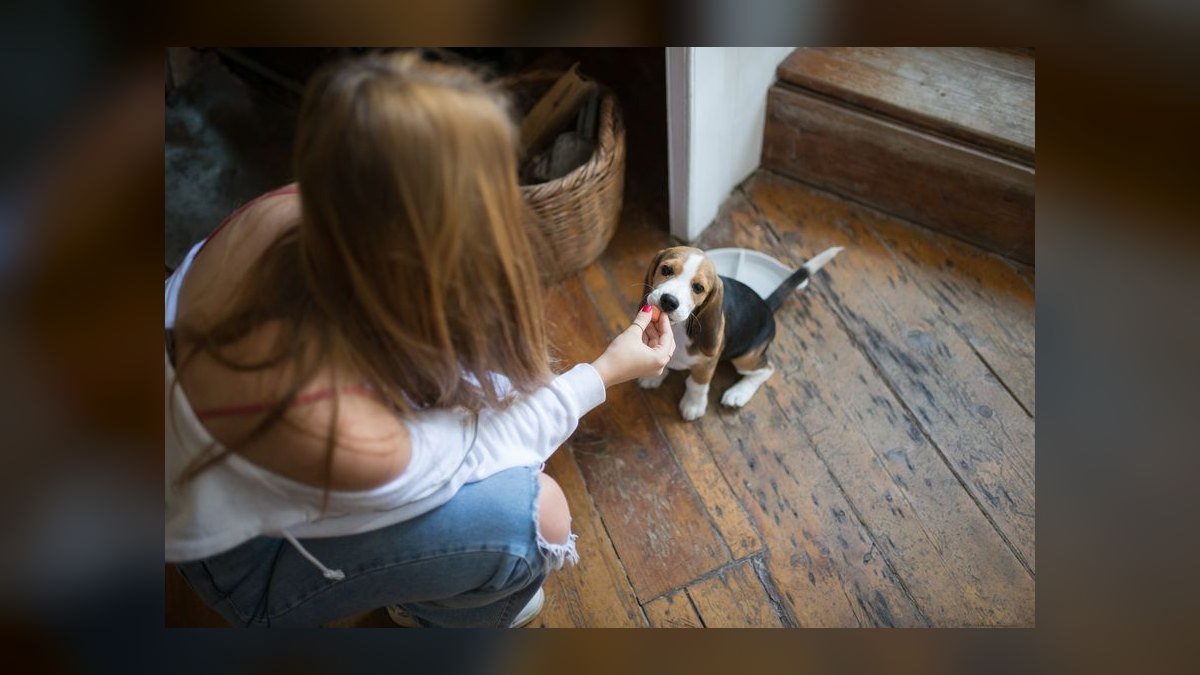
Every single trip — run the same four steps. Leash the puppy even in a fenced yard, walk to the one designated spot, stand still and stay boring, and wait up to five minutes. Boring matters: if you talk, pace, or play, the puppy investigates you instead of emptying. The second elimination begins to finish, mark it with a consistent word — "yes," "good potty," whatever — and deliver a high-value treat within three seconds. Not thirty seconds later at the back door. Three seconds. The delay is what determines which behavior the puppy thinks earned the reward. Then play or walk as a bonus, which teaches that eliminating starts the fun rather than ending it.

If nothing happens in five minutes, go back inside, crate or tether the puppy for ten to fifteen minutes, then try again. Do not release into open house access on an empty attempt — that is where the accident comes from.
Weeks four through twelve — earn freedom in stages. The rule that keeps people out of trouble: expand territory only after two consecutive accident-free weeks at the current level. Level one is crate plus one supervised room. Level two adds a second room with the puppy dragging a leash so you can catch them. Level three is unsupervised access to one room for short windows. Full house freedom comes last, usually well after the puppy is otherwise reliable.
Overnight. For the first few weeks, set an alarm for roughly four hours after bedtime. Take the puppy out on leash, no talking, no play, straight back to the crate. It is a transaction, not an event. Most puppies drop the night waking on their own between twelve and sixteen weeks.

Teaching a signal. Once the puppy is reliably eliminating outside, add bell training. Hang a bell on the door at nose height, touch their nose or paw to it before every single trip out, and eventually they ring it themselves. The one caveat every owner discovers: some dogs learn that the bell summons a human and start ringing it to go sniff the yard. Take them out, give the five-minute window, and if nothing happens go back in with no play. The bell stops being a toy within a week.
Costs, timelines, and what a realistic curve looks like
Timelines first, because expectations cause more quitting than accidents do.
Most puppies are substantially reliable — meaning rare accidents, understands the routine, signals sometimes — between four and six months. "Reliable" in the sense that you would leave them loose in the house while you shower is closer to six to eight months. Full trust unsupervised for hours is often a year. Small breeds tend to run later, sometimes eight to twelve months, for two reasons: smaller bladders relative to their water intake, and owners who tolerate small accidents longer because they are easier to clean. That tolerance is the actual cause. A four-pound puddle that gets shrugged off is a rep in the wrong direction.

The curve is not linear. Expect a plateau or regression somewhere between four and six months. Teething, a growth spurt, adolescent hormone changes, a move, a new person in the house, or a schedule change can all produce a week of backsliding in a puppy who seemed finished. The correct response is to go back one freedom level and tighten the interval for seven to ten days, not to conclude that the training failed.
On cost, the honest breakdown for the equipment that actually matters:
- Crate with divider — the single most useful purchase. A wire crate in a medium-to-large size runs roughly $40 to $120. Buy the adult size with a divider rather than buying twice.
- Enzymatic cleaner — around $10 to $25 a bottle, and you will use more than one. Non-negotiable. Ammonia-based cleaners smell like urine to a dog and actively invite re-marking.
- Exercise pen — $50 to $150. Worth it for apartment dwellers and anyone who works partial days, since it gives a bigger safe zone without full house access.
- High-value treats — small budget item, large effect. Freeze-dried liver, chicken, or cheese outperform kibble by a wide margin because the reward has to be worth interrupting an interesting yard for.
- Midday coverage — a dog walker or sitter for a single midday break typically runs $15 to $30 per visit in most US markets. For anyone working an eight-hour day with a puppy under six months, this is the difference between four months and ten.
- A vet visit to rule out medical causes — an exam plus a urinalysis or fecal test is usually in the $50 to $200 range, and it is the cheapest thing on this list relative to what it saves you.

Optional gear — cameras, smart feeders, activity collars, artificial or real-grass indoor patches — can help specific situations, particularly apartments and long workdays, but none of it substitutes for the schedule. A camera tells you the puppy woke up; it does not take them outside.
The hidden cost people underestimate is time, not money. The first three to four weeks realistically consume one to two hours a day of active supervision and trips. Front-loading that is what compresses the total timeline. Owners who try to spread the effort out over months usually spend more hours in aggregate and get a worse result.
Where people go wrong, and the adjacent habits that leak into it
Punishing after the fact. Rubbing a puppy's nose in a mess, scolding, or dragging them to the spot teaches only one thing: eliminating in front of a human is dangerous. The puppy's response is not better control — it is going behind the couch, in the spare bedroom, or during the four minutes you are in the shower. Owners then report that the puppy "knows it was wrong" because of the guilty look. That look is appeasement behavior in response to your body language, not an admission. Dogs do not connect a correction to an act that happened even a minute earlier. If you catch them mid-stream, a neutral interrupting sound and an immediate carry outside is the whole intervention.

Free feeding. Food left out all day means elimination timing is unpredictable, which makes the schedule impossible to build. Scheduled meals give you a predictable window. This has a second benefit that shows up later — it makes it obvious when a puppy skips a meal, which is one of the earliest signs something is medically wrong.
Too much freedom too soon. Two clean weeks feels like victory and gets rewarded with the run of the house. Then the puppy finds a room you cannot see into and gets three unpunished, unwitnessed reps on carpet. Territory expands on evidence, not on optimism.
Puppy pads used as a permanent strategy. Pads have a legitimate use — high-rise apartments, medically restricted puppies before full vaccination, extreme climates. But used casually, they teach that indoor elimination is acceptable and you will have to untrain it. If you need them, keep them in one fixed spot far from bed and food, and move them a few inches toward the door every day or two until they are outside. Real-grass patches transition more cleanly than synthetic pads because the substrate already matches the destination.

Skipping the medical check. Persistent accidents in a puppy who was previously doing well, accidents inside the crate despite correct sizing, straining, frequent small volumes, or blood are not training problems. Urinary tract infections, giardia and other parasites, and in some cases congenital issues all present as "won't house train." Rule these out before escalating the training. A crate-soiling puppy in particular is worth a vet call, because den instinct is strong enough that overriding it usually means the puppy physically cannot hold it, was raised in a soiled environment, or is in genuine distress from separation anxiety — three problems with three different fixes.
Inconsistency between people. If one household member enforces the leash-and-designated-spot routine and another opens the back door and lets the puppy wander, you get roughly half the training value. Write the schedule on the fridge. It is not overkill; it is the single cheapest intervention available.
The adjacent version of this problem is worth noting because the same mechanics apply elsewhere in pet ownership: crate training, kennel introductions, litter training a cat or a small mammal, and even loose-leash walking all run on the same three levers — control the environment so the wrong choice is hard, reward the right choice within a few seconds, and expand freedom only against evidence. Owners who internalize the pattern here tend to find the next training project dramatically easier, because they stop treating it as a battle of wills and start treating it as an environment design problem.
Decision framework: choosing the right setup for your situation
There is no single correct answer, because the constraint that dominates is your daily schedule and your housing. Work through it in this order.

If you are home most of the day, run the pure crate-and-schedule method. It is the fastest and cleanest path, with no indoor elimination taught at any stage, and it typically lands in that four-to-six month window.
If you work full days and have yard access, the deciding factor is midday coverage. A puppy under six months physically cannot hold it for eight hours, and forcing them to try teaches them to eliminate in the crate — which breaks the den instinct you are relying on. A walker, a neighbor, a sitter, or a lunchtime trip home is the fix. If none of those are possible, use an exercise pen with a crate at one end and a potty surface at the far end rather than a crate alone.
If you live in a high-rise or the puppy is not yet fully vaccinated, indoor elimination is a legitimate intermediate step, not a failure. Set it up deliberately: pen with a defined potty zone, real-grass patch rather than synthetic if you can manage it, and a planned transition. Budget an extra four to eight weeks on the back end for the untraining.
If you have extreme weather, invest in the environment rather than fighting the dog. A covered patch of ground, an awning, a section of the porch, or a cleared path in snow removes the objection. A puppy refusing to go out in rain is usually objecting to wet grass on their feet and belly, not to the trip itself.
If there is already a house-trained adult dog in the home, use them. Puppies learn substrate preference partly by observation, and taking both dogs out together to the same spot accelerates the association meaningfully. The trade-off is that you must still supervise the puppy indoors independently — the adult dog's reliability tells you nothing about the puppy's.
If accidents persist past two weeks of consistent effort, stop escalating training and go medical first, then re-examine the three variables in order: interval length, territory size, and reward value. In practice, one of those three is almost always the culprit, and reward value is the most commonly underestimated.
Related questions
How long can a puppy hold their bladder overnight?
Longer than during the day, because metabolism slows during sleep. An eight-to-ten week puppy typically needs one middle-of-the-night trip; most drop it between twelve and sixteen weeks. Set an alarm roughly four hours after bedtime rather than waiting for whining, which teaches whining works.
Should I use puppy pads or go straight outdoors?
Straight outdoors is faster and avoids untraining an indoor habit. Use pads only when housing or vaccination status genuinely requires it — high-rise apartments, pre-vaccination periods, extreme climates. If you use them, plan the transition from day one and prefer real-grass patches over synthetic.
Why is my puppy having accidents again after weeks of success?
Regression around four to six months is common and usually traces to teething, a growth spurt, adolescence, or a household change. Occasionally it is a urinary tract infection. Rule out medical causes, then go back one freedom level and tighten the interval for seven to ten days.
Is crate training cruel?
No, when the crate is correctly sized, never used for punishment, and paired with adequate exercise and company. Dogs are den animals and most choose the crate voluntarily once it is established. It becomes cruel when used as long-term confinement or as a substitute for supervision and exercise.
What cleaner actually stops repeat accidents?
An enzymatic cleaner, which breaks down the uric acid that ordinary detergents leave behind. Avoid ammonia-based products entirely — ammonia is a component of urine odor and effectively signals to the dog that the spot is an approved bathroom.
FAQ
How many times a day should I take a puppy outside?
For a puppy under twelve weeks, plan on ten to fifteen trips a day. That includes every waking, every meal, every play session, and a one-to-two-hour default interval in between. It sounds excessive and it is genuinely tiring, but the frequency drops fast — by four months most puppies are down to five or six trips, and by six months, three or four.
My puppy only goes on walks and never in the yard. How do I fix that?
This is a learned preference, and the fix is to stop letting the walk be the reward for holding it. Take the puppy out on leash to the designated yard spot and wait — five minutes, no walking, no play. If nothing happens, go back inside and try again in fifteen minutes. Only start the walk after elimination. Within a week or two the yard becomes the place where the walk gets unlocked.
Is it normal for an eight-week puppy to have accidents every thirty minutes?
Yes. At eight weeks, bladder control is minimal and the puppy has no established habit at all. Take them out every thirty to forty-five minutes while awake, plus after every nap, meal, and play session. This phase is short. Frequency requirements ease noticeably by ten to twelve weeks as capacity grows.
How do I house train a puppy when I work an eight-hour day?
You need midday coverage — a walker, sitter, neighbor, or a trip home. A puppy under six months cannot hold it eight hours, and making them try teaches crate soiling, which is the hardest habit to reverse. If coverage is impossible, use an exercise pen with sleeping area and potty surface at opposite ends and accept a longer timeline.
Does the breed change the timeline?
Somewhat, but less than owners expect. Small and toy breeds often take longer, largely because of smaller bladder capacity and because owners tolerate small accidents. Some breeds are notably slower on average. But household consistency predicts the outcome far better than breed does — a consistently run schedule beats an easy breed with a chaotic one.
When should I see a vet about house training problems?
Any accident in a correctly sized crate, straining, frequent small volumes, blood in urine, sudden regression in a previously reliable puppy, or persistent accidents after two weeks of consistent effort. A urinalysis and fecal check are inexpensive relative to months of failed training, and urinary tract infections and parasites both commonly present as a house training failure.
Sources
- https://www.akc.org/expert-advice/training/how-to-potty-train-a-puppy/ — American Kennel Club, potty training guidance and timelines
- https://www.humanesociety.org/resources/housetraining-your-puppy — The Humane Society of the United States, house training schedules and methods
- https://www.aspca.org/pet-care/dog-care/common-dog-behavior-issues — ASPCA, house training and crate training fundamentals
- https://vcahospitals.com/know-your-pet/house-training-puppies — VCA Animal Hospitals, veterinarian-reviewed house training protocol
- https://www.avma.org/resources/pet-owners/petcare — American Veterinary Medical Association, general pet care and behavior resources
- https://www.petmd.com/dog/training/how-potty-train-puppy — PetMD, veterinarian-reviewed puppy training guidance
- https://vetmed.illinois.edu/pet-health-columns/ — University of Illinois College of Veterinary Medicine, pet health columns
- https://www.rspca.org.uk/adviceandwelfare/pets/dogs/behaviour — RSPCA, dog behaviour and training advice
Related on PULSE
This page will be disappearing soon. Save it to your device for $1 — or read it free while it is here.
@Kory-White- · if Venmo asks, the last 4 of my number are 2012
This page is gone.
This one is off the shelf now. $1 keeps it on your phone for good — the whole page, pictures and diagrams included.
 pulse-petsTop 10 aquarium siphon brands 2027
 petsHow long after adding dechlorinator to tap water is it actually safe to pour into the tank in 2027?
 pulse-petsTop 10 Auto Top-Off Systems for Aquariums 2027
 petsWhat should you know before investing in Pets in 2027?
 pulse-petsTop 10 best aquarium snail varieties 2027
 pulse-petsTop 10 aquarium fish for beginners 2027
 pulse-petsTop 10 Aquarium Tweezers and Scissors 2027
 pulse-petsTop 10 Bucephalandra Varieties 2027
 petsHow do I dechlorinate tap water before adding it to a freshwater aquarium in 2027?
 pulse-petsTop 10 best frozen fish foods 2027