


MQL vs SQL — what's the actual difference, and how should you define them?
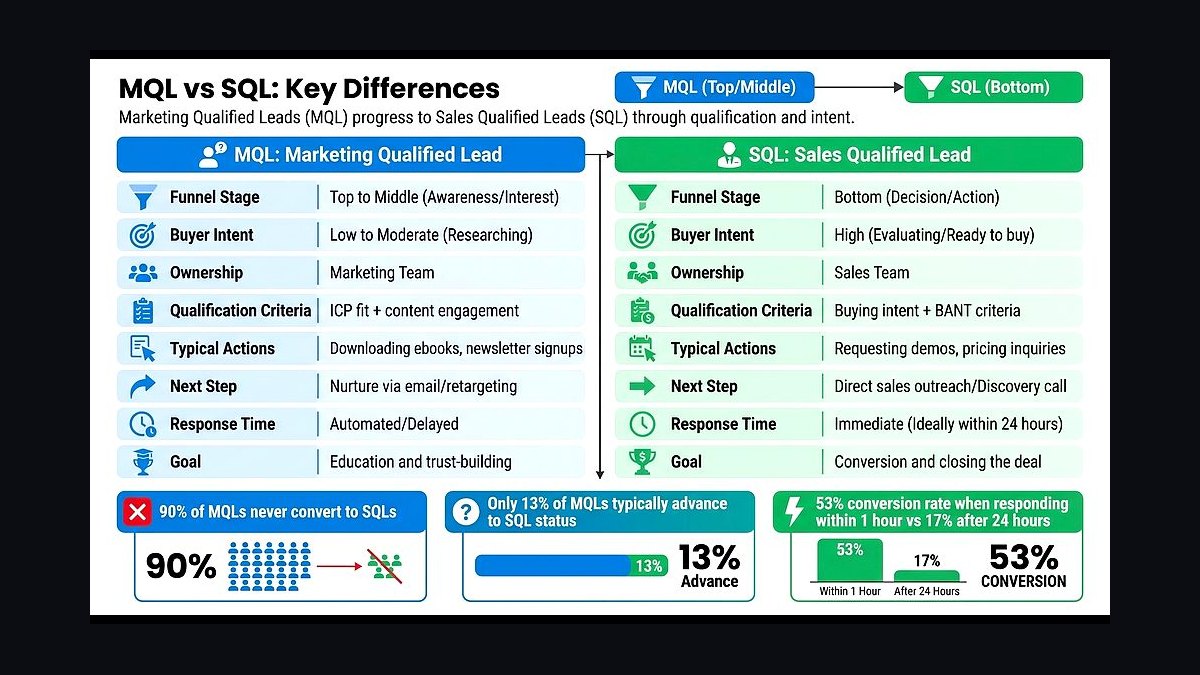
MQL means a lead that hits a fit-plus-intent threshold marketing controls (right company, real buying signal). SAL means sales accepted the handoff inside SLA (usually 24-48 hours). SQL means an SDR or AE worked it, qualified it against BANT or MEDDIC, and converted it to a real opportunity. The three stages exist because each one has a different owner, a different accept criterion, and a different conversion rate — and collapsing them is the fastest way to destroy sales-marketing trust. Define each stage as a contract, not a score.
TL;DR
- MQL is a marketing-owned threshold (ICP fit AND a high-intent action like a demo request or pricing-page-plus-gated-asset), not a form fill.
- SAL is the under-discussed middle stage: a sales rep formally accepted the lead within a 24-48 hour SLA. Without SAL, "MQL conversion" lies.
- SQL is a lead an SDR or AE has worked, qualified against BANT or MEDDIC, and accepted as a real opportunity that creates pipeline.
- 2027 benchmarks (Pavilion, Bridge Group): MQL to SAL ~70%, SAL to SQL ~30-40%, SQL to opp ~75%, opp to win ~22-30%. End to end ~3-5% MQL-to-revenue.
- Many top RevOps orgs (Snowflake, Datadog historically) moved away from MQL toward account-based qualification — MQL is increasingly a 2010s mid-market SaaS framework.
Real Definitions With Real Examples
A Marketing Qualified Lead (MQL) is a lead that meets a fit-plus-intent threshold marketing controls. Fit means the account looks like your ICP — right industry, employee count, tech stack, region. Intent means the person took an action that signals real buying interest. "Downloaded a top-of-funnel ebook from a 200-person logistics company" is not an MQL in 2027 — that's a content engagement. "VP of Operations at a Series B fintech requested a demo after visiting the pricing page twice" is an MQL. The cleanest 2027 definitions combine firmographic fit (Clearbit, ZoomInfo, 6sense enrichment) with a high-intent behavior (demo request, pricing visit, ROI calculator, gated technical content from a senior title). If your MQL definition is "filled out any form," you have a marketing-influenced contact, not an MQL — and sales has already learned to ignore your handoffs.

A Sales Accepted Lead (SAL) is the most under-discussed stage in the funnel, and the one that separates mature RevOps orgs from immature ones. SAL means a sales rep — usually an SDR — looked at the MQL, agrees it meets criteria, and formally accepted ownership within an SLA (commonly 24 hours for hot demo requests, 48 for content-driven MQLs). The SAL stage exists to create accountability on both sides of the handoff. Without SAL, marketing reports "we sent 400 MQLs" and sales reports "those leads were garbage" and nobody can resolve the contradiction. With SAL, you know how many MQLs sales actually agreed to work and whether SLAs are being honored. Pavilion 2024 data shows top-decile orgs hit ~85% SAL acceptance within SLA; median is 60-70%.

A Sales Qualified Lead (SQL) is a lead or account an SDR or AE has worked — connected via call, email, or LinkedIn — and qualified against a framework (BANT: Budget, Authority, Need, Timeline; or MEDDIC: Metrics, Economic buyer, Decision criteria, Decision process, Identify pain, Champion). At SQL, the rep has confirmed there's a real evaluation underway, a buyer with influence, and a plausible path to a deal. SQL is the gate to "opportunity" in your CRM — the point where a deal gets a stage, amount, and close date, and contributes to pipeline coverage.

The honest 2027 take: MQL is contested. Many top RevOps orgs moved toward account-based qualification — a Marketing Qualified Account (MQA) requires multiple intent signals across multiple personas, plus a mapped buying committee. Snowflake and Datadog (historically) led this shift. MQL still dominates mid-market SaaS where high-velocity inbound makes lead-level scoring practical, but treating MQL as the only model in 2027 is a tell that your RevOps function hasn't refreshed its frameworks.
End-to-End Conversion Math
Benchmarks below are blended from Pavilion 2024 GTM Benchmarks, Bridge Group 2024 SDR Metrics, and ICONIQ Growth 2024 Operating Metrics. Treat these as median ranges, not targets — your ICP, ACV, and motion will shift them materially.

| Stage transition | SMB (under 1k employees) | Mid-Market (1k-5k) | Enterprise (5k+) |
|---|---|---|---|
| MQL → SAL | 70-78% | 65-72% | 55-65% |
| SAL → SQL | 35-45% | 28-38% | 22-30% |
| SQL → Opportunity | 75-82% | 70-78% | 65-75% |
| Opportunity → Closed Won | 25-32% | 20-26% | 15-22% |
| End-to-end MQL → Revenue | ~5-7% | ~3-5% | ~1.5-3% |
| Median sales cycle | 30-60 days | 60-120 days | 120-270 days |
Two takeaways. First, only 3-5% of MQLs become revenue in mid-market — which is why marketers obsess over volume. If your AE needs 4 wins per quarter at 4% end-to-end conversion, you need 100 MQLs per AE per quarter just to feed the funnel. Second, the steepest drop is almost always SAL → SQL — where reps discover the "demo request" was a student writing a thesis or the timeline is "sometime next year." This is why SAL exists: it surfaces the leak before it pollutes pipeline forecasting.

The 3 Broken MQL Definitions That Erode Sales-Marketing Trust
1. "Anyone who fills a form is an MQL." The most common failure mode under $20M ARR. Marketing hits its number, sales gets buried in tire-kickers, stops working the queue, and within a quarter the SDR team is sourcing 80% of pipeline themselves. Fix: require fit AND intent. A form fill alone is a *contact*, not an MQL.

2. "Intent score above 50 equals MQL" with no human review. HubSpot, Marketo, and Pardot all ship default scoring models that accumulate points for email opens, page views, and webinar registrations. A persistent researcher hits MQL in a week without being a real buyer. Fix: weight high-intent actions (demo request, pricing, ROI calculator) at 10x low-intent actions, and apply firmographic disqualification (no MQL outside ICP — full stop).
3. "MQL equals SQL because sales accepts everything." When SDR teams are compensated on accept rate or punished for rejects, they accept every MQL — which destroys qualification. You lose the diagnostic signal telling you whether marketing is sending real leads. Fix: measure SDRs on SQL-to-opp conversion, not MQL accept rate; rejection reasons are mandatory and reviewed weekly in the sales-marketing SLA meeting.
Related on PULSE
- How should a 2027 sales org design the MQL to SQL handoff?
- What is the MEDDPICC approach to inbound qualification, and how does it speed SQL→opportunity conversion?
- How do you audit marketing-sourced pipeline quality and spot rotten SQL sources?
- What's the right conversion rate from SQL to closed-won at our stage?
- RevOps vs Sales Ops: what's the actual difference?
- ARR vs MRR vs bookings vs revenue — what's the actual difference?
The Handoff Process That Makes or Breaks MQL-to-SQL Conversion
The MQL-to-SQL handoff is where most revenue teams leak 30-50% of their pipeline. The core issue is almost never the definition itself — it's the operational process that surrounds it. A well-defined MQL means nothing if the handoff process is broken.
The three most common handoff failures:
- No SLA enforcement — Marketing passes MQLs, but sales doesn't review them within the agreed window (typically 24-48 hours for B2B). After 48 hours, lead interest drops by 60-80%, making conversion nearly impossible.
- Incomplete data transfer — Marketing captures intent signals (content downloads, webinar attendance, pricing page visits) but doesn't pass them to the CRM. The SDR receives a name and email with no context, forcing them to start from scratch.
- No feedback loop — Sales rejects MQLs without explaining why. Marketing keeps generating the same type of lead, wasting budget and creating friction.
The fix is a structured handoff with three components:
- A shared SLA document that both teams sign off on quarterly
- Automated CRM enrichment that passes all intent data with the lead
- A monthly MQL-to-SQL audit where both teams review rejected leads together
Companies that implement this structured handoff see MQL-to-SQL conversion rates improve from 5-10% to 15-25% within 90 days.
Common MQL and SQL Definition Mistakes (and How to Fix Them)
Most teams get their definitions wrong in predictable ways. Here are the three most common mistakes and how to correct them:
Mistake #1: Using lead score thresholds alone Many teams set MQL at "score > 80" without specifying what actions contribute to that score. A high score from email opens and blog visits doesn't indicate buying intent — it indicates curiosity. Fix: Combine score thresholds with explicit intent actions (demo request, pricing page visit, competitor comparison download).
Mistake #2: Defining SQL as "sales agrees to work it" This creates a subjective handoff where one rep's SQL is another's cold lead. Without objective criteria, you'll have inconsistent pipeline reporting and forecasting errors of 20-40%. Fix: Require at least 3 of 5 BANT criteria or 4 of 6 MEDDIC elements before labeling a lead SQL.
Mistake #3: Ignoring lead decay A lead that was MQL-qualified 60 days ago is likely cold. Yet many teams keep leads in "MQL" status indefinitely, inflating their pipeline. Fix: Add a time-based decay rule — MQLs that aren't contacted within 7 days revert to raw lead status. SQLs that aren't progressed within 14 days get recycled back to marketing.
Real-world example: A SaaS company with 200 employees was converting 8% of MQLs to SQLs. After auditing their definitions, they discovered 40% of their "MQLs" were from students and competitors. They added firmographic filters (company size 50-500 employees, specific industries) and their MQL-to-SQL rate jumped to 18% in two months.
How to Align Marketing and Sales on MQL and SQL Definitions
The technical definition is easy. The human alignment is hard. Here's the process that works for B2B teams of 10-200 people:
Step 1: Joint definition workshop (2 hours) Both teams bring their top 10 won deals and top 10 lost deals from the last quarter. Map each deal back to the lead source and initial qualification criteria. You'll find patterns — 70% of won deals came from leads that showed 2+ of the same intent signals. Those signals become your MQL criteria.
Step 2: Create a shared scorecard Instead of marketing owning MQL and sales owning SQL, create a joint scorecard with weighted criteria. Example: Company fit = 30%, Intent signal = 40%, Engagement recency = 30%. Both teams agree on the weights quarterly.
Step 3: Implement a 30-day trial period Run the new definitions for 30 days without changing compensation. Track three metrics: MQL volume, SQL conversion rate, and rejected lead percentage. If rejected leads exceed 25%, adjust the criteria.
Step 4: Lock in the contract Write the final definitions into a one-page agreement both teams sign. Include:
- Exact MQL criteria (firmographics + behaviors)
- Exact SQL criteria (BANT/MEDDIC checklist)
- Handoff SLA (timeframe and process)
- Rejection reasons (dropdown menu in CRM)
- Monthly review cadence
The result: Teams that follow this process report 40-60% fewer definition disputes within 90 days, and their MQL-to-SQL conversion rates stabilize at 15-25% (vs. 5-10% for teams with no alignment).
FAQ
What is the main difference between an MQL and an SQL? An MQL is a lead that meets marketing’s fit and intent criteria, while an SQL is a lead that sales has qualified as a real opportunity. The key distinction is ownership: marketing controls the MQL stage, and sales controls the SQL stage, with a handoff (often an SAL) in between.
How do you define the stages MQL, SAL, and SQL? Define each as a contract with specific acceptance criteria. An MQL requires a fit-plus-intent threshold set by marketing. An SAL means sales accepted the handoff within a set SLA (commonly 24-48 hours). An SQL means an SDR or AE qualified it against a framework like BANT or MEDDIC and converted it to an opportunity.
Why can’t you just collapse MQL and SQL into one stage? Collapsing them destroys sales-marketing trust because each stage has a different owner, acceptance criterion, and conversion rate. Separating them ensures accountability—marketing owns lead generation, sales owns qualification—and prevents blame when leads don’t convert.
What is a typical conversion rate from MQL to SQL? Conversion rates vary widely by industry and company, but honest ranges often fall between 10% and 30%. Factors like lead quality, sales follow-up speed, and qualification criteria heavily influence this rate.
How quickly should sales follow up on an MQL to turn it into an SQL? Best practice is within 24-48 hours, as defined in your SLA. Faster follow-up (within minutes or hours) can improve conversion, but the exact timing depends on your team’s capacity and lead source.
Do MQL and SQL definitions change over time? Yes, they should evolve as your market, product, and sales process change. Review definitions quarterly or semi-annually with both marketing and sales to ensure they remain aligned with actual buying behaviors and business goals.
Sources
- Pavilion 2024 GTM Benchmarks Report — funnel conversion rates by segment
- Bridge Group 2024 SDR Metrics and Compensation Report — SAL and SQL conversion benchmarks
- SiriusDecisions / Forrester Demand Waterfall — canonical MQL/SAL/SQL framework
- Gartner 2024 B2B Buying Journey Report — buying committee size and behavior
- ICONIQ Growth 2024 Operating Metrics for B2B SaaS — end-to-end funnel benchmarks
- Pavilion Sales-Marketing Alignment Playbook — SLA structures and handoff design
- HubSpot 2024 State of Marketing Report — MQL scoring practices
- 6sense 2024 Buyer Experience Report — intent signals and account-based qualification
This page will be disappearing soon. Save it to your device for $1 — or read it free while it is here.
@Kory-White- · if Venmo asks, the last 4 of my number are 2012
This page is gone.
This one is off the shelf now. $1 keeps it on your phone for good — the whole page, pictures and diagrams included.
 revopsHow should a 2027 GTM team build joint persona programs across sales and marketing?
 revopsWhat are Tennessee Volunteers football's 2027 NIL needs and strategy?
 revopsHow do you design sales-assist for a PLG motion in 2027?
 revopsHow do you build a customer reference program that AEs can actually use in 2027?
 revopsHow should a 2027 RevOps team build an ICP scoring rubric?
 revopsHow do you use revenue intelligence for renewals and customer success in 2027?
 revopsHow do you operate sales during a system outage during end-of-quarter in 2027?
 revopsWhat is Second Nature and why is it a hot RevOps AI sales-training platform for 2027?
 revopsWhat are the first 90 days of a new Chief Revenue Officer in 2027?
 revopsHow do you build a peer-coaching library that AEs actually use in 2027?