


PLG vs sales-led growth — which one should you actually pick in 2027?
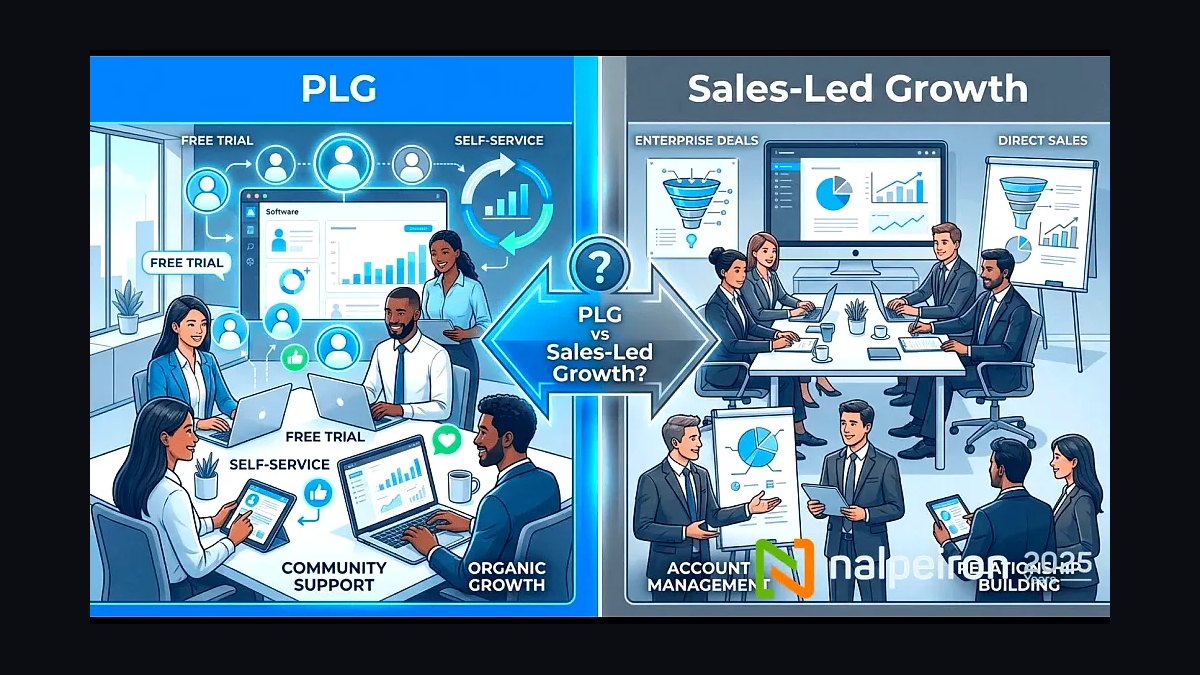
In 2027, the honest answer is hybrid — and the right shape of that hybrid is decided almost entirely by your average contract value (ACV) and who actually signs the check. Under roughly $5K ACV, product-led growth (PLG) dominates because the buyer is also the user. From $5K to $25K, you need PLG acquisition with a sales-assist layer for expansion. Above $25K, sales-led wins with a free or low-touch PLG entry as top-of-funnel. Above $100K, pure PLG is structurally impossible — somebody senior has to sign, and they will never self-serve.
TL;DR
- Pure PLG and pure sales-led are both rare in 2027 — the live debate is "where on the spectrum?"
- ACV is the single most predictive variable: under $5K → PLG, $5–25K → hybrid, $25K+ → sales-led with PLG entry, $100K+ → sales-led only.
- The dominant Series B–D motion is product-qualified lead (PQL) handoff — free user crosses a usage threshold and an account executive (AE) reaches out, as documented by Bessemer's State of the Cloud 2024.
- Named exemplars: Figma (PLG with sales-assist post-Adobe interest), Slack, Datadog, Snowflake (PQL handoff), Salesforce Trailhead funneling into Sales Cloud (sales-led with PLG entry).
- Three reliable ways to kill a PLG motion: refusing to add sales-assist, over-generous free tiers that cannibalize paid, and using PLG as an excuse to never hire AEs past $10M annual recurring revenue (ARR).
The Decision by ACV and Buyer Type
The cleanest way to pick a motion in 2027 is to cross ACV with the buyer persona. If the buyer is the end user — a designer, a developer, an individual contributor (IC) — PLG works because the same person who feels the pain can also swipe a card. If the buyer is a vice president (VP) or above, or if procurement and security have to review, you cannot dodge sales no matter how good your free tier is.

| ACV band | Buyer profile | Dominant motion | Live 2027 example |
|---|---|---|---|
| Under $5K | IC, prosumer, small team lead | PLG only | Linear, Calendly, Cal.com |
| $5K–$25K | Team lead to director, expansion is the play | PLG-led with sales-assist | Figma, Loom, Notion mid-market |
| $25K–$100K | Director to VP, multi-team rollout | Sales-led, PLG entry tier | HubSpot, Datadog, Atlassian |
| $100K–$500K | VP to C-suite, security review required | Sales-led with land-and-expand | Snowflake, MongoDB Enterprise |
| $500K+ | C-suite, board-visible spend | Pure sales-led, custom contract | Palantir, ServiceNow, Workday |
The corollary that catches founders off guard: you do not get to choose your ACV. The product and the market choose it. If your product solves a $250K-per-year problem for an enterprise, charging $20/seat to look "PLG-friendly" is leaving 95% of the value on the table — and you will still need a sales team to land the procurement review, so you get neither motion's economics.
The Hybrid Model That Won 2024–2027

The dominant Series B through D motion is the PQL handoff, and it looks the same at Slack, Datadog, Snowflake, Loom, and dozens more. The shape is: free or freemium signup with full self-serve onboarding, then product instrumentation watches for an account to cross a defined usage threshold — 10 active seats, 50 dashboards created, 1TB of data ingested, whatever the leading indicator of paid intent is — and at that moment an AE is alerted, given context on what the account has actually done in-product, and reaches out with a personalized message.

What makes this work in 2027 specifically: the AE is no longer cold-calling. They have intent data, usage data, the email domain mapped to a firmographic profile via Clearbit or 6sense, and increasingly an AI-summarized account brief generated the moment the PQL fires. Time-to-first-touch has compressed from days in 2020 to minutes in 2027 at the well-run motions. ICONIQ's 2024 operating-metrics benchmarks show median PQL-to-AE-touch time of under one hour at top-quartile PLG companies.
The compensation model also evolved. AEs at PQL-handoff shops are paid on net new ARR sourced from PQLs and on expansion of accounts they "claim" after the handoff — so they have no incentive to fight the PLG funnel, only to amplify it. That alignment is what kept earlier hybrid attempts (think Box circa 2014) from working — back then AEs were paid as if every deal were a cold outbound win, so they resented the free tier rather than feeding off it.
The 3 PLG Failure Modes

First, refusing to add sales-assist. PLG purists love to say "the product should sell itself," but that ideology costs you every $50K–$500K deal where the buyer wants to talk to a human before signing. Calendly hit this wall around 2022 and quietly built an outbound team; Notion did the same in 2023 after enterprise demand outpaced their self-serve flow.

Second, pricing the free tier so generously it cannibalizes paid revenue. Slack's pre-2022 free tier kept the full message history for 90 days, which meant most small teams never had a forcing function to upgrade — Salesforce eventually capped it at 90 days of messages to drive conversion. Notion's 2023 free-tier expansion did the same damage in reverse and had to be partially rolled back. The rule from OpenView's PLG Index: the free tier should solve the "single-user, single-use-case" problem perfectly and break the moment a real team forms.
Third, treating PLG as an excuse to not hire a sales team. This works beautifully to $5–10M ARR. Then it breaks, hard. The accounts that were going to self-serve already have. Growth stalls. Founders who refuse to hire AEs at this stage are usually visible on growth-curve charts a year later as the company that plateaued at $12M ARR while a hybrid competitor sailed past them to $50M. Wes Bush's PLG playbook is explicit about this — PLG is a customer-acquisition strategy, not a replacement for sales.
Related on PULSE
- Salesforce vs HubSpot for RevOps in 2027 — which one should you actually pick?
- How do you transition from sales-led to PLG (product-led growth) in 2027?
- What is the 2027 PLG vs Sales-Led growth debate for B2B SaaS?
- Outreach vs Salesloft vs Apollo in 2027 — which sales engagement platform should you actually pick?
- Should I open or buy a Pick Up Stix franchise in 2027?
- Outreach vs Salesloft vs HubSpot Sales Hub: Which sales engagement platform should you pick in 2027?
The PLG-to-Sales Handoff: Where Most Revenue Leaks Happen
The single most expensive mistake in a hybrid PLG/sales model isn't choosing the wrong growth engine — it's having no structured handoff between the two. By 2027, companies that treat PLG and sales as separate funnels lose 30-50% of potential pipeline simply because self-serve users who hit a complexity wall never get a human conversation.
The critical handoff point lives between $2K and $8K ACV. Below that, users churn before a sales call makes sense. Above that, self-serve stalls because the product can't answer "how does this integrate with our existing stack?" or "what's the security compliance story?" The winning playbook in 2027 uses behavioral triggers — not demo requests — to initiate handoff: a user who tries an API endpoint, invites 3+ teammates, or exports data for the first time gets an automated calendar invite from a sales development rep within 2 hours. Companies that build this trigger-based routing see 40-60% higher conversion from free to paid compared to those relying on manual lead scoring.
The technical infrastructure matters here. You need a reverse ETL pipeline that pushes product usage events into your CRM in real time, not batch. Without it, your sales team is working off data that's 24-48 hours stale, which in a fast-moving PLG motion means the user has already either bought or bounced. Expect to invest $15K-$40K annually in middleware (tools like Census, Hightouch, or dbt) to make this handoff work at scale.
Why "Free Trial" Is Dying and "Usage-Based Free Tier" Is Replacing It
The classic 14-day free trial is becoming an anachronism in 2027 — and it's not because trials don't work. It's because they attract the wrong users. Startups and mid-market buyers now expect to evaluate a product in their actual workflow, not in a sandbox that resets after two weeks. The shift is toward usage-based free tiers that never expire but cap features or volume.
For PLG-dominant products under $5K ACV, the most effective model is a freemium tier that limits storage (e.g., 500 records), API calls (e.g., 1,000/month), or team size (e.g., 3 users). This accomplishes three things: it eliminates the urgency of a trial clock (which pressured users to buy before they were ready), it lets power users self-qualify by hitting the cap, and it creates a natural upgrade path that feels like "unlocking" rather than "paying." Companies using this model report 20-35% higher conversion rates from free to paid compared to time-bound trials.
For sales-led products above $25K ACV, the free tier serves a different purpose: it's a qualification filter. If a prospect won't spend 30 minutes setting up a free workspace, they're unlikely to champion a $50K deal internally. The free tier becomes a pre-qualification gate that saves your sales team from chasing tire-kickers. Expect 15-25% of free tier users in this ACV range to eventually request a sales conversation — and those leads close at 2-3x the rate of cold outbound.
The key metric to watch isn't free tier signups — it's "time-to-value" for free users. If a user doesn't reach their first meaningful outcome (e.g., first report generated, first integration connected) within 10 minutes, your free tier is a leaky bucket. Optimize for that metric before you optimize for conversion.
How to Budget for a Hybrid Model in 2027 (Without Wasting Money)
Most companies blow their budget on hybrid PLG/sales because they fund both motions at full strength simultaneously. The smarter approach in 2027 is to treat PLG as the demand gen budget and sales as the conversion budget — and allocate accordingly.
For products with ACV between $5K and $25K, the rule of thumb is 60-70% of your growth spend goes to PLG (product development, self-serve onboarding, content that ranks for "how to X" queries), and 30-40% goes to sales (sales development reps, account executives, demo tools). The PLG spend generates a high volume of qualified users; the sales spend converts the top 10-15% of those users into paying customers. Companies that invert this ratio — spending heavily on sales outreach to cold leads while underfunding product-led acquisition — see customer acquisition costs 40-60% higher than their hybrid-optimized peers.
For ACV above $25K, the split flips: 20-30% on PLG (mostly a free tier and product documentation that serves as pre-sales education), and 70-80% on sales (outbound, account-based marketing, executive relationships). The PLG spend here isn't generating revenue directly — it's shortening the sales cycle by letting prospects self-educate before the first call. Companies that invest in a strong free tier for enterprise products report 25-35% shorter sales cycles because prospects arrive at the first meeting already knowing the product's capabilities and limitations.
A specific budget line item worth adding in 2027 is "PLG-to-sales handoff software." This includes tools like Pendo or Appcues for in-app messaging, a product analytics platform (Amplitude, Mixpanel, or Heap — expect $20K-$60K/year depending on event volume), and a revenue orchestration platform that connects product data to CRM workflows. Without this stack, your hybrid model is two separate companies sharing a logo.
FAQ
What is the main difference between PLG and sales-led growth in 2027? The core difference is who drives the purchase. PLG lets users try, buy, and expand on their own, while sales-led relies on human outreach and demos. In 2027, the line blurs — most companies use a hybrid, with the balance set by their average contract value.
At what ACV should I switch from PLG to sales-led? There’s no single magic number, but a rough guide is under $5K ACV for pure PLG, $5K–$25K for PLG with sales assist, and above $25K where sales-led takes the lead. Above $100K, pure PLG is nearly impossible because senior sign-off is required.
Can a low-ACV product still use sales-led growth? It’s possible but rarely efficient. For products under $5K ACV, the cost of a sales rep often exceeds the deal value, making PLG the better default. Some companies add a sales layer for upsells or enterprise tiers, but the core motion stays self-serve.
Does PLG work for enterprise software with high ACV? Only as a top-of-funnel entry point. For deals above $25K, PLG can generate leads through free trials or low-touch signups, but the close requires a sales team. Above $100K, buyers expect demos, negotiations, and contracts — self-serve alone won’t close.
How do I decide the right hybrid model for my business? Look at your ACV and buyer persona. If the user and decision-maker are the same person and ACV is under $5K, lean PLG. If they differ or ACV climbs above $25K, invest in sales-led with a PLG funnel. Test both with small segments before scaling.
Will PLG or sales-led growth be more popular in 2027? Both will coexist, but hybrid models will dominate. PLG continues to grow in lower-ACV SaaS and developer tools, while sales-led remains standard for high-touch enterprise deals. The trend is toward blending — using PLG for acquisition and sales for expansion.
Sources
- OpenView Partners, "2024 Product-Led Growth Index" — ACV bands and PLG penetration by segment.
- Bessemer Venture Partners, "State of the Cloud 2024" — PQL handoff as dominant Series B–D motion.
- Wes Bush, "Product-Led Growth: How to Build a Product That Sells Itself" — failure-mode taxonomy.
- ICONIQ Capital, "Topline Growth and Efficiency Operating Metrics 2024" — PQL-to-AE-touch SLA benchmarks.
- Reforge, "Product-Led Growth Playbook" by Elena Verna — sales-assist layering at $5M ARR.
- Pavilion, "2024 Go-to-Market Benchmarks" — hybrid motion compensation alignment.
- Kyle Poyar (OpenView), "Growth Unhinged" newsletter — Slack and Notion free-tier cannibalization case studies.
- a16z, "The Era of Product-Led Sales" by Kristina Shen — PQL workflow architecture.
This page will be disappearing soon. Save it to your device for $1 — or read it free while it is here.
@Kory-White- · if Venmo asks, the last 4 of my number are 2012
This page is gone.
This one is off the shelf now. $1 keeps it on your phone for good — the whole page, pictures and diagrams included.
 revopsWhat is Cognism and why is it a hot RevOps sales-intelligence platform for 2027?
 revopsWhat's the right interview process for hiring a great B2B SaaS AE in 2027?
 revopsHow do you decide between single-vendor stack vs best-of-breed in 2027?
 revopsWhat is the product-led-sales (PLS) playbook in 2027?
 revopsHow should a 2027 CS team respond to a coordinated customer revolt?
 revopsWhat are Kentucky Wildcats men's basketball's 2027 NIL needs and strategy?
 revopsHow should a 2027 sales org structure deal review templates?
 revopsHow do you design a sales kickoff that changes behavior in 2027?
 revopsHow should a 2027 sales org run the crisis playbook for a botched product launch?
 revopsWhat are the 2027 best churn-save playbooks?