


What is a customer advisory board (CAB) — and how do you actually run one that's worth the cost in 2027?
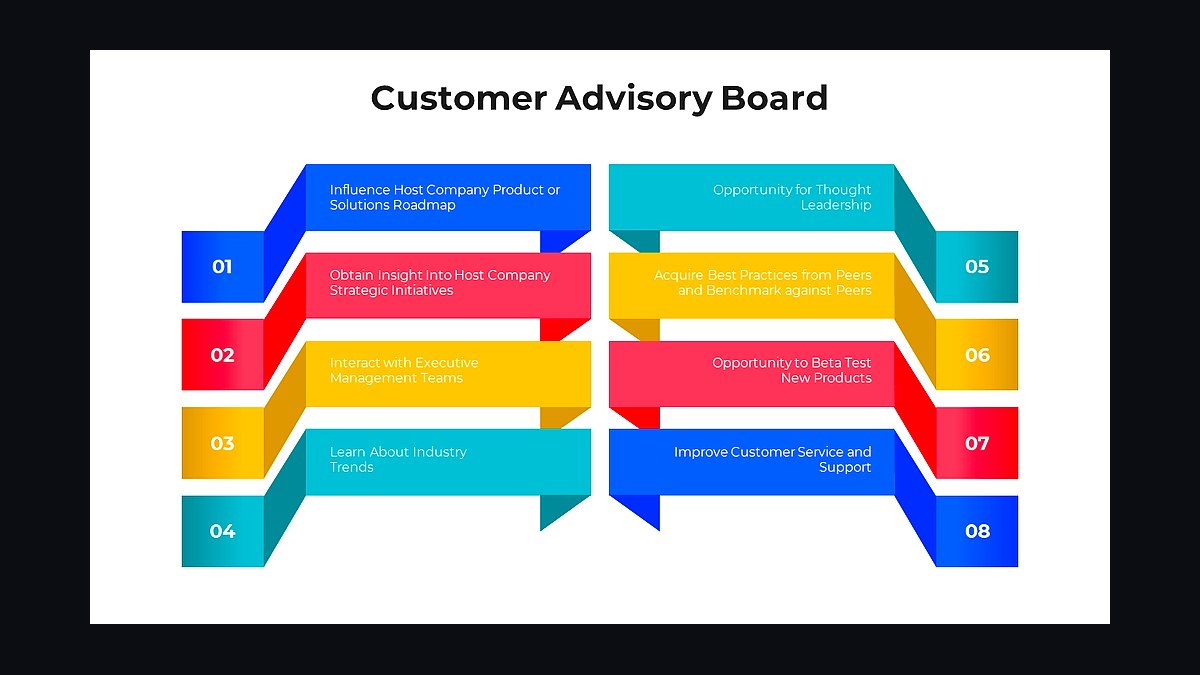
A customer advisory board (CAB) is a curated group of 10-20 strategic customers — usually buyer-side champions or executive sponsors — who meet quarterly in person or monthly virtually to give you strategic feedback on roadmap, GTM motion, and industry positioning. It is not a focus group and not a marketing event. Done right, a CAB pays for itself many times over in product clarity, case studies, and unprompted expansion. Done wrong, it becomes a feature-request waterfall, a sales pitch in disguise, or a calendar event nobody respects, and it quietly dies inside 18 months.
TL;DR
%20%E2%80%94%20and%20how%20do%20you%20actually%20run%20one%20%2C%20realistic%20magazine%20style%2C%20warm%20light%2C%20no%20text%2C%20no%20watermark?width=1200&height=675&nologo=true&model=flux&seed=30090)
- A CAB is 10-20 curated strategic customers giving structured feedback on roadmap, GTM, and positioning — not a focus group, not a user conference.
- It works only with five elements: curated membership, quarterly themed cadence, executive sponsorship, pre-read plus structured agenda, and action commitments with receipts.
- Pavilion 2024: 70 percent of 100M-plus ARR B2B SaaS runs a formal CAB; only 12 percent of sub-10M ARR companies do, because at that stage signal-to-noise is too low.
- Real cost is 50-150K per year (venue, travel, executive hours); top-tier CABs return 3-5 roadmap pivots, 2-3 case studies, and 2-5M in unprompted expansion annually.
- Four failure modes kill most CABs by year two: feature-request waterfall, sales-y meetings, no executive accountability, and no action follow-through after the session.
The 5 Elements of a Working CAB
%20%E2%80%94%20and%20ho%2C%20realistic%20magazine%20style%2C%20warm%20light%2C%20no%20text%2C%20no%20watermark?width=1200&height=675&nologo=true&model=flux&seed=89397)
A CAB does not fail because the idea is wrong. It fails because one of these five pieces is missing or under-resourced. Each element has an owner, and that owner has to treat the CAB the way they treat a board meeting — not the way they treat a webinar.

| Element | Who owns | What good looks like |
|---|---|---|
| Curated membership | CRO with CCO input | 10-20 customers across segments, industries, and ICP profiles; representative not just biggest; champion plus exec sponsor per account |
| Quarterly themed cadence | Chief of Staff | Q1 product roadmap, Q2 GTM motion, Q3 industry trends, Q4 annual retro; calendar locked 12 months out |
| Executive sponsorship | CEO | CEO plus CRO plus CPO present in person; no delegating to directors; named in the invite |
| Pre-read plus structured agenda | Product Marketing | 8-12 page pre-read sent T-5 days; agenda built around debate prompts, not slide walk-throughs |
| Action commitments and receipts | VP Customer Marketing | Every meeting closes with 3-5 named commitments; next meeting opens with public progress against each one |
The single biggest predictor of CAB longevity is element five. Members will forgive a mediocre agenda or a missed dinner. They will not forgive feeling ignored. If your CEO stands up and says "last quarter you asked us for usage-based pricing and a new SOC2 region, and here is what we shipped," members lean in for another year. If the next meeting starts with "thanks for coming again," they quietly stop showing up.

Cost + ROI Math
A respectable CAB costs 50-150K per year, fully loaded. The venue and food for two in-person sessions runs 15-30K. Travel and lodging for 12-20 members and a handful of internal executives adds another 25-60K. Production — pre-reads, recap decks, a dedicated Slack channel, light agency support — costs 10-30K. And the hidden cost, which most finance teams miss, is executive time: roughly 40-60 hours per year of CEO, CRO, and CPO calendar, which on a fully-burdened basis is worth another 30-50K.

The ROI from a healthy CAB is large and unusually legible. A world-class CAB typically drives 3-5 product roadmap pivots per year — not feature requests, but direction changes that prevent six- to twelve-month wrong-way builds. It produces 2-3 high-quality case studies, because members trust you enough to go on the record. Most importantly, it generates 2-5M in unprompted expansion annually from CAB members themselves, because every quarterly session ends with a "where should we go next" conversation that surfaces adjacencies their procurement team is already budgeting for.
Concrete example. A 50M ARR enterprise SaaS launched a formal CAB in 2024 with 12 customers and the full CEO-CRO-CPO triad. Year one surfaced three product gaps the roadmap had missed, drove one major platform pivot away from a planned vertical, and CAB members closed 4.2M in unprompted expansion across the year — every dollar traceable to a "where you should go next" conversation inside or right after a session. Total CAB cost that year was 110K. The expansion alone was a 38x return, before counting the avoided cost of the wrong-way platform build.
The 4 Failure Modes That Kill CABs by Year 2

Failure mode one is the feature-request waterfall. Members show up, list every wish, and leave. PM resents the meeting because none of it is prioritized, none of it is strategic, and all of it lands in their backlog. The fix is agenda discipline: anchor every session in three to five debate prompts, not an open-mic.
Failure mode two is too sales-y. The CRO uses the CAB to soft-pitch the next product line. Members can smell this in the first thirty minutes and they tell each other in the hallway. Within two cycles, the highest-status members find a scheduling conflict, and once they leave, the CAB loses its center of gravity. The fix is a hard rule: no sales pitches, no upsell asks, no logos in the deck.

Failure mode three is no executive accountability. The CEO sends regrets, the CPO sends a director, and the meeting becomes a customer marketing event with a fancier name. Members notice immediately. The fix is treating the CAB like a board meeting on the executive calendar — if the CEO cannot make all four sessions, do not start the CAB.
Failure mode four is no action follow-through. The session ends, everyone goes home, and three months later nothing has visibly changed. Members feel ignored, and they stop showing up — not loudly, just gradually. The fix is the receipts ritual at the top of every session: a single slide showing every prior commitment, its owner, and its status. Done in public, this single habit doubles CAB retention.
Related on PULSE
- How do you decide if a CRO advisory before a full-time hire is right for a Series A company when board wants a revenue turnaround?
- How do you structure a sales advisory board for a $20M ARR company — who to invite, how often to meet, what to share?
- Should I open a financial advisory practice in 2027?
- How Many Advisors Do I Need to Hire for My Financial Advisory Firm?
- How do you decide if a CRO advisory before a full-time hire is right for a vertical SaaS niche company when RevOps exists without a revenue executive?
- How do you decide if a CRO advisory before a full-time hire is right for a usage-based pricing pivot company when renewals are flat while new logo slows?
Common Pitfalls That Derail a CAB (and How to Avoid Them)
Even well-intentioned CABs fail when leadership treats them as a sales channel or a rubber-stamp committee. The most common killer is agenda mismatch: the executive team wants to present a polished product roadmap, while members want to discuss unsolved industry pain points. When the meeting becomes a one-way slide deck, engagement drops fast. A second frequent failure is selection bias — filling the board only with your happiest, most vocal customers. That creates an echo chamber where you hear what you want to hear, not what you need to hear. To avoid this, deliberately recruit 2-3 customers who have been critical or who nearly churned. Their candor is worth more than a dozen cheerleaders. A third pitfall is ghost participation: members who attend but never speak. This usually means the format (too large, too formal, too long) doesn't match their preferred contribution style. Combat this by capping groups at 12 people, using round-robin check-ins, and sending pre-work that requires a written response before the session. Finally, don't let the CAB become a logistical burden on your team. If scheduling, travel, and follow-up fall on one overworked person, the program will atrophy. Assign a dedicated CAB manager or fractional leader who owns the calendar, the prep, and the post-meeting action tracking.
How to Measure Whether Your CAB Is Actually Worth the Cost
A CAB's direct costs — travel, catering, executive time, and sometimes member honorariums — typically range from $2,000 to $5,000 per meeting per member for an in-person session, or $500 to $1,500 for virtual. That adds up fast. To justify the investment, you need measurable outcomes beyond "we got good feedback." Track three categories of ROI. Product impact: How many roadmap items were changed or killed based on CAB input? Assign a rough dollar value to avoided development waste or accelerated feature adoption. For example, one SaaS company we've seen saved an estimated $120,000 by canceling a feature their CAB unanimously said would flop. Revenue influence: Monitor how many CAB members expanded their contract within 6 months of participating. A typical benchmark is 30-40% expansion rate among active members, compared to 10-15% for the broader customer base. Reference and advocacy value: Count the case studies, testimonials, referrals, and speaking invitations that originated from CAB members. A single warm intro to a Fortune 500 prospect can be worth more than the entire program's annual budget. Also track softer signals: meeting attendance rates (should be above 80%), unsolicited member feedback ("this was the most valuable hour of my quarter"), and whether your own product team starts proactively asking "what would the CAB think?" If those metrics are absent or declining after 12 months, the program needs restructuring — not cancellation, but recalibration.
The Pre-Meeting Cadence That Makes or Breaks Your CAB
The actual meeting is only 20% of the work. The other 80% happens in the weeks before. A strong pre-meeting cadence starts 6 weeks out: send a one-page "provocation paper" — not a slide deck, but a narrative that frames 2-3 strategic questions you want the group to wrestle with. For example, "Should we double down on enterprise compliance features or build for mid-market speed?" Include data points but no predetermined answer. 4 weeks out: schedule 15-minute one-on-one calls with each member to surface their hot topics privately. This prevents the loudest voice in the room from dominating and lets you adjust the agenda before anyone sees it. 2 weeks out: share a draft agenda and ask members to rank their interest in each topic. This gives you a weighted priority list and signals that their preferences shape the session. 1 week out: send a short video (under 3 minutes) from the CAB sponsor — usually your CEO or product VP — thanking them and previewing one key tension you'll explore. This builds emotional commitment. On the day itself, open with a "state of the industry" discussion (not your company update) to get members talking about their challenges first. Reserve the last 30 minutes for "what would you do if you were in our shoes?" — that's where the strategic gold emerges. After the meeting, within 48 hours, send a summary that explicitly names who said what (with permission) and what action you're taking. If members don't see their fingerprints on your next release or strategy shift, they'll stop showing up.
FAQ
How many customers should be on a CAB? Most effective CABs have 10 to 20 members. Going smaller risks losing diversity of perspective, while larger groups become unwieldy and reduce the depth of individual contributions.
How often should a CAB meet? Quarterly in-person meetings are the gold standard, with monthly virtual check-ins between sessions. Some teams run fully virtual CABs on a monthly cadence, but the strategic depth tends to be lower without occasional face-to-face time.
What’s the typical budget for running a CAB? Annual costs range from roughly $30,000 to $100,000, covering travel, venue, meals, and modest honorariums. The exact number depends on geography, number of members, and how elaborate the meetings are.
How do you recruit the right members? Look for executive sponsors or champions who are already engaged, give strategic feedback, and have influence in their industry. Avoid customers who only want to push feature requests or who have a transactional relationship with your company.
How long does a CAB typically last before it needs renewal? Most CABs run in 12- to 24-month cycles. After that, member turnover is common due to job changes or shifting priorities, so you should plan to refresh the roster annually.
What’s the biggest mistake companies make with CABs? Treating the CAB as a sales opportunity or a feature-request dump. When members feel their time is wasted on pitches or minor asks, they disengage quickly — and the CAB dies within 18 months.
Sources
- Pavilion, "2024 Customer Advisory Board Benchmark Survey" (CAB prevalence by ARR band, 70 percent above 100M, 12 percent below 10M).
- Forrester, "B2B Customer Experience Index 2024" (CAB impact on retention and NRR among enterprise SaaS).
- Gainsight, "Customer Advisory Board Playbook" (cadence, agenda, and exec-sponsorship benchmarks).
- Bessemer Venture Partners, "State of the Cloud 2024 — Customer Marketing" (cost benchmarks for CAB programs at 50-150K range).
- Sales Hacker, "How to Run a Customer Advisory Board That Actually Works" (failure modes and receipts ritual).
- Winning by Design, "Customer-Led Growth Operating Model" (CAB role inside post-sale motion).
- Harvard Business Review, "Why Customer Advisory Boards Fail" (executive accountability and feature-waterfall traps).
- Pragmatic Institute, "Product Roadmap Influence from Customer Advisory Boards" (3-5 pivots per year benchmark).
This page will be disappearing soon. Save it to your device for $1 — or read it free while it is here.
@Kory-White- · if Venmo asks, the last 4 of my number are 2012
This page is gone.
This one is off the shelf now. $1 keeps it on your phone for good — the whole page, pictures and diagrams included.
 revopsWhat are Notre Dame Fighting Irish football's 2027 NIL needs and strategy?
 revopsHow do you design the PLG-to-sales handoff in 2027?
 revopsHow should a 2027 CS team attribute expansion vs save revenue?
 revopsWhat are UConn Huskies men's basketball's 2027 NIL needs and strategy?
 revopsWhat are Tennessee Volunteers men's basketball's 2027 NIL needs and strategy?
 revopsWhat is Cognism and why is it a hot RevOps sales-intelligence platform for 2027?
 revopsWhat are the 2027 predictive interview signals for hiring AEs?
 revopsWhen should a 2027 acquirer unify GTM motions vs keep them separate?
 revopsWhat is Second Nature and why is it a hot RevOps AI sales-training platform for 2027?
 revopsHow do you compare quotas across sales segments in 2027?