


CMMC 2.0 compliance cost — why small federal integrators are getting crushed in 2027
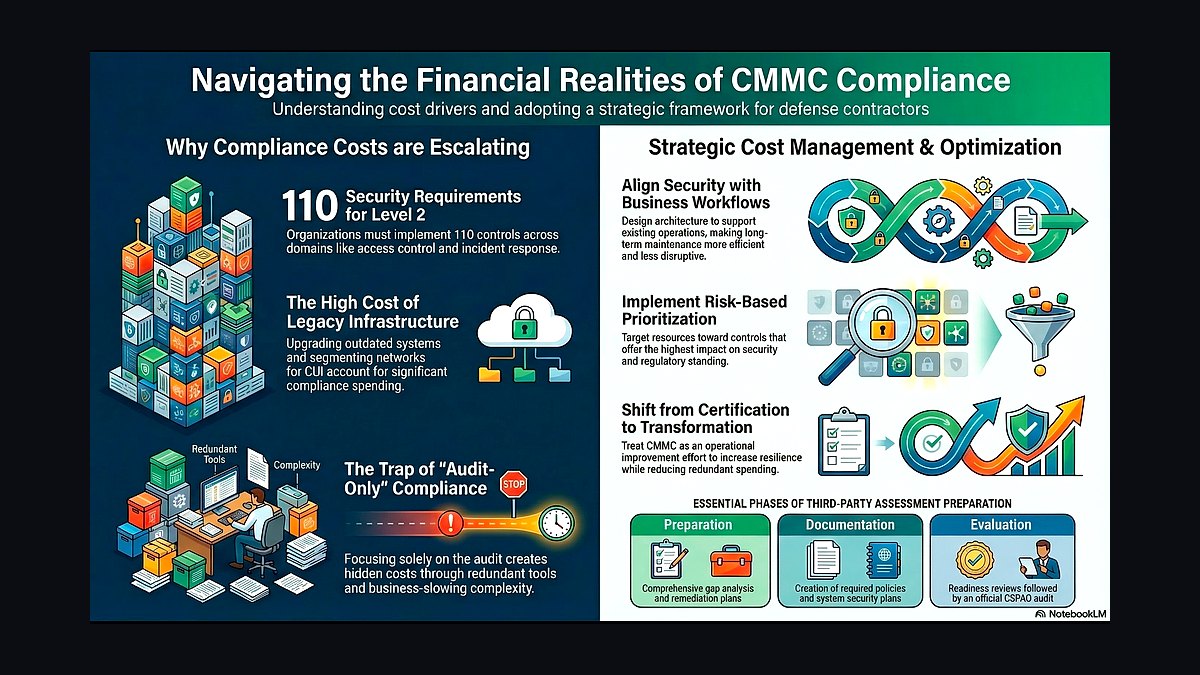
CMMC 2.0 is quietly executing the largest small-business culling in the history of the federal supply chain. Level 2 certification now costs small contractors $75,000 to $150,000 in year one and roughly $488,000 across a three-year lifecycle — numbers the DoD itself published — while the assessor pool has not scaled to meet a contract base of roughly 80,000 affected suppliers. The framework was sold as "right-sized" cybersecurity. In practice it has become a regressive tax that punishes the integrators, machine shops, and IT services firms who built the defense industrial base, while consolidating revenue into a handful of large primes and a cottage industry of consultants who profit from the rule's complexity.
1The Headline Numbers Are Worse Than They Look
1.1 A six-figure ticket on a $2M revenue shop
The marketing brochures quote a tidy range — $75K to $150K for Level 2. Operators in the field tell a different story. Assessment fees alone run $30,000 to $150,000 depending on enclave scope. Preparation, gap remediation, and technology stack overhauls account for the other 60 to 75 percent of the spend. For a 12-person systems integrator pulling $2M to $4M in DoD-adjacent revenue, that is one to two full FTEs of margin vaporized before a single line of code is shipped.
1.2 The three-year lifecycle hides the real damage
The DoD's own cost model pegs the three-year burden for small contractors at $487,970. That figure assumes everything goes right — no failed assessments, no scope creep, no auditor turnover, no enclave rebuilds. In reality, roughly 40 percent of organizations fail their first formal assessment and pay again. The lifecycle number for a contractor that stumbles once is closer to $650,000 to $750,000, and that is before annual affirmation costs and the triennial recertification cycle resets the meter.

1.3 Maturity gap as a multiplier
Mature organizations with existing NIST SP 800-171 scaffolding spend 60 to 65 percent less than greenfield shops. That sounds like a fair gradient until you realize the firms with mature postures are already the large primes and well-capitalized mid-tiers. The penalty falls hardest on the small subs who never had a CISO, never bought a GCC High tenant, and never priced compliance into their cost-plus rates.
2The Assessor Bottleneck Nobody Wants to Discuss
2.1 Supply and demand math that does not work
The Cyber AB has authorized somewhere between 80 and 110 C3PAOs to perform Level 2 assessments. The contract base requiring those assessments sits north of 80,000 suppliers. Even at an aggressive ten assessments per C3PAO per year, the entire ecosystem can certify roughly 1,000 contractors annually — a 70-year backlog at current throughput. The math is not subtle, and it is producing exactly the price gouging you would expect: assessment quotes have climbed 30 to 50 percent year-over-year as small shops scramble for slots ahead of contract option years.

2.2 Auditor inconsistency is a feature, not a bug
Two assessors looking at the same enclave routinely arrive at different scope determinations, different control interpretations, and different POA&M demands. There is no formal appeals mechanism that does not involve more billable hours. Contractors who push back find themselves shopping for a different assessor at a new six-figure price tag.
3Who Actually Wins
3.1 The compliance industrial complex
A new vertical has materialized — Registered Practitioner Organizations, managed compliance providers, GCC High resellers, vCISO shops, and a wave of "CMMC-in-a-box" SaaS platforms charging $40K to $90K annually. None of them build a weapon system. None of them ship a line of working software to a warfighter. They exist purely to translate a federal rule into deliverables, and they are extracting an estimated $4B to $6B annually from a defense industrial base that was already margin-starved.

3.2 The large primes
Primes with mature security organizations absorb the cost as a rounding error and pass it through on cost-plus vehicles. Worse, they are quietly using CMMC status as a sub-selection filter — a polite way to shrink the supplier list and consolidate share. Several Tier-1 primes have publicly stated they will reduce their small-business sub base by 20 to 40 percent over the next 24 months, citing "supply chain risk reduction." Translation: CMMC just gave them air cover to do what acquisition policy used to forbid.
3.3 The consultants who actually deliver value
There is a thin slice of practitioners — firms like ACG and a handful of peers — who do the unglamorous work of pairing real engineering with realistic scoping, keeping enclaves tight, and refusing to oversell. They are the exception. The median engagement in this market is a bloated SOW that treats the small contractor as a billable cost center rather than a client to protect.

4The Strategic Damage to the Industrial Base
4.1 Innovation moves to the commercial side
The small integrators leaving DoD work are not retiring — they are pivoting to commercial cloud, healthcare, and state and local government work where the compliance overhead is a fraction of CMMC. The Department is losing exactly the agile, ten-to-fifty-person shops it spent two decades courting through SBIR, OTA, and AFWERX.
4.2 Fewer bidders, higher prices
Contracting officers in the field are already reporting a 15 to 25 percent decline in qualified bidders on small-dollar IDIQs in CMMC-affected categories. Fewer bidders means less price competition, which means the taxpayer pays the compliance premium twice — once at the contractor level and again in the form of fatter award prices.

4.3 The strategic irony
A program designed to harden the defense industrial base against adversary intrusion is, in 2027, actively thinning that base, concentrating it into fewer hands, and creating exactly the single-points-of-failure that supply chain risk management was supposed to eliminate. The cybersecurity outcome may be marginally better. The industrial base outcome is unambiguously worse.

Related on PULSE
- What are CMMC requirements and how do they gate defense contractor sales?
- Cleared-workforce shortage hitting federal AV+comms integrators in 2027
- ACG Systems vs national AV integrators in 2027 — where regional firms fall short
- Is a Fractional CRO Worth It for a Small Business?
- Can Notion replace both Trello and Confluence for a small marketing team, or are there gaps?
- What is the best AI-powered CRM for small businesses in 2024?
The Hidden Cost of Assessment Bottlenecks
Even if a small integrator can afford the upfront compliance investment, they may not be able to schedule an assessment in time to win or retain a contract. The DoD’s CMMC Accreditation Body (now Cyber AB) has certified roughly 500 third-party assessment organizations (C3PAOs) as of early 2025 — but only a fraction are actively performing Level 2 assessments. Industry estimates suggest the active assessor pool can handle fewer than 5,000 assessments per year, against an estimated 40,000–60,000 small businesses that will need Level 2 certification by 2027. This bottleneck forces small integrators into a bidding war for assessor time, with scheduling lead times stretching 6–12 months and premium pricing of $30,000–$50,000 per assessment. For a firm with a single $2 million contract, a one-year delay in certification can mean losing the contract entirely — a risk that primes and large consultancies simply don’t face.
The Unfunded Mandate of Continuous Monitoring
CMMC 2.0 Level 2 requires more than a one-time certification — it demands ongoing compliance through continuous monitoring and annual self-assessments. Small integrators must maintain a full-time or fractional CISO, invest in SIEM tools, and conduct regular penetration testing, vulnerability scanning, and incident response drills. These recurring costs — $50,000–$100,000 annually for a small firm — are rarely reimbursed by prime contractors or passed through in fixed-price contracts. The DoD has not created a dedicated funding stream for small business compliance, leaving integrators to absorb these costs as a condition of doing business. For firms operating on thin margins, this unfunded mandate effectively reduces net profit by 5–15 percentage points, making many contracts economically unsustainable.
The Consolidation Play: Who Really Wins
The compliance burden is accelerating a predictable consolidation in the defense industrial base. Large primes like Lockheed Martin, Northrop Grumman, and Booz Allen Hamilton have dedicated compliance teams, existing infrastructure, and the ability to absorb certification costs as a fixed overhead. For them, CMMC 2.0 is a competitive moat — it raises barriers to entry and reduces the pool of small subcontractors they must compete with for talent and contracts. Private equity firms are also circling, acquiring compliant small integrators at depressed valuations (3–5x EBITDA versus 6–8x pre-CMMC) and rolling them up into larger entities that can amortize compliance costs across a broader revenue base. The net effect: the small integrators who built the DIB are being systematically replaced by a smaller number of larger, better-capitalized firms — exactly the opposite of what the DoD’s small business programs were designed to achieve.
Sources
- Department of Defense (DoD) CMMC website — official program requirements, timelines, and policy updates for CMMC 2.0.
- National Institute of Standards and Technology (NIST) — NIST SP 800-171 and related standards that form the technical basis for CMMC compliance.
- Government Accountability Office (GAO) — reports on cybersecurity challenges and cost impacts for small defense contractors.
- Small Business Administration (SBA) — guidance and resources for small businesses navigating federal contracting and compliance costs.
- Cybersecurity Maturity Model Certification Accreditation Body (CMMC-AB) — accreditation, assessor training, and certification process details.
- Federal Register — official rulemaking notices and public comments on CMMC 2.0 implementation and cost estimates.
FAQ
Is CMMC 2.0 really that expensive for small businesses? Yes, the DoD’s own estimates show Level 2 certification costs $75,000 to $150,000 in year one, with a three-year lifecycle cost around $488,000. For a small integrator with thin margins, that can be 5–10% of annual revenue or more.
Why can’t small contractors just use cheaper compliance tools? The assessment requires a certified third-party assessor organization (C3PAO) for Level 2, and their fees are fixed by market demand—not tool choice. Even with automation, the labor for documentation, evidence collection, and remediation pushes costs into the six-figure range.
Are there any exemptions for very small businesses? Level 1 (self-assessment) is cheaper, but most contracts with CUI require Level 2. There is no size-based exemption for Level 2; a 10-person shop faces the same assessment scope as a 500-person firm.
How long does the certification process actually take? Most small integrators report 12–18 months from start to certification, assuming they have no major gaps. Delays from C3PAO scheduling backlogs can add 3–6 months, and remediation cycles often extend timelines further.
Will the assessor shortage get better by 2027? The DoD has tried to expand the C3PAO pool, but growth has been slow—roughly 50–100 assessors nationwide as of late 2024. Demand from ~80,000 contractors means wait times are likely to remain 6–12 months for an assessment slot.
What happens if a small contractor can’t afford certification? They will lose eligibility for new contracts and eventually be non-renewed on existing ones. Many are already exiting the market or being acquired by larger primes, which is exactly the consolidation trend the rule is accelerating.
Bottom Line
CMMC 2.0 is not a bad idea. The execution, the pricing structure, the assessor bottleneck, and the lack of any small-business cost relief mechanism have turned a reasonable policy into a regressive tax that is hollowing out the small and mid-sized integrator tier. Until the DoD funds a true small-business compliance offset, expands the C3PAO pool by an order of magnitude, and standardizes scoping interpretations, the rule will continue to crush the very contractors it was meant to protect.
Sources:
This page will be disappearing soon. Save it to your device for $1 — or read it free while it is here.
@Kory-White- · if Venmo asks, the last 4 of my number are 2012
This page is gone.
This one is off the shelf now. $1 keeps it on your phone for good — the whole page, pictures and diagrams included.
 acg-systemsACG Systems' 24/7 help desk and technician network in 2027
 acg-systemsWhat does ACG Systems specialize in for mission-critical communications, and where does that expertise matter most in 2027?
 acg-systemsFederal AV+comms project change orders — how scope creep eats budgets in 2027
 acg-systemsUtility and SCADA communications integrator market — co-op buyer challenges in 2027
 acg-systemsFederal microwave backhaul and RF infrastructure integrator market in 2027
 acg-systemsWhat does ACG Systems in Annapolis MD do, and what makes them notable in 2027?
 acg-systemsSCIF buildout integrator market — why ICD-705 schedules slip in 2027
 acg-systemsFederal AV+comms supply chain disruption — TAA Section 889 challenges in 2027
 acg-systemsHow'd you fix Pluralsight's revenue issues in 2026?
 acg-systemsThe Maryland defense contracting market — DoD procurement challenges for Annapolis-area firms in 2027