


Why is pipeline coverage moving from 3x to 5x in 2027?
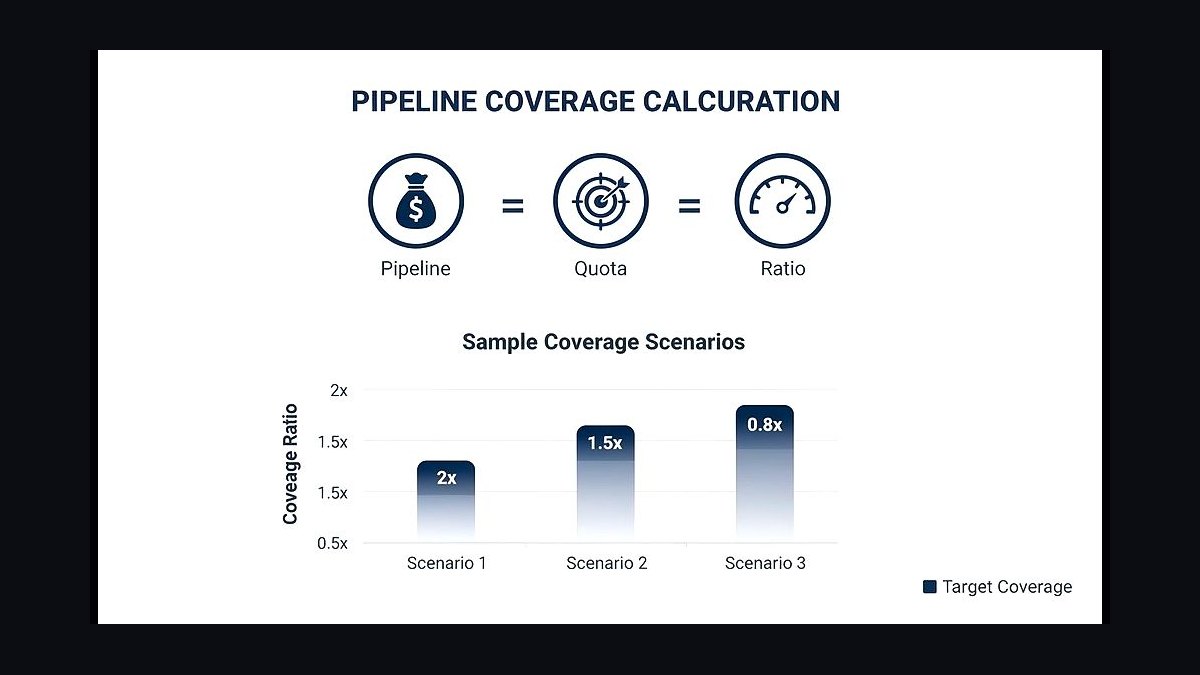
Pipeline coverage — the ratio of total open pipeline value to the quota or revenue target for a given period — is moving from the traditional 3x standard to a 5x or higher standard in 2027 because sales cycles have become harder to predict, win rates on individual deals have become more volatile, and AI-powered forecasting tools have revealed that the older 3x coverage assumption was producing too much forecast risk. The 2027 best-practice pipeline coverage target for B2B SaaS is 5x to 6x for enterprise sales motions (long cycles, high ACV variability), 4x to 5x for mid-market motions, and 3x to 4x for SMB motions (shorter cycles, more predictable). The shift is driven by three factors: agentic AI-enabled forecasting tools (Clari, BoostUp, Salesforce Einstein) that quantify forecast risk more precisely than gut judgment ever did; macro and AI-disruption volatility that has reduced predictability across the buying-committee market; and competitive pressure that has compressed win rates in many B2B SaaS categories. Companies running 3x coverage in 2027 frequently miss forecast; companies running 5x coverage with disciplined pipeline qualification consistently hit forecast.
1The Pipeline Coverage Definition and Why It Matters
Pipeline coverage equals total open pipeline value (typically weighted by stage) divided by the quota or revenue target for a given period. A 3x coverage ratio means the open pipeline equals three times the period's target; a 5x ratio means five times.
The metric matters because B2B SaaS sales involves significant uncertainty on which specific deals will close. Some deals slip, some are lost, some change scope, and only a fraction of identified opportunities actually convert to closed-won. The coverage ratio is a buffer against this uncertainty — if win rates are 25 percent, a 4x coverage ratio should produce 1.0x quota attainment (4x times 25 percent equals 1.0x).
The right coverage ratio depends on the company's historical win rate, sales cycle predictability, and the period of interest (quarterly versus annual). Companies with 33 percent win rates on identified opportunities need 3x coverage to hit quota; companies with 20 percent win rates need 5x coverage.

1.1 The historical 3x standard
The traditional 3x coverage standard came from the late-1990s and 2000s enterprise software era when win rates on qualified opportunities ran approximately 30 to 35 percent and sales cycles were relatively predictable. With those parameters, 3x coverage produced reliable quota attainment.
The 3x standard became conventional wisdom and was applied across many B2B sales contexts, often without recalibrating to the specific company's win rates and cycle dynamics. By 2020-2022, many B2B SaaS companies were nominally running 3x coverage but missing forecast because their actual win rates had compressed to 20 to 25 percent without an equivalent coverage adjustment.
2Why Coverage Has Moved to 5x or Higher in 2027
Three forces have pushed pipeline coverage requirements upward in 2027.

First, AI-powered forecasting has revealed forecast risk. Clari, BoostUp, Salesforce Einstein Forecasting, and similar tools quantify forecast risk with much more precision than the older AE-self-reported forecast methods. The AI tools consistently show that 3x coverage produces forecast risk in the 15 to 25 percent range — too high for reliable quarterly delivery. The empirical evidence has pushed sales leaders to require higher coverage.
Second, macro and AI-disruption volatility. The 2024-2027 macro environment includes significant volatility from interest rate cycles, corporate IT-spend volatility, and AI-driven competitive disruption. Buying committees that were stable in 2018-2022 have become more volatile — deals that looked secure stall when budgets get re-allocated to AI investments or when buying-committee members change roles. The volatility requires more pipeline buffer.
Third, competitive pressure has compressed win rates. Many B2B SaaS categories have become more competitive through 2024-2027 as AI-driven product launches accelerate. Win rates on qualified opportunities have compressed from 30 to 35 percent in 2018 to 20 to 28 percent in 2027 in many categories. Lower win rates require higher coverage to produce equivalent quota attainment.
2.1 The math behind the shift
The arithmetic is straightforward. A sales motion with 33 percent win rate on qualified opportunities and predictable cycle timing produces 1.0x quota attainment at 3x coverage. A sales motion with 22 percent win rate and moderate timing volatility needs approximately 5x coverage to produce 1.0x quota attainment. A sales motion with 18 percent win rate and high timing volatility needs approximately 6x coverage.

Most enterprise B2B SaaS motions in 2027 are in the 20 to 28 percent win rate range with moderate timing volatility, putting the right coverage at 4.5x to 5.5x.
3The 2027 Coverage Benchmarks by Segment
The 2027 best-practice coverage benchmarks by sales segment look as follows.
Enterprise B2B SaaS (ACV 250 thousand and above, 6 to 12-month cycles). Coverage target: 5x to 6x. Enterprise deals have the highest timing volatility, the most complex buying committees, and the most exposure to macro and AI-disruption volatility. The high coverage requirement reflects the high forecast risk.

Mid-market B2B SaaS (ACV 25 to 250 thousand, 3 to 6-month cycles). Coverage target: 4x to 5x. Mid-market deals have moderate timing volatility and moderate cycle predictability. The middle coverage requirement balances forecast risk against pipeline maintenance cost.
SMB B2B SaaS (ACV under 25 thousand, 30 to 90-day cycles). Coverage target: 3x to 4x. SMB deals have lower timing volatility and shorter cycles, so the older 3x standard remains roughly appropriate. Some SMB-focused companies run 3.5x as the new norm.
PLG (product-led growth) motions. Coverage targets are different because the qualification model is different. For sales-assisted PLG (where product usage qualifies the lead), coverage requirements are typically 4x to 6x reflecting the high volume but lower per-deal conversion. For self-service PLG, traditional pipeline coverage doesn't apply.

4The Composition of Quality Pipeline
The right pipeline coverage requires quality pipeline, not just volume. Companies that hit 5x coverage with poor-quality pipeline still miss forecast because the open opportunities are not genuinely qualified. Three quality criteria matter most.
Stage-weighted coverage. Pipeline at later stages (proposal, contracting) has higher close probability than pipeline at earlier stages (discovery, qualification). A coverage ratio that includes mostly early-stage pipeline is qualitatively weaker than one that includes mostly mid-to-late-stage pipeline. The discipline is to track stage-weighted coverage in addition to gross coverage.
Vintage. Pipeline that has aged significantly (e.g., opportunities created 6-plus months ago and still open) is qualitatively weaker than pipeline that is actively progressing. Top-performing sales operations track average pipeline age and intervene on stale pipeline.

ICP fit and qualification depth. Pipeline that includes opportunities from outside the company's ICP, or opportunities with shallow qualification, is qualitatively weaker than well-qualified ICP-fit pipeline. The discipline of regularly auditing pipeline for ICP fit and qualification depth filters out low-quality pipeline before it dilutes the coverage signal.
4.1 The MEDDIC and MEDDPICC quality lens
MEDDIC and MEDDPICC (the dominant sales qualification methodologies in 2027) provide structured quality criteria for pipeline. Top-performing sales operations require AEs to fill in MEDDIC/MEDDPICC fields for each opportunity and use the completeness as a quality signal.
A 5x coverage ratio where 70 percent of pipeline has complete MEDDIC qualification is much higher quality than the same 5x coverage with 30 percent qualification. The qualification depth matters more than gross coverage volume.

5The Implementation Approach for Moving from 3x to 5x
A CRO transitioning from 3x to 5x pipeline coverage in 2027 should approach the transition in this sequence.
Months 1 to 2: assess the current state. Measure historical win rates, cycle predictability, and forecast accuracy. Calculate the empirical coverage requirement to produce reliable quota attainment given the company's specific dynamics.
Months 2 to 4: increase top-of-funnel volume. Pipeline coverage is increased by generating more qualified opportunities, not by inflating pipeline values. Increase marketing-sourced and SDR-sourced pipeline through agentic AI tools, ABM programs, and AE prospecting.

Months 4 to 6: tighten qualification discipline. Use the larger pipeline volume as opportunity to tighten qualification — disqualify opportunities that don't meet ICP or MEDDIC criteria. Coverage should rise from 3x toward 5x with simultaneously improving pipeline quality.
Months 6 to 9: deploy AI-powered forecasting tools. If not already deployed, implement Clari, BoostUp, or Einstein Forecasting to measure forecast risk with precision. Use the AI tool's risk signals to refine the coverage target by segment.
Months 9 to 12: institutionalize the new coverage discipline. Set quarterly coverage targets by segment, weekly pipeline reviews with coverage status, monthly forecast accuracy tracking. The discipline of consistent measurement and intervention is what sustains the improvement.
By month 12, the company has typically established 4.5x to 5x coverage with stronger qualification discipline and improved forecast accuracy.

6The Mistakes Companies Make on Pipeline Coverage
The biggest mistake is treating coverage as a target rather than a buffer. Some sales teams hit the coverage number by including low-quality opportunities (early-stage opportunities that won't close in the forecast period, opportunities with shallow qualification, opportunities outside ICP). The coverage number looks healthy but forecast still misses.
The second mistake is failing to recalibrate by segment. Companies that apply a single coverage target across all segments miss the segment-specific dynamics. Enterprise needs higher coverage than SMB; the right framework recognizes these differences.
The third mistake is over-relying on AE-self-reported pipeline values. AEs are typically optimistic about deal values and close probabilities. Top-performing sales operations require objective qualification criteria (MEDDIC/MEDDPICC, customer-validated business case, identified champion, identified economic buyer) to count opportunities at full value.

The fourth mistake is failing to deploy AI forecasting tools. The AI tools are dramatically more accurate than AE-self-reported forecasts. Companies that have not deployed Clari, BoostUp, or Einstein Forecasting are operating with worse forecast accuracy than is necessary.
The fifth mistake is failing to address the root cause of weak coverage. When coverage is below target, some sales leaders respond by pressuring AEs to "find more pipeline" without addressing the underlying issues (insufficient marketing-sourced pipeline, weak SDR productivity, poor ICP definition, low win rates). The pressure approach produces inflated pipeline values without quality improvement.
Related on PULSE
- What data sources are most effective for training AI models to predict next best action in complex enterprise deals?
- How does the expanding size of B2B buying committees increase the risk of vendor consolidation paralysis?
- Which vendor consolidation strategies are failing most often when integrating AI sales tools into existing stacks?
- Why are longer sales cycles now correlating with a shift from pipeline velocity to deal value predictability?
- What specific metrics are B2B RevOps teams using to measure AI's impact on lead quality in the top-of-funnel?
FAQ
Is 5x pipeline coverage really necessary, or is it just a safe target? 5x is a realistic minimum for enterprise sales in 2027, not an overly conservative cushion. With win rates often ranging from 15% to 25% on large deals and deal cycles stretching 6–12 months, 3x coverage leaves little room for slippage. Companies that run 5x still see forecast misses if qualification is weak, but the buffer helps absorb the natural volatility of modern buying committees.
Does this mean I should double my prospecting efforts immediately? Not necessarily—coverage is about quality as much as quantity. A 5x pipeline filled with poorly qualified or early-stage deals won’t improve forecast accuracy. The shift works best when you combine higher volume with rigorous stage-gating and AI-driven scoring to ensure deals have a realistic path to close.
Will 5x coverage work for SMB or transactional sales? For SMB motions with shorter cycles and higher predictability, 3x to 4x is usually sufficient. The 5x standard is most relevant for enterprise and mid-market deals where ACV varies widely and buying groups are larger. Applying 5x to simple, low-ACV sales could waste resources on overbuilding pipeline.
How do AI forecasting tools change the coverage math? Tools like Clari, BoostUp, and Einstein now quantify forecast risk more granularly, revealing that 3x coverage often masked a 40–60% chance of missing target. With these tools, you can see which deals are truly likely to close and adjust coverage dynamically. They don’t eliminate the need for volume, but they help you focus on the right deals.
What happens if I keep using 3x coverage in 2027? You’ll likely miss forecast more frequently, especially in enterprise segments. Many B2B SaaS teams running 3x in 2027 report hitting quota only 50–60% of the time, while those at 5x with disciplined qualification hit 80–90%. The gap widens as deal cycles lengthen and buyer behavior becomes less predictable.
Is this change permanent, or might coverage targets drop again? It depends on market stability and AI adoption. If macro volatility subsides and AI forecasting matures to the point where win rates become more predictable, coverage requirements could ease. For now, the trend points to 5x+ as the new baseline for complex sales through at least 2028–2029.
Sources
- Pavilion 2026 RevOps Benchmark Survey on pipeline coverage and forecast accuracy
- Clari 2026 Forecast Accuracy Benchmark Report
- BoostUp 2026 Pipeline Health Benchmarks
- TOPO Research 2026 Sales Methodology and Pipeline Quality Research
- The Bridge Group 2026 SDR and Pipeline Metrics Survey
- Forrester Research 2026 Sales Forecasting Wave report
- Gartner 2027 Magic Quadrant for Sales Performance Management
- Salesforce Einstein Forecasting 2026-2027 customer benchmarks
This page will be disappearing soon. Save it to your device for $1 — or read it free while it is here.
@Kory-White- · if Venmo asks, the last 4 of my number are 2012
This page is gone.
This one is off the shelf now. $1 keeps it on your phone for good — the whole page, pictures and diagrams included.
 revopsHow do you run a weekly forecast call in 2027?
 revopsHow do you calculate and improve pipeline coverage ratio in 2027?
 croWhat does the weekly operating cadence of a world-class CRO look like in 2027?
 revopsWhy are SaaS companies cutting sales headcount 15-25% in 2027 with AI?
 revopsHow do you do effective deal coaching in 2027?
 revopsHow do you handle a sales reorg without losing pipeline in 2027?
 revopsHow do you run RevOps as an internal service team in 2027?
 revopsHow do you consolidate an overgrown sales tech stack in 2027?
 revopsHow do you handle commission disputes in 2027?
 revopsWhat is Microsoft Copilot for Sales and what does it mean for RevOps in 2027?