


What is Xactly and why is it a hot RevOps sales performance management platform for 2027?
Quality
Certified

Xactly is an enterprise sales performance management (SPM) platform that unifies incentive compensation, quota and territory planning, and forecasting on 20-plus years of pay-and-performance benchmark data. It is a hot RevOps platform for 2027 because it connects the full performance discipline — not just commission math — and layers Incent AI Agents on top to accelerate plan design and seller transparency.
What Xactly is and why it matters
Xactly is a sales performance management platform, which means it is deliberately broader than commission-calculation software. Its core identity rests on three connected disciplines: incentive compensation automation, quota and territory planning, and forecasting. Where a point tool answers "what do we owe this rep this month," Xactly's pitch is the full performance picture — what you pay, where reps sell, what targets they carry, and what the business can expect to close.
The platform is modular. Xactly Incent is the foundation: incentive compensation automation that calculates commissions, bonuses, and credits accurately across complex plan structures. AlignStar handles territory and quota management — designing territories, balancing them, and setting quotas that roll up coherently to the company number. Around those sit Forecasting, Analytics, and Planning modules. Together they let RevOps and finance run the entire sales performance lifecycle on one connected system rather than stitching together a comp tool, a spreadsheet-based territory model, and a separate forecasting product that never quite agree with each other.
Why does the breadth matter? Because these disciplines are causally linked. Compensation drives seller behavior. Territories and quotas set the targets that behavior is measured against. Forecasting predicts whether attainment will land where the board expects. When each lives in a different tool with a different data model, the seams become the errors: a quota set in a spreadsheet that doesn't match the comp plan's crediting rules, a territory change that never propagates to the forecast, a rep who doesn't trust their commission statement because the math is opaque. Xactly's argument is that connecting them removes those seams.
The second pillar is data depth. Xactly has accumulated more than two decades of pay-and-performance data, which it uses to benchmark compensation plans and inform predictive analytics. That corpus is the kind of asset a newer entrant cannot simply build overnight — it reflects years of observed plan structures, attainment distributions, and payout patterns across many organizations. For RevOps leaders designing a plan, benchmark context is genuinely useful: it answers questions like whether a given commission rate is competitive, how quota attainment typically distributes across a sales force, and what plan mechanics tend to produce the behavior you want.
The third pillar, and the reason Xactly is specifically a 2027 story, is AI. Xactly announced Incent AI Agents in December 2025 as an early-access preview. Two capabilities stand out. Accelerate Program Design lets RevOps model and deploy new incentive plans from natural-language prompts, collapsing what is traditionally weeks of manual configuration into a much shorter cycle. Seller-facing agents help reps understand their performance, their commissions, and their plan documents — directly attacking the trust-and-transparency problem where reps quietly disbelieve their comp statements. Neither capability replaces judgment, but both target the slowest and most friction-filled parts of the SPM workflow.
For a RevOps team at a larger enterprise, the combination is the pitch: comprehensive SPM breadth, a deep benchmark data moat, and emerging AI agents that accelerate the historically slow work of plan design and the historically contentious work of seller communication. That is what makes Xactly a platform to evaluate seriously for 2027 rather than a legacy comp tool riding an old reputation.
The step-by-step process: how Xactly gets deployed and run

Understanding Xactly as a platform is one thing; understanding what actually happens when a company adopts it is another. The deployment and operating sequence matters because SPM implementations fail on process, not on features. Here is how the work typically unfolds.
Step 1 — Scope the modules. Before anything technical, the team decides which modules it needs. Some organizations start with Incent alone because their comp plans are the acute pain. Others scope Incent plus AlignStar because territory and quota planning is equally broken. The full suite adds Forecasting, Analytics, and Planning. This decision drives nearly everything downstream, including cost, timeline, and integration surface area.
Step 2 — Map the data sources. Xactly needs deal and attainment data from the CRM, headcount and hierarchy data from HR systems, and often financial data from the ERP. The implementation team documents which fields flow where, how often, and who owns each source. This is where most of the upfront effort lands, and it is where weak implementations are usually lost.
Step 3 — Model the compensation plans. The existing plans — however they currently live, usually in spreadsheets and tribal knowledge — get translated into the platform's plan model. This is a genuine forcing function: organizations routinely discover that their documented plan and their actual plan differ, and that different regions have quietly diverged. Modeling the plans surfaces those discrepancies.

Step 4 — Configure crediting, splits, and rules. Commission crediting rules, split credit across multiple reps, draw and guarantee handling, clawbacks, accelerators, and quota relief all get configured. Complexity here scales with the sales organization's complexity, which is why enterprise implementations take longer than mid-market ones.
Step 5 — Validate against historical periods. The standard practice is to run historical commission periods through the new system and reconcile the output against what was actually paid. Discrepancies get investigated and resolved before go-live. This step is unglamorous and essential — it is the only way to build confidence that the new system produces the same or better answers.
Step 6 — Integrate territory and quota planning. If AlignStar is in scope, territories get modeled, balanced against historical potential, and quotas get allocated down through the hierarchy. The value here is that quota allocation can be tested against the comp plan mechanics in the same system.
Step 7 — Layer forecasting and analytics. Forecasting connects attainment data to forward projections. Analytics surfaces the patterns — which plans are producing which behaviors, where attainment is concentrated, where it is thin.
Step 8 — Enable seller-facing transparency. Reps get access to their statements, their plan documents, and increasingly, agent-assisted explanations of their earnings. This is where the trust problem gets addressed directly.

Step 9 — Go live and run the cycle. After go-live, the operating rhythm is monthly or quarterly commission cycles, periodic plan reviews, annual territory and quota resets, and continuous forecast updates. The AI agents fold into this rhythm — plan design prompts during planning season, seller questions during the commission cycle.
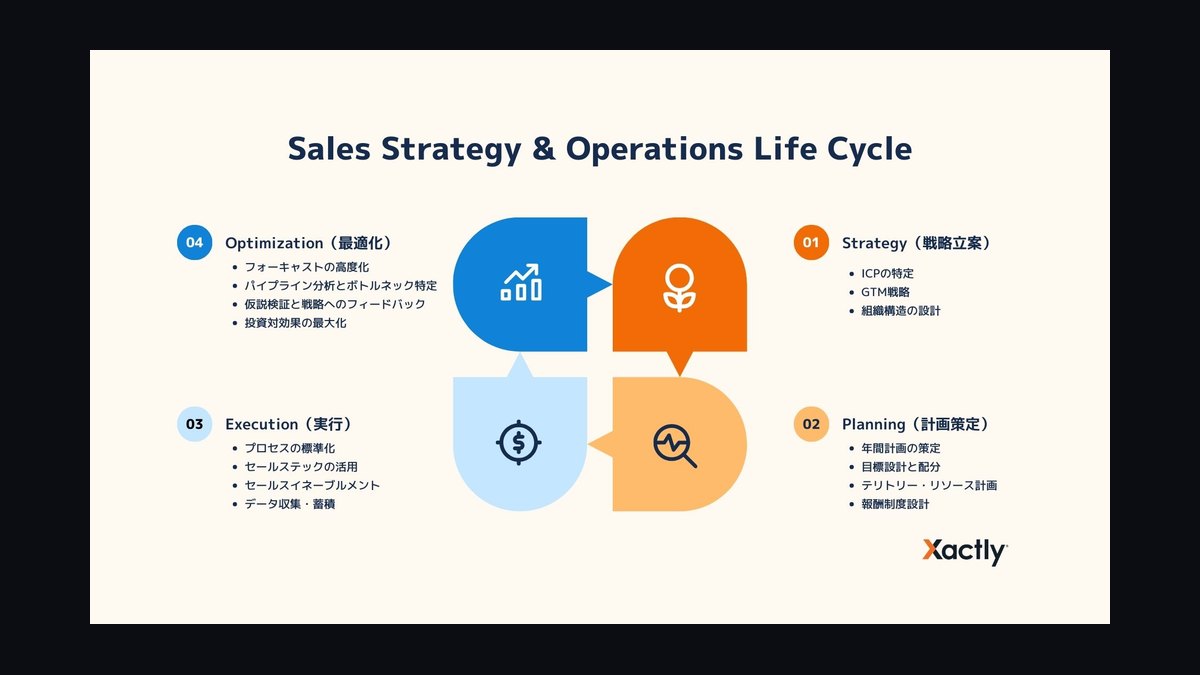
The loop back from annual planning to plan modeling is intentional. SPM is not a one-time implementation; it is a recurring cycle where each year's plan design builds on the last year's observed performance. The organizations that get the most from Xactly treat the platform as the system of record for that cycle, not as a calculator they visit once a month.
Costs, timelines, and typical ranges
Xactly pricing is enterprise in structure: named-user licenses across selected modules, with volume discounts that begin at higher user counts and increase as the organization grows. Published discount tiers commonly cited start around 50 users and step up at 100, 250, and 500-plus users. Beyond that, most deals are custom-quoted based on user count, module selection, data volume, and integration complexity. There is no meaningful public price list, which is itself a signal about the buyer profile.
A practical way to think about cost is that it scales along two axes simultaneously. The first axis is breadth: Incent alone is a smaller commitment than Incent plus AlignStar plus Forecasting plus Analytics plus Planning. The second axis is headcount: because licensing is named-user, cost rises with the number of people who need access, whether they are reps viewing statements, managers reviewing team performance, or finance and RevOps administrators configuring plans.

Timelines vary with complexity, but a reasonable planning range for an enterprise SPM deployment runs from a few weeks for a narrow, well-scoped Incent-only rollout at a mid-market company to several months for a full-suite enterprise implementation with complex plans, multiple geographies, and heavy integration requirements. The variables that stretch timelines most reliably are: the number of distinct compensation plan types, the degree of divergence between regions, the quality and accessibility of source data, and whether territory and quota planning is in scope from day one or added later.
The ongoing cost picture includes more than licenses. Implementation services, integration work, and internal RevOps time all consume budget. Organizations should also plan for the operational cost of running the cycle — someone has to own plan configuration, someone has to own data quality, and someone has to own the seller-facing support queue during commission cycles. At enterprise scale these are real roles, not side tasks.
The trade-off to weigh honestly: Xactly's breadth and data depth are the value, but they are also the cost driver. A company with a single simple commission plan and forty reps is paying for capability it will never use. A company with multiple plan types, layered crediting rules, several geographies, and a genuine territory-planning problem is paying for capability it will use every single cycle. The economics only work in the second case.
Where teams get it wrong
The most common failure is buying Xactly for the wrong shape of organization. Companies with simple compensation structures and small sales forces sometimes adopt enterprise SPM because it looks like the mature choice, then discover that the platform's breadth is overhead rather than value. A focused commission tool or even a well-governed spreadsheet model can serve that profile better and cheaper. The match between organizational complexity and platform breadth is the single most important decision.

The second failure is under-scoping the data work. Teams budget for licenses and implementation hours but underestimate the effort required to make CRM, HR, and financial data clean and consistently mapped. When source data is unreliable, the platform calculates unreliable numbers faster — which is worse than calculating them slowly, because the errors now look authoritative. Data quality work should be treated as a first-class project phase, not a prerequisite someone else handles.
The third failure is treating the AI agents as a finished product. Incent AI Agents entered early access following a December 2025 announcement, which means the headline capabilities are still maturing. Buyers who select the platform purely on the strength of an AI announcement, without validating what is live, reliable, and supported in their configuration, set themselves up for disappointment. The right posture is to evaluate the agents as an accelerating layer on top of a platform you would choose anyway for its core SPM capability.
The fourth failure is under-owning plan design. AI can accelerate the mechanics of modeling and deploying a plan, but it cannot decide what behavior the business wants to reward. A plan that calculates flawlessly but rewards the wrong behavior is still a bad plan. RevOps must own the intent, review what the agents produce, and stress-test the design against the outcomes the business actually needs. Delegating design judgment to automation is a category error.
The fifth failure is neglecting the seller-facing side. A significant share of comp disputes trace back to reps not understanding how their number was calculated, not to the calculation being wrong. If the platform's transparency features — statements, plan documents, and now seller-facing agents — are not actively rolled out and supported, the organization pays for a trust-building capability it never realizes. Adoption on the seller side is a change-management project, not a configuration toggle.

The sixth failure is treating go-live as the finish line. SPM is a recurring cycle. Organizations that configure once and never revisit plan models, territory definitions, or quota methodology drift out of alignment with the business within a year or two. The platform rewards teams that build a genuine operating rhythm around it.
Decision framework: when to choose what
The decision is not "is Xactly good" — it is "does this organization's shape match this platform's shape." Working through that honestly prevents the most expensive mistake in SPM selection.
Choose Xactly when the organization is a larger enterprise with genuinely complex compensation — multiple plan types, layered crediting, splits, accelerators, draws, clawbacks — and when territory and quota planning is a real, recurring pain rather than an afterthought. Choose it when forecasting needs to be connected to the same attainment data that drives commissions. Choose it when the value of benchmark data is real to you: when you genuinely want to know how your plan compares to market and you will use that context in design decisions. Choose it when you have the internal capacity to run an enterprise platform — dedicated RevOps ownership, data engineering support, and a change-management muscle for seller adoption.
Choose a focused commission tool when the compensation structure is comparatively simple, the sales force is smaller, and the acute pain is specifically commission calculation accuracy and speed. These tools often deliver faster time-to-value and lower total cost for that profile, and they can be genuinely modern and AI-forward in their own right. The trade-off is that territory planning, quota allocation, and connected forecasting may remain separate problems.

Choose spreadsheets when the organization is very small, the plans are simple and stable, and the volume of transactions is low enough that manual reconciliation is not a meaningful risk. This is a legitimate answer below a certain scale, and pretending otherwise leads companies to buy platforms they cannot operate well.
Choose a phased approach when the organization is complex but not ready for a full-suite deployment. Starting with Incent, proving the value on commission accuracy and seller transparency, then adding AlignStar and Forecasting in later phases is a common and sensible path. It reduces upfront risk and lets the team build operational competence incrementally.
The framework's purpose is to force the honest question before the demo. Vendors are persuasive; organizational fit is not negotiable. A platform that is excellent for a 900-rep enterprise with five plan types can be actively harmful for a 30-rep company with one plan, because the operational overhead exceeds the value delivered.
Related questions
Is Xactly only for commission calculation?
No. Xactly is a sales performance management platform spanning incentive compensation, territory and quota planning, forecasting, analytics, and planning. Commission calculation is the foundation module (Incent), but the platform's value proposition is connecting comp to planning and forecasting on shared data.
How does Xactly's benchmark data actually help?
Two decades of pay-and-performance data let Xactly provide market context on plan structures, commission rates, and attainment distributions. RevOps teams use that context to sanity-check plan design decisions — for example, whether a proposed rate is competitive or whether a quota distribution is realistic.
Are Incent AI Agents generally available?

Incent AI Agents were announced in December 2025 as an early-access preview. That means capabilities are maturing rather than fully mature. Buyers should validate current availability, supported configurations, and reliability directly with the vendor rather than assuming general availability.
What size company is Xactly designed for?
Xactly is built for mid-market to enterprise organizations, commonly with 50 or more sales reps and often with complex, multi-plan compensation structures. Smaller companies with simple plans typically find focused commission tools or spreadsheets more economical.
Does Xactly replace the CRM?
No. Xactly consumes deal and attainment data from the CRM and sits alongside it as the sales performance management layer. The CRM remains the system of record for pipeline and opportunities; Xactly is the system of record for compensation, planning, and performance analytics.
FAQ
What exactly does Xactly do? Xactly is a sales performance management platform that automates incentive compensation, supports territory and quota planning, and connects forecasting and analytics on a shared data model. Its modules include Incent for compensation, AlignStar for territory and quota management, plus Forecasting, Analytics, and Planning. It serves sales, finance, and RevOps teams.
Why is Xactly considered a hot RevOps platform for 2027?

Three reasons converge. First, SPM is increasingly treated as a connected discipline rather than separate comp, planning, and forecasting tools. Second, Xactly's 20-plus-year pay-and-performance data provides benchmark context newer entrants lack. Third, Incent AI Agents announced in December 2025 target the slowest workflows — plan design and seller transparency — with AI assistance.
How is Xactly priced? Pricing is enterprise and custom-quoted, based on named-user licenses across selected modules. Volume discounts commonly begin around 50 users and increase at 100, 250, and 500-plus tiers. Total cost scales with both module breadth and headcount, plus implementation services and internal operating effort.
How long does a Xactly implementation take? Timelines range from a few weeks for a narrowly scoped Incent-only rollout to several months for a full-suite enterprise deployment. The biggest timeline drivers are the number of distinct plan types, regional divergence in plan structure, source data quality, and whether territory and quota planning is in scope from the start.
What are the main risks when adopting Xactly? The main risks are organizational fit (enterprise breadth is overkill for simple comp), underestimated data integration work, treating early-access AI agents as finished products, under-owning plan design judgment, and neglecting seller-side adoption so transparency features go unused.
How does Xactly differ from a standalone commission calculator? A commission calculator computes payouts. Xactly connects compensation to territory and quota planning, forecasting, and analytics on one platform, informed by benchmark data. That connection is the point: it removes the seams where quota, plan, and forecast data disagree with each other.
Sources
- https://www.xactlycorp.com/
- https://www.xactlycorp.com/products/incentive-compensation
- https://www.xactlycorp.com/products/alignstar
- https://www.gartner.com/reviews/market/sales-performance-management
- https://www.g2.com/categories/sales-compensation
- https://vendr.com/
- https://www.forrester.com/research/
- https://hbr.org/topic/sales
Related on PULSE
- Top 10 performance management platforms in 2027
- How should a 2027 sales org handle compensation impact during a performance improvement plan?
- How do you build a sales coaching program in 2027 that actually improves rep performance?
- Why are renewal rates dropping as buyers demand retrospective AI performance guarantees in 2027?
- How do buying committees use synthetic data provided by vendors to validate AI model performance?
- How Do I Score My Channel Partners on Performance?
This page will be disappearing soon. Save it to your device for $1 — or read it free while it is here.
@Kory-White- · if Venmo asks, the last 4 of my number are 2012
This page is gone.
This one is off the shelf now. $1 keeps it on your phone for good — the whole page, pictures and diagrams included.
 revopsHow do you compare quotas across sales segments in 2027?
 revopsWhat are UConn Huskies men's basketball's 2027 NIL needs and strategy?
 revopsWhat are the 2027 best churn-save playbooks?
 revopsWhat are the first 90 days of a new Chief Revenue Officer in 2027?
 revopsWhat is the product-led-sales (PLS) playbook in 2027?
 revopsWhat are Michigan Wolverines football's 2027 NIL needs and strategy?
 revopsHow should a 2027 sales org run the crisis playbook for a botched product launch?
 revopsHow should a 2027 startup run a founder-shadow program for the first AE?
 revopsHow should a 2027 sales org structure deal review templates?
 revopsWhat's the right interview process for hiring a great B2B SaaS AE in 2027?