


How do you optimize LLM inference cost in production in 2027?
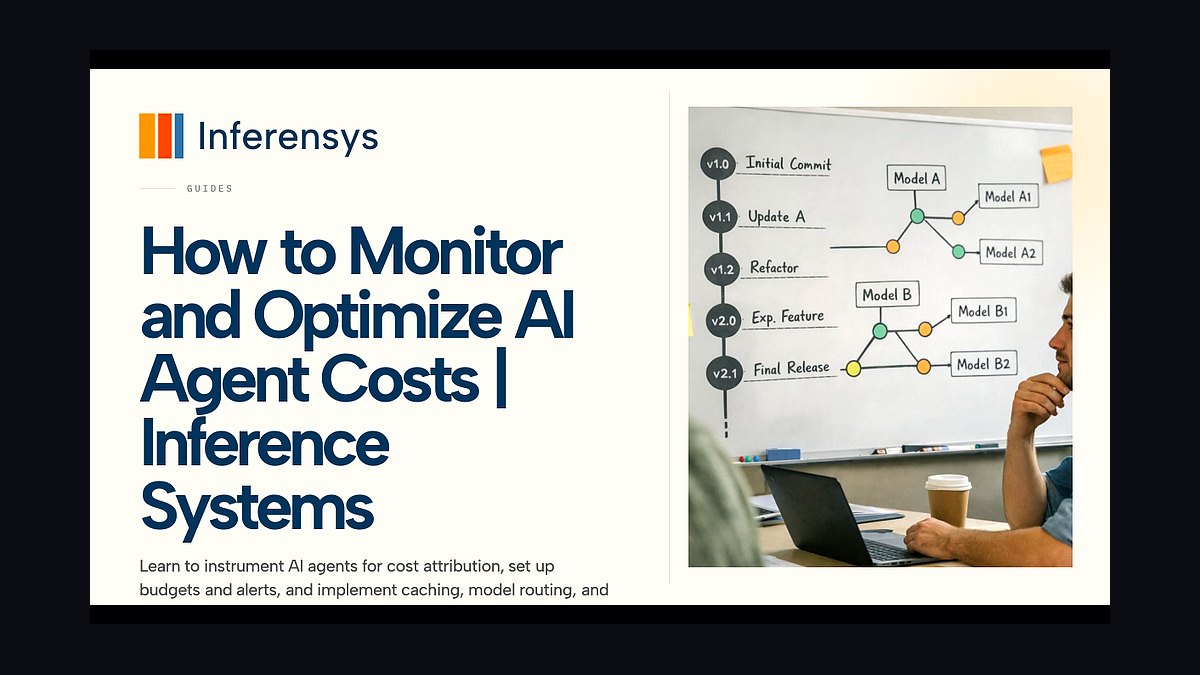
In 2027, LLM inference cost optimization runs on seven proven techniques: (1) prompt caching (50–90% input cost reduction), (2) model routing (route easy queries to cheaper models, hard queries to premium), (3) structured output mode (eliminates re-prompt retries), (4) batch inference (50% discount on Anthropic and OpenAI batch APIs), (5) quantization (FP8 or INT4 for self-hosted), (6) context trimming via retrieval re-ranking (cuts input tokens 60–80%), and (7) speculative decoding (faster generation without quality loss). Apply all seven and most production deployments cut LLM cost by 60–80% vs. naive single-model implementations.
1Prompt Caching
The single biggest cost lever in 2027. Anthropic, OpenAI, Google all support caching of repeated input prefixes.
- Anthropic caching: explicit
cache_controlmarkers; cached input at $1.50/M (10x cheaper than non-cached on Claude Opus 4.7). - OpenAI caching: automatic on prompts above 1024 tokens with identical prefix; 50% discount on cached tokens.
- Google Gemini caching: explicit cache API; 25% discount on cached tokens.
Pattern: put your system prompt and any static context (RAG-retrieved documents that repeat) at the start of every call. Mark them as cacheable. Vary only the user input at the end.

1.1 Real-World Savings
For a typical RAG system with stable system prompts:
- System prompt ~2K tokens (cached).
- Retrieved context ~10K tokens (some cached if from a hot document set).
- User query ~100 tokens (not cached).
Caching cuts input cost by 60–80%.
2Model Routing
Not every query needs Claude Opus or GPT-5. Route by complexity:

- Simple lookups, classifications, formatting: GPT-5o-mini ($0.30/M input), Gemini Flash 2.5 ($0.30/M), Claude Haiku 4.5 ($1/M).
- Standard generation, reasoning: Claude Sonnet 4.6 ($3/M input), GPT-5 ($5/M input).
- Hard reasoning, planning, complex code: Claude Opus 4.7 ($15/M input), GPT-5 with extended thinking, Gemini Pro 2.5 with
thinking_budget.
Tools: OpenRouter, LiteLLM, Portkey all provide routing with automatic fallback.

2.1 Complexity Classifier
For dynamic routing, run a cheap classifier model (Haiku, GPT-5o-mini) first to score complexity, then route accordingly. Adds 50ms latency, saves 40–60% on the average call.
3Structured Output Mode
Free-form text generation produces "off-format" responses that require retry. Structured output (JSON Schema enforcement) eliminates retries.
- Anthropic tool_use — first-class structured output.
- OpenAI
response_format: json_schema— strict JSON enforcement. - Google
responseSchema— Gemini structured output.

Pydantic + Instructor (Python) or Zod + LangChain (TypeScript) layer Pydantic/Zod schemas on top. Reject unstructured outputs immediately.
4Batch Inference
For non-realtime workloads (overnight analysis, bulk content generation), use batch APIs at 50% discount:
- Anthropic Batch API: 50% off, 24-hour SLA.
- OpenAI Batch API: 50% off, 24-hour SLA.
- Google Vertex Batch: 50% off, variable SLA.
Use for: weekly analytics, bulk eval runs, historical data backfill, content rewrite jobs.

5Quantization (for Self-Hosted)
For self-hosted Llama, Mistral, DeepSeek:
- FP8 (8-bit float) — default on Hopper/Blackwell hardware; minimal quality loss.
- INT8 (8-bit integer) — strong quality preservation; 2x memory reduction.
- INT4 / GPTQ / AWQ — 4x memory reduction; small quality loss; runs Llama 4 70B on a single H100.
- GGUF — CPU inference for edge deployments.
6Context Trimming via Re-Ranking
Stuffing 50K tokens of retrieved context into every prompt wastes money. Top-K retrieval + re-ranking reduces context to 3–5 truly relevant chunks (5–10K tokens).
- Cohere Rerank-3 — $1/1K queries.
- Voyage AI Re-Ranker — $0.05/1K queries.
- bge-reranker-v2 — open-source alternative.

Re-ranking cuts input tokens by 60–80% on most RAG workloads while improving answer quality.
7Speculative Decoding
Generate output tokens faster by using a smaller "draft" model to predict tokens, then verify with the main model. 2–3x latency speedup with no quality loss.
- vLLM supports speculative decoding out of the box.
- Anthropic and OpenAI have implemented internally; not user-facing.
- Medusa, EAGLE are research-leading speculative decoding methods.

Combined Impact
Apply all 7 techniques to a typical RAG application:
- Naive baseline: $50K/month at 10M queries.
- + Prompt caching: $30K/month (40% reduction).
- + Model routing: $18K/month (45% additional reduction).
- + Re-ranking (context trimming): $10K/month (45% additional).
- + Structured output: $8K/month (20% additional, mainly retry elimination).
- + Batch for non-realtime: $7K/month (10% additional).
Total: ~85% cost reduction vs naive baseline.
Production Monitoring & Cost Attribution
Even the most aggressive optimization techniques fail without granular visibility into where your inference budget is actually going. By 2027, mature LLM deployments treat cost monitoring as a first-class observability concern, not an afterthought. The standard approach involves per-request cost tracking using structured logging that captures model family, token count (split into prompt vs. completion), cache hit/miss status, model routing decision, and latency tier. Most teams instrument this via OpenTelemetry spans or custom middleware in their inference gateway (e.g., Envoy, Kong, or a purpose-built LLM proxy like Portkey or Helicone). The key metric to track is cost per resolved query, not just aggregate spend — this reveals whether your routing logic is actually sending cheap queries to cheap models or leaking expensive tokens on trivial tasks.

A practical pattern that emerged in late 2026 is budget-aware model selection. Instead of hard-coded routing rules, teams set per-user or per-feature budget caps (e.g., $0.002 per query for the auto-complete feature, $0.05 for the legal-drafting feature). The inference gateway then dynamically selects the cheapest model that can meet the quality threshold for that budget, falling back to a more expensive model only if the cheaper one fails a lightweight quality check (like a 50-token probe). This approach naturally handles traffic spikes and new model releases without manual reconfiguration. Expect to see 15–30% additional savings beyond static routing alone, purely from eliminating over-provisioning on easy queries.
Another critical but often overlooked practice is cost attribution by feature or customer. In multi-tenant SaaS products, some users or features drive disproportionate inference costs (e.g., long-document summarization vs. short chatbot replies). Tagging every request with a tenant ID and feature flag lets you build a cost-per-customer dashboard. This enables two things: first, you can identify and investigate anomalous cost spikes (e.g., a customer suddenly sending 10x more tokens due to a bug in their integration); second, you can make data-driven decisions about pricing tiers or feature gating. Teams that implement per-customer cost tracking report catching cost leaks within hours instead of weeks, saving an average of 8–12% of monthly inference spend purely from anomaly detection.

Hardware-Aware Deployment & Scheduling
Optimizing inference cost isn't just about model selection — it's also about where and when you run inference. In 2027, the hardware market offers several cost levers that teams routinely exploit. For self-hosted deployments, the dominant strategy is spot/preemptible GPU instances for non-latency-critical workloads. Most cloud providers (AWS, GCP, Azure) offer 60–80% discounts on spot instances, and LLM inference is often tolerant of interruptions if you implement a simple retry mechanism with a persistent queue (e.g., Redis or RabbitMQ). The trick is to separate your inference workload into two tiers: synchronous (latency-sensitive, uses on-demand instances) and asynchronous (batchable, uses spot instances). Many teams report 40–55% reduction in compute cost by routing all non-real-time inference (e.g., nightly report generation, background content moderation) to spot instances.
A more advanced pattern is multi-region inference with cost-aware routing. GPU pricing varies significantly by region — for example, US East (N. Virginia) might be 15–25% cheaper than US West (Oregon) for the same instance type, and Asia-Pacific regions can be 30–50% more expensive. By deploying model replicas in 2–3 low-cost regions and routing traffic based on both latency and cost, teams achieve 10–20% additional savings without sacrificing user experience. This requires a global load balancer (e.g., Cloudflare Workers or AWS Global Accelerator) that considers both network distance and current GPU pricing. Some teams even implement time-of-day scheduling: during peak business hours, they route to cheaper regions; during off-peak, they use spot instances in the closest region for lowest latency.
For organizations running their own GPU clusters, dynamic GPU allocation is a major change. Instead of dedicating GPUs to specific models, use a Kubernetes-based scheduler (e.g., Volcano or NVIDIA's MIG-aware scheduler) that pools GPUs and assigns them to inference pods based on real-time demand. This eliminates the "one model, one GPU" waste pattern. Combined with model warm-up caching (pre-loading popular model weights into GPU memory during idle periods), dynamic allocation can improve GPU utilization from typical 30–40% to 70–85%, effectively halving the per-request hardware cost. The upfront engineering effort is non-trivial (2–4 weeks for a skilled team), but the ongoing savings are substantial — often 30–50% reduction in total GPU spend.

Prompt Engineering for Token Efficiency
While the direct answer mentions prompt caching and context trimming, there's a deeper layer of cost optimization that lives entirely in how you structure your prompts. In 2027, the most cost-conscious teams treat prompt engineering as a token-budget discipline, not just a quality exercise. The core insight is that every input token costs money, and many common prompt patterns are unnecessarily verbose. For example, verbose system prompts like "You are a helpful assistant that responds concisely and accurately to user queries" can often be replaced with a single short instruction like "Concise answers only" — saving 10–15 tokens per request. Across millions of requests, that adds up to thousands of dollars monthly.
A systematic approach involves prompt compression through distillation. Instead of manually trimming prompts, teams use a small, cheap model (e.g., a 1B-parameter model or even a fine-tuned BERT variant) to compress the user's input before passing it to the expensive inference model. The compressor removes redundant phrases, condenses multi-sentence queries into single sentences, and strips out irrelevant context. Research from late 2026 shows that this technique reduces input token count by 40–60% with less than 2% degradation in output quality for most tasks (the compressor model costs pennies per thousand requests). The compressed prompt is then fed to the main model, which generates the final response. This is particularly effective for long-context tasks like document analysis or customer support ticket summarization.
Another powerful technique is dynamic instruction selection. Instead of always sending a full system prompt, maintain a library of pre-written, token-optimized instructions for different task types (e.g., classification, extraction, summarization, generation). At inference time, a lightweight classifier (again, a small model) selects the shortest instruction that matches the user's intent. For example, a user asking "Summarize this email" gets the 20-token summarization instruction, while "Write a poem about AI" gets the 15-token creative writing instruction. This replaces the common pattern of sending a 200-token omnibus system prompt that covers all possible tasks. Teams report 30–50% reduction in system prompt tokens with this approach, which translates directly to lower input costs, especially for high-volume applications like chatbots or content generation APIs.
FAQ
What is the most effective single technique for reducing LLM inference cost? Prompt caching typically delivers the biggest impact, cutting input token costs by 50–90%. It works by reusing cached results for identical or similar prompts, so you only pay for new or changed parts of the input.
Do I need to use all seven techniques to see significant savings? No, but combining at least three or four—like prompt caching, model routing, and batch inference—usually yields 60–80% cost reduction. A single technique alone might only save 20–40% depending on your workload.
Is model routing hard to implement in production? It requires a lightweight classifier or rule set to decide which queries go to cheap vs. expensive models. Many teams find it straightforward once they have logged a few thousand requests, and it can cut total cost by 30–50% without sacrificing quality on hard queries.
Does quantization hurt output quality for self-hosted models? FP8 quantization usually maintains quality within 1–2% of the full-precision model, while INT4 can degrade more on nuanced tasks. Testing on your specific use case is essential, but many production systems use FP8 with negligible quality loss.
How much can batch inference actually save compared to real-time? Batch APIs from providers like Anthropic and OpenAI offer roughly 50% discounts. The trade-off is latency—responses come back in minutes or hours instead of seconds—so it’s best for non-urgent tasks like data enrichment or nightly summarization.
What is speculative decoding and does it require special hardware? Speculative decoding uses a small draft model to predict tokens, which the large model then verifies in parallel. It speeds up generation by 2–3x without quality loss and runs on standard GPUs—no special hardware needed.
Bottom Line
LLM inference cost optimization in 2027 is a stack of seven techniques. Apply all of them and cut cost 60–85%. Prompt caching is the biggest single lever. Model routing is the smartest architectural decision. Skip cost optimization at your own peril — naive LLM deployments waste 5–10x more than disciplined ones.
Related on PULSE
- How do AI inference costs and AI product gross margins work in 2027?
- How does Snowflake handle the cost of Anthropic + OpenAI inference at scale?
- Top 10 questions to optimize a rep's email outreach templates
- How does NRR drive valuation in 2027 and how do you optimize for it?
- What's the relationship between CAC, MRR, and sales cycle length, and how do you optimize the trade-off?
- How do you detect LLM jailbreaks in production in 2027?
Sources
- Anthropic — Prompt Caching Documentation and Pricing
- OpenAI — Caching and Batch API Documentation
- Google — Gemini Context Caching Reference
- OpenRouter — Multi-Provider Routing Documentation
- LiteLLM — Multi-Provider Routing Reference
- Cohere — Rerank-3 Documentation
- Voyage AI — Re-Ranker Documentation
- vLLM — Speculative Decoding Documentation
- NVIDIA — TensorRT-LLM Quantization Reference
- Hugging Face — Quantization Library Reference
This page will be disappearing soon. Save it to your device for $1 — or read it free while it is here.
@Kory-White- · if Venmo asks, the last 4 of my number are 2012
This page is gone.
This one is off the shelf now. $1 keeps it on your phone for good — the whole page, pictures and diagrams included.
 revopsWhat are the LLM API provider selection criteria in 2027?
 revopsVector database benchmarks: which should you choose for production RAG in 2027?
 revopsHow do you select an embedding model for RAG in 2027?
 revopsWhat does the production LLM observability stack look like in 2027?
 revopsHow does the AI data center boom and its power-constraint economics work in 2027?
 revopsHow do you onboard a RevOps analyst in 2027?
 revopsHow do you write a RevOps charter that executives actually use in 2027?
 revopsHow do you align sales and customer success in 2027?
 revopsWhat skills should you hire for in a RevOps analyst in 2027?
 revopsWhy is annual comp planning being replaced by quarterly cycles in 2027?