


How much does a fractional CRO cost in 2027?
Quality
Certified

A fractional CRO in 2027 typically costs $8,000 to $25,000 per month on retainer, with most Series A–B engagements landing at $15,000–$20,000 for two to three days a week. Annualized, that is roughly $144,000 to $300,000 — against $700,000 to $1 million all-in for a full-time CRO.
The outcome you should expect when you sign the retainer
Price is the easy part of this question. The harder part is knowing what $18,000 a month actually buys you, because that is the number you will defend to your board in ninety days when someone asks whether the spend is working.
A fractional CRO is not a consultant who delivers a deck. They hold an operating seat: they own the revenue plan, run the forecast call, sit in on pipeline reviews, coach the VP of Sales, and carry a line item on the board deck. The "fractional" part describes their calendar, not their accountability. Two to three days a week is the standard commitment at the $15K–$20K band, and those days are usually fixed — Tuesday and Thursday, say — so the team knows when the leader is in the building and schedules the decisions that need them.
In the first thirty days, expect diagnosis rather than output. A competent operator spends that month pulling the CRM apart, interviewing every rep, reading the last four quarters of closed-won and closed-lost, and mapping where deals actually die. Many independents discount month one to $7,000–$10,000 specifically because it is a diagnostic month with no operating cadence yet. If someone promises a rebuilt pipeline in week two, they are selling you a template.
Months two through six are where the money earns out. The typical deliverable set: a rewritten qualification framework the reps can actually run, a comp plan that pays for the behavior you want instead of the behavior you inherited, a forecast process that produces a number the CEO can say out loud, a defined stage-exit criteria set in the CRM, and one or two key hires made. Somewhere in there the fractional will also fire someone, because the single most common finding in a revenue diagnostic is that a tenured rep or a well-liked manager is the constraint, and founders rarely act on that without cover.

Months seven through eighteen are transition. The good engagements are designed to end. The exit criterion is usually "hire and onboard the full-time revenue leader" or "sustain three consecutive quarters at 90%+ of forecast," and the fractional's last act is to hand the machine to whoever runs it next. Average engagement length runs twelve to twenty-four months, clustering around eighteen. Anything drifting past thirty months without a stated exit has quietly become a permanent part-time executive at part-time attention, which is the worst version of this arrangement.
What you should not expect: a closer. A fractional CRO at this price is not going to personally work your top ten accounts, and if they do, you are paying executive rates for individual-contributor labor and starving the team of the leadership you bought. A few engagements carve out an explicit exception — "will join executive-sponsor calls on deals above $250K" — and that is fine as long as it is written down. What kills engagements is the unspoken version, where the founder assumed the CRO would close and the CRO assumed they were there to build.
What actually drives the number inside the band
The $8K–$25K spread is wide enough that the band alone tells you almost nothing. Four variables move you inside it, and understanding them is the difference between negotiating and just accepting a quote.
Day commitment is the largest single lever and the most negotiable. Two days a week generally prices at $10K–$15K, three days at $15K–$20K, four days at $20K–$25K. Dropping from four days to three typically cuts the retainer 20–25%. Before you buy four days, be honest about whether your organization can absorb four days of executive attention — a company with six reps and no marketing function cannot, and you will be paying for a leader who spends Thursday afternoons inventing work.
Operator pedigree is the second lever and the least negotiable. Someone stepping up from a VP of Sales role prices at $8K–$15K. An operator who has held the CRO title at a Series B or C company prices at $15K–$22K. Someone who ran revenue at a public company, with hundreds of reps and a real quota-carrying org underneath them, commands $20K–$25K and up, and generally will not discount, because the scarcity is real. This is verifiable — LinkedIn history, Pavilion member profiles, and reference calls with two former CEOs will tell you within an hour whether the pedigree matches the price.

Deal motion and ACV shift the band 15–25%. SMB and transactional motions price at the bottom because the playbook is standardized and the sales cycle is short enough to iterate weekly. Mid-market lands in the middle. Enterprise and complex product-led-growth hybrids price at the top, because the operator has to navigate six-plus stakeholders per deal, longer cycles that punish bad decisions for two quarters, and the kind of qualification discipline that only comes from having run it before.
Team maturity cuts both directions. If you already have a functional VP of Sales, a marketing lead, and a customer-success owner, the fractional CRO is orchestrating existing pieces — lower band, fewer days. If you are greenfield with no GTM leadership at all, they are building from nothing: higher band, more days, and a longer engagement. Counterintuitively, the cheapest-looking company to serve is often the most expensive to fix.
Geography still matters, though less than it did. Operators based in San Francisco or New York quote roughly 10–20% above secondary markets, but remote-default work has compressed that gap considerably since 2025. Do not pay a coastal premium for someone who will never be in your office.
Scope creep is the hidden cost driver, and it is the one that shows up in month five rather than in the contract. A $15K retainer scoped for strategic oversight quietly becomes $22K of work when the CRO ends up running every pipeline review, managing two direct reports who were supposed to be someone else's, and personally handling the renewal conversation with your largest account. Write the boundaries into the SOW — number of standing meetings, named direct reports, explicit exclusions like "no direct deal ownership without written pre-approval" — and revisit them at ninety days rather than renegotiating under pressure.
The five structures the money moves through
Retainer is the default, but it is not the only shape, and picking the wrong one is how companies end up paying market rate for a mismatch.
Monthly retainer covers the large majority of engagements: a flat $8,000–$25,000 billed monthly against an agreed day commitment. Firms in the SMB space commonly land at $10K–$15K; independents and networks serving Series A–B SaaS cluster at $15K–$25K. The retainer normally excludes travel pass-throughs and third-party tool licenses, which matters more than founders expect — see the hidden-cost section below.

Day rate runs $2,500–$5,000 per day and exists for scoped, finite work: a ten-day comp-plan rebuild before the fiscal year turns, a fifteen-day board-prep sprint, thirty days of interim coverage while you search for the permanent hire. Many operators quote day rate and retainer side by side in the same proposal, which is a good sign — it means they have thought about whether you actually need an ongoing seat.
Hourly at $350–$750 exists but is a signal worth reading. True fractional CRO work does not decompose cleanly into billable hours, because most of the value is in decisions that happen between meetings. If someone quotes hourly, you are usually buying an advisor — one weekly call, opinions on demand, no operating ownership. That can be exactly right for a company that already has a competent VP of Sales and just needs a sounding board. It is not the same product, and it should not cost the same.
Equity-heavy structures serve cash-constrained pre-Series-A companies: an advisory grant in the 0.25%–1.0% range, typically with a one-year cliff and multi-year vest, paired with a reduced cash retainer of $5,000–$10,000. The grant is deliberately larger than a standard advisor slug (0.1%–0.25%) because the work is operational rather than advisory. Two cautions. First, run the dilution math at your expected next round, not at today's cap table — 0.75% feels cheap until you model it against a $60M post. Second, understand that equity alignment cuts both ways: an operator with meaningful upside will push harder on the things that create enterprise value, which is usually good, and occasionally means they want to change your pricing model in month four.
Performance-tied deals pair a base retainer of $8K–$15K with a success fee — a fixed bonus on a financing close, a percentage of net new ARR above plan, a quarterly payment for hitting forecast within a defined band. These are excellent when the KPI is clean and the CRO genuinely controls it. They go wrong when the metric is downstream of things the CRO cannot influence, like a product launch slipping two quarters or a founder who will not approve headcount. If you go this route, write the KPI so precisely that a stranger could calculate the payment from your reporting without a conversation, and define what happens to the fee if the engagement ends mid-quarter.
One structure worth naming because it keeps appearing: the pilot. Run three months at day rate — eight to twelve days total, so $20,000–$60,000 — before committing to a retainer. You get a real diagnostic, the operator gets to see whether your organization can actually execute, and both sides find out about fit before anyone is locked into a twelve-month term. Many independents require a ninety-day minimum on retainers anyway, so a day-rate pilot is often the cheaper way to buy the same look.
Benchmarks, realistic ranges, and the number your CFO will ask for

The cleanest anchor in this market is a percentage of next-twelve-month ARR. Budget 1–3% of NTM ARR for the fractional CRO's cash retainer, and you will land inside the market in almost every case.
Run it. A $5M ARR company targeting $7M should expect roughly $50,000–$150,000 a year — $4,000–$12,000 a month, the SMB and low-mid band. A $10M ARR company targeting $15M sits at $100,000–$300,000, or $8,000–$25,000 a month, which is exactly the Series A–B sweet spot. A $20M company can support $200,000–$400,000, though by then the conversation is usually shifting toward a full-time hire. Above 3% of NTM ARR, the spend gets hard to defend against the alternative: promote a strong internal director, pair them with a board-level advisor at $3K–$5K a month, and spend the difference on two more reps.
Most Series A/B companies I would expect to land at $180,000–$240,000 a year, all-in, including a modest success-fee pool of $20,000–$50,000 tied to milestones. Add $5,000–$10,000 of onboarding — CRM cleanup, playbook build, the first thirty days of discovery — and plan for $45,000–$75,000 of cash out before you see anything that looks like ROI. That last number is the one founders underestimate, and it is why the ninety-day pilot exists.
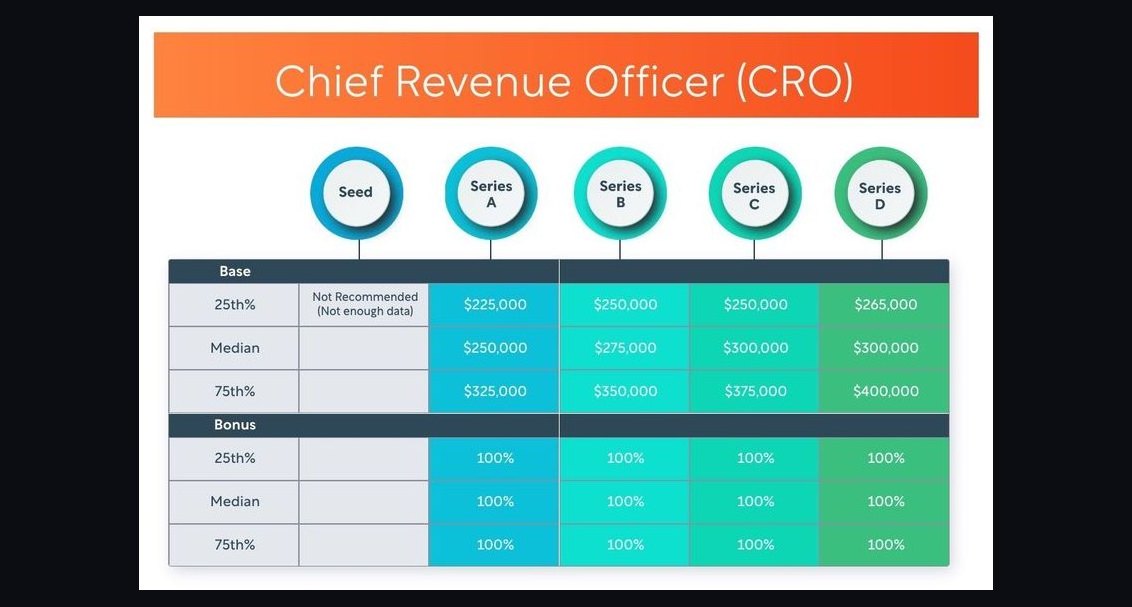
The full-time comparison is where the fractional case gets made or lost. A full-time CRO at Series B and beyond runs roughly $400,000–$550,000 base with a target bonus of $200,000–$300,000, plus equity typically in the 1.0%–2.0% range over four years, plus benefits and payroll load of roughly $60,000. Then the costs nobody puts in the offer letter: an executive recruiter fee at 25–30% of first-year OTE, which is $150,000–$200,000 for a single hire, a severance reserve the board will expect at six to twelve months of OTE, and the opportunity cost of a ninety-to-one-hundred-eighty-day search during which nobody owns the number. Year one all-in lands at $700,000 to $1 million. The fractional equivalent, retainer plus optional advisory equity, lands at $150,000–$310,000 — a 40–60% reduction against a genuinely comparable scope, with zero recruiting exposure and thirty-to-sixty-day termination instead of a severance negotiation.
Where does full-time win? Above roughly $30M–$40M in ARR, the math flips. At that scale the CRO needs to be in every customer dinner, every board call, every escalation, and every leadership one-on-one. Bandwidth becomes the binding constraint rather than judgment. If you scaled a fractional operator's day rate to five days a week, you would exceed the loaded full-time number anyway — the fractional model is cheap precisely because you are buying a fraction. It stops being cheap the moment you need all of it.

Terms to expect from independents: three-month minimum, thirty-to-sixty-day notice on either side, a discounted first month, and either month-to-month or quarterly renewal after the minimum. Firms are generally less flexible on terms and slightly more consistent on delivery, which is the trade you are making. A six-to-twelve-month commitment typically earns a 10–15% discount from an independent; firms rarely discount for term.
Risks, edge cases, and the failure modes that waste the money
The most common way a fractional CRO engagement fails is not that the operator is bad. It is that the company was not in a position to use one.
Product-market fit is not actually there. A fractional CRO can build a repeatable motion around a product people want. They cannot manufacture demand for a product that has not found its buyer. If your win rate is under 10%, your churn is over 30% annually, and every closed-won deal came through a founder relationship, you have a product problem wearing a sales problem's clothes. Hiring a revenue leader to fix it costs $200,000 and buys you two quarters of expensively-instrumented confirmation that the problem is upstream. Spend the money on customer research instead.
The founder will not actually delegate. This is the quiet killer. A founder who has closed every deal personally for four years hires a CRO and then keeps taking the inbound calls, overriding pricing on the fly, and promising custom work in demos. The CRO builds a process; the founder routes around it; the reps learn that the real path to a deal runs through the founder. Six months and $120,000 later, nothing has changed. If you are the founder reading this, the honest test is whether you are prepared to lose a deal you think you could have saved, in order to let the process prove itself. If the answer is no, wait.
The scope was never written down. Covered above, but it belongs on the failure list too. Undefined scope is how a strategic engagement becomes an expensive interim VP of Sales role, and it is how the operator ends up frustrated and the founder ends up feeling overcharged, both with reasonable grounds.
Fractional-executive stacking. A pattern worth flagging because it has become common: a company runs a fractional CRO, a fractional CFO, and a fractional CMO simultaneously, each at $10K–$18K a month. That is $360,000–$650,000 a year of part-time executives with no full-time peer to coordinate them, all reporting to a founder who now spends most of their week in leadership meetings. Occasionally this works — usually when the fractionals have worked together before. More often it produces three excellent functional plans that contradict each other on headcount, pricing, and timing. If you are stacking, name one of them as the coordinating seat and pay for the extra day it requires.

Availability mismatch. Two days a week means two days. A crisis on Wednesday waits until Thursday. Most fractional CROs carry two to four concurrent clients — that is the business model, and an operator claiming exclusivity at $15K a month is either lying or about to have a cash-flow problem. Ask directly how many engagements they hold and whether any of them are in your competitive space. Ask what their escalation path is when something breaks on an off day. A good answer sounds like "text me and I'll call you within two hours." No answer at all is the risk.
Institutional knowledge walks out. When the engagement ends, the CRO takes the context with them unless you deliberately capture it. Build the handoff into the contract: documented playbooks in your own systems, CRM configuration you own and understand, a written operating cadence, and thirty days of overlap with whoever comes next. The tell that this is going badly is a CRO whose critical process lives in their personal spreadsheets rather than in your stack.
Data and RevOps debt eats the first quarter. This is the most predictable cost overrun in the entire category. A fractional CRO cannot forecast on a CRM where stages mean different things to different reps, close dates are set by habit, and half the opportunities have no amount. The first four to eight weeks routinely get spent on RevOps hygiene that nobody budgeted for, and that work often requires a person the CRO does not have — a RevOps analyst at $6,000–$12,000 a month contract, or an internal ops hire. Budget for it, or the diagnostic month stretches into a diagnostic quarter and you burn $50,000 before anyone touches a deal.
Interaction with your existing sales leader. If you have a VP of Sales already, a fractional CRO sits above them, and that is a conversation the VP deserves to have before the contract is signed rather than after. Sometimes it goes well and the VP gets the coaching they have never had. Sometimes the VP reads it — correctly — as a signal that they were not going to get promoted, and starts a job search. Either outcome is survivable. Discovering it in month three is not.
A practical rollout plan for the first hundred and eighty days

Treat the engagement like any other significant operational change: staged, instrumented, and reversible at defined points.
Weeks minus-four to zero — scoping and selection. Write the problem statement before you talk to anyone. Not "we need a CRO," but "our forecast has missed by more than 20% for three straight quarters and we do not know why." Source three to five candidates through a network, a firm, or the Pavilion member directory, and interview them against that statement. Ask each to describe the first thirty days specifically; the answers separate operators from packagers immediately. Take two references per finalist, and make one of them a CEO whose engagement ended — how someone exits tells you more than how they start. Negotiate day commitment first, term second, price third; price mostly follows from the first two.
Days 1–30 — diagnostic. No new initiatives. The operator interviews every rep and every GTM-adjacent leader, audits the last four quarters of pipeline data, listens to recorded calls, sits in on live deals without intervening, and reads every closed-lost note. Deliverable at day thirty is a written diagnostic: where deals die, which stages are fictional, what the real conversion rates are, and a ranked list of three things to fix. Pay the discounted rate this month if the operator offers it. Gate: if the diagnostic reads like generic best practices rather than findings specific to your business, stop here. That is a cheap $10,000 lesson.
Days 31–90 — fix the two things that matter. Two, not seven. Usually that means qualification discipline plus forecast process, or comp plan plus stage definitions. This is also where the RevOps cleanup lands, and where you should expect the CRM to change in ways that annoy the team. Weekly forecast call now runs to a fixed agenda with the CRO facilitating. Gate at day ninety: is forecast accuracy improving, is pipeline coverage measurable and trending, and can each rep articulate the qualification framework without looking it up? If all three are no, have the hard conversation now rather than at renewal.
Days 91–180 — build and hire. With the process stable, attention shifts to people. Key hires get made — usually a sales manager, sometimes a RevOps analyst, occasionally the first enterprise rep. Underperformers get managed out on a defined timeline. The CRO starts transferring the operating cadence to internal owners rather than running it themselves, which is the single best leading indicator that the engagement will end well. Gate at day one-eighty: name the exit criterion out loud and put a date on it. "Full-time VP of Sales hired and onboarded by month twelve" or "three consecutive quarters within 10% of forecast." Without a stated criterion, you are on a permanent retainer and neither party will admit it.
Ongoing — measure the thing you bought. Track four numbers monthly and put them on one page: forecast accuracy versus actuals, pipeline coverage ratio against plan, win rate by segment, and sales cycle length. Those four move before ARR does, and they are how you know at day ninety whether a number you will not see until day two-seventy is going the right way. Attributing ARR growth directly to the CRO is mostly theater; attributing process improvement is not.
Hidden costs, real savings, and where the budget actually lands

The retainer is not the invoice. Two line items catch founders regularly.
Travel and expenses. If the operator visits your office monthly, attends the sales kickoff, or joins a customer offsite, budget $500–$2,000 a month. Most retainers explicitly exclude this. Cap it in the contract rather than approving it ad hoc.
Tooling. A fractional CRO will want conversation intelligence, forecasting, and sequencing infrastructure — and if you do not have it, they will ask for it. That is another $1,000–$3,000 a month depending on seat count, and it is a real cost of the engagement even though it stays on your books after the operator leaves. Some of it is genuinely necessary; some of it is preference. Ask which tools they consider non-negotiable versus nice-to-have, and make them defend the difference.
RevOps support. Discussed above, worth restating as a budget line: $6,000–$12,000 a month if you need contract analyst support, or an internal hire if the debt is structural.
On the other side of the ledger, the savings are larger and more certain than the costs. No recruiter fee — that alone is $150,000–$200,000 avoided. No benefits load, roughly $30,000–$50,000 a year. No severance exposure, which for a full-time CRO is a six-to-twelve-month liability that boards increasingly insist on reserving against. No ramp: a fractional operator is producing findings in week two rather than week twelve, because they have done the diagnostic dozens of times and know exactly which four questions separate a pipeline problem from a pricing problem.
Net it out honestly and a fractional CRO costs 40–60% less than the full-time equivalent on comparable scope, while carrying a fraction of the downside if it does not work. For a company growing 30–50% year over year, where the right revenue leader eighteen months from now may not be the right one today, that optionality is often worth more than the per-day rate premium. You are paying for judgment applied on the days it is needed, not for a seat that has to be filled every day whether or not there is a decision to make.
One last framing that helps in board conversations: compare the retainer to the cost of the mistake it prevents. A misaligned comp plan at a twenty-rep organization misallocates seven figures of selling effort in a year. A forecast that is wrong by 25% two quarters running costs a board's confidence and, sometimes, a round's terms. Against that, $200,000 a year for someone who has fixed both problems before is not an expense line. It is the cheapest insurance available on the number that determines everything else.
Related questions

Is a fractional CRO the same as an interim CRO?
No. Interim means full-time coverage for a defined gap, usually while a search runs — five days a week, three-to-six months, priced closer to full-time pro-rata. Fractional means permanent part-time attention over a longer horizon. Interim covers a seat; fractional builds a machine.
At what ARR should I hire full-time instead?
Roughly $30M–$40M ARR, or earlier if the role requires constant presence — heavy field sales, frequent customer escalations, or a board that wants the revenue leader in every conversation. Below that, the fractional model usually delivers the same judgment for 40–60% less all-in cost.
Can a fractional CRO also fix my RevOps stack?
They can direct it, not staff it. Most will define the CRM architecture, stage definitions, and reporting requirements, then need an analyst to implement. Budget $6,000–$12,000 a month for contract RevOps support, or expect the first quarter to be consumed by cleanup.
What is a fair notice period?
Thirty to sixty days on either side, after an initial three-month minimum. Anything longer than ninety days on the client side is unusual and worth pushing back on. Mutual notice matters — a one-sided clause tells you how the operator thinks about the relationship.
Should the fractional CRO carry a quota?
Generally no. Quota-carrying pulls an executive into individual deals and away from the system work you hired them for. A milestone-based success fee tied to forecast accuracy or net new ARR above plan gets you alignment without turning a $20,000-a-month operator into your most expensive rep.
FAQ

What exactly does a fractional CRO do for $8,000–$25,000 per month?
They hold the revenue operating seat part-time: owning the plan, running the forecast cadence, defining qualification and stage criteria, rebuilding comp, coaching or replacing the sales leadership layer, and presenting revenue to the board. They are not closing deals. Scope varies most on whether they are building a GTM function from nothing or optimizing one that already exists, and that distinction is what moves the price within the band more than anything else.
How do I know whether I need a fractional CRO or a full-time hire?
If your ARR sits between roughly $1M and $20M and you cannot justify $700,000–$1M all-in for a full-time executive, fractional is usually correct. It also fits when you need senior judgment for a specific transition — Series A to B, a motion change, a segment expansion — rather than permanent presence. The trade is availability: two to three days a week means your team has to execute in between, so you need enough internal bench to carry the other days.
Can I negotiate an equity-heavy or performance-tied deal?
Yes, particularly pre-Series A. Common shapes are a reduced cash retainer of $5,000–$10,000 plus a 0.25%–1.0% advisory grant, or a base of $8,000–$15,000 plus a success fee on a defined milestone. Performance structures need a KPI the CRO genuinely controls and a written calculation method — otherwise you are building a dispute into month nine. Run the dilution math at your expected next round, not today's cap table.
How long do fractional CRO engagements typically last?
Twelve to twenty-four months, averaging around eighteen. That is enough time to build a repeatable motion, make the core hires, and reach a milestone like a Series B raise or a stretch of accurate forecasting. Shorter three-to-six-month engagements exist for scoped projects — a comp rebuild, interim coverage — but you will pay day rate rather than retainer for that flexibility, which works out more expensive per day.
What should I ask for in the first thirty days to know it is working?
A written diagnostic specific to your business: where deals actually die by stage, real conversion rates versus what the CRM reports, findings from rep interviews, and a ranked list of the three things to fix first. If what comes back reads like generic best practices you could have found in a blog post, stop the engagement there. That is a $10,000 lesson rather than a $200,000 one.
What hidden costs should I budget beyond the retainer?
Travel and expenses at $500–$2,000 a month if there is any on-site component, tooling at $1,000–$3,000 a month for conversation intelligence and forecasting infrastructure, onboarding at $5,000–$10,000 for CRM setup and playbook creation, and contract RevOps support at $6,000–$12,000 a month if your data hygiene is poor. Assume $45,000–$75,000 of total cash out before you see measurable return.
Sources
- https://www.saasacademy.com/
- https://www.bridgegroupinc.com/
- https://openviewpartners.com/expansion-saas-benchmarks/
- https://www.salesxceleration.com/
- https://chiefoutsiders.com/
- https://winningbydesign.com/
- https://www.forcemanagement.com/
- https://www.saas-capital.com/research/
- https://www.bls.gov/ooh/management/top-executives.htm
- https://hbr.org/topic/subject/sales
Related on PULSE
- How Much Does a Fractional CRO Cost?
- How do I hire a fractional CRO for a B2B SaaS company in 2027?
- Should I Hire a Fractional CRO If I Am Taking the Company to Market in a Year?
- Should I Hire a Fractional CRO If My Forecast and Actuals Never Match?
- Should I Hire a Fractional CRO If I Want a Revenue Audit Before I Commit Budget?
- Should I Hire a Fractional CRO If My Reps Are Great Hunters but Poor Farmers?
This page will be disappearing soon. Save it to your device for $1 — or read it free while it is here.
@Kory-White- · if Venmo asks, the last 4 of my number are 2012
This page is gone.
This one is off the shelf now. $1 keeps it on your phone for good — the whole page, pictures and diagrams included.
 revopsCRO compensation — fractional, full-time, equity in 2027
 revopsBest fractional CRO firms in 2027
 revopsWhat does a fractional CRO do in the first 90 days in 2026?
 revopsWhat's the ROI of a fractional CRO in 2027?
 revopsWhen should you hire a fractional CRO in 2027?
 revopsWhat is a fractional CRO in 2027?
 revopsHow to evaluate a fractional CRO — 15 interview questions in 2027
 revopsFractional CRO vs full-time CRO — which should you hire?
 revopsSigns you need a CRO (not just a VP of Sales)
 revopsFractional CRO vs fractional VP of Sales — what's the difference?