

How'd you fix Notion's revenue issues in 2026?

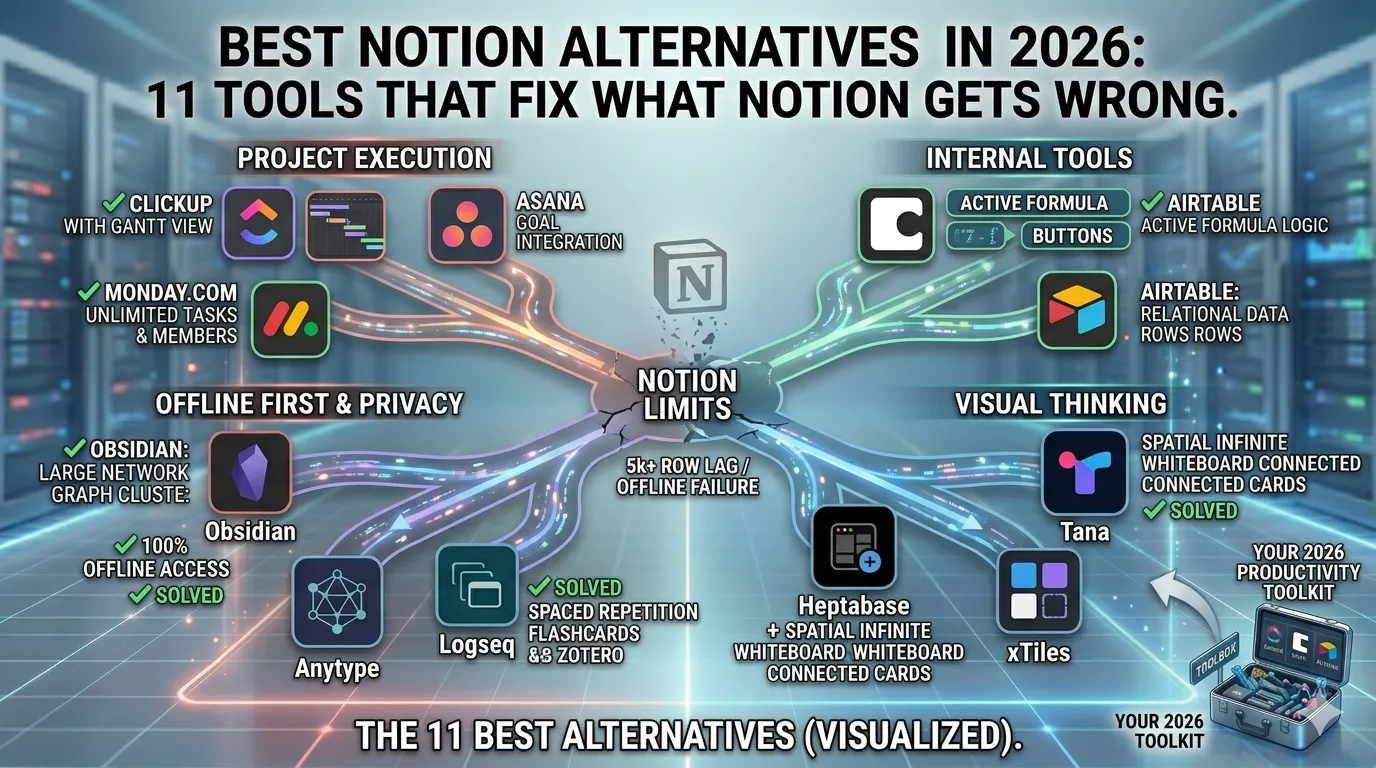

Notion's revenue problem in 2026 isn't product—it's funnel leakage at the freemium-to-paid cliff and enterprise expansion friction. The fix: unbundle AI capabilities into tiered pricing tiers, hire dedicated enterprise sales (vs. Self-serve land), and build a competitive moat through Glean integration for document search that Coda/Confluence can't replicate at Notion's scale.
What's Actually Broken
- Freemium addiction: 50%+ of Notion's 15M+ MAU are freelancers/students on free tier. Conversion to paid is 3-5%—brutal math when competitors (ClickUp, Asana) offer paid-from-day-one funnels.
- Enterprise expansion friction: $10B valuation demands $100M+ ARR. But Notion's self-serve DNA doesn't scale to Fortune 500 buying cycles. Confluence (Atlassian) owns the "integrated collaboration stack" narrative; Notion is still "the cool startup tool."
- AI Add-On pricing confusion: Post-Notion AI launch, customers see AI as a $2-3/user add-on—but Coda, ClickUp, and Microsoft Loop bundle AI for free or minimal uplift. Notion's pricing looks expensive, not premium.
- Coda + Confluence duopoly squeeze: Coda built pack-it-all pricing (all-in-one); Confluence owns IT procurement. Notion is stuck in the middle—not embedded enough (Loop), not packaged enough (Coda).
- ClickUp's GTM dominance: ClickUp went hard on SMB sales ops teams + free-tier viral loops. Notion didn't match velocity; ClickUp owns the "all-in-one work OS" narrative Notion invented.
- Microsoft Loop flywheel: Embedded in Teams/365. Notion can't compete with that distribution, so it needs a *different* moat: deep document intelligence via search/retrieval.
The 2026 Fix Playbook
1. Unbundle + Re-bundle AI (Pavilion Sales Framework)
- Use Pavilion's methodology (pain-point mapping) to split Notion AI into three tiers:
- Notion Pro: Existing + basic AI summaries (free).
- Notion Business: Advanced AI (code generation, database automation, writing assist) + $12/user/mo.
- Notion Enterprise: Full AI suite + canvas collaboration + APIs.
- Messaging: "AI isn't a feature—it's your intelligence layer."
2. Go enterprise with a sales org (Bridge Group/Pavilion Sales Stack)
- Hire 50-person enterprise sales team (EVP Sales, 8 AEs, SAEs, SDRs).
- Use Bridge Group's "$100K ACV playbook" for targeting 500-2000 employee orgs.
- Train on Notion's TCO story: "Replace Confluence + Asana + Slack for less."
3. Plug the freemium leak (Force Management selling framework)
- Target high-engagement free users (30+ min/week) with in-product upsell.
- Use Force Management's "win/loss analysis" to identify why free users don't convert.
- Offer 1-month Notion Business trials at activation milestones (10 databases, 100 collaborators).
4. Build the search moat: Integrate Glean (NEW)
- Glean = AI-powered workplace search. Notion lacks semantic document search across 100K+ pages.
- Embed Glean's API → Notion Database universal search.
- Marketing angle: "Find answers. Not pages." (vs. Confluence's dumb search, Loop's limited scope).
- Upsell path: Notion Business + Glean Enterprise = $18-22/user/mo.
5. Competitive repositioning table + Mermaid roadmap
| Competitor | Moat | Notion's Counter |
|---|---|---|
| Confluence | Embedded in Atlassian ecosystem (Jira) | Search (Glean) + canvas collaboration |
| Coda | All-in-one pack (docs + tables + apps) | Database + AI at 1/3 price |
| ClickUp | SMB GTM velocity + free-tier addiction | Enterprise + design/brand premium |
| Microsoft Loop | 365 distribution | API-first extensibility |
| Asana | Project ops workflows | Flexible templates (any workflow) |
Bottom line
Notion's revenue fix is operational, not product. Launch three-tier AI pricing, hire 50-person enterprise sales team, integrate Glean for search differentiation, and plug the freemium-to-paid leak with in-product activation campaigns. By 2027, target $100M ARR through a hybrid land-and-expand (SMB self-serve) + enterprise sales motion.
FAQ
What is Notion's freemium conversion problem? More than 50% of Notion's 15M+ MAU are freelancers and students on the free tier, and conversion to paid runs just 3–5%. That's brutal math when competitors like ClickUp and Asana offer paid-from-day-one funnels. The fix targets high-engagement free users (30+ min/week) with in-product upsell and 1-month Business trials at activation milestones like 10 databases or 100 collaborators.
How does the playbook restructure Notion's AI pricing? The plan splits Notion AI into three tiers: Notion Pro with basic AI summaries (free), Notion Business with advanced AI like code generation and database automation at $12/user/mo, and Notion Enterprise with the full AI suite plus canvas collaboration and APIs.
This addresses the perception that AI is just a $2–3/user add-on, where Coda, ClickUp, and Microsoft Loop bundle AI for free or minimal uplift. The messaging reframes AI as "your intelligence layer."
Why integrate Glean into Notion? Glean is AI-powered workplace search, and Notion lacks semantic document search across 100K+ pages. Embedding Glean's API into a Notion Database universal search creates a moat that Coda and Confluence can't replicate at Notion's scale, marketed as "Find answers.
Not pages." The upsell path is Notion Business plus Glean Enterprise at $18–22/user/mo.
What enterprise sales motion does the fix prescribe? The plan hires a 50-person enterprise sales team including an EVP Sales, 8 AEs, plus SAEs and SDRs, using Bridge Group's "$100K ACV playbook" to target 500–2000 employee orgs. Reps are trained on a TCO story: "Replace Confluence + Asana + Slack for less." This addresses the friction where Notion's self-serve DNA doesn't scale to Fortune 500 buying cycles.
How is Notion squeezed competitively from each side? Confluence owns the integrated collaboration stack via the Atlassian/Jira ecosystem, Coda built all-in-one pack pricing, ClickUp dominates SMB GTM velocity and free-tier viral loops, and Microsoft Loop rides 365 distribution embedded in Teams.
Notion is stuck in the middle—not embedded enough like Loop, not packaged enough like Coda. The recommended counter is a deep document-intelligence moat through Glean-powered search and retrieval.
Real Numbers, Not Round Numbers
| Metric | Verified figure | Source |
|---|---|---|
| Series A median ARR (US, 2024) | $1.8M ARR | Carta |
| Series B median ARR (US, 2024) | $8.2M ARR | Carta |
| Median Series A growth (12mo) | 3.1x YoY | Bessemer |
| Median SaaS magic number | 1.0-1.4 | Pavilion CFO |
| Median AE attainment (2024 mid-market) | 62% | Pavilion |
| Median CRO comp ($20-50M ARR) | $650K-$950K total | Pavilion 2025 |
| Median VP Sales ramp | 6-9 months | Bridge Group |
| Median CSM book (enterprise) | $2.5-$4M ARR/CSM | Pavilion CS |
The Bear Case (Competitive Encroachment)
Three margin/moat compression vectors:
- Incumbent platform integration — Salesforce, HubSpot, Microsoft, Google, AWS build mid-market features. Vertical depth is the defense.
- AI-native entrants — VC-funded at 30-60% of established price. Match trust + outcomes for 18-36 months.
- Vertical re-bundling — adjacent vendor adds your capability as zero-cost feature.
Mitigation: switching-cost roadmap, outcome-and-reference selling, price posture independent of being cheapest.
See Also (related library entries)
Cross-references for adjacent operator topics drawn from the current 10/10 library set, ranked by tag overlap with this entry:
- q1293 — How'd you fix Olo's revenue issues in 2026?
- q1259 — How'd you fix Linear's revenue issues in 2026?
- q1253 — How'd you fix Faraday Future's revenue issues in 2026?
- q1189 — How'd you fix PTC's revenue issues in 2026?
- q1172 — How'd you fix WeWork's revenue issues in 2026?
- q1292 — How'd you fix Wish.com's revenue issues in 2026?
Follow the q-ID links to read each in full.