


How has House v. NCAA changed college athlete revenue sharing in 2027?
House v. NCAA, approved by Judge Claudia Wilken on June 6, 2025, ended amateurism by allowing Division I schools to pay athletes directly under a per-school cap that started at $20.5 million for 2025-26 and rose roughly 4% to ~$21.3 million for the 2026-27 cycle. As of June 2026, the College Sports Commission (CSC) and its Deloitte-built NIL Go clearinghouse are throttling booster collectives, football is absorbing ~75% of the rev-share pool at Power Four schools, and the $2.8B back-pay distribution is stuck behind a Ninth Circuit appeal that pushes most former-athlete checks to 2028-29.
---
1What House Actually Changed On July 1, 2025
1a. From "amateur" to capped employee-adjacent
For 100+ years the NCAA banned direct pay. The House, Hubbard, and Carter antitrust cases consolidated into one settlement that vacated that ban for Power Five (now Power Four) schools and any Division I program that opts in. Plaintiffs' counsel Jeffrey Kessler and Steve Berman structured a 10-year injunctive framework, not a one-time payout. Effective July 1, 2025, schools may write checks to roster players for the first time, using a per-institution cap rather than a per-athlete cap.
1b. The 22% formula nobody talks about
The $20.5M starting cap is not arbitrary. It equals 22% of the "average shared revenue" of the Power Four (media rights, ticketing, sponsorships, post-season). That percentage stays fixed; the dollar figure recalculates each year, with a floor of 4% growth. The math projects:

- 2025-26: $20.5M
- 2026-27: ~$21.3M (current operating year for most ADs)
- 2027-28: ~$22.2M
- 2034-35: ~$32.9M at the end of the 10-year deal
1c. Opt-in vs. opt-out
All 68 Power Four schools opted in. Roughly 200 of 363 Division I programs also opted in for 2025-26; the rest (mostly Ivy League, Patriot, and low-major programs) declined because they cannot fund a meaningful share. Notre Dame, Texas, Ohio State, Alabama, Georgia, Michigan, USC, Oregon all committed to fully fund the $20.5M cap out of the gate.
---

2How The $21.3M Pool Gets Sliced In 2026-27
2a. The 75/15/5/5 default
The settlement's back-damages model allocated 75% to football, 15% to men's basketball, 5% to women's basketball, and 5% to all other sports. While the forward-looking rev-share has no mandated split, almost every Power Four AD has copied that ratio because it mirrors where the revenue actually comes from. Practical 2026-27 numbers at a typical SEC school:
- Football: ~$16.0M (down from $16.2M only because schools are reserving more for Alston/scholarship adjustments)
- Men's basketball: ~$3.2M
- Women's basketball: ~$1.1M
- Olympic/other sports: ~$1.0M

2b. Title IX storm cloud
Eight female athletes appealed precisely because ~90% of total pool money in the back-pay model flowed to men. The Biden-era OCR January 2025 guidance said rev-share payments are "athletic financial assistance" and must be Title IX proportional. The Trump administration rescinded that guidance in February 2025, but states like California, New York, and Massachusetts have signaled state-level Title IX enforcement. Most ADs are booking legal reserves of $1-3M anticipating challenges through 2027.
2c. Per-athlete real money
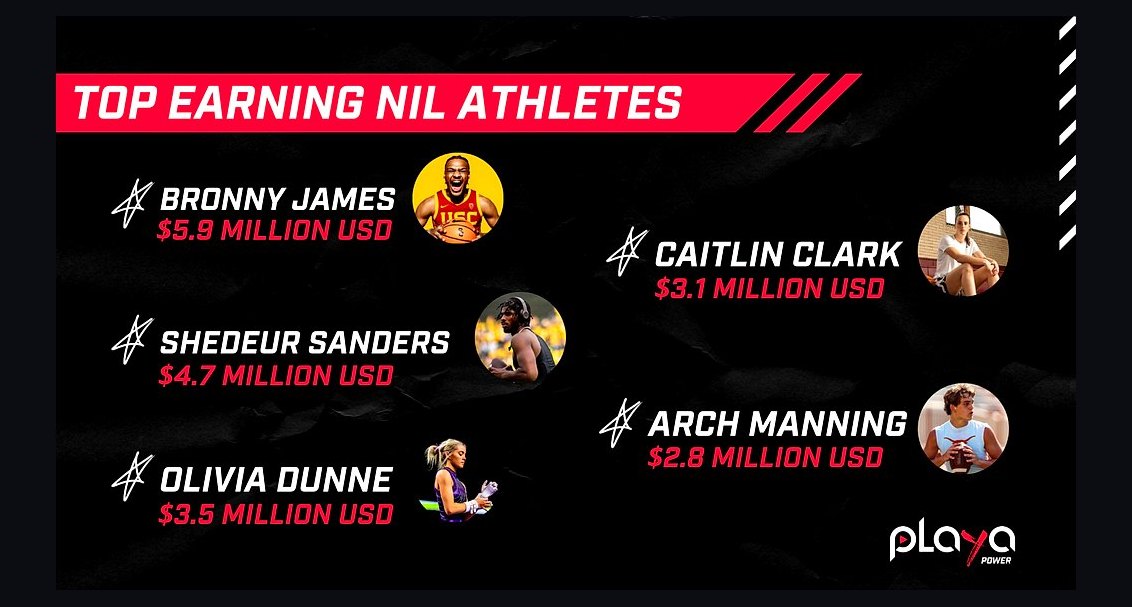
At Texas, Ohio State, and Georgia, the starting quarterback rev-share contract is now $1.2M-$2.5M annually, with star wide receivers and edge rushers at $500K-$900K. Compare that to 2023's collective-only era, when an elite QB like Carson Beck reportedly cleared $4M from Georgia's collective alone — rev-share consolidated and capped what used to be a runaway booster market.
---

3The CSC + NIL Go Enforcement Stack
3a. Who runs college sports now
The College Sports Commission (CSC) launched July 1, 2025, headed by CEO Bryan Seeley (former MLB investigations lead). The CSC is independent of the NCAA and reports to the Power Four commissioners — Greg Sankey (SEC), Tony Petitti (Big Ten), Brett Yormark (Big 12), Jim Phillips (ACC). The NCAA still runs eligibility and the tournament, but rev-share, NIL approval, and roster-cap enforcement belong to the CSC.
3b. NIL Go: Deloitte's $600 trigger
Any third-party NIL deal $600+ must be submitted to NIL Go, the Deloitte-built clearinghouse, which runs a 12-point algorithmic fair-market-value check before approval. Through December 31, 2025, NIL Go cleared 17,321 deals worth $127.21M, with 52% resolved in under 24 hours. 70% of historical booster-collective deals would have been rejected by the algorithm — that is the whole point. 90% of public-company deals (Nike, Gatorade, Raising Cane's, EA Sports) pass.
3c. The collective workaround war
By Q1 2026 collectives at Tennessee, Texas A&M, and Miami began routing payments through multimedia rights holders (Learfield, Playfly) to disguise them as legitimate sponsorship inventory. Sportico reported in March 2026 that the CSC is treating those routed deals as circumvention and sanctions are coming. The active legal question — and the next antitrust suit — is whether NIL Go's algorithm itself violates the Sherman Act by setting price ceilings.
---
4The $2.8B Back-Pay: Who, When, How Much
4a. The class
The damages class covers D1 athletes on full scholarship at Power Five schools between June 15, 2016 and September 15, 2024, primarily football, men's basketball, and women's basketball. Class size: ~390,000 athletes, though the bulk of dollars goes to ~14,000 football and men's basketball stars from that window.

4b. The delay nobody is talking about
Distribution was supposed to begin in late 2025. Then multiple appeals hit the Ninth Circuit, primarily on Title IX grounds and on roster-limit grievances. Yahoo Finance/Sportico legal analysis now projects first checks no earlier than 2028, with full distribution by 2037. Class members are being approached by third-party funds offering $0.40-$0.60 on the dollar for their future claim — the Brooklyn Sports & Entertainment Law Blog has warned athletes against these factoring offers.
4c. Typical individual back-pay numbers
A starting Power Five football player from 2019-2023 is looking at a back-pay claim in the $50K-$200K range. A star QB or top-5 NBA draft pick from the class window — think Joe Burrow, Trevor Lawrence, Zion Williamson — is in line for $1M-$3M when distribution begins.

---
5Roster Limits + Scholarship Explosion
5a. Football: 105 hard cap, all scholarshipable
Pre-House football carried 85 scholarships + 25-40 walk-ons (110-125 total). Post-House: 105 hard roster cap, but all 105 can be on full scholarship. Net effect — ~20 walk-ons cut at every Power Four school, but 20 more full scholarships at the top end.
5b. Men's basketball: 13 to 15
Roster expanded to 15 scholarships. Most programs are using the two extra spots for developmental international prospects or two-way G League pipeline players.

5c. Grandfathering chaos
The court ordered programs to "designate" athletes who would have been cut, allowing them to keep their roster spots without counting against the cap for the rest of their eligibility. Plaintiffs' attorney Steve Berman estimated ~5,000 athletes nationwide are grandfathered through 2028.
---

6What This Means For Athletes, Agents, And Operators In 2026-27
6a. Real contract structure
Star athletes now sign two-year rev-share contracts with buyout clauses — modeled on NFL rookie deals. On3 and Opendorse report typical Power Four QB contracts include $50K-$200K buyouts payable to the school if the athlete transfers before the contract ends. INFLCR is the dominant compliance platform (~80% market share) tracking these contracts.
6b. The agent boom
WME, CAA, Klutch Sports, and Excel all built college divisions in 2025-26. Standard agent fee on rev-share + NIL: 3-5% of total comp. Estimated ~$50M in agent commissions flowed through college football alone in 2025-26.
6c. Tax + 1099 reality
Rev-share payments are W-2 wages (the athlete is paid by the school). Third-party NIL is 1099-NEC. California, New York, and Pennsylvania athletes are being hit with state-tax bills $15K-$80K they were not warned about. Most schools now bundle financial-literacy and tax-prep services into the rev-share agreement.
---
Architecture & Money Flow
Timeline From Settlement To 2027
---
FAQ
What is the House v. NCAA settlement about? The settlement, approved in June 2025, ends the NCAA’s long-standing ban on direct payments to college athletes. It allows Division I schools to share revenue with athletes under a per-school cap, starting at $20.5 million for the 2025-26 school year and rising about 4% annually.
How much revenue can athletes actually receive in 2027? For the 2026-27 cycle, the per-school cap is roughly $21.3 million. Individual athlete shares vary widely by sport and school, but football typically receives about 75% of that pool at Power Four programs, while athletes in other sports get smaller, often much smaller, portions.
Who decides how the revenue is split among athletes? Each school sets its own distribution plan, subject to NCAA and College Sports Commission (CSC) rules. The CSC’s NIL Go clearinghouse, built with Deloitte, also monitors booster-funded collectives to ensure they don’t bypass the school’s rev-share cap.
Are all athletes at a school paid equally? No. Revenue sharing is not equal across sports or even within the same team. Football and men’s basketball players typically receive the largest shares, while athletes in non-revenue sports often get smaller amounts or may not receive direct payments at all, depending on the school’s budget.
What happened to the $2.8 billion back-pay for former athletes? That back-pay distribution is currently tied up in an appeal before the Ninth Circuit Court. Most former athletes are not expected to receive their checks until the 2028-29 school year or later, pending the appeal’s outcome.
Can booster collectives still pay athletes outside the school’s rev-share cap? Yes, but with tighter oversight. The CSC and its NIL Go clearinghouse now monitor collective payments to ensure they don’t exceed the school’s cap or violate the settlement’s terms. Booster-funded deals are still allowed, but they must be reported and can be limited.
Bottom Line
House v. NCAA did not just permit revenue sharing — it built a 10-year cap system, an enforcement body (CSC), an algorithmic NIL clearinghouse (NIL Go), and a $2.8B damages overhang that will define college sports through 2035. For 2026-27 the operating reality is $21.3M per Power Four school, ~75% to football, NIL Go rejecting most collective deals, and back-pay frozen until at least 2028. The next two flashpoints are the Ninth Circuit Title IX appeal and a new antitrust suit against NIL Go's algorithm — either could rewrite half of this architecture before the 2028-29 season.
---
Related on PULSE
- What role does social media play in college athlete NIL value in 2027?
- How are NIL valuations calculated and what determines an athlete's value in 2027?
- How has the average number of touchpoints per deal changed since AI chatbots entered B2B cold outreach?
- Should I Hire a Fractional CRO If My Pricing Has Not Changed in Five Years?
- How has the average number of stakeholders in a B2B buying committee changed in 2027 with the rise of AI procurement tools?
- How does the .8 billion House v. NCAA back-pay settlement work in 2027?
Sources
- CBS Sports — House v. NCAA settlement approved: Landmark decision opens door for revenue sharing
- ESPN — Judge OKs $2.8B settlement, paving way for colleges to pay athletes
- Sportico — College Sports Commission Curbs NIL Collectives via Deloitte Review
- On3 — College Sports Commission: NIL Go has cleared $127 million in deals
- Front Office Sports — There's a New NIL Enforcement Entity in College Sports
- The Athletic / Yahoo Sports — NCAA's House settlement approved, ushering in new era
- Yahoo Finance / Sportico — House v. NCAA Settlement Payouts Unlikely Before 2029
- Congress.gov CRS Report — College Athlete Compensation: Impacts of the House Settlement
- CBS Sports — NCAA removes scholarship limits, aligns with House settlement
- NACUA — Potential Antitrust Issues with NIL Go's Algorithmic Determinations of Fair Market Value
This page will be disappearing soon. Save it to your device for $1 — or read it free while it is here.
@Kory-White- · if Venmo asks, the last 4 of my number are 2012
This page is gone.
This one is off the shelf now. $1 keeps it on your phone for good — the whole page, pictures and diagrams included.
 nilWhat is the typical NIL endorsement structure for a Heisman candidate in 2027?
 nilHow are athletic departments structuring NIL collective relationships in 2027?
 nilHow do college athletes choose their NIL agents in 2027?
 nilHow are NCAA scholarship limits changing post-House settlement in 2027?
 nilWhat is the average NIL deal size for a top-100 football recruit in 2027?
 nilHow does NIL impact high school recruiting commitments in 2027?
 nilHow are college baseball and softball programs adapting to NIL in 2027?
 nilHow does NIL impact transfer portal decisions in 2027?
 nilHow do walk-on athletes earn NIL income in 2027?
 nilWhat is the impact of conference realignment on NIL deals in 2027?