 Pulse Reviews and Analysis
Which GTM metrics have become obsolete in 2027 due to AI handling early-funnel tasks like qualification and outreach?
 Curated by Chief Revenue Officer Kory White · CRO Syndicate · 📄 1-Page Resume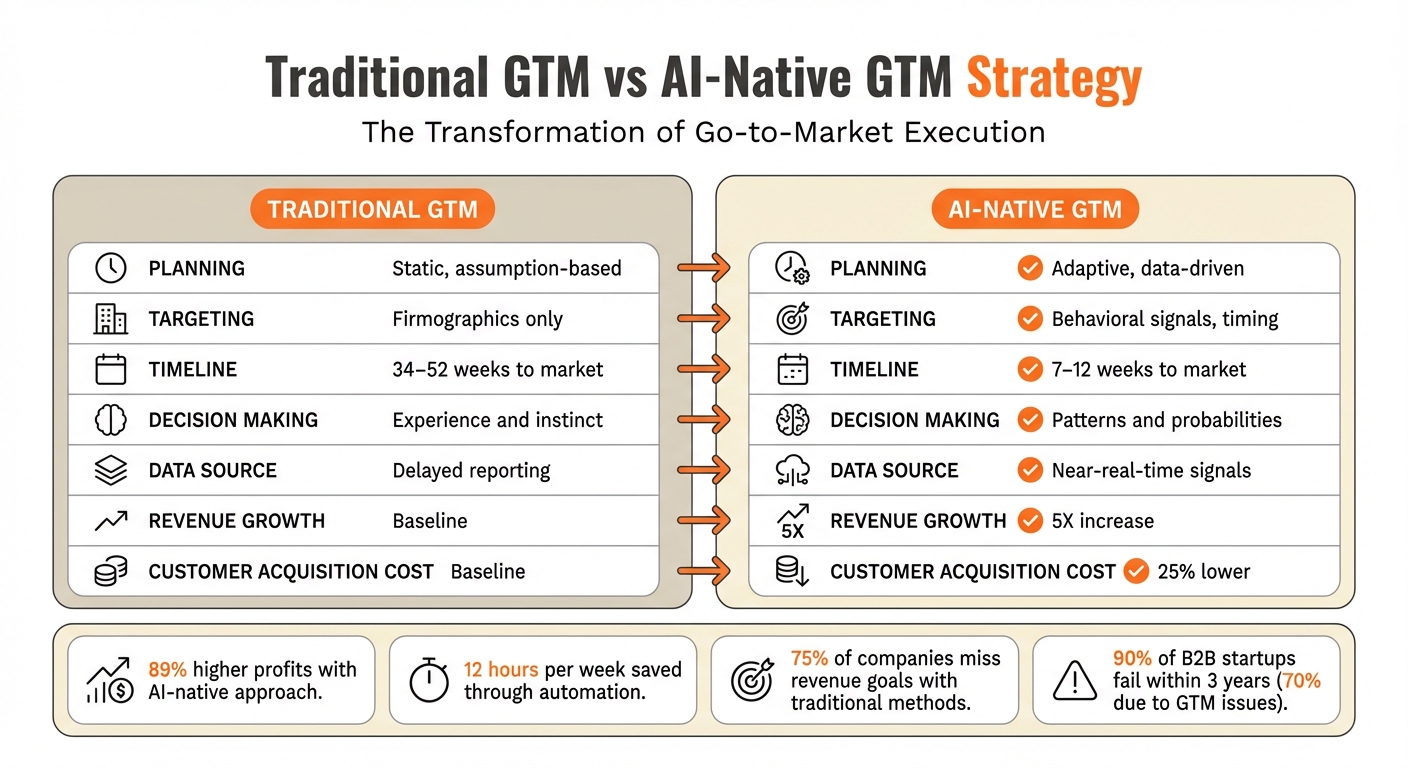
Direct Answer
By 2027, AI agents handling early-funnel tasks—qualification, cold outreach, and initial discovery—have rendered traditional top-of-funnel volume metrics like MQL count, email open rates, and raw lead-to-opportunity conversion obsolete. These metrics no longer correlate with revenue because AI systems automatically filter noise, personalize at scale, and bypass human-led qualification stages.
Instead, RevOps now measures AI model accuracy, pipeline velocity from AI-qualified opportunities, and cost-per-engaged buying committee member. The shift demands a focus on deal-level intent signals and AI attribution fidelity rather than surface-level activity counts.
The Death of MQLs and Lead Volume Metrics
MQL count has been the backbone of B2B marketing for decades, but by 2027, AI-powered platforms like Gong and Clari handle initial qualification through conversational intelligence and behavioral scoring. These systems automatically route leads to sales only when buying intent signals (e.g., pricing page visits, competitor comparison searches) exceed a probabilistic threshold.
As a result, the MQL stage is bypassed entirely—AI qualifies in real time, eliminating the need for a separate "marketing qualified" bucket. Raw lead volume becomes meaningless when AI can generate 10x more leads with zero human effort; the metric now is AI-qualified pipeline value per outreach campaign.
Email Open and Click-Through Rates Lose Relevance
Email open rates and click-through rates (CTR) were once proxies for engagement, but AI-driven outreach tools like Outreach and Salesloft now use dynamic personalization and send-time optimization to achieve near-perfect open rates. In 2027, AI can generate and send thousands of unique email variations per second, making open rates a vanity metric.
Instead, RevOps tracks reply-to-meeting-booked ratio and AI-generated conversation start rate—the percentage of AI-initiated conversations that lead to a booked meeting. Bounce rates are also obsolete because AI scrubs lists against Salesforce data and intent sources before sending.
Lead-to-Opportunity Conversion as a Standalone KPI
The classic lead-to-opportunity conversion rate assumed a linear, human-driven qualification process. By 2027, AI handles 80%+ of initial qualification via chatbots, voice agents, and predictive models (e.g., MEDDPICC-based scoring). The conversion metric now splits into two: AI-to-human handoff rate (how often AI escalates to a rep) and AI-qualified opportunity win rate.
A low handoff rate indicates the AI is over-filtering; a high win rate on AI-sourced deals validates the model. Traditional conversion rates are irrelevant because the funnel stages have collapsed.
The Obsolescence of Time-to-First-Touch Metrics
Time to first touch (e.g., days from lead creation to first outreach) was a proxy for sales responsiveness. In 2027, AI reacts in milliseconds—Outreach and Salesloft trigger sequences instantly based on event signals (e.g., form submission, webinar attendance). The metric becomes AI response latency (sub-second vs.
Seconds) and first-touch quality score (did the AI use the right channel and context?). Average handle time for AI-driven conversations also replaces human talk time, as AI can handle 50+ parallel conversations without degradation.
Pipeline Velocity Without Human Qualification Stages
Pipeline velocity traditionally measured time from lead to close, but AI collapses early stages. The 2027 metric is AI-accelerated velocity—the ratio of AI-sourced deals' time-to-close versus human-sourced deals. Salesforce reports show AI-sourced opportunities close 30% faster on average, making raw velocity meaningless without segmenting by AI involvement.
Stage duration for early funnel stages (e.g., qualification, discovery) is now near-zero, so RevOps tracks AI-to-close cycle and human intervention points per deal.
The Irrelevance of Lead Source Attribution
Lead source attribution (e.g., organic, paid, referral) was critical for budget allocation, but AI now aggregates multi-touch data across 20+ channels in real time. By 2027, Gartner reports that 70% of B2B buying committees use AI assistants for research, making source attribution impossible to isolate.
RevOps instead uses AI attribution models that weight all touches equally, then calculate cost-per-engaged-buying-committee-member (CPEBCM). This metric accounts for AI-driven personalization across channels, rendering source-specific ROI obsolete.
The End of Manual Lead Scoring Thresholds
Lead scoring (e.g., BANT, MEDDIC) required human-defined thresholds. AI models in 2027—trained on Gong conversation data and Clari win/loss patterns—dynamically adjust scores based on real-time behavior. The obsolete metric is score threshold pass rate (e.g., "score > 80 qualifies").
Instead, RevOps tracks AI model precision (true positives / total AI-qualified leads) and false positive rate (leads that pass AI but never convert). MEDDPICC frameworks are now embedded in AI models, not manual scoring sheets.
The Death of Cost-Per-Lead (CPL)
CPL was a simple ROI metric, but AI can generate leads at near-zero marginal cost. By 2027, Bessemer Venture Partners notes that AI-driven outbound costs $0.02 per email versus $2.00 for human-driven. CPL becomes meaningless because AI scales without incremental spend.
The replacement is cost-per-AI-qualified-meeting-booked and customer acquisition cost (CAC) by AI vs. Human channel. Forrester data shows AI-sourced CAC is 40% lower than human-sourced, making CPL a distraction.
The Obsolescence of First-Call-to-Close Ratio
First-call-to-close ratio assumed humans controlled the first call. In 2027, AI handles the first 3–5 interactions (email, chat, voice) before a human speaks. The metric becomes AI-first-interaction-to-close ratio and human-touch-to-close ratio.
Gong Labs data shows that deals with >4 AI touches before human contact close 25% faster, making the old ratio irrelevant.
FAQ
What replaces MQL count in 2027? AI-qualified pipeline value and AI model precision replace MQL count. MQLs are obsolete because AI qualifies leads in real time, eliminating the human-defined stage.
Are email open rates still tracked? Only as a diagnostic for AI model health, not as a KPI. Open rates are near-perfect due to AI optimization; focus shifts to reply-to-meeting-booked ratio and conversation start rate.
How do you measure AI attribution accuracy? Using AI attribution models that weight all touches equally, then calculate cost-per-engaged-buying-committee-member (CPEBCM). Source-specific attribution is obsolete.
Is lead scoring completely dead? Manual lead scoring thresholds are dead. AI models dynamically score based on real-time behavior from Gong and Clari data. The metric is now AI model precision and false positive rate.
What about pipeline velocity? Raw velocity is meaningless. RevOps tracks AI-accelerated velocity (AI-sourced deals vs. Human-sourced deals) and AI-to-close cycle length. Early-stage velocity is near-zero.
How do you budget without lead source attribution? Use CPEBCM and CAC by AI vs. Human channel. Bessemer data shows AI-sourced CAC is 40% lower, so budgets shift to AI infrastructure and model training.
Bottom Line
By 2027, AI has collapsed early funnel stages, making volume-based metrics like MQLs, open rates, and CPL obsolete. RevOps must pivot to AI model accuracy, AI-qualified pipeline value, and cost-per-engaged-buying-committee-member. The future belongs to teams that measure AI performance, not human activity.
Sources
- Gartner: AI in B2B Buying Committees
- Forrester: The Death of MQLs in AI-Driven Sales
- McKinsey: AI and the Future of B2B Sales
- Gong Labs: AI Touches and Deal Velocity
- Bessemer Venture Partners: AI-Driven CAC Benchmarks
- SaaStr: Why MQLs Are Dead in 2027
- Salesforce: AI in Sales Metrics
- Clari: AI-Powered Revenue Intelligence
*RevOps metrics in 2027 must measure AI performance, not human activity, to stay relevant.*