 Pulse Reviews and Analysis
How Do I Design a Lead-Routing SLA Across Global Time Zones in 2027?
 Curated by Kory White · Fractional CRO, CRO Syndicate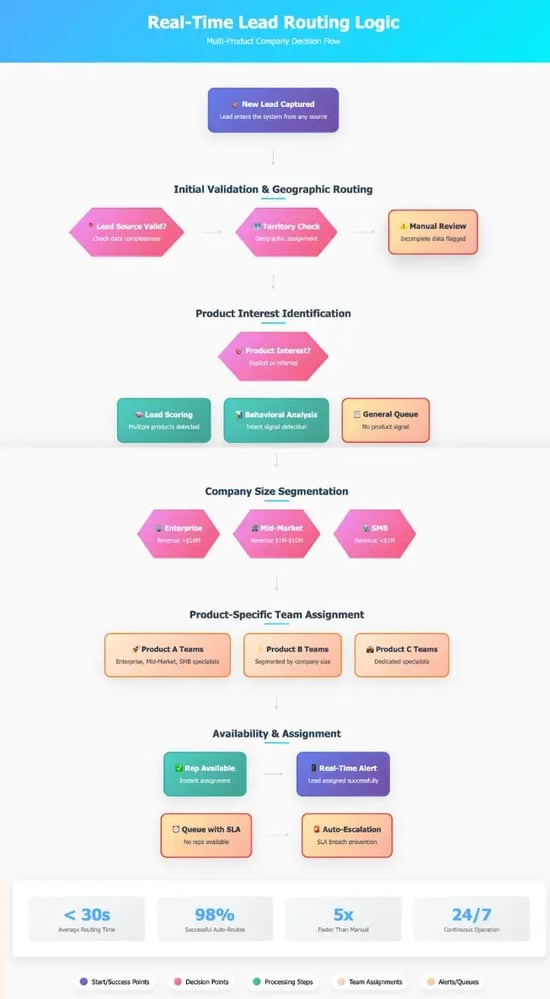
Direct Answer
To design a lead-routing SLA across global time zones in 2027, define speed-to-lead targets in business hours local to the lead, not your headquarters, and route each lead to a rep who is awake, in-territory, and qualified to handle it — with an automated fallback chain when no one is available.
The core mistake is a single global SLA ("respond in five minutes") that quietly fails overnight, so a lead that arrives at 3 a.m. In your HQ time zone sits for hours while a competitor in the lead's region responds first. The fix is a routing engine that knows the lead's geography and language, the coverage windows of each regional team, and a follow-the-sun handoff so coverage passes between regions.
Pair that with capacity-aware assignment, an after-hours path (AI agent or queue), and per-region SLA reporting so you can see where the clock is actually being met.
Why a Single Global SLA Breaks
Speed-to-lead is one of the most durable predictors of win rate: the faster you respond, the more likely you are to connect and qualify before a competitor. But a one-size SLA measured in HQ time creates a structural blind spot. Leads arriving outside HQ business hours — which, for a global pipeline, is a large fraction — either breach the SLA or get a token auto-reply that does not advance the deal.
Worse, a rep in the wrong time zone may be assigned a lead they cannot work for ten hours, freezing it.
The 2027 answer treats the globe as a set of coverage windows and routes to whoever can actually act now, in the lead's language and region.
Build the Routing Model on Geography and Coverage
Start by capturing, on every lead, the data routing needs: country/region, time zone, language, and segment. Then map your teams to coverage windows — when each regional team is online. The router's job is to match a lead to a rep who is (a) in-territory or language-matched, (b) currently in business hours, and (c) under capacity.
Define the SLA in the lead's local business hours. "Respond within X minutes during the lead's business day" is enforceable worldwide; "respond within X minutes, always" is not.
Follow-the-Sun and Fallback
For truly global coverage, implement follow-the-sun: as one region's day ends, unworked leads and live queues pass to the next region coming online. Where a region has no team, use a fallback chain:
- AI responder — an autonomous agent acknowledges and begins qualification instantly, any hour, then books or hands off.
- Overflow queue — leads hold for the next in-region team opening, with the SLA clock measured from their business-hours start.
- Escalation — high-value or high-intent leads can break glass to an on-call rep.
Capacity and Fairness
Routing must respect capacity and fairness so no rep is buried while another idles. Use round-robin within a region with weighting for capacity, and guardrails against cherry-picking (reps skipping low-value leads). Tie this back to territory rules so the right owner gets the right account.
Tooling that supports this includes LeanData or Distribution Engine for routing logic, Salesforce or HubSpot for the lead record and ownership, an AI responder (e.g., conversational agents that qualify after hours), and a BI layer for per-region SLA dashboards.
The routing rules should live in one governed place, not scattered across point automations.
Measure Per-Region, Not Just Globally
A single global average hides regional failure. Report speed-to-lead and SLA attainment by region and by hour of day, so you can see exactly where coverage gaps live and staff or automate against them. Track the after-hours fallback's conversion separately to prove it is earning its keep.
Governing the Routing Rules in One Place
Global routing breaks most often not because the logic is wrong but because it is scattered. When time-zone rules live in one tool, territory rules in another, and after-hours fallbacks in a third automation nobody documented, no one can reason about why a given lead went where it did, and fixing a coverage gap means hunting across systems.
The discipline is to keep the routing model — geography, language, coverage windows, capacity weighting, fallback chain, and SLA definitions — in one governed place with a single owner in RevOps. Document the rules in plain language, version changes, and test routing against sample leads from each region whenever you change them.
A single source of routing truth makes the system auditable: when a regional leader asks why their team is overloaded or starved, you can show the exact rule and adjust it deliberately, rather than discovering that two automations were quietly fighting over the same leads.
Common Pitfalls
- SLA in HQ time. Guarantees overnight breaches for global leads.
- Assigning to sleeping reps. Freezes leads for hours; route to who is awake.
- No after-hours path. Leaves a large share of global leads unworked until morning.
- Global-only reporting. Hides regional coverage gaps behind an average.
- Ignoring language fit. A fast response in the wrong language still loses the lead.
FAQ
Should the speed-to-lead SLA be the same worldwide? The *target* can be consistent, but it must be measured in the lead's local business hours, not HQ time, so it is actually achievable across regions.
How do I cover time zones where I have no team? Use a follow-the-sun handoff to the nearest covering region, plus an AI responder that acknowledges and begins qualifying instantly until a human is available.
What lead data does global routing require? Country or region, time zone, language, and segment at minimum, so the router can match leads to an awake, in-territory, language-appropriate rep under capacity.
How do I stop reps from cherry-picking leads? Use weighted round-robin within regions and routing guardrails that prevent skipping, tied to territory ownership rules.
How should I report routing performance? By region and hour of day, not as a single global average, so coverage gaps are visible and you can staff or automate the weak windows.
Sources
- LeanData and Distribution Engine — lead routing and SLA enforcement documentation.
- InsideSales / XANT and Harvard Business Review — speed-to-lead response-time research.
- Salesforce — lead assignment, territory management, and Einstein documentation.
- HubSpot — lead rotation and routing workflow documentation.
- Drift / Qualified — conversational and AI-responder qualification documentation.
Related on PULSE
- How do you measure speed-to-lead and why does it still decide win rate in 2027?
- What round-robin routing rules prevent rep cherry-picking in 2027?
- How do you build a lead-to-account matching model in 2027?
- How Do I Deploy AI SDRs and Autonomous Outbound Agents Safely in 2027?
- Explore the Pulse Tools library for a lead-routing SLA template.