
Is ServiceNow CRM good enough to replace Salesforce Service Cloud in 2027?
 Curated byKory White · Fractional CRO · Maryland
 PULSEKNOWLEDGE LIBRARY
Quality
Certified

For B2B enterprise service tied to IT, product, or operational workflow, ServiceNow CRM can replace Salesforce Service Cloud — especially where ServiceNow ITSM already runs. For high-volume B2C contact centers, marketing-triggered service, or Sales Cloud cross-sell motions, it cannot. The deciding factor is where your resolution data actually lives.
What ServiceNow CRM is and why the question matters now
ServiceNow has sold Customer Service Management (CSM) since 2017, but CSM was positioned as a bolt-on for companies that already lived in the platform — a way to route customer-reported issues into the same incident and problem tables that IT used. The CRM positioning is newer and much more aggressive: ServiceNow is now explicitly pitching itself as the system of record for B2B customer service, sales engagement, and order management, and it names Salesforce Service Cloud as the incumbent it intends to displace. That reframing is what turned a niche module comparison into a genuine RevOps platform decision.
The technical substance behind the pitch is the workflow data layer. When a customer service case opens in ServiceNow, the agent can see the configuration item from the CMDB, the open ITSM incident affecting that customer's environment, the change request that likely caused it, the HR case for the account team, and the contract entitlement — without an integration, because those all live in adjacent tables on the same instance. Salesforce solves the same problem with Data Cloud and MuleSoft: it can absolutely reach that data, but it reaches it as an ingested copy or a federated query, not as a native join. For an incident-shaped service case, that difference is the whole ballgame.
Salesforce's advantage is the mirror image. Service Cloud sits next to Sales Cloud's account, contact, and opportunity objects, next to Marketing Cloud journeys, next to Commerce order data, and next to Slack. When a case is about a purchase, a billing dispute, a loyalty tier, a campaign response, or a renewal risk signal that the AE needs today, Salesforce holds that context natively and ServiceNow has to import it. Neither vendor has a general-purpose answer here — each has a data gravity, and the gravity determines the fit.

Why this matters to a RevOps team rather than just IT: service platform choice quietly determines whether your customer health signal, your churn-risk telemetry, and your expansion triggers land in the same system as your pipeline. If service moves to ServiceNow and pipeline stays in Salesforce, someone has to own the reverse sync of case volume, CSAT, escalation counts, and entitlement burn back into the account record — or your CS and AE teams will operate on two different versions of the customer. That integration ownership is the real cost of a split, and it rarely appears on the licensing comparison slide.
The other reason the question is live in 2026 is bundling. ServiceNow's top-tier platform licensing packages CRM alongside ITSM, ITOM, and HR service delivery, which means for an existing large ServiceNow customer the incremental cost of trying CRM is far lower than the cost of adding a comparable Salesforce Service Cloud footprint. That's not a product argument, it's a procurement argument — but procurement arguments win a lot of platform decisions, and any honest evaluation has to treat the bundle as a real variable rather than a footnote.
The evaluation and migration process, step by step
A credible replacement evaluation is not a feature bake-off. Feature grids make ServiceNow CRM and Service Cloud look nearly identical, because at the checkbox level they are: both do case management, queues, SLAs, knowledge bases, self-service portals, omnichannel routing, and AI-assisted summarization. The differentiation shows up only when you test real tickets, so the process has to start with your ticket mix rather than the vendor's demo script.

Step one: classify a real ticket sample. Pull 500 to 1,000 closed cases from the last two quarters and tag each by what actually resolved it. Categories that matter: infrastructure or product defect, configuration change, entitlement or contract question, billing or invoice dispute, purchase or upgrade request, account administration, and how-to. Then compute what share of resolutions required data that lives in an ITSM/CMDB-shaped system versus a CRM/commerce-shaped system. In practice, teams find a bimodal split — most orgs come out clearly over 60% on one side. If your sample lands genuinely mixed at 45/55, the answer is almost certainly a hybrid rather than a replacement, and you should stop evaluating "which one" immediately.
Step two: map the integration surface you would inherit. List every downstream system that reads from Service Cloud today — the data warehouse, the CS platform, the billing system, the BI layer, the customer health scoring model, the NPS tool, the telephony stack, the QA and workforce management tools. Each one is a migration line item with its own connector maturity question. Telephony and workforce management are usually the two that blow up timelines, because the CTI ecosystem around Salesforce is deep and mature and the equivalent integrations on the other side are thinner.
Step three: build a working proof of concept on your worst cases, not your best ones. Take the twenty hardest tickets from step one — the escalations, the multi-team swarms, the ones that bounced four times — and rebuild those flows end to end in a sandbox. If the platform can't shorten the ugly cases, the migration won't pay for itself, because the easy cases were already cheap.
Step four: model the split-brain cost explicitly. If you're keeping Sales Cloud (almost everyone does), write down who owns the bidirectional sync of accounts, contacts, entitlements, and case rollups, what the sync latency budget is, and what happens on conflict. Assign it an FTE number. This is the line item most business cases omit and most migrations discover in month five.

Step five: pilot on one business unit with a hard rollback gate. Pick a single segment, run it for a full quarter, and define in advance the metrics that would trigger rollback — first-response time, resolution time, reopen rate, CSAT, and agent-reported friction. Publish the gate before the pilot starts so nobody relitigates it later.
Step six: cut over in waves by case type, not by team. Move the IT-adjacent and product-defect queues first, since those are the ones with the clearest platform advantage. Leave billing, renewal, and marketing-triggered cases on the incumbent until you've proven the sync layer holds.
Costs, timelines, and where the money actually goes
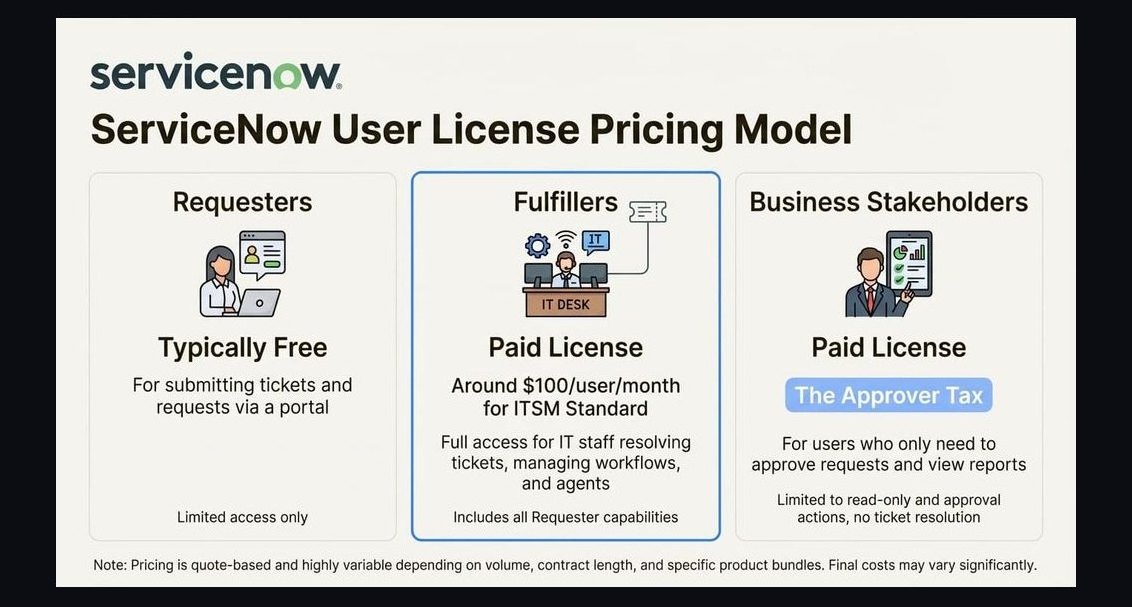
Start with the licensing comparison, then discount it, because licensing is rarely the deciding number. Salesforce publishes Service Cloud list pricing per user per month across Enterprise and Unlimited tiers, with AI, voice, and data platform capabilities layered on as separate line items. ServiceNow does not publish list pricing at all — its commercial model is negotiated per customer, priced largely by fulfiller seats and platform tier, with CRM capability packaged into the higher platform tiers. That asymmetry alone should tell you something about the evaluation: you can benchmark the Salesforce number against public data and peer benchmarks, and you cannot do the same on the other side without your own quote. Insist on a written multi-year price-protection schedule before you compare anything, because the year-one bundled price and the year-four renewal price are frequently very different animals.

The pattern that shows up consistently in real evaluations: if you are already buying the high ServiceNow platform tier for ITSM, the incremental license cost of CRM is small and the comparison favors consolidation. If you are not, adding CRM often requires a platform-tier upgrade that reprices your entire ITSM footprint, and the apparent savings evaporate. Ask the vendor for the delta price in both scenarios explicitly and in writing, and have your ITSM owner in the room — because the upgrade lands on their budget line, not yours.
Implementation cost is the number that dominates. For a mid-size enterprise service org, expect the services and internal-labor cost of a platform migration to run somewhere in the range of one to three times the first-year license cost, depending on how much custom logic sits in the incumbent. Two things drive that multiplier: the volume of custom Apex, flows, validation rules, and managed packages you've accumulated in Service Cloud, and the number of downstream integrations from step two. A vanilla Service Cloud instance with six integrations is a very different project from a ten-year-old instance with 200 custom objects and a homegrown telephony bridge.
On timelines, plan by scope rather than by vendor promise. A single-business-unit pilot on a clean case type is a one-quarter exercise. A B2B service org that already has ServiceNow deployed and needs to move a few hundred agents is realistically two to three quarters end to end, including a parallel-run period. A full enterprise cutover with telephony, workforce management, quality monitoring, and reporting rebuilt is a year-plus program, and anyone quoting materially less either has an unusually simple estimate or hasn't scoped the reporting rebuild.

Budget these three lines that estimates routinely miss. First, reporting and dashboard reconstruction: every operational report, every executive dashboard, every scheduled export, rebuilt and re-validated against historical numbers. Second, agent retraining and the productivity dip that follows — plan for weeks, not days, of degraded handle time after cutover, and staff for it rather than pretending it won't happen. Third, historical case data: decide early whether you migrate all history, migrate a rolling window, or leave the old system in read-only archive mode. Full history migration is expensive and slow; a read-only archive is cheap but creates a permanent two-system lookup habit for your agents that has its own ongoing cost.
Finally, model the do-nothing case honestly. Renewal leverage is real — a credible evaluation of an alternative platform is the single most effective tool for improving an incumbent renewal, and some organizations capture most of the available value from the evaluation itself without migrating at all. That is a legitimate outcome, not a failed project, but say so out loud at the start rather than discovering it at the end.
Where teams get this wrong
Treating it as an IT decision. The most common failure is that ITSM owners drive the evaluation because they own the ServiceNow relationship, and the service and RevOps organizations get consulted after the direction is set. The people who know which reports matter, which integrations are load-bearing, and which case types are genuinely painful are the ones who get looped in last. Put a service operations lead and a RevOps lead on the evaluation team from week one with real veto authority, or you will discover the requirements during cutover.

Benchmarking on features instead of on tickets. Feature matrices converge; both platforms will check nearly every box. The differentiation is entirely in whether the resolution data is native or imported, and a checkbox comparison is structurally incapable of revealing that. If your evaluation artifact is a spreadsheet of capabilities with green checks, you have not evaluated anything.
Ignoring the reverse-sync problem until it's live. Moving service off Salesforce while leaving sales on it means account, contact, entitlement, and case-rollup data now needs to flow both directions continuously and reliably. Teams treat this as a two-week integration task. It is an ongoing operational responsibility with an owner, an SLA, a monitoring story, and a conflict-resolution policy. Underestimating it is how a technically successful migration becomes an operational mess where the AE sees a different customer than the support agent does.
Migrating customizations instead of retiring them. A long-lived Service Cloud instance carries years of accumulated custom logic, half of which encodes process decisions nobody remembers making. The migration is the single best opportunity you will ever get to retire that debt. Teams that lift-and-shift their customizations pay the full implementation cost and arrive with the same complexity they started with, now in a platform whose customization idioms their team doesn't know yet. Audit every customization against "would we build this today?" and default to no.

Assuming AI capability decides the platform. Both vendors are shipping AI agents for service, both are still in the early-attach phase of their installed bases, and the deployed production evidence on either side is thinner than the marketing implies. Deflection and resolution-time claims are also measured differently by different vendors and different customers, which makes cross-vendor comparison close to meaningless right now. Choose the platform on data gravity and workflow fit; assume both will have competent AI agents within your evaluation horizon. If a vendor's AI story is the primary reason you're switching, wait a year and re-evaluate with real production data.
Skipping the parallel run to hit a date. Cutover dates slip for good reasons. The parallel-run period — where both systems are live and you reconcile outputs — is the only mechanism that catches routing gaps, SLA misconfiguration, and reporting drift before customers feel them. It is also the first thing cut when the program is behind. Protect it in the plan and defend it in the steering committee.
Forgetting the agent experience. Agents are the users, and their handle time is your cost structure. A platform that is architecturally superior but requires four more clicks per case will cost you more in labor than it saves in license fees. Time real agents on real cases in the sandbox, in both systems, with a stopwatch. That measurement is worth more than any analyst report in your evaluation, and almost nobody does it.

Decision framework: choosing between replacement, hybrid, and staying put
The framework has three plausible outcomes, and only one of them is "replace." Working through them honestly is what separates a real evaluation from a vendor-driven one.
Full replacement is defensible when a clear majority of your service resolutions depend on infrastructure, product, or operational data; ServiceNow is already deployed at scale with a mature platform practice; your Marketing Cloud and Slack dependencies are light; and your contact center is B2B-shaped — moderate volume, high complexity, long-lived accounts, named contacts. Telecom, enterprise hardware, managed services, infrastructure providers, and enterprise SaaS vendors cluster here. Even then, sequence it: IT-adjacent queues first, everything else after the sync layer proves itself.
Hybrid is the right answer far more often than either vendor will admit, and it is the default outcome for genuinely mixed portfolios. The line usually cuts cleanly by case type rather than by team or geography: technical, product, and infrastructure cases go where the resolution data lives, while billing, renewal, purchase, and campaign-triggered cases stay where the customer and commercial record lives. The cost of hybrid is the integration layer and a permanent decision rule about where a new case type lands — write that rule down and give it an owner, or you'll re-argue it every quarter and end up with cases arbitrarily scattered across both systems.
Stay put is correct when you run a high-volume consumer contact center, when Marketing Cloud journeys or Slack-based customer collaboration are load-bearing, when service-to-sales handoff happens daily and matters commercially, or when your telephony and workforce management stack is deeply wired into Service Cloud. It is also correct — and underrated — when your organization simply lacks the change capacity. A migration competing with an ERP program, a data platform rebuild, and a reorg will lose, and a half-finished migration is materially worse than either endpoint.

Two adjacent scenarios worth flagging, because they change the calculus. First, if you're a ServiceNow shop evaluating this alongside a field service or order management need, the consolidation argument strengthens considerably — field service dispatch sitting next to the CMDB and the customer case is a genuinely strong pattern, and it's often the use case that carries the business case. Second, if you're mid-acquisition or carving out a business unit, the correct move is usually to defer entirely; platform consolidation during an integration is how both programs slip.
What this means for the RevOps operating model
Whatever you choose, the operating-model consequences outlive the platform decision, and they're where RevOps earns its seat in the evaluation.
If you split, the customer record fragments by definition, and you need an explicit answer to "which system is authoritative for what." Accounts and contacts almost always stay authoritative in the CRM that holds pipeline. Entitlements and contract terms usually follow billing. Case history becomes authoritative wherever the case was worked, which means your reporting layer has to union two sources and reconcile their definitions of things like "reopen" and "first response." Build that union in the warehouse rather than in either application — application-layer syncs are for operational data the agent needs in the moment, not for analytics.

Health scoring and churn signal is the piece most likely to break silently. If your health score consumes case volume, escalation count, and CSAT, and half the cases move platforms, the score's inputs shift underneath it without any code changing. Re-baseline the model against the new data sources before cutover and validate that historical scores are still comparable, or you'll spend a quarter with a CS team chasing false churn alarms and quietly learning to ignore the score.
Handoff mechanics need redesign, not just re-plumbing. If an agent spots an expansion signal, the path from case to opportunity has to be one motion, not a Slack message and a hope. In a split architecture that means a purpose-built handoff — a button that creates the opportunity with context attached and notifies the owner — rather than relying on the agent to switch systems. Design it before cutover; retrofitting it after agents have established a workaround habit is much harder.
Finally, forecast and capacity planning for support depends on consistent historical volume data. A migration creates a discontinuity in that series. Decide up front whether you're carrying history forward, mapping old categories to new, or accepting a break in the series with a documented note. Analysts will trip over this for years otherwise, and the fix is fifteen minutes of decision-making at the start versus a permanent asterisk on every capacity model.
Related questions
Can I run both platforms without a full integration build?
Technically yes for a narrow pilot, practically no at scale. Without bidirectional account, contact, and case-rollup sync, sales and support see different customers within weeks. Budget the integration as a permanent owned service, not a project.
Does staying on Service Cloud mean I lose the ITSM data advantage?
No. Salesforce can ingest CMDB and incident data through its data platform and integration tooling. It's a copy rather than a native join, which adds latency and mapping work, but for moderate volumes it's a workable pattern many organizations already run.
How long before ServiceNow competes for consumer contact centers?
Not in the near term. Consumer scale demands mature telephony, IVR, workforce management, and quality monitoring ecosystems that took Salesforce years and a large partner network to build. Treat B2C parity as a multi-year question, not a current-cycle one.
Is a service platform migration worth it purely for cost savings?
Rarely. Implementation and internal labor typically consume several years of projected license savings. Migrate for workflow fit and data gravity; treat cost reduction as a secondary benefit and use the evaluation itself for renewal leverage if savings are the only driver.
What should RevOps own in this decision?
The reverse-sync design, the reporting union, health-score re-baselining, and the case-to-opportunity handoff. Those four determine whether the commercial team experiences the migration as invisible or as a quarter of broken pipeline hygiene.
FAQ
Is ServiceNow CRM a true replacement for Salesforce Service Cloud?
For a specific buyer profile, yes — B2B enterprise service where cases resolve against infrastructure, product, or operational data, and where ServiceNow is already deployed. For consumer contact centers, marketing-triggered service, or organizations where service-to-sales handoff is a daily commercial motion, it is not a replacement and the evaluation should end early.
How do I tell which side my organization falls on?
Sample 500 to 1,000 closed cases and tag each by what data actually resolved it. If most resolutions required CMDB, incident, or product configuration data, ServiceNow has a structural advantage. If most required account, order, billing, or campaign data, Salesforce does. Mixed results point to a hybrid split by case type.
What is the single most underestimated cost?
The bidirectional sync between the service platform and the CRM that still holds pipeline. Teams scope it as an integration project and it is actually a permanent operational service with an owner, monitoring, latency budget, and conflict-resolution policy. Second place goes to rebuilding and re-validating every operational report and dashboard.
Should AI agent capability drive the platform choice?
No. Both vendors are early in deploying AI service agents across their installed bases, deflection and resolution metrics are measured inconsistently across vendors, and the gap is likely to narrow within a typical evaluation horizon. Choose on data gravity and workflow fit, and re-evaluate AI capability with real production evidence later.
Can we get value from the evaluation without migrating?
Yes, and it's a legitimate outcome. A credible, well-documented alternative evaluation is the strongest renewal-negotiation input most organizations have. Say up front that "stay and renegotiate" is an acceptable result so the team evaluates honestly rather than working backward from a predetermined migration.
What does a realistic timeline look like?
A single-business-unit pilot runs about a quarter. Moving a few hundred B2B agents on an existing ServiceNow footprint is typically two to three quarters including parallel run. A full enterprise cutover with telephony, workforce management, and reporting rebuilt is a year-plus program. Estimates well under these usually haven't scoped reporting or integrations.
Sources
- https://www.servicenow.com/products/customer-service-management.html
- https://www.salesforce.com/service/pricing/
- https://www.salesforce.com/service/
- https://www.gartner.com/reviews/market/crm-customer-engagement-center
- https://www.forrester.com/research/
- https://www.trustradius.com/customer-relationship-management-crm
- https://docs.servicenow.com/
- https://help.salesforce.com/s/
- https://www.g2.com/categories/help-desk
Related on PULSE
- [Is ServiceNow's mobile app good enough in 2027?](/knowledge/q1661)
- [Is HubSpot CRM free enough for a 5-person startup or will I hit limits immediately?](/knowledge/q14520)
- [Is Salesloft mobile app good enough in 2027?](/knowledge/q1841)
- [Is Outreach mobile app good enough in 2027?](/knowledge/q1781)
- [Is Datadog mobile app good enough in 2027?](/knowledge/q1721)
- [Is your 2027 contract structure flexible enough for a 14-month sales cycle?](/knowledge/q16455)
This page will be disappearing soon. Save it to your device for $1 — or read it free while it is here.
@Kory-White- · if Venmo asks, the last 4 of my number are 2012
This page is gone.
This one is off the shelf now. $1 keeps it on your phone for good — the whole page, pictures and diagrams included.
 servicenowServiceNow vs Salesforce — which should you buy?
 servicenowIs ServiceNow CSM still strategic in 2027?
 servicenowWill ServiceNow beat Salesforce in enterprise workflow by 2027?
 servicenowShould ServiceNow kill its CSM module in 2027?
 servicenowShould ServiceNow kill its Pro+ pricing tier in 2027?
 servicenowWhat is the bear case for ServiceNow 2027?
 servicenowWhat should ServiceNow do about ITSM stagnation in 2027?
 servicenowWhat is ServiceNow AI strategy in 2027?
 servicenowWhat is ServiceNow's playbook for the next $5B in revenue in 2027?
 servicenowHow should ServiceNow rethink its workflow thesis for AI buyers in 2027?