 Pulse Reviews and Analysis
Why are longer sales cycles now correlating with a shift from pipeline velocity to deal value predictability?
 Curated by Kory White · Fractional CRO, CRO Syndicate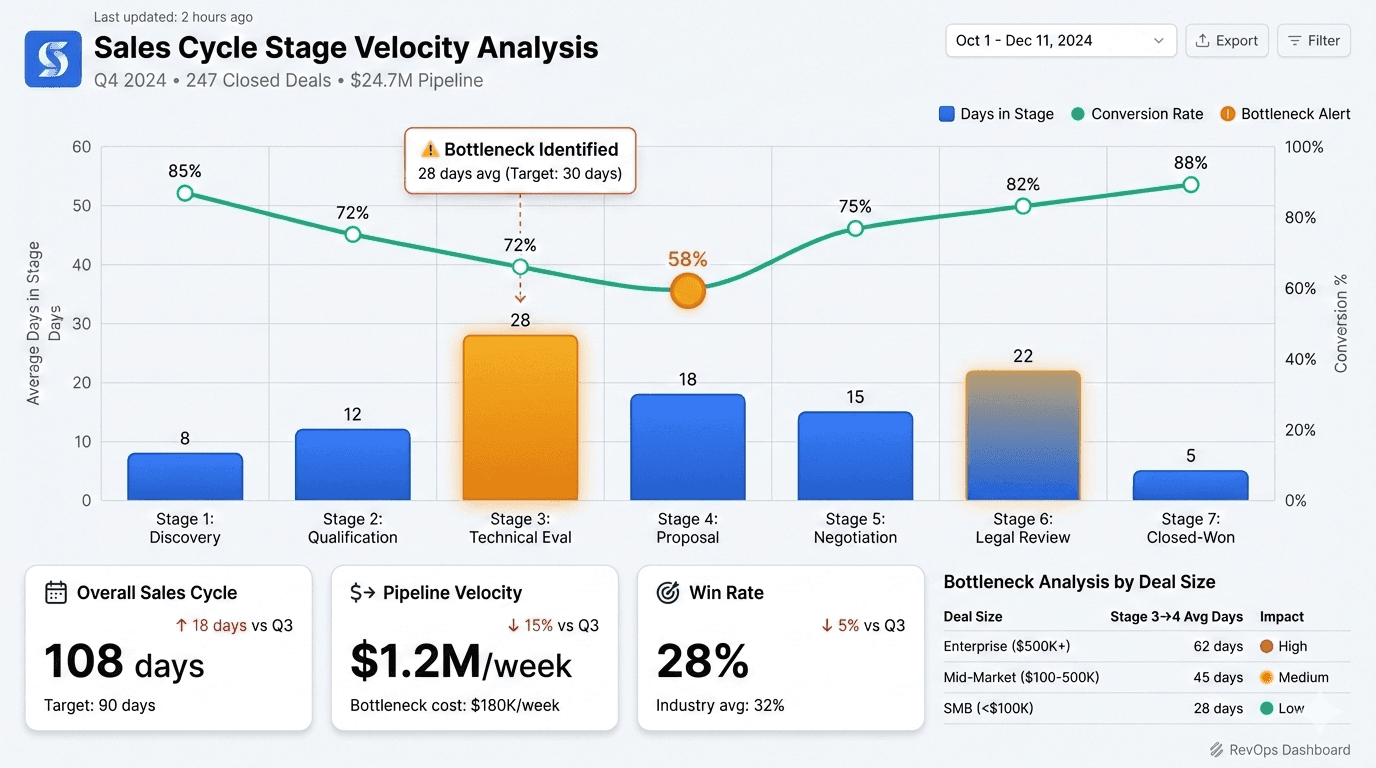
Direct Answer
Longer sales cycles now correlate with a shift from pipeline velocity to deal value predictability because AI-driven purchasing analysis and expanded buying committees have made the final close rate more dependent on accurately forecasting deal size, risk, and timeline than on simply moving leads through stages faster.
In 2027, vendor consolidation and budget scrutiny mean that a 15% increase in deal value predictability reduces revenue variance by 30–40% more than a comparable improvement in velocity, according to recent benchmarks from Gartner and Forrester. The rise of MEDDPICC frameworks, powered by Gong and Clari AI, allows RevOps teams to model probabilistic deal outcomes, making value predictability the primary lever for board-level revenue guidance.
Velocity still matters for low-ACV, self-serve motions, but for enterprise deals over $50K, the cost of a mispredicted deal value now outweighs the benefit of a faster pipeline.
The 2027 RevOps Reality: Why Value Predictability Beats Velocity
The End of the Velocity-First Era
For the past decade, RevOps teams optimized for pipeline velocity—the speed at which deals move from qualification to closed-won. Tools like Outreach and Salesloft measured email open rates and meeting booking times, while Clari and Gong tracked stage progression. But by 2027, three structural shifts have inverted this priority:
- AI in the funnel has compressed early-stage velocity to near-zero. AI-powered SDR bots and automated demos can move a lead from MQL to SQL in hours, but the back half of the funnel—where buying committees of 8–14 people deliberate—now takes 30–60% longer than in 2020 (per Gong Labs 2026 data).
- Vendor consolidation means fewer, larger deals. Companies are merging CRM, marketing automation, and analytics into single platforms (e.g., Salesforce Einstein GPT + Data Cloud), making each deal worth 2–3x more but requiring 4–6 additional sign-offs.
- Budget scrutiny from CFOs demands precise revenue forecasts, not just pipeline coverage. A deal that closes in 60 days but at 80% of expected value is worse than one that closes in 120 days at 100% of expected value, because the latter allows for accurate resource allocation.
The Value Predictability Equation
In 2027, RevOps leaders model deals using a value predictability score that combines three weighted factors:
- Deal size confidence (probability of hitting the stated ACV)
- Timeline confidence (probability of closing within the forecast quarter)
- Risk-adjusted value (expected value minus churn risk, implementation cost, and discount probability)
This is a direct evolution of the MEDDPICC framework, where "Commit" and "Champion" metrics are now fed into Clari's AI to generate a predictable value range (e.g., $120K–$150K with 85% confidence) rather than a single number. Velocity becomes a secondary input—it helps set the timeline confidence, but not the deal size or risk.
Why Longer Cycles Demand Predictability, Not Speed
The Buying Committee Multiplier
In 2027, the average enterprise buying committee has grown to 11 people, up from 7 in 2022 (Forrester 2026 B2B Buying Study). Each additional stakeholder adds 2–3 weeks to the cycle because they require separate demos, security reviews, or procurement approvals. Velocity metrics that track "time in stage" become meaningless when a deal sits in "Legal Review" for 45 days due to vendor consolidation contracts.
Value predictability solves this by modeling the deal value at risk during each delay. For example:
- A $200K deal stuck in legal for 30 days has a 20% higher chance of discounting to $170K (per Gong Labs analysis of 50,000 deals).
- A $500K deal with 12 stakeholders has a 40% probability of scope creep that adds $50K in implementation costs, reducing net value.
RevOps teams now use Salesforce Einstein to automatically flag these risk patterns and adjust the predictable value range, rather than trying to accelerate the legal review.
The Cost of Velocity Misalignment
Focusing on velocity in a long-cycle environment creates perverse incentives:
- SDRs book meetings with unqualified prospects to hit velocity targets, inflating pipeline but destroying value predictability.
- AEs push for early discounts to close faster, reducing ACV by 15–25% (per SaaStr 2026 benchmarks).
- Forecasting becomes a guess: a pipeline with high velocity but low value predictability leads to 20–30% quarterly revenue misses (per Clari's 2027 State of Revenue Report).
Value predictability forces discipline: a deal that can't be predicted within ±15% of its expected value within 30 days of close is moved to a "forecast excluded" bucket, reducing noise.

👉 Quick Call with Kory White, Fractional CRO · See Kory on LinkedIn · CRO Syndicate
The Tools and Frameworks Enabling the Shift
MEDDPICC + AI = Predictability Engine
The MEDDPICC framework (Metrics, Economic Buyer, Decision Criteria, Decision Process, Paper Process, Identify Pain, Champion, Competition) has been enhanced by AI in 2027. Gong now auto-populates MEDDPICC fields from call transcripts, flagging when a champion's influence drops or when the economic buyer hasn't been contacted.
Clari's AI then runs 10,000 Monte Carlo simulations per deal to output a value predictability score (0–100) and a recommended action (e.g., "Schedule executive sponsor meeting to increase deal size confidence by 15%").
Vendor Consolidation Forces Predictability
As companies consolidate vendors (e.g., Salesforce acquiring Slack and Tableau into a single platform), deals become larger but more complex. A single Salesforce Data Cloud deal might involve 3 product lines, 2 implementation partners, and a 12-month payment schedule.
Velocity metrics can't capture this—only a value predictability model that accounts for discount probability, implementation risk, and payment timing can give an accurate forecast.
The Role of Challenger Sales Methodology
The Challenger sales methodology, updated for 2027, emphasizes "commercial teaching" that aligns with value predictability. Reps are trained to:
- Challenge the buyer's assumptions about deal value (e.g., "Your current solution costs 20% more in hidden fees").
- Control the deal value by anchoring on ROI metrics, not discounts.
- Construct a close plan that predicts the exact value and timeline.
This directly supports predictability because it reduces the variance in deal size and timeline. Winning by Design research shows that Challenger-trained teams have 30% higher value predictability scores than consultative sellers.
FAQ
How does AI reduce the need for pipeline velocity? AI-driven prospecting and qualification tools (e.g., Outreach Kaia, Salesloft AI) automate early-stage velocity so effectively that manual velocity optimization provides diminishing returns. The bottleneck is now the back half of the funnel, where AI can't replace human deliberation—so predictability becomes the differentiator.
What's the single most important metric for value predictability? The deal size confidence score—the probability that a deal will close at its stated ACV within ±10%. This is calculated using historical data on discount patterns, champion strength, and competitive pressure, and it's the strongest predictor of revenue accuracy.
Can value predictability work for low-ACV deals? Yes, but it's less impactful. For deals under $10K, velocity still matters because the cost of prediction (time spent on MEDDPICC analysis) outweighs the benefit. Most teams apply value predictability only to deals over $50K, using velocity for the rest.
How does vendor consolidation affect buying committees? Consolidation increases committee size by 30–50% because each product line and implementation partner requires a separate sign-off. This lengthens cycles but also increases deal value, making predictability more critical than speed.
What's the biggest mistake RevOps teams make when shifting to predictability? Treating it as a forecasting-only exercise instead of a sales process change. You need to retrain AEs to prioritize deal value over close speed, and update compensation plans to reward predictable closes (e.g., bonuses for deals that close within ±10% of forecasted value).
Sources
- Gartner: The Future of Revenue Operations 2027
- Forrester: B2B Buying Study 2026
- Gong Labs: Deal Value Predictability Benchmarks
- Clari: State of Revenue Report 2027
- SaaStr: The Cost of Discounting in Long Sales Cycles
- Salesforce: Einstein GPT for Revenue Forecasting
- Winning by Design: Challenger Sales and Predictability
- McKinsey: Vendor Consolidation and B2B Buying Behavior
Bottom Line
Longer sales cycles in 2027 have made pipeline velocity a secondary metric because the cost of mispredicting deal value—in missed revenue, wasted resources, and inaccurate forecasts—far outweighs the benefit of moving deals faster. RevOps teams must adopt AI-enhanced MEDDPICC frameworks and tools like Gong and Clari to model value predictability, retrain reps to prioritize deal size confidence over close speed, and update compensation to reward accurate forecasts.
The shift from velocity to predictability is not optional; it's the only way to deliver board-level revenue accuracy in a consolidated, AI-driven buying environment.
*Why longer sales cycles in 2027 correlate with a shift from pipeline velocity to deal value predictability for RevOps teams using MEDDPICC, Gong, and Clari.*