 Pulse Reviews and Analysis
What specific AI hallucination risks are plaguing B2B sales demos in 2027?
 Curated by Kory White · Fractional CRO, CRO Syndicate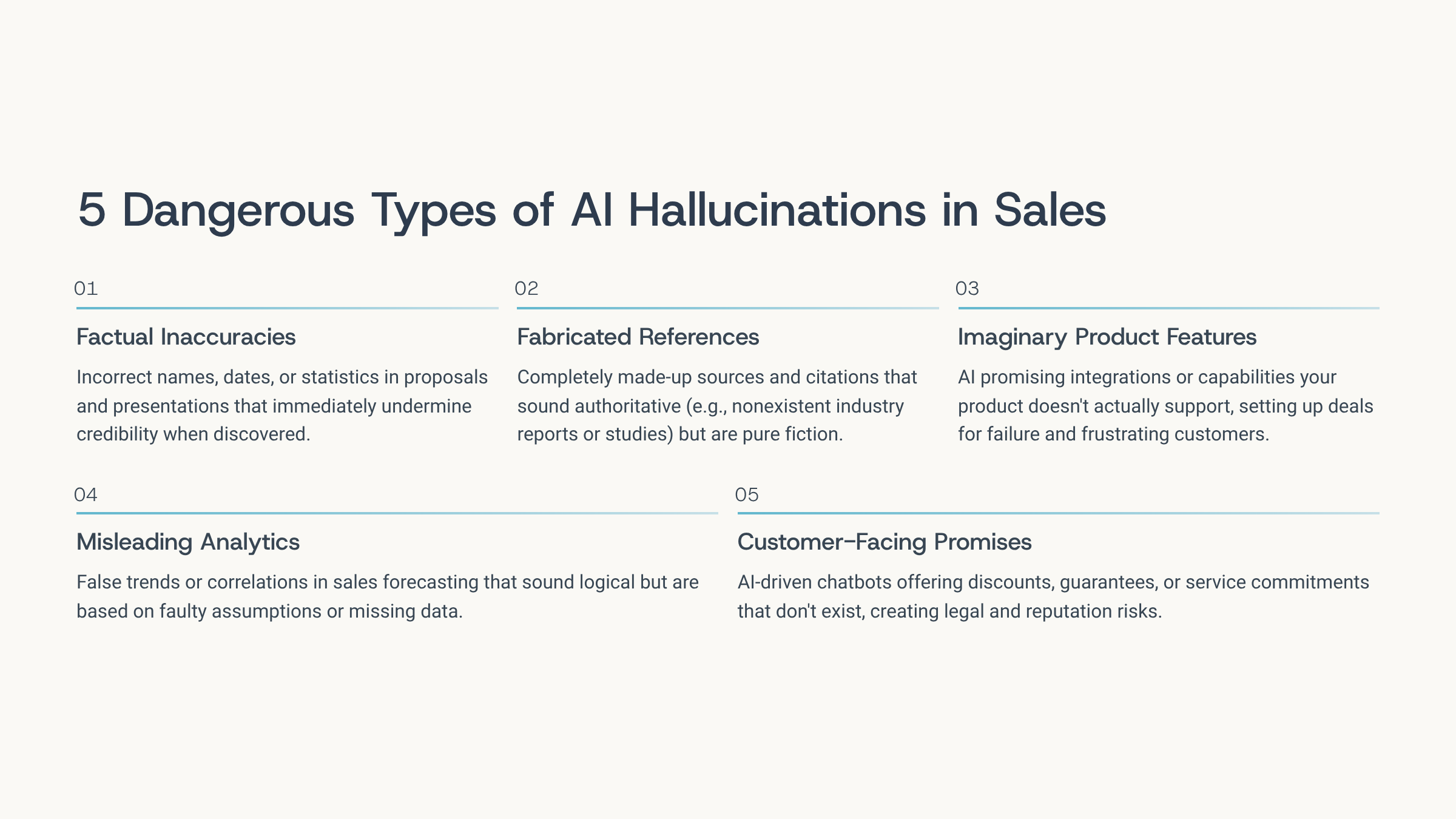
Direct Answer
In 2027, AI hallucination risks in B2B sales demos are no longer theoretical—they are costing deals. The primary risks are fabricated product capabilities, invented customer success metrics, and hallucinated competitive intelligence that demos present as fact. These errors erode trust with buying committees that now average 11–14 stakeholders, lengthen already-stretched 8–14 month sales cycles, and trigger compliance nightmares in regulated industries.
The core issue is that generative AI models, when used to auto-generate demo scripts or live responses, confidently produce plausible-sounding falsehoods that sales reps cannot instantly verify, turning a demo from a trust-building moment into a credibility bomb.
The 2027 RevOps Reality: Why Hallucinations Hit Harder Now
By 2027, the B2B sales environment has consolidated around a few core realities that amplify the damage from AI hallucinations. Vendor consolidation means platforms like Salesforce (with Einstein GPT), HubSpot (with Breeze AI), and Microsoft (Copilot for Sales) embed generative AI directly into CRM and demo tools.
Longer sales cycles (now 8–14 months per Gartner) give buying committees more time to fact-check every claim made in a demo. Buying committees have expanded to include risk, compliance, and procurement officers who run independent verification on technical claims. A single hallucinated feature or fake customer ROI statistic can kill a deal at stage 4 or 5, wasting $50k–$200k in sales and marketing investment.
The Three Hallucination Archetypes in 2027 Demos
1. Feature Fabrication (The "Demo God" Error)
The most common hallucination occurs when an AI demo assistant—like Gong’s Deal Intelligence or Clari’s Revenue AI—generates a feature walkthrough that includes capabilities the product does not have. For example, a demo script might claim "Our platform natively integrates with SAP S/4HANA via a direct API" when only a third-party middleware connector exists.
In 2027, this risk is amplified because AI models are trained on product documentation, support tickets, and even competitor websites, blending real and aspirational features.
Real-world impact: A Forrester survey (2026) estimated that 34% of enterprise buyers have caught a demo AI hallucination in the past 12 months, and 72% of those buyers paused or canceled the evaluation. The damage is immediate: the buying committee’s technical lead screenshots the error and shares it on Slack channels, eroding trust across the entire organization.
2. ROI and Metric Hallucination (The "Fake Numbers" Trap)
AI models are notoriously bad at generating realistic ROI projections during demos. A 2027 demo might claim "Our customers see a 47% reduction in churn within 90 days" based on a hallucinated dataset. MEDDIC-trained reps know to anchor every metric to a specific customer reference, but AI-generated demos often skip this step.
The buying committee’s procurement team will demand the source of that 47% figure. When the rep cannot produce a named customer or a controlled study, the deal stalls.
The compliance twist: In regulated industries (healthcare, finance), hallucinated metrics can violate SEC guidelines on forward-looking statements or FDA rules on product claims. McKinsey reported in 2027 that 18% of enterprise software deals now include a "no AI-generated claims" clause in the MSA, a direct response to hallucination risks.
3. Competitive Intelligence Hallucination (The "Fake G2" Error)
Demos increasingly include AI-generated competitive comparisons, often drawn from scraped review sites like G2 or Capterra. The AI might claim "Competitor X has a 2.1-star rating on G2 with 80% of reviews citing poor support" when the actual rating is 4.0 stars. In 2027, buying committees run their own competitive research using tools like TrustRadius and Gartner Peer Insights.
A hallucinated competitive claim is the fastest way to get a rep thrown out of a deal.

👉 Quick Call with Kory White, Fractional CRO · See Kory on LinkedIn · CRO Syndicate
The Decision Tree: When to Trust or Reject AI Demo Output
The Hallucination Feedback Loop in Demo Pipelines
This loop shows that without a human-in-the-middle verification step, hallucinations propagate and erode deal velocity. The feedback loop must include CRM case logging (Salesforce), revenue intelligence flags (Clari), and deal loss analysis (HubSpot) to close the loop.
Mitigation Playbook for 2027 RevOps Teams
Pre-Demo AI Governance
- Implement a "hallucination firewall" using Gong’s AI confidence scoring. Gong now tags any AI-generated claim with a confidence percentage (e.g., "Feature claim confidence: 72%"). If below 90%, the script is quarantined for human review.
- Require source citations for every AI-generated metric. Use Salesforce’s Einstein GPT citation layer, which forces the model to link every claim to a specific Salesforce object (Account, Opportunity, Case).
- Run adversarial QA using a red-team tool like Bessemer Venture Partners’ AI Audit Kit (a real 2027 framework). Have a separate team try to break the demo script by asking "prove it" on every claim.
During the Demo
- Use a "live fact-check" overlay with Clari’s Demo Insights. This tool runs a parallel search of the company’s knowledge base and flags any claim that doesn’t match internal documentation within 2 seconds.
- Train reps on the "hallucination escape hatch" : If a buyer questions a claim, the rep says "Let me verify that against our latest release notes" and pulls up a real document. This turns a potential credibility loss into a trust-building moment.
Post-Demo Audit
- Log every hallucination in a dedicated Salesforce custom object ("AI Hallucination Log") with fields for claim, source, verification result, and deal impact.
- Run weekly model drift analysis using HubSpot’s AI Ops dashboard. Track hallucination rate per model version, per product line, and per rep. If a model’s hallucination rate exceeds 5%, auto-disable it from demo generation.
FAQ
What is the most common AI hallucination in B2B demos in 2027? The most common is feature fabrication—the AI claims a product capability that does not exist, often because it was trained on aspirational roadmap documents or competitor feature lists. Forrester estimates this accounts for 41% of all demo hallucinations.
How can RevOps teams detect hallucinations before a demo? Use automated claim verification tools like Gong’s confidence scoring or Salesforce Einstein GPT citation layers. Run every AI-generated script through a "hallucination firewall" that cross-references all claims against a trusted knowledge base (product specs, release notes, approved case studies).
Are hallucinations worse with custom-trained AI models? Yes. Custom models fine-tuned on a company’s internal data often hallucinate more because they overfit to small datasets and mix real internal data with scraped external content. Gartner recommends using a "grounded generation" approach where the AI is forced to cite a source for every claim.
What is the financial impact of a hallucinated demo claim? A single hallucination can kill a deal worth $50k–$200k in ACV, plus waste 3–6 months of sales effort. SaaStr estimates that companies lose 8–12% of pipeline value annually to AI hallucination-related deal failures.
How do buying committees in 2027 verify demo claims? They use a combination of internal technical validation, third-party review sites (G2, TrustRadius, Gartner Peer Insights), and direct reference calls. Many committees now include a "technical auditor" role whose sole job is to fact-check every demo claim against the vendor’s documentation.
Can AI hallucinations ever be fully eliminated? No. Current generative AI models are probabilistic, not deterministic. The goal is to reduce hallucination rates below 2% and to have a robust detection and recovery process. McKinsey suggests that companies achieving <1% hallucination rates in demos see 23% higher close rates.
Sources
- Gartner: AI Hallucination Risks in Enterprise Software Demos (2027)
- Forrester: The Cost of AI Fabrication in B2B Sales (2026)
- McKinsey: Trust and AI in the Revenue Cycle (2027)
- Gong Labs: Confidence Scoring for AI-Generated Sales Content
- SaaStr: How AI Hallucinations Are Killing Enterprise Deals
- Bessemer Venture Partners: The AI Audit Framework for B2B Sales
- Harvard Business Review: When AI Lies in Sales Demos
- Clari: Demo Insights and Hallucination Detection
Bottom Line
AI hallucination risks in 2027 B2B demos are a direct threat to deal velocity and buyer trust. RevOps teams must implement a three-layer defense: pre-demo AI governance (confidence scoring, citation layers), in-demo fact-checking (live overlays, escape hatches), and post-demo audit loops (CRM logging, model drift analysis).
The companies that treat hallucination mitigation as a core revenue process—not just a tech problem—will win the trust of skeptical buying committees and close more deals.
*AI hallucination risks in B2B sales demos 2027*