

How much does a year of room and board cost at a public university in 2027?
 Curated byKory White · Fractional CRO · Maryland
Quality
Certified
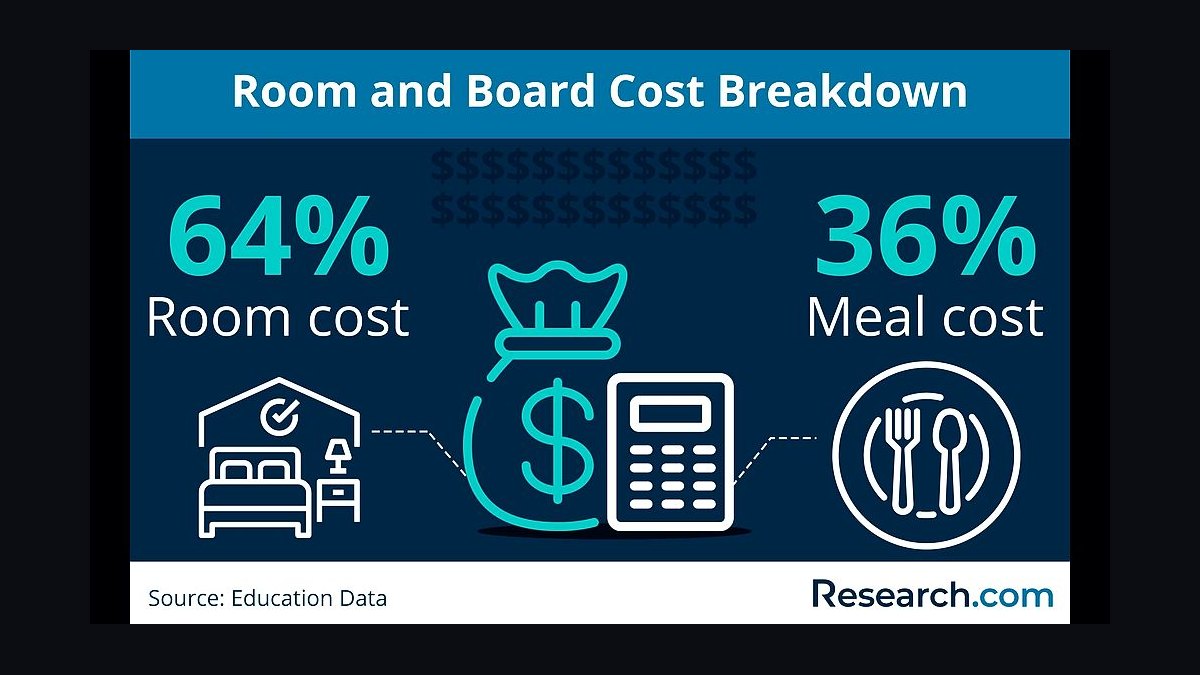
For the 2027–28 academic year, a full year of room and board at a four-year public university in the United States is projected to run roughly $14,500 to $18,000 on average, with on-campus residence halls and a standard meal plan clustering near the middle of that range. Individual campuses vary widely by state, housing type, and meal plan tier.
The two core options compared: on-campus versus off-campus room and board
When a family asks what a year of room and board costs at a public university in 2027, the honest answer depends on which of two very different arrangements they mean. On-campus housing — a residence hall room plus a campus meal plan — is the number most commonly quoted in university cost-of-attendance pages, and it is also the number financial aid offices use when building a standard student budget. Off-campus housing — an apartment lease plus groceries and utilities — is usually cheaper on paper but carries its own set of costs that the sticker price hides.
The on-campus option bundles everything into one bill. A student pays a housing rate (often tiered by room type: single, double, triple, suite) and a meal plan rate (often tiered by swipes per week or declining-balance dollars per semester). The university sets these rates annually, usually in the spring before the academic year, and they are published on the bursar or housing office website. Because the rates are set by the institution, they are predictable: a family can look up the current year's rate and apply a reasonable escalation to estimate 2027.
The off-campus option unbundles everything. Rent is paid to a landlord, not the university. Food is bought at a grocery store. Utilities — electricity, water, internet — are separate. Furniture is often a one-time purchase. And there is usually a 12-month lease, not a 9-month academic year, which means a student pays for summer months even if they leave town. That 12-month commitment is the single biggest reason off-campus "savings" sometimes evaporate on closer inspection.

There is also a third arrangement that sits between the two: living at home with parents or relatives and commuting. For students whose family lives within commuting distance of a public university, this is almost always the cheapest option because it eliminates rent entirely. It is worth naming because the question "how much does room and board cost" has a legitimate answer of "close to zero" for a meaningful slice of public university students — though it trades away the independence and campus proximity that many students value.
The comparison matters because the gap between the two options is not small. In many college towns, a shared off-campus apartment with two or three roommates can bring a student's annual housing cost below the on-campus rate, while a solo one-bedroom near campus can easily exceed it. The decision is not "which is cheaper in the abstract" but "which is cheaper given this specific campus, this specific town, and this specific student's needs."
How to decide between them
The decision between on-campus and off-campus room and board at a public university is not purely financial. It is a trade-off among cost, convenience, social integration, and risk. The flowchart below sketches the decision path a family can walk through when planning for 2027.

The first branch — commuting distance — is the most decisive. If a student can live at home, the room and board line item drops to transportation and perhaps a portion of household groceries. That is not a small consideration: for many families, the difference between paying $16,000 for a dorm and meal plan and paying $3,000 for gas and insurance is the difference between affording the university and not.
The second branch — whether on-campus housing is guaranteed or required — matters because many public universities require first-year students to live on campus unless they commute from home. If that is the case, the comparison for year one is not really a choice; it is a mandated cost. The choice opens up in year two and beyond, when students typically move off campus.
The third branch — the actual dollar comparison — is where families often make arithmetic errors. The correct comparison is not "on-campus rate versus monthly rent times nine." It is "on-campus rate versus monthly rent times twelve, plus utilities, plus internet, plus furniture amortized over the lease, plus the food that replaces the meal plan." When that full off-campus cost is tallied, the savings are sometimes smaller than expected, and occasionally the on-campus option wins outright.
There is also a non-financial dimension that the flowchart cannot capture: the first year on campus is often where students build the social network and study habits that carry them through graduation. A student who moves off campus too early can end up isolated, especially at a large public university where making friends requires proximity. That is not a reason to ignore cost, but it is a reason to weigh the decision holistically rather than treating the cheapest line item as automatically correct.
Concrete numbers behind each option

The numbers below are built from the pattern of published cost-of-attendance figures at large public university systems in recent years, escalated forward to 2027. They are ranges, not quotes, because no single number applies to every campus. Treat them as planning anchors, not predictions.
On-campus housing rates. At most four-year public universities, a standard double-occupancy residence hall room runs somewhere between $6,000 and $10,000 for the academic year. A single room, where available, typically adds $1,500 to $3,500 on top of the double rate. Suite-style or apartment-style on-campus housing often sits at the upper end of that range or slightly above it. In high-cost states — California, Massachusetts, New York, Washington — the upper end of the range is more common; in lower-cost states across the South and Midwest, the lower end is more typical.
Meal plan rates. A standard meal plan — often described as "unlimited swipes" or "14 meals per week plus declining balance" — typically runs between $4,000 and $6,500 for the academic year. Plans with fewer swipes or more declining-balance dollars can be cheaper, sometimes in the $3,000 to $4,500 range. The trend in recent years has been toward more flexible plans, which means the headline meal plan rate is not always the one a student ends up paying.

Combined on-campus total. Adding housing and meals, the on-campus room and board figure at a public university for 2027 lands roughly in the $14,500 to $18,000 range for a standard double room and a mid-tier meal plan. That is the number most financial aid offices will use in a student's cost of attendance. It is also the number that appears in most "how much does college cost" comparisons.
Off-campus rent. In a typical college town, a room in a shared house or apartment runs between $500 and $1,000 per month per student. A one-bedroom apartment near campus can run $900 to $1,600 per month, depending on the market. Over a 12-month lease, a shared room costs roughly $6,000 to $12,000 per year, and a solo one-bedroom costs roughly $11,000 to $19,000. Note that the 12-month lease is the key difference from the on-campus 9-month rate.
Off-campus food. A student cooking most meals at home typically spends $250 to $450 per month on groceries, or roughly $3,000 to $5,400 per year. Eating out regularly pushes that higher. A student who buys a commuter meal plan or eats on campus frequently may spend more than a dorm resident on food, not less.
Off-campus utilities and setup. Electricity, water, and internet for a shared apartment typically run $100 to $200 per month per student, or $1,200 to $2,400 per year. Furniture and basic household setup — bed, desk, cookware, cleaning supplies — is a one-time cost of roughly $500 to $1,500 in the first year of off-campus living.

Combined off-campus total. Adding rent, food, utilities, and first-year setup, a student in a shared off-campus apartment spends roughly $11,000 to $18,000 per year — overlapping heavily with the on-campus range. A student in a solo apartment can easily exceed $20,000. The off-campus option is not automatically cheaper; it is cheaper under specific conditions, most notably sharing with roommates and cooking at home.
Commuter total. A student living at home and commuting spends on transportation, parking, and perhaps a partial meal plan. Parking passes at public universities often run $200 to $600 per year, and fuel and insurance depend heavily on distance and vehicle. A reasonable planning range is $2,000 to $5,000 per year, though some commuters spend less and some spend more.
The escalation factor. Published rates at public universities have historically risen faster than general inflation, often in the 3% to 5% annual range for housing and meals. Applying that to a current-year rate is the standard way to estimate 2027. A family looking at a 2024–25 rate of $13,500 for room and board should plan for roughly $15,000 to $15,800 by 2027–28 under that assumption. A family looking at a 2024–25 rate of $16,000 should plan for roughly $17,800 to $18,700. These are planning estimates, not guarantees; some systems have held rates flat in recent years, and others have raised them more aggressively.
Regional variation. The single biggest driver of the number is geography. Public universities in the Northeast and West tend to have higher housing and meal rates than those in the South and Midwest, though there are exceptions in both directions. A student comparing two public universities in different states should compare the actual published rates, not a national average, because the national average can be off by several thousand dollars in either direction.
Implementation details and sequencing

Planning for 2027 room and board is not a one-time calculation. It is a sequence of steps that starts well before the academic year and continues through the first few weeks of enrollment. The diagram below shows the sequence a family can follow.
The first step is research, and it should start more than a year before enrollment. Public universities publish their current-year room and board rates on their bursar, housing, or financial aid websites. Those rates are the best available starting point. A family should collect the rates for every campus under consideration and apply a consistent escalation factor — 3% to 5% per year is a reasonable planning assumption — to project the 2027–28 figure.
The second step is the off-campus comparison, which requires looking at the local rental market, not just the university's website. Rental listings near a campus are easy to find online, and a family can estimate a shared-room rate and a solo-apartment rate for each town. This step is often skipped, and skipping it is a mistake: at some public universities, off-campus housing is dramatically cheaper than the dorm, and at others it is not.
The third step is checking the housing requirement. Many public universities require first-year students to live on campus unless they commute from home. If that is the case, the first-year decision is made for the family, and the off-campus comparison applies only to later years. Knowing this early prevents a family from planning around an option that is not actually available.

The fourth step is checking the financial aid package. This is where the room and board number interacts with the rest of the college budget. A financial aid award that covers tuition but not room and board leaves a gap that the family must fill. Some aid packages are built around the on-campus rate; if a student moves off campus, the aid may be reduced or may stay the same depending on the institution's policy. Understanding that interaction before committing to a housing type can prevent an unpleasant surprise.
The fifth step is the deposit. On-campus housing often requires a deposit and a contract signed months in advance, sometimes before a student has committed to the university. Off-campus leases near a campus often fill up early, especially for the following academic year. A family that waits too long may find the cheapest options gone.
The sixth step is the actual payment. Room and board is typically billed per semester, with payment due at the start of each term. Meal plans can sometimes be changed in the first few weeks of the semester, which gives students a chance to adjust if the plan they chose does not fit their eating habits.
The seventh step is ongoing tracking. A budget set in the spring is a hypothesis; actual spending is the test. A student who chose the 14-meal plan but eats most meals off campus is paying for swipes they do not use. A student who moved off campus but underestimated utilities is running a deficit. Reviewing actual spending against the budget a few weeks into each semester catches these problems while there is still time to adjust.
Related questions

How much does room and board cost at a public university compared to a private one?
Private universities typically charge more for room and board, often $16,000 to $20,000 per year, though some public universities in high-cost states approach or exceed that range. The gap is usually smaller for room and board than for tuition, because housing and food costs are driven by local markets and campus amenities rather than by the institution's overall price tier.
Does financial aid cover room and board at a public university?
Federal student aid, state grants, and institutional scholarships can often be applied to room and board, but the amount covered depends on the specific award. Some packages cover tuition only, leaving room and board as an out-of-pocket cost. Families should read the aid award letter carefully to see what the room and board allowance actually is.
Is it cheaper to live on campus or off campus at a public university?
It depends on the campus and the town. On-campus housing is often comparable to off-campus rent once utilities, food, and a 12-month lease are counted. Off-campus living is usually cheaper when a student shares with roommates and cooks at home; it is often more expensive when a student rents alone or eats out frequently.
How much should a family budget for room and board increases each year?
A reasonable planning assumption is 3% to 5% per year, though some public university systems have held rates flat and others have raised them more. A family that budgets for the high end of that range is less likely to be surprised, and any unused amount can be redirected to other costs.
Can a student waive the on-campus housing requirement at a public university?

Many public universities allow exemptions for students who commute from a parent's home within a certain radius, are married, are veterans, or have other qualifying circumstances. The specific rules vary by institution, so families should check the housing office's policy directly rather than assuming an exemption applies.
FAQ
What is the average cost of room and board at a public university in 2027? A full year of room and board at a four-year public university in 2027–28 is projected to average roughly $14,500 to $18,000 for a standard on-campus arrangement. That figure combines a residence hall room and a mid-tier meal plan. Off-campus arrangements can fall below or above that range depending on rent, roommates, and food spending.
Does the room and board cost include tuition? No. Room and board is a separate line item from tuition and fees. A university's cost of attendance typically lists tuition and fees, room and board, books and supplies, transportation, and personal expenses as distinct categories. When comparing schools, families should look at the total cost of attendance, not just tuition.
Why is room and board so expensive at some public universities?

Housing and meal rates reflect the local real estate market, construction and maintenance costs, staffing, and the amenities a campus offers. Universities in high-cost metro areas tend to charge more, and newer or renovated residence halls with suite-style rooms and dining halls often carry higher rates than older, traditional dormitories.
Can a student reduce room and board costs at a public university? Yes. Choosing a double or triple room instead of a single, selecting a lower-tier meal plan, becoming a resident assistant (which often includes a housing discount), moving off campus with roommates after the first year, or commuting from home are all common ways to reduce the room and board line item.
Is room and board tax deductible? Room and board is generally not tax deductible as an education expense, though tuition and certain fees may qualify for education tax credits or deductions. Families should consult a tax professional or the IRS guidelines for their specific situation rather than assuming room and board qualifies.
How much does a year of room and board cost at a public university in 2027 if the student lives at home? If a student lives at home and commutes, the room and board cost drops to transportation, parking, and possibly a partial meal plan — often $2,000 to $5,000 per year. That is dramatically lower than the on-campus figure, but it requires the family to live within commuting distance of the university.
Sources
- https://nces.ed.gov/collegenavigator/
- https://bigfuture.collegeboard.org/plan-for-college/college-costs
- https://www.collegeboard.org/
- https://studentaid.gov/
- https://www.consumerfinance.gov/
- https://www.bls.gov/cex/
- https://www.nasfaa.org/
- https://www.aacrao.org/
Related on PULSE
- How much does tuition cost at a public university in 2027?
- How much does a year of room and board cost at a private university in 2027?
- What is the total cost of attendance at a public university?
- How do financial aid packages cover room and board?
- How much should a family budget for college cost increases each year?
- Is it cheaper to live on campus or off campus at a public university?
This page will be disappearing soon. Save it to your device for $1 — or read it free while it is here.
@Kory-White- · if Venmo asks, the last 4 of my number are 2012
This page is gone.
This one is off the shelf now. $1 keeps it on your phone for good — the whole page, pictures and diagrams included.
 pulse-schoolsTop 10 Law Schools in 2027
 schoolsHow much less do parishioners pay for Catholic high school tuition than non-parishioners in 2027?
 pulse-schoolsTop 10 Sororities at Mississippi State University in 2027
 schoolsHow much does it cost to get a DVM degree in 2027?
 pulse-schoolsTop 10 Public High Schools in Nevada in 2027
 schoolsTop 10 Catholic Schools in Richmond in 2027
 schoolsTop 10 Catholic Schools in Tacoma in 2027
 schoolsTop 10 Catholic Schools in Seattle in 2027
 schoolsWhat Does It Cost a Family to Send a Child to Public High School for a Year in 2027?
 schoolsHow many credit hours can you take at a public university before tuition switches to a flat full-time rate in 2027?