
How to Choose a Wedding Speech That Fits Your Relationship in 2027
 PULSEKNOWLEDGE LIBRARY
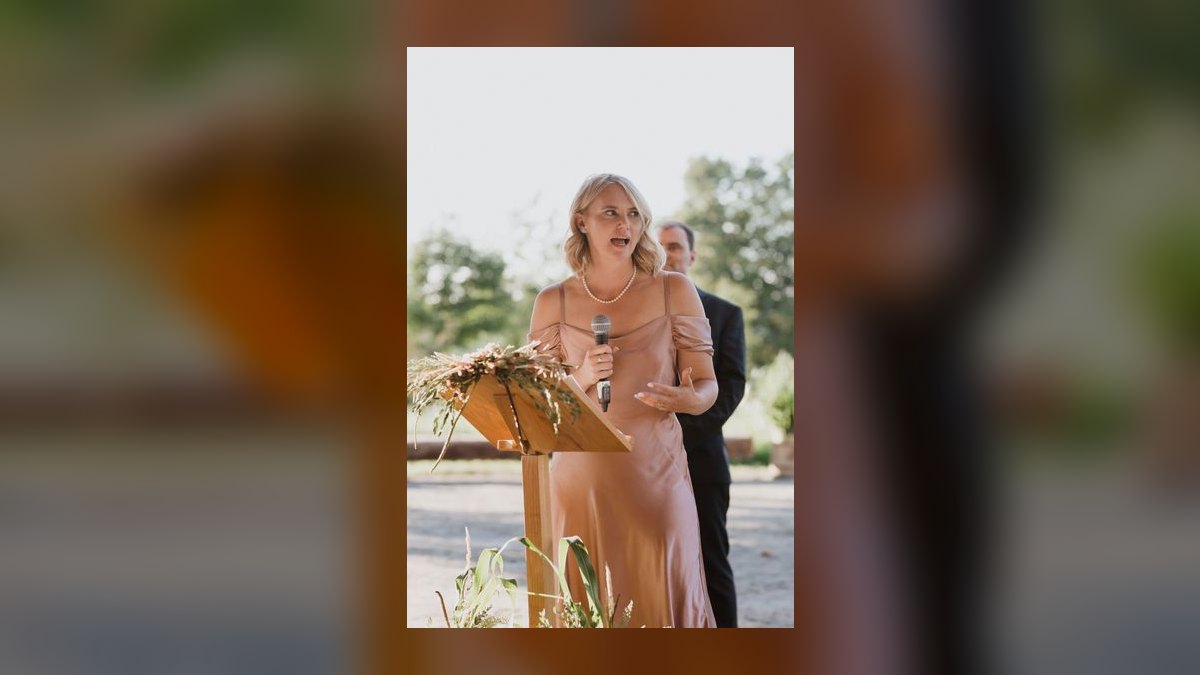
Choose a wedding speech by matching format to your actual relationship: siblings and lifelong friends earn story-driven toasts, newer colleagues stay warm and brief, parents lean on arc and gratitude. Pick one true story, one theme, and a length of two to four minutes — roughly 250 to 500 spoken words.
The outcome you should expect
A speech that fits your relationship does three things reliably, and it is worth naming them before you write a single line, because most people optimize for the wrong outcome — being funny — and end up with a set of jokes that could have been delivered by anyone in the room.
The first outcome is recognition. When you finish, the couple should feel that someone who actually knows them stood up and said something only that person could have said. That is the entire test. If your speech could be handed to another guest and delivered without changing a word, it is not a speech about your relationship; it is a generic toast wearing your name. The specificity that produces recognition is almost always concrete: a place, a date, a habit, an object, an exact sentence someone said. "She's the most loyal person I know" produces nothing. "She drove four hours in a snowstorm to sit in my apartment and not talk about it" produces the same claim and lands it.
The second outcome is comfort. A wedding audience is mixed by design — grandparents, coworkers, children, a few people who met the couple last year, and an ex-roommate who knows too much. A speech that fits your relationship also fits that room. This is where relationship type does real work: the closer you are to the couple, the more license you have, and the more responsible you are for using it carefully. Proximity buys you permission for tenderness far more than it buys you permission for edge.
The third outcome is brevity that feels generous rather than rushed. Guests do not remember the length of a good speech; they remember the length of a bad one. Two to four minutes is the working band for nearly every speaker at nearly every wedding. At an average delivered pace of roughly 120 to 140 words per minute — slower than conversational speech because of pauses, laughter, and a microphone — that is about 250 to 500 words on the page. Five minutes is the outer edge, and it should be reserved for a parent or a single best-person speech at a wedding with only two or three speakers total. Anything past six minutes is a talk, not a toast.
Set your expectations for the audience response accurately, too. A good four-minute speech typically produces two or three genuine laughs, one quiet moment where the room goes still, and a clean landing. It does not produce a standing ovation, and chasing one is how speeches go wrong. The people who try for eight laughs get four cheap ones and lose the room in the middle. Aim for one real laugh per ninety seconds and one moment of sincerity that you have earned by then, and you will be in the top quarter of speeches at any wedding you attend.
Finally, expect the writing to take longer than the speaking. A well-fitted four-minute speech generally represents three to six hours of total work spread across two or three weeks: one hour of collecting raw material, one to two hours of drafting, one hour of cutting, and one to two hours of rehearsal out loud. That ratio — roughly one hour of work per thirty to sixty seconds of finished speech — surprises people, and it is the single most common reason speeches underperform. They were written on the plane.
What drives that outcome
The variable that drives everything downstream is your relationship category, because it determines your license, your material, and your obligations to the room. Think of it as four inputs feeding one decision.
Proximity is how much shared history you have. A sibling or a childhood friend has twenty-plus years of material and can assume the audience accepts their authority to speak. A coworker of three years has a narrower but often sharper window — the couple at work, under pressure, being who they are when no one is performing. Proximity does not equal quality of material. Some of the best speeches come from someone who knew the couple for a specific, vivid eighteen months.
License is what the room will forgive. Siblings can tease. Parents can be openly emotional without it reading as excessive. Friends can reference the couple's early awkwardness. Colleagues and newer friends should stay firmly on the warm side, because the audience has no baseline for your tone and will read any edge as a stranger being unkind. A useful calibration: you have license for a joke only if at least three people in the room already know the story, and none of them would wince.
Obligation is what the room expects you to cover. A parent of either partner is generally expected to welcome the other family explicitly, name the new in-laws, and thank guests who traveled. A best person or maid of honor is expected to address the partner they know less well directly and generously — this is the single most under-delivered element in wedding speeches, and doing it well makes an ordinary speech memorable. A friend or colleague has almost no formal obligation beyond a clean toast at the end.
Register is your natural voice. Do not choose a comedic speech if you are not funny in life, and do not force sincerity if your entire friendship is built on mockery — the couple will hear the falseness before anyone else does. The best speeches sound like the speaker on a good day, not like a different person entirely.
Once you know your category, the material selection rule is the same for everyone: choose one story, not three. The single most reliable structural failure in wedding speeches is the anthology — four anecdotes, each half-developed, none landing. One story told with real detail beats four told in summary, every time, because detail is what creates the feeling of being let into a real relationship. If you have four good stories, pick the one that best proves the theme you want to end on, and put the other three in a card you give the couple privately.
The theme is what turns a story into a speech. After you tell your story, you need one sentence that says what it reveals about the person, and then one move that connects that quality to the marriage. That three-part engine — story, meaning, forward-looking connection — is what separates a toast from a fond recollection. It also gives you an ending, which is where unstructured speeches die.
Benchmarks and realistic ranges
Concrete numbers make the choice easier, so here are the working ranges practitioners and planners use.
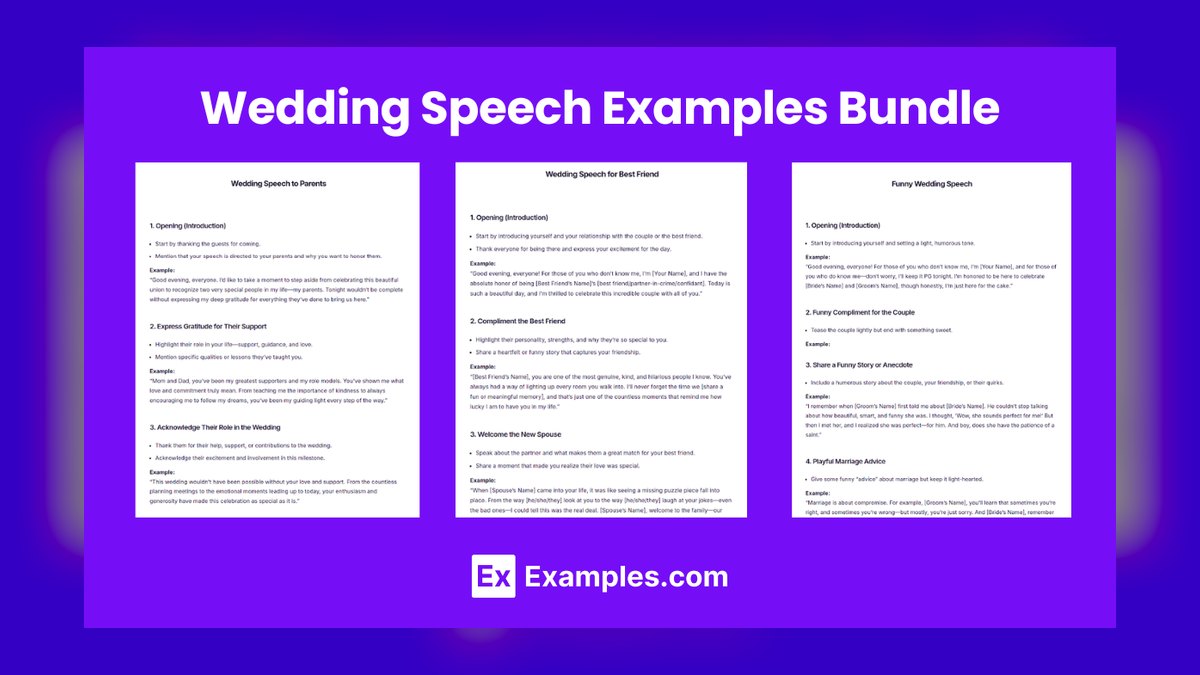
Length by role. Best person or maid of honor: three to five minutes, 350 to 600 words. Parent of either partner: three to five minutes, with the longer end acceptable if they are one of only two speakers. Sibling who is not in the wedding party: two to three minutes. Friend or colleague speaking as one of several: ninety seconds to two minutes, 180 to 280 words. Couple thanking guests together: two to three minutes total, split. Officiant remarks are separate and not counted here.
Total speech block. Most receptions can absorb twelve to eighteen minutes of speeches before attention degrades measurably — you can watch it happen as phones come out. Three speakers at four minutes each plus transitions lands comfortably inside that. Six speakers at four minutes each does not, and this is where couples should either cut speakers or cut lengths. If your wedding has five or more speakers, everyone should target two to three minutes, and you should say so explicitly when you invite people, because nobody self-regulates without a number.
Word count math. Write to 130 words per minute as a planning figure. A four-minute target is 520 words on the page, but you should draft to about 620 and cut, because delivered speech runs longer than read speech once you add pauses and laughter breaks. Time yourself out loud at full delivery pace, not skim pace — skimming a page underestimates real delivery by roughly 20 to 30 percent.
Rehearsal count. Five to eight full out-loud run-throughs is the practical range for a speech you will deliver from notes. Three is enough only if you are unusually comfortable speaking. Fifteen-plus tends to produce a recital cadence that sounds memorized rather than felt. Do at least two of those run-throughs standing up, and at least one in front of a person.
Notes format. Index cards or a single sheet in 14- to 16-point type, in the hand, unapologetically. Reading is fine; being lost is not. Phones are workable but read as less formal and risk a notification or a screen dimming mid-sentence — set do-not-disturb and screen timeout to five minutes if you go that route.
Content mix. For a four-minute speech, a workable split is roughly: 30 seconds of setup and who-you-are, 90 to 120 seconds of the single story, 45 seconds of what it means about the person, 30 to 45 seconds directly addressing the partner you know less well, and 15 to 20 seconds of toast. Notice how little room that leaves — which is the point. The constraint is what forces the choice.
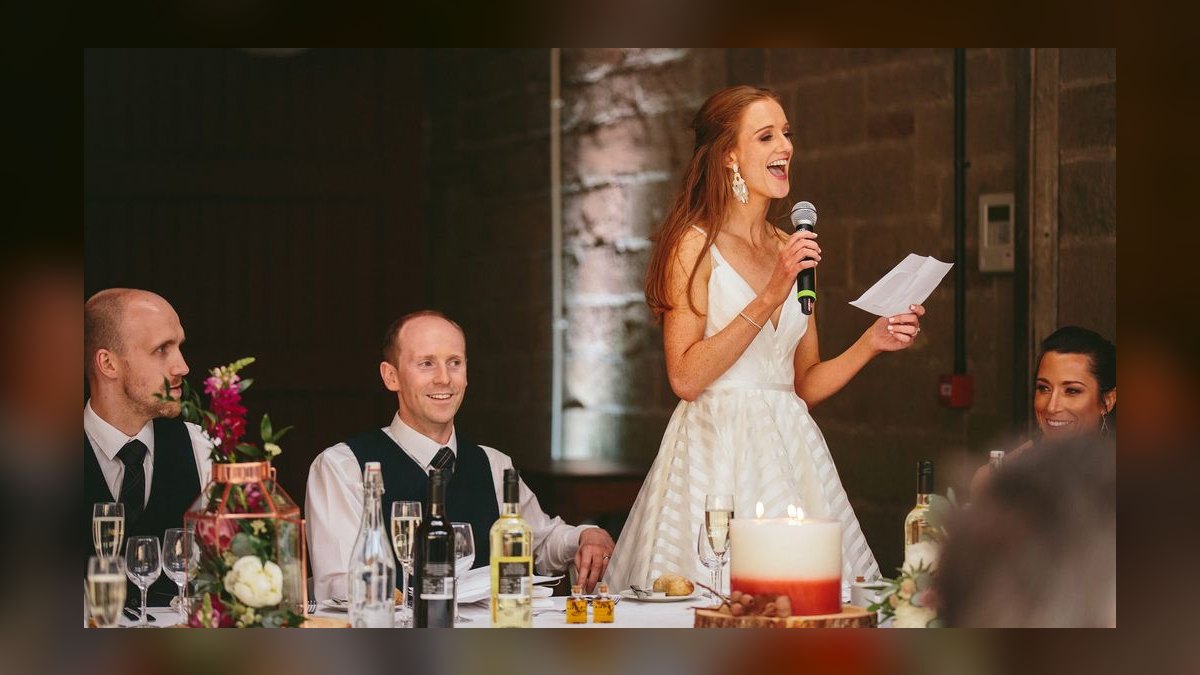
Lead time. Start four to six weeks out if you can. Collect material for a week without writing. Draft in week two. Leave it alone for a week. Cut and rehearse in the final two weeks. Speeches written in the final 48 hours are recognizably different, and the difference is not the prose — it is that there was no time to discover which story was actually the right one.
Risks, edge cases, and failure modes
The failure modes are predictable enough to check against directly.
The ex. Never mention a previous partner of either person, even affectionately, even as a joke that the couple would find funny in private. There is no version of this that improves the speech, and there are many versions that end it.
The inside joke with no on-ramp. A reference that eight people understand makes the other 140 feel excluded, and it converts what should be a shared moment into a private one performed in public. If you must use one, spend a sentence letting everyone in: "There's a thing we say — it started when..." Two seconds of setup makes the joke land for the whole room instead of one table.
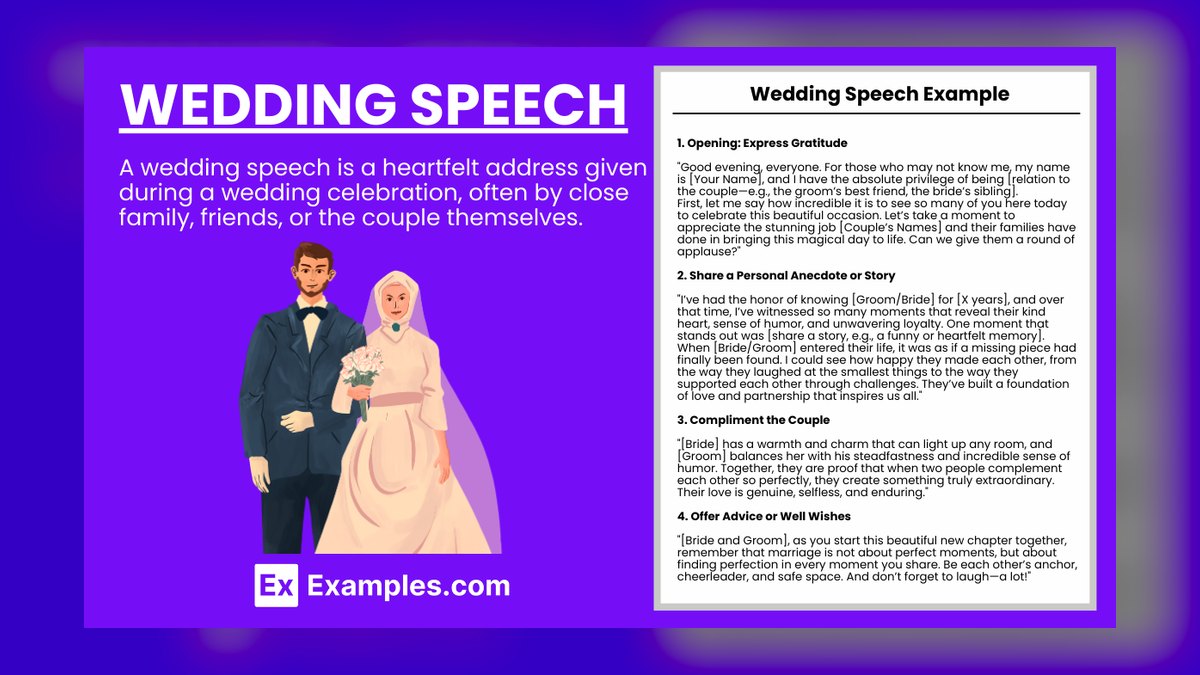
The roast that misreads license. Bachelor-party material, drinking stories, and anything about the couple's past dating life belong to a different event. The reliable filter: would you say this in front of the couple's grandparents and their boss, because both are in the room. If the answer is no, cut it — not soften it, cut it.
Ignoring the partner you know less well. This is the most common structural miss, and it is the easiest to fix. If you are the bride's oldest friend, at least 30 to 45 seconds should be directed at her partner, by name, with something specific you have observed — how they are together, something that partner did that told you they were right for your friend. Without it, the speech reads as a tribute to one person delivered at a wedding for two.
The apology opening. "I'm not good at this," "I hate public speaking," "I'll keep it short, I promise." These lower the room's expectations and cost you the first fifteen seconds, which are your most valuable. Open with the story or a single concrete line instead.

Overrunning. A speech that goes long damages the ones after it, delays the meal service, and eats the band's set. If you are speaking third and the first two ran over, cut a section live — drop your setup and go straight to the story. Know in advance which 45 seconds you would sacrifice.
Reading from a phone that dies or locks. Print a backup. Always.
Edge cases worth planning for. If a parent has died, decide with the couple in advance whether and how to acknowledge them — never surprise anyone with grief. If families are estranged or there has been a recent divorce, keep your framing to the couple and avoid family-wide sweep statements. Second weddings and blended families often include children; a single warm, specific line naming them is enormously appreciated and almost never done. If you are one of several speakers, ask the others what story they are using — the same anecdote told twice is a real and frequent collision. If alcohol is involved, the operative rule is simple: speak first, drink after.
AI-drafted speeches. Using a model to help organize or tighten is unremarkable now. Using one to generate the content is detectable, because it produces claims without specifics — "her kindness knows no bounds" instead of the snowstorm. If you use one, feed it your actual raw material and let it help with structure and cuts, not with what to say about people it has never met.
A practical rollout plan
Here is the sequence that reliably produces a fitted speech, mapped to a four-week runway.
Week one — collect, do not write. Keep a running note. Every time a memory surfaces, log one line: what happened, where, roughly when. Aim for fifteen to twenty fragments. Text two or three mutual friends and ask what they remember. Do not judge material yet; volume now makes selection easy later.
Week two — choose and draft. Read your list and pick the one story that makes you feel something when you read it. That reaction is the signal. Write the theme sentence first — the single thing you want the room to understand about this person — then write the story to prove it. Draft fast and long; 700 to 800 words is fine at this stage. Then write the closing toast as a separate exercise so it does not inherit the drift of the draft.
Week three — cut and shape. Read it aloud with a timer. Cut every sentence that does not either advance the story or deliver the theme. Cut the second-best joke; it is competing with your best one. Add the 30 to 45 seconds addressed to the partner you know less well if you have not already. Get to your target word count with 10 percent margin.
Week four — rehearse and stress-test. Five to eight full out-loud runs, at least two standing, at least one in front of someone who will tell you the truth. Send it to one person who knows both partners and ask one question: is there anything here that lands wrong? Print two copies in large type. Confirm with whoever is running the reception when you are speaking and how long you have.
On the day: eat something, have one drink at most before you speak, and get the timing confirmed rather than assumed. When you stand, wait three full seconds for the room to settle before your first word — it feels endless and it works. Speak to the back wall, not the microphone. When you reach the toast, say the couple's names clearly, raise the glass, and stop. The single most underrated move in wedding speaking is sitting down immediately after the toast instead of adding one more thought.
Related questions
How long should a wedding speech be in 2027?
Two to four minutes for most speakers, three to five for a parent or lone best-person speech. At 120 to 140 spoken words per minute, that is roughly 250 to 600 words. Keep the whole speech block under about fifteen to eighteen minutes across all speakers.
Should I write it myself or use notes?
Write it yourself and read from notes without apology. Index cards or one large-type sheet is standard and invisible to guests. Memorizing fully tends to produce a recital cadence and creates a failure point if you blank mid-speech.
What if I barely know one half of the couple?
Say so warmly, briefly, then use it. Describe what you have observed about them together and one specific thing the partner did that told you they were right for your friend. Observation from a shorter vantage often lands harder than long history.
Can I mention the couple's rough patch or breakup?
Only with explicit permission from both, and usually not. Struggle stories work when the couple has already made the story public themselves. Otherwise you are disclosing something private to 150 people on their behalf.
What if multiple speakers pick the same story?
Ask in advance. Text the other speakers two weeks out and trade one-line summaries of what you plan to use. Duplicate anecdotes are common and easy to avoid, and the second telling always lands worse than the first.
FAQ
How do I choose which story to tell?
Write down fifteen to twenty memory fragments over a week without evaluating them, then pick the one that produces an actual reaction when you reread it. Test it against your theme: does this story prove the one thing you want the room to understand? If yes, that is your story. Resist the anthology instinct — one story told in detail outperforms four told in summary because detail is what convinces people you actually know the couple.
How much can I tease the couple?
It depends entirely on your relationship and the room. Siblings and lifelong friends have real license; colleagues and newer friends have almost none, because guests have no baseline for your tone and will read edge as unkindness. Use this filter regardless of category: at least three people present already know the story, none of them would wince, and you would say it in front of both a grandparent and a boss.
Do I have to talk about the partner I know less well?
Yes, and it is the most common miss. Devote 30 to 45 seconds of a four-minute speech to addressing them by name with something specific you have observed — how they are together, or one moment that showed you they were right for your friend. Without it, the speech reads as a tribute to one person delivered at an event for two.
Is it acceptable to read from my phone?
It works, but paper is safer and reads as slightly more considered. If you use a phone, enable do-not-disturb, set the screen timeout to five minutes, and print a backup anyway. Screens dim, notifications arrive, and batteries fail at exactly the wrong moment. Nobody has ever criticized a speaker for holding a card.
How far in advance should I start?
Four to six weeks is the comfortable runway: one week collecting material, one week drafting, one week away from it, and two weeks cutting and rehearsing. Expect three to six hours total for a four-minute speech. Speeches written in the last 48 hours are recognizably weaker, not because the prose is worse but because there was no time to discover which story was the right one.
What should the last line be?
The toast, and nothing after it. Name both people clearly, say the one forward-looking thing your story earned, raise the glass, and sit down. The most common ending failure is adding a stray extra thought after the toast, which deflates the moment you just built. Write the closing separately from the draft so it stays clean.
Sources
- https://www.brides.com/wedding-speech-tips-5115614
- https://www.theknot.com/content/wedding-toast-tips
- https://www.marthastewart.com/7891076/wedding-toast-tips
- https://www.weddingwire.com/wedding-ideas/wedding-speech-tips
- https://hbr.org/2014/06/how-to-give-a-killer-presentation
- https://www.toastmasters.org/resources/public-speaking-tips
- https://www.vogue.com/article/how-to-write-a-wedding-speech
- https://www.nytimes.com/guides/how-to-give-a-toast
Related on PULSE
- How to plan the speech order at a wedding reception
- How to write a maid of honor toast that isn't generic
- How to rehearse a speech so it sounds unscripted
- How to handle public speaking nerves before a toast
- How to run reception timing so the program doesn't overrun
 pulse-speechesA Toast for a Baby Shower
 pulse-speechesA Graduation Toast From a Proud Parent
 pulse-recentHow to Choose the Right Wedding Speech Structure for Your Role in 2027
 pulse-speechesPatrick Henry’s Give Me Liberty or Give Me Death (1775) — Text and Lessons
 pulse-speechesA Welcome Speech for a New Neighbor Gathering
 pulse-speechesA Speech for a Customer Appreciation Event
 pulse-speechesA Toast for a Housewarming
 pulse-speechesHow to Structure a Best Man Speech
 pulse-speechesA Speech for Welcoming a New Hire
 pulse-speechesA Toast for a Christening