Surviving the Procurement Gauntlet: Defending Price and Terms When a Champion-Built Deal Gets Handed to Procurement (2027) β a 60-Minute Sales Training
π‘οΈ The Pulse Training
Who this is for: Account executives, enterprise sellers, sales managers, and deal-desk owners whose deals β built over weeks with a real champion β suddenly get routed to a procurement, sourcing, or vendor-management team in the final stretch. The champion goes quiet. A category manager you have never met emails asking for a "best and final," a 15% discount, NET-90 terms, and a side-by-side against two competitors.
This is the moment most sellers either cave on margin or freeze and let the deal stall into next quarter.
What teams leave with: The 5-STAGE PROCUREMENT GAUNTLET FRAMEWORK β DECODE β RE-ANCHOR β TRADE β PACKAGE β CLOSE β plus the 4 procurement tactics every seller falls for, the concession-trading discipline that protects margin, two full role-plays, a deliberate counter-case stress-test, and a leave-behind script card.
Manager brings: (1) Three recent deals that went to procurement β one won clean, one won at a deep discount, one lost or stalled. (2) The current discount-approval / deal-desk matrix. (3) A whiteboard tally of last quarter's average discount on procurement-involved deals vs. champion-only deals.
Direct Answer
A champion-built deal handed to procurement is not an ambush β it is a predictable, decodable process with a finite set of moves. Procurement does not route a deal to a sourcing team to *kill* it; they route it to *de-risk and discount* it. Sellers who treat that moment as a hostile surprise cave on price and terms; sellers who treat it as a process keep the champion engaged behind the glass, re-anchor on value and total cost of ownership, and trade every concession for something in return.
This 60-minute training installs the DECODE β RE-ANCHOR β TRADE β PACKAGE β CLOSE framework, names the four tactics procurement uses to make you cave (extreme anchor, competitor decoy, "best and final," deadline squeeze), drills it through two pressure-tested role-plays, and β critically β teaches the counter-case: the three conditions under which running the Gauntlet is the *wrong* move and a disciplined walk is the win.
The single rule that survives the hour: never give a concession β always trade one.
π TL;DR
- The problem: Week 9, a deal moves from your champion to a procurement team. The champion goes silent. The seller panics and discounts. On a $140K deal at ~78% gross margin, every 1 point of discount erases ~$1,400 of pure gross profit β a panicked 18-point give-away vaporizes ~$25K.
- The framework: 5 stages β DECODE the procurement mandate via the champion, RE-ANCHOR off list price onto total cost of ownership, TRADE every concession for equal value, PACKAGE one clean bundled offer, CLOSE on terms not just price.
- The 4 tactics: Extreme anchor Β· Competitor decoy Β· "Best and final" Β· Deadline squeeze. Each has a named counter.
- The discipline: Concessions are made slowly, in shrinking increments, and *always traded β never given* (Harvard Program on Negotiation).
- The counter-case: Run the full Gauntlet only when (a) you have a live champion, (b) the deal clears your margin floor at a realistic discount, and (c) your offer is genuinely differentiated. If any one is false, fix it or walk.
- The meeting: 60 minutes β 8 intro, 22 teach, 12 discussion, 15 role-play, 3 debrief β runnable as-is.
MEETING AGENDA β 60 MINUTES
| Time | Block | Owner | Outcome |
|---|---|---|---|
| 0:00-0:08 | Intro + Cold Open β two reps, same deal size, one caved to 22% off and NET-75, one held at 6% off for a multi-year commit | Manager | Procurement is a process, not an ambush β it can be navigated |
| 0:08-0:30 | Teach β the 5-stage Procurement Gauntlet (DECODE / RE-ANCHOR / TRADE / PACKAGE / CLOSE) + the 4 tactics sellers fall for | Manager | Reps can recite all 5 stages and name the 4 tactics |
| 0:30-0:42 | Discussion β 7 prompts on champion silence, "best and final," competitor decoys, when to walk | Manager + room | Audit last quarter's procurement-deal discounts |
| 0:42-0:57 | Role-Play x2 β R1: category manager demands 20% + NET-90; R2: "best and final" call with a competitor decoy on the table | Pairs | Run all 5 stages live under pressure |
| 0:57-1:00 | Debrief + Leave-Behind β commitments + the Gauntlet Script Card | Manager | One concession-trade habit per rep this week |
π― Bottom Line
Procurement does not hand a champion-built deal to a sourcing team to *kill* it β they do it to *de-risk and discount* it. The seller who treats procurement as a hostile ambush caves on price and terms. The seller who treats it as a predictable, decodable process keeps the champion engaged behind the scenes, re-anchors on value and total cost of ownership, and trades every concession for something in return.
Five stages. Four tactics. Never give a concession β always trade one.
SECTION 1 β INTRO + AGENDA (0:00-0:08)
π‘ Coach Note
Eight minutes, hard stop. Do not open with the discount matrix. Open with the two-rep story and the one number that stings: the gap between your team's average discount on procurement-involved deals versus champion-only deals. That gap is the entire ROI of this hour.
1.1 The two-rep cold open
Rep A had a $140K annual deal. Strong champion β a VP of Operations who had co-built the business case. Week 9, the champion emailed: *"Looping in our procurement team to finalize."* A category manager Rep A had never met replied with a request for a 20% discount, NET-90 payment terms, an uncapped liability clause, and a side-by-side comparison against two competitors.
Rep A panicked, assumed the deal was slipping, and offered 18% off plus NET-75 to "keep it alive." Final: $115K, NET-75, margin gutted, and procurement still asked for more.
Rep B had a nearly identical $135K deal. Same week-9 hand-off. Same category-manager email.
Rep B did four things: (1) called the champion *before* responding to procurement and asked what the procurement mandate actually was; (2) re-anchored every commercial conversation on total cost of ownership and the documented business case, not list price; (3) treated each procurement demand as a tradeable item, never a free giveaway; (4) packaged a final offer that traded a modest 6% discount for a 3-year commitment, a case-study reference, and faster payment terms.
Final: $127K average annual value, 3-year lock, margin intact.
Same deal. Same procurement team. A $12K-per-year swing β and across a 3-year term, a $36K total-contract-value difference β decided entirely by how the seller handled the hand-off.
1.2 Why this is the highest-leverage hour on the calendar
Most sales trainings teach the front of the funnel: prospecting, discovery, demo. The procurement gauntlet sits at the *back* of the funnel β and the back of the funnel is where margin lives or dies. A discovery mistake costs you a deal you never had.
A procurement mistake costs you margin on a deal you already *won*. Per CSO Insights / Korn Ferry sales-performance research, win rates on forecasted deals hover in the 45-50% range across B2B β meaning roughly half the deals your reps mark "commit" still slip or shrink, and the procurement stage is where a disproportionate share of that shrinkage happens.
The deal is already in the bag commercially; only the *terms* are still moving. That is the single most concentrated margin decision your reps make all quarter, and most of them make it on instinct, alone, at 4:55 PM on a Friday.
Walk the room through the asymmetry one more time, because it is the emotional core of why reps cave. When a deal is in discovery, the rep's downside is *time* β a few hours of meetings on a deal that may never close. When a deal is at procurement, the rep's downside is *the deal itself* β a forecasted, told-the-manager-about-it, commission-already-mentally-spent deal.
Loss aversion, the principle the Harvard Program on Negotiation and behavioral economists like Daniel Kahneman have documented repeatedly, says a loss feels roughly twice as painful as an equivalent gain feels good. So a rep staring at a procurement demand is not making a rational margin calculation; the rep is making a fear calculation.
The Gauntlet framework exists to replace the fear calculation with a process the rep can run while afraid. That is the whole design goal: not to make reps fearless, but to make them *executable* under fear.
There is also a quieter cost the room rarely names: the *renewal*. A deal that procurement grinds into a thin, resentful margin does not just hurt this year's number. It sets the floor for the renewal three years from now, because procurement files the discount you gave and re-anchors the renewal against it.
A 22% discount given in panic today is not a one-time $30K loss β it is a $30K loss *compounding across every renewal cycle the account stays alive*. The reps who internalize that stop seeing the procurement stage as a single transaction and start seeing it as the opening move of a decade-long account relationship.
That reframe alone is worth the hour.
β οΈ Common Trap
"The champion went silent, so the deal must be in trouble." Champion silence at the procurement stage is almost never a buying-signal problem β it is a *process* signal. Per Gartner's B2B buying-journey research, buyers spend only about 17% of the entire purchase journey meeting with potential suppliers; when that 17% is divided across an average of ~3 competing vendors, any single supplier gets roughly 5-6% of total buyer mindshare.
A quiet stretch is the statistical norm, not a danger sign. Procurement rules often forbid the champion from negotiating commercials directly. The champion is still on your side; they are just behind glass.
Transition: "For the next 22 minutes: the five stages of the procurement gauntlet, and the four tactics that make sellers cave."
SECTION 2 β THE TEACH (0:08-0:30)
π‘ Coach Note
Twenty-two minutes. Spend ~12 on the 5 stages and ~10 on the 4 tactics. End-of-section test: every rep recites all five stage names and names all four tactics without notes.
2.1 The 5-STAGE PROCUREMENT GAUNTLET β DECODE β RE-ANCHOR β TRADE β PACKAGE β CLOSE
You do not win a procurement-led close by being the cheapest. You win it by DECODING what procurement is actually mandated to achieve, RE-ANCHORING the conversation off list price and onto value and total cost of ownership, TRADING every concession for something of equal worth, PACKAGING a final offer that is hard to counter, and CLOSING with terms that protect both margin and the relationship.
Per Gartner's research on the B2B buying journey, the modern enterprise buying group numbers 6-10 people, and sourcing and procurement functions are now pulled into deals earlier and with more authority than a decade ago. Run the math on why the stakes are real: a typical SaaS gross margin sits around 75-80% β public benchmarks bear this out, with companies like Adobe (NASDAQ: ADBE), Salesforce (NYSE: CRM), and ServiceNow (NYSE: NOW) all reporting gross margins above 75% in recent filings β so on a $140K deal carrying roughly $110K of gross profit, every 1 point of discount erases about $1,400 of pure margin, and a panicked 18-point give-away on Rep A's deal vaporized ~$25K of gross profit in a single email.
A framework is cheaper than improvisation.
The five stages are sequential but not rigid. You DECODE first because everything downstream depends on knowing the mandate. You RE-ANCHOR before you TRADE because trading off a list-price anchor concedes the frame.
You PACKAGE before you CLOSE because an item-by-item negotiation never *ends*. But in a live deal, you may loop β a new procurement contact appears and you DECODE again, or a fresh competitor decoy lands and you RE-ANCHOR again mid-TRADE. Teach the sequence as a discipline, not a script.
2.2 Stage 1 β DECODE (the procurement mandate)
Before you respond to a single procurement demand, find out β usually through your champion β what procurement has actually been *told to do*. A category manager is rarely freelancing. Per the CIPS (Chartered Institute of Procurement & Supply) professional competency framework, sourcing leads are trained to run structured, multi-round competitive events against an explicit mandate: a savings target, standardized payment terms, a security or liability clause, or simply a documented paper trail of competitive tension.
A 20% discount ask might really be an "8% of documented savings" mandate dressed up as an opening bid β and 8% is a number you can hit through trades that cost margin far less than 20% off list.
The DECODE conversation does three things at once. First, it surfaces the *real* objective so you are not negotiating against a number procurement invented for theater. Second, it re-activates your champion as an inside ally β even one who cannot negotiate commercials can usually tell you what "done" looks like for the sourcing team.
Third, it buys you time: the act of asking good DECODE questions converts a one-email panic into a multi-touch process you control.
A subtle point reps miss: DECODE is not a single phone call, it is a *posture*. From the moment a deal is routed to procurement, every interaction is an opportunity to learn more about the mandate β including interactions with the category manager directly. Procurement professionals are not adversaries by temperament; they are process-runners under their own quota.
Many category managers will tell you their savings target *if you ask in a way that lets them keep face* β framed as "help me bring you something useful on the first pass" rather than "what is the lowest you will accept." The seller who treats the category manager as a fellow professional with a job to do, rather than a gatekeeper to be outmaneuvered, decodes faster and with less friction.
This is also the discovery muscle from the procurement-vs-buyer engagement question (q136): the line buyer cares about the outcome, procurement cares about the *process and the paper trail* β and you sell to each on their own terms.
One more DECODE discipline: write the mandate down. After the champion call, the rep should be able to complete the sentence "Procurement has been told to deliver ______, and the way they will know they succeeded is ______." If the rep cannot complete that sentence with specifics, DECODE is not finished and no offer should go out.
A vague mandate produces a vague counter, and a vague counter is how reps end up discounting against a number nobody actually asked for.
What procurement is typically mandated to deliver falls into four buckets, and reps should learn to listen for which one is live:
| Mandate type | What procurement is told to deliver | What it actually costs you to satisfy | Decode signal |
|---|---|---|---|
| Savings target | A documented X% reduction vs. a reference quote | Often satisfiable via trades, not raw discount | "We need to show savings to the steering committee" |
| Terms standardization | NET-60/90, specific liability cap, SLA language | Usually low margin cost, high cash-flow cost | "Our standard payment terms are NET-90" |
| Competitive process | A paper trail proving 2-3 vendors were compared | Near-zero margin cost β just participation | "We are required to run a competitive evaluation" |
| Risk/compliance gate | Security, indemnification, audit clauses cleared | Legal time, not margin | "Legal flagged the liability clause" |
π€ Verbatim Script β DECODE (to your champion)
*"Before I respond to your procurement team β help me help you. Is their goal a specific savings number, a payment-terms standard, or a competitive-process box to check? If I know what they actually have to deliver, I can build an offer that gets them a win and gets you the solution you picked. What does a 'done' look like for them?"*
π€ Verbatim Script β DECODE (direct to the category manager)
*"I want to make this efficient for both of us. So I bring you something useful on the first pass rather than a back-and-forth β what does success look like for your sourcing process here? Is it a specific savings figure, getting our terms onto your standard, or documenting a competitive evaluation? Tell me the goal and I will build toward it."*
2.3 Stage 2 β RE-ANCHOR (off price, onto total cost of ownership)
Procurement's job is to make the conversation about unit price. Your job is to make it about total cost of ownership and the business case your champion already built. Re-anchor on the cost of the problem, the value of the outcome, and the risk of the cheaper alternative β implementation drag, switching cost, support quality.
Per the Harvard Program on Negotiation (PON), first anchors exert a disproportionate gravitational pull on final outcomes β so whoever sets the reference number tends to win. When the documented business case projects $400K of annual impact, a $140K price is a 2.9x first-year return; re-anchored on that ratio, a 20%-off conversation becomes almost irrelevant.
Re-anchoring is not denial. You do not refuse to discuss price β that reads as evasive and burns trust. You *reframe* what number is on the table.
The category manager wants the discussion to be "$140K vs. a discount." You move it to "$140K vs. the $400K of impact, the cost of the status quo, and the switching risk of the cheaper option." The price line item does not disappear; it simply stops being the only number in the room.
The mechanics of a re-anchor are worth slowing down on, because reps tend to *announce* a re-anchor instead of *executing* one. Announcing sounds like: "Well, you should really think about the value here." That is a slogan, not an anchor β it has no number, so it exerts no gravity.
Executing a re-anchor sounds like: "The business case your VP built projects $400K of annual impact, and the status quo is costing roughly $33K a month while this sits unsigned." Now there are two hard numbers on the table that are *larger* than the price, and the Harvard Program on Negotiation research on anchoring says the conversation will drift toward whichever numbers are most concrete and most repeated.
The discipline is: never re-anchor without a number, and repeat the number every time price comes up.
A second re-anchor technique is the *comparison swap*. Procurement wants you to compare your price to a competitor's price. You swap the comparison to: your price vs. the cost of the problem, or your price vs. the cost of a failed implementation.
Frameworks like Keenan's Gap Selling and the value-based pricing research from McKinsey and Bain all converge on the same point β buyers who anchor on the *cost of the problem* tolerate a far higher price than buyers who anchor on a competitor's quote, because the problem cost is usually an order of magnitude larger than the price difference.
When a buyer says a competitor is 15% cheaper, the disciplined re-anchor is not "but we are better" β it is "a 15% price difference is roughly $21K a year; the business case says the *problem* is costing $400K a year, so the real question is which option closes that gap fastest and most reliably." That sentence does not deny the competitor exists; it makes the competitor's price look like a rounding error against the stake.
Re-anchoring also has a defensive job: it protects the champion's credibility. When procurement believes your price is unjustified, the unspoken subtext is that the champion picked badly. A clean re-anchor β grounded in the champion's own documented business case β does the opposite: it makes the champion look like a rigorous buyer who chose the highest-ROI option.
Reps who re-anchor well are not just protecting margin; they are protecting the internal standing of the person who will renew and expand the account for the next decade.
A useful re-anchor inventory β the reference points you can put on the table that are *not* list price:
| Re-anchor lever | The number it surfaces | Why procurement cannot easily dismiss it |
|---|---|---|
| Cost of the problem | Annual cost of the status quo the buyer is solving | Their own champion documented it |
| Value of the outcome | Projected annual impact / ROI multiple | Pre-agreed in the business case |
| Switching/implementation cost | Hours, ramp time, integration risk of a swap | Hard, real, and felt by the end users |
| Total cost of ownership | 3-year all-in cost including support and risk | Procurement is trained to respect TCO |
| Cost of delay | Monthly value lost while the deal stalls | Reframes the deadline as the buyer's problem |
π€ Verbatim Script β RE-ANCHOR
*"I want to make sure we're comparing the right number. The business case your VP of Operations built projects roughly $400K of annual impact. The conversation we should have isn't '$140K versus a 20% discount' β it's 'what's the fastest, lowest-risk path to that $400K.' Happy to talk price, but let's price the outcome, not just the line item."*
2.4 Stage 3 β TRADE (never give, always trade)
This is the discipline that protects margin. Every concession procurement asks for β discount, terms, clauses β is a *thing of value*. The Harvard Program on Negotiation is explicit on this: concessions should be made slowly, in shrinking increments, and *always traded β never given away*.
You never hand a concession over for free. A discount trades for a longer commitment, a bigger volume tier, a reference, a case study, faster payment, or a reduced scope. Quantify the trade: a 3-year commitment converts a one-year deal into roughly 3x the contract value and a far lower renewal-loss risk, which is exactly why a deal desk will approve a 6% discount against it but not against a bare one-year term.
The mechanics matter. A trade has three parts: the *ask* (what they want), the *get* (what you want in return), and the *link* (the explicit sentence that ties them together). Reps fail at trading not because they refuse to discount but because they discount and *then* ask for something β by which point the concession is already spent.
The link must be spoken before the concession lands: "I can do X *if* you can do Y." If Y does not happen, X does not happen.
There is a sequencing rule inside the trade that reps consistently get wrong: *concede the cheap things generously and the expensive things reluctantly, and never in the same breath*. Payment terms, a start-date adjustment, a reference call β these cost you little, so you can move on them quickly and visibly, which builds the impression of a flexible, reasonable counterparty.
Raw discount is the expensive thing; it moves last, slowly, in shrinking increments, and only against a real get. The Harvard Program on Negotiation guidance on concession patterns is explicit: a negotiator who concedes in *shrinking* steps signals they are approaching a true limit, while a negotiator who concedes in steady or growing steps signals there is always more to give.
If your reps go 18% β 15% β 12%, procurement correctly reads that as "keep pushing." If they go 6% β 7% β 7.5%, procurement reads that as "we are near the floor." Same endpoint, completely different signal.
A second discipline: every trade must be *quantified out loud*. When a rep trades a 6% discount for a three-year term, the rep should say what the term is worth β "a three-year commitment roughly triples the contract value and removes two renewal-loss risk events, which is exactly why my deal desk will approve the 6% against it." This does three things.
It justifies the discount to procurement's own steering committee, which is a gift to the category manager. It makes the trade feel *fair* rather than extracted. And it trains procurement that, with you, discounts have a price β they are bought with commitment, not with persistence.
The concession-as-scope-trade framing in (q288) is the same muscle: a concession that is named, priced, and linked to a get is a trade; an unnamed concession is just a discount with extra steps.
What reps trade *for* matters as much as the discipline of trading. The strongest gets are the ones that compound: a multi-year term (compounds into contract value and forecast stability), a logo and case study (compounds into future pipeline and social proof), an executive reference (compounds into credibility on the next ten deals), and an expanded scope or seat tier (compounds into a larger renewal base).
Weak gets are one-time and non-compounding β a vague "good relationship," a promise to "consider us next time." Coach reps to trade only for things that keep paying after the ink dries. The margin-eroding-concession question (q334) makes the same point from the defensive side: saying no to a free concession is only half the skill; the other half is knowing which paid concession to say yes to.
Build a standing trade ladder so reps are not improvising. On the left, what procurement commonly asks for. On the right, what each ask is worth and what you trade it for:
| Procurement asks for | Approx. margin cost | Trade it for | Why the trade clears deal desk |
|---|---|---|---|
| 6% discount | ~$8,400/yr on a $140K deal | 3-year commitment | Triples contract value, cuts renewal-loss risk |
| 10-12% discount | ~$14K-17K/yr | Multi-year + volume tier expansion | Larger committed base offsets per-unit give |
| NET-90 payment terms | Cash-flow cost, near-zero margin | Faster signature / earlier start date | Working-capital trade, not a margin trade |
| Removed feature/scope | Negative cost β you save delivery | Lower price WITH narrower scope | Honest re-scope, not a discount |
| Custom contract language | Legal time | Reference call + logo rights | Marketing value offsets legal cost |
| Logo / case study | Near-zero cost to buyer | A modest, deal-desk-bounded discount | You buy proof at a controlled price |
π€ Verbatim Script β TRADE
*"I can move on price. Here's how that works on our side: a discount at that level needs a multi-year commitment to be approved β it's a volume trade. If you can commit to three years instead of one, I can take the annual number down meaningfully. One-year term at list, or three-year term at a real discount. Which serves your team better?"*
2.5 Stage 4 β PACKAGE (the offer that's hard to counter)
Do not negotiate item by item β that lets procurement nibble forever. Assemble one clean, bundled final offer where every concession is visibly tied to a trade, and present it as a coherent package: "Here is the whole thing; the pieces don't come apart." Note the asymmetry in the numbers: a 6% discount costs you roughly $8,400 a year on a $140K deal, while moving payment terms from NET-90 to NET-30 improves your cash position by about two months of working capital at near-zero margin cost β package the cheap concession generously and the expensive one tightly.
The package has a property procurement finds genuinely hard to counter: *interdependence*. When the discount, the term, the payment schedule, and the reference are presented as a single structure, pulling any thread forces the whole thing to be re-built β and re-building means re-justifying to the steering committee.
A loose pile of line items invites a thousand cuts. A welded package invites a yes-or-no decision. That is the entire point of Stage 4.
The package should also be explicitly framed as *deal-desk-approved*. This is not a small detail. It tells procurement that what they are looking at is not your opening bid but your *organization's* sanctioned best structure β which makes further grinding look like a request to go around your company's controls.

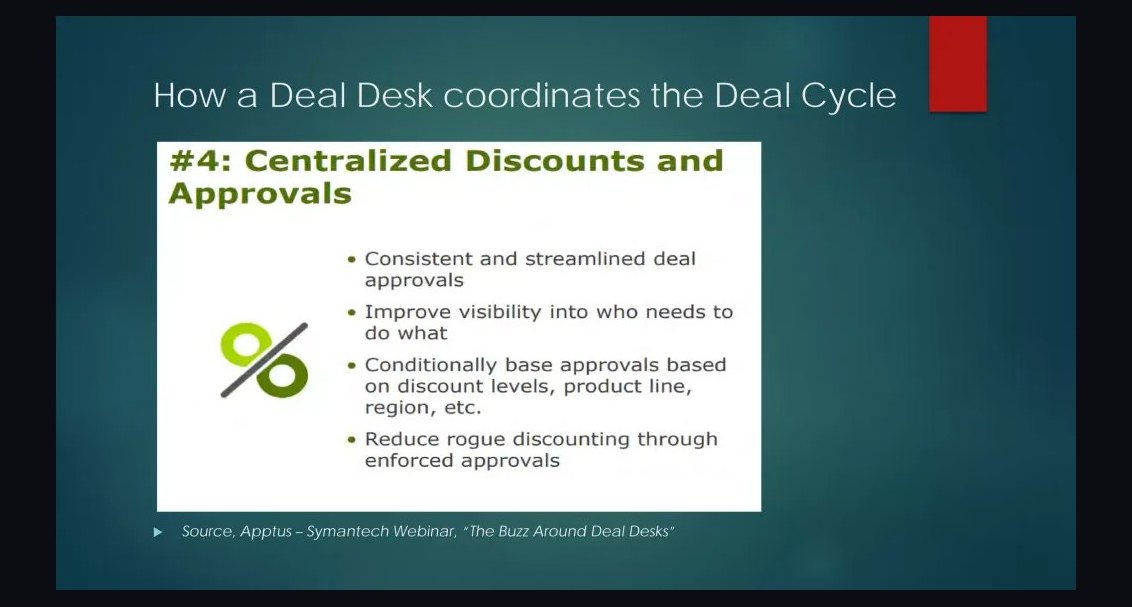
Procurement professionals respect process; use yours. A deal desk is, in effect, your own internal procurement function β and procurement-to-procurement, the conversation is far more civil than seller-to-procurement. When a rep says "this is what my deal desk approved," the category manager hears a fellow process-runner, not an evasive salesperson.
The discount-approval-matrix mechanics in (q1162) are the backbone of this: a rep whose company has a clear, defensible discount governance matrix can package with conviction, because the rep genuinely cannot go further without breaking a control β and procurement can tell the difference between a rep who *will not* and a rep who *cannot*.
Packaging also solves a timing problem. An item-by-item negotiation has no natural endpoint β there is always one more line to revisit, one more clause to reopen. A package has a built-in decision moment: yes, no, or one specific counter to the *whole structure*.
That forces procurement to either accept, walk, or make a serious counter-proposal β and a serious counter-proposal is itself a buying signal. The redline-flood scenario in (q1111), where procurement drops a wave of unfamiliar contract changes late in the cycle, is best answered with packaging discipline: rather than litigating twelve redlines one at a time, the rep bundles a response β accept these four, trade on these five, hold firm on these three with a stated reason β and presents it as one coherent counter-package.
The flood loses its power the moment it meets a structured response instead of twelve separate panics.
π€ Verbatim Script β PACKAGE
*"Here's the complete package, and it's built to move together. Three-year term. A 6% discount off the annual number β earned by that term length.
NET-30 payment. A reference call and a case study after 90 days of use. This is our deal-desk-approved best structure.
If a piece changes, the package has to be rebuilt β but as it stands, this is something I can get signed today."*
2.6 Stage 5 β CLOSE (lock terms, protect the relationship)
Close on the *non-price* terms too β term length, auto-renewal, scope, the trades you secured β and re-engage the champion to confirm the package lands. The goal is a signature that protects margin without burning the relationship you will renew against in three years. A 3-year term also de-risks your own forecast: instead of three annual renewal events each carrying renewal-loss exposure, you have one signature covering 36 months.
The CLOSE stage is where reps most often leave value on the table by treating "signed" as the finish line. It is not. The order form is the *contract* β every trade you negotiated must appear *in writing* in it, or it does not exist.
The reference call, the case study, the auto-renewal language, the scope boundary, the start date that justified the faster terms β all of it goes into the document. Procurement teams are paid to find ambiguity at renewal; remove the ambiguity now.
Re-engaging the champion at CLOSE matters for a second reason: the champion is your renewal insurance. A deal that procurement grinds into a margin-thin, resentful signature renews badly. A deal where the champion watched you trade fairly, protect their chosen solution, and treat their procurement team with respect renews β and expands.
The CLOSE is not the end of this deal; it is the opening position of the next one.
There is a specific failure mode at CLOSE worth naming: the *verbal trade that never makes the paper*. A rep secures a three-year term and a reference call in conversation, feels the deal is done, and lets the procurement team draft an order form that quietly contains only the price and a one-year term with the trades omitted.
Six weeks later the rep discovers the discount was given but the term that justified it was not captured β the trade collapsed and only the concession survived. Procurement teams are not necessarily acting in bad faith here; an order form is drafted by whoever drafts it, and what is not specified is not included.
The discipline is absolute: the rep reads the final order form line by line against the trade ladder before signature, and every get is named in the document. Term length, auto-renewal trigger, scope boundary, reference commitment, start date, payment terms β if it was traded, it is written.
A final CLOSE move that separates good reps from great ones: confirm the *sign-off path*, not just the *sign-off date*. "Sign by Thursday" is meaningless if the rep does not know whose signature is required and in what order β procurement, legal, the budget owner, the VP. Great reps map the signature chain explicitly and ask the champion to confirm it, because a deal that is "agreed" but routed to an unmapped approver is a deal that slips into next quarter for reasons that have nothing to do with price.
The economic-buyer identification work in (q182) pays off here: the rep who knew the real economic buyer from the start knows whose signature actually closes the deal.
π€ Verbatim Script β CLOSE
*"Let's lock it. Three-year term, the 6% earned discount, NET-30, the reference and case-study trades documented in the order form so there's no ambiguity at renewal. I'll send the paper today. Can you and your VP confirm sign-off by Thursday so we both hit your timeline?"*
2.7 The 4 procurement tactics every seller falls for
Procurement professionals are trained negotiators running a repeatable playbook. The good news: the playbook is *short*. Four tactics account for the overwhelming majority of what makes sellers cave. Name them in the room, out loud, and a rep who can name a tactic mid-call is a rep who will not fall for it.
Tactic 1 β The extreme anchor. Procurement opens with a demand far beyond what they expect to get (20% off, NET-90) so that "only" 12% feels like a win. The Harvard Program on Negotiation documents anchoring as one of the most reliable levers in any negotiation β the first number spoken drags the final number toward it.
*Counter:* never treat the opening number as the real target; re-anchor immediately β remember a 20% open often masks an 8% mandate. Do not counter the anchor with a slightly smaller number; that *accepts* the anchor's frame. Move the conversation back to TCO.
Tactic 2 β The competitor decoy. "We're also looking at [Competitor X], who came in lower." Sometimes true, often a leverage prop. *Counter:* ask specific, scoping questions about the alternative β a real comparison survives scrutiny; a decoy does not. "Lower on what scope?
Same implementation support? Same SLA? Same security posture?" A genuine competitor produces specific answers; a decoy produces vagueness.
Tactic 3 β "Best and final." Designed to make you empty your bag in one move. *Counter:* a best-and-final is a *trade*, not a *give* β your best-and-final is contingent on their commitment. "My best and final exists β and it is contingent on a signature this week and the three-year term.
If those hold, here is the number. If they do not, there is no best-and-final to give yet."
Tactic 4 β The deadline squeeze. "We need this signed by Friday or we move on." *Counter:* real deadlines have reasons; ask what is driving it. If real, the deadline is leverage *for you* to ask for a trade in exchange for speed: "I can compress our side to hit Friday β that fast-track itself is a concession, so let's pair it with the multi-year term."
Teach reps the meta-pattern behind all four tactics: every one of them is an attempt to make the rep negotiate against *themselves*. The extreme anchor makes the rep mentally settle for less before procurement has conceded anything. The competitor decoy makes the rep imagine a loss that has not happened.
"Best and final" makes the rep spend every concession at once with no get. The deadline squeeze makes the rep trade calm judgment for speed. None of the four tactics actually changes the economics of the deal β they change the *rep's emotional state*, and a rep in a worse emotional state makes worse decisions.
The single most powerful counter to all four is simply naming the tactic, silently, in the rep's own head: "this is an extreme anchor" is a sentence that instantly restores judgment. A rep who can name the move is a rep the move no longer works on. That is why this section is taught out loud and tested without notes β recognition speed is the whole skill.
It is also worth telling the room what procurement is *not* doing. Procurement is not trying to destroy the relationship, is not personally hostile, and β critically β is usually not lying. The competitor "who came in lower" often genuinely exists; the deadline often is real.
The tactics are not deceptions to be exposed; they are *pressure* to be absorbed and redirected. A rep who treats every procurement move as a bluff to be called will eventually call a real one and lose the deal. The discipline is not skepticism β it is *scope-testing*: ask the specific question, accept the honest answer, and respond with a trade either way.
| Tactic | What it sounds like | Why it works on untrained reps | The named counter |
|---|---|---|---|
| Extreme anchor | "We need 20% off and NET-90" | Makes a smaller give feel like a win | Re-anchor on TCO; never counter the anchor |
| Competitor decoy | "Vendor X came in lower" | Triggers fear of loss | Scope-test the alternative with specifics |
| Best and final | "Give us your best and final" | Pressures you to spend every concession at once | Make it contingent on their commitment |
| Deadline squeeze | "Sign by Friday or we move on" | Manufactures urgency | Ask what drives it; trade speed for a term |
SECTION 3 β DISCUSSION (0:30-0:42)
π‘ Coach Note
Twelve minutes. Run the seven prompts fast. The deliverable is an honest audit of last quarter's discounting on procurement-involved deals. Keep a running whiteboard tally β the gap between procurement-deal discounts and champion-only discounts is the number that should follow reps out the door.
- Champion silence. When a champion goes silent at the procurement stage, what's our default assumption β and is it right? What would change if we assumed "process," not "danger"?
- What procurement actually won. What did procurement actually *win* on our last three procurement-led deals β was it ever really just price, or was it terms, a competitive paper trail, or a savings number to report upward?
- Free concessions. Name one concession we gave for free last quarter that we could have traded. What would we have asked for in return?
- Real vs. decoy. How do we tell a real competitor threat from a decoy? What scope-test question works best for our category?
- The discount gap. What's our honest average discount on procurement deals vs. champion-only deals β and what does each point cost us in gross profit at our margin?
- Tradeable vs. non-negotiable. Which procurement demands are clauses we can trade, and which are non-negotiable risk we must hold? Where is the line on liability and indemnification?
- When to walk. When should we be willing to walk β and what does walking actually look like, said out loud, with the door left open?
SECTION 4 β ROLE-PLAY (0:42-0:57)
π‘ Coach Note
Fifteen minutes, two role-plays. Pairs swap roles. Observer scores against the 5 stages using the scorecard below β one point per stage executed cleanly, five total.
4.1 Role-Play 1 β The discount-and-terms demand
Setup. A category manager demands 20% off and NET-90 on a $140K deal, citing "company standard." The champion β a VP of Operations β has gone quiet but is reachable.
The seller must: (1) DECODE β call the champion before responding, surface whether the mandate is savings, terms, or process; (2) RE-ANCHOR β move the conversation onto the $400K business case and TCO; (3) TRADE β link the discount explicitly to a multi-year commitment; (4) PACKAGE β present one bundled, deal-desk-approved offer; (5) CLOSE β lock the non-price terms in writing and re-engage the champion.
Observer scorecard:
| Stage | What "executed cleanly" looks like | Score 0-1 |
|---|---|---|
| DECODE | Reached the champion before answering procurement; named the mandate | |
| RE-ANCHOR | Moved off list price onto TCO / business case | |
| TRADE | Spoke the link sentence β "X only if Y" β before conceding | |
| PACKAGE | Presented one bundled offer, not line items | |
| CLOSE | Locked terms in writing; named a sign-off date |
4.2 Role-Play 2 β The "best and final" call
Setup. Procurement says a competitor came in 15% lower and asks for a best-and-final by Friday. The seller must test whether the competitor is real, refuse to empty the bag, and PACKAGE a contingent final offer.
The seller must: scope-test the competitor decoy with specific questions; refuse to give a non-contingent best-and-final; identify whether the Friday deadline is real or manufactured; convert any deadline into a trade for speed; and present a contingent package. Observer scores the same five-stage card, with extra attention to whether the rep made the best-and-final *contingent* rather than absolute.
4.3 Running the role-plays well
Two coaching notes for the manager running this section. First, make the procurement role genuinely hard. The rep playing the category manager should not fold at the first re-anchor β they should push, repeat the anchor, name a competitor, and apply the deadline. A role-play where the procurement side is soft teaches nothing; the value is entirely in the pressure.
Hand the procurement-side rep a short card with their mandate, their decoy, and their deadline so they have ammunition.
Second, debrief on process, not outcome. The point of the role-play is not whether the rep "won" β it is whether the rep ran all five stages. A rep who decoded, re-anchored, traded, packaged, and closed but still landed an 8% discount executed *better* than a rep who improvised to 6% with no champion call and no documented trades, because the disciplined rep will be repeatable next quarter and the improviser will not.
Score the card honestly, stage by stage, and praise the process.
| Common role-play failure | What it looks like | The fix to coach |
|---|---|---|
| Skipping DECODE | Rep answers procurement's email immediately | "Who did you call first, and what did they tell you?" |
| Announcing not executing re-anchor | "Think about the value" with no number | Demand a hard number every time price comes up |
| Discounting before linking | Rep names a discount, then asks for a term | The link sentence comes first, always |
| Negotiating line by line | Rep concedes item, item, item | Bundle into one package and present once |
| Verbal-only trades | Rep "agrees" a term but never writes it | Read the order form against the trade ladder |
SECTION 5 β DEBRIEF + COMMITMENTS (0:57-1:00)
π‘ Coach Note
Three minutes. Each rep names one concession-trade they'll apply to a live deal this week. Write the commitments down; review them at the next pipeline meeting.
Each rep commits to: (1) one open deal they will DECODE this week by calling the champion; (2) one concession they will trade rather than give; (3) one verbatim script they will use, named aloud.
| Rep commitment | Specifics to capture |
|---|---|
| DECODE a live deal | Which deal, which champion, by when |
| Trade not give | Which concession, what they will ask in return |
| Use a verbatim script | Which of the five stage scripts, on which call |
SECTION 5B β THE COUNTER-CASE: WHEN THE GAUNTLET PLAYBOOK IS THE WRONG TOOL
π‘ Coach Note
Five minutes, and the most important five minutes in the room for your best reps. A framework that is never questioned becomes a religion, and religious sellers lose deals they should win and win deals they should walk. Run this section last, out loud, as a deliberate stress-test of everything taught above.
Everything in Sections 1 through 5 assumes one thing: that procurement is running a *de-risk-and-discount* process on a deal you genuinely deserve to win. That assumption is correct most of the time. It is not correct all of the time β and a rep who runs DECODE β RE-ANCHOR β TRADE β PACKAGE β CLOSE on autopilot will mishandle the cases where it does not hold.
5B.1 Counter-case 1 β Procurement is right and your price is genuinely out of line
Sometimes the category manager is not anchoring. Sometimes your quote really is 20% above a fair market rate because it was built on an inflated "list" nobody pays, or because a prior rep over-scoped the deal. Re-anchoring on total cost of ownership against a buyer who has accurate benchmark data does not make you persuasive β it makes you look uninformed, and it burns the champion's credibility for having picked you.
The tell: procurement cites *specific, verifiable* comparables β named competitors, real published rates, a documented internal benchmark β rather than a vague "we can do better elsewhere." When that happens, the correct move is not TRADE; it is to go back to your own deal desk and re-scope honestly.
A framework cannot defend a price that should not be defended.
5B.2 Counter-case 2 β The deal economics no longer clear your floor
The Gauntlet is built to *protect* margin, not to *win at any cost*. If the only path to signature is a discount that pushes the deal below your gross-margin floor, or payment terms that turn a profitable contract into a working-capital drain, the disciplined answer is to walk β politely, with the door open.
Recall the margin math: on a $140K deal at ~78% gross margin, a "give them what they want" 22% discount erases roughly $30,800 of gross profit. Some deals are worth more dead than alive. A rep who has never walked from a procurement-led deal is almost certainly leaving margin on the table on every other one, because procurement can feel it.
5B.3 Counter-case 3 β There is no champion behind the glass
The entire DECODE stage depends on a champion who is still on your side and can tell you the procurement mandate. If the champion has actually left, been overruled, or was never as strong as you believed, you are not navigating a process β you are negotiating blind. The honest move here is not to fake a mandate you cannot verify; it is to *rebuild* sponsorship before you respond to a single procurement demand, or to qualify the deal down in your forecast.
Running RE-ANCHOR with no internal voice to carry the business case is theater.
5B.4 Counter-case 4 β It is a pure commodity buy
For genuinely undifferentiated purchases β where switching cost is near zero and every vendor is interchangeable β procurement *should* win on price, and a reverse auction is a rational process, not a hostile one. Trying to RE-ANCHOR on "value" a buyer correctly perceives as identical across vendors wastes their time and yours.
The strategic answer is upstream: either differentiate the offer *before* it reaches procurement, or accept the commodity dynamics and compete on cost-to-serve.
| Counter-case | The tell | Wrong move | Right move |
|---|---|---|---|
| 1 β Price genuinely out of line | Specific, verifiable comparables cited | Grind a TCO re-anchor | Re-scope honestly with your deal desk |
| 2 β Deal below margin floor | The only path to yes breaks your floor | Cave to "save" the deal | Walk politely, door open |
| 3 β No champion | Champion left, overruled, or never strong | Fake a mandate you cannot verify | Rebuild sponsorship first, or qualify down |
| 4 β Pure commodity buy | Zero switching cost, interchangeable vendors | Re-anchor on "value" | Differentiate upstream or compete on cost-to-serve |
β οΈ Common Trap
"We have a framework, so we should always be able to hold price." No. The Gauntlet is a tool for *capturing the margin a deal genuinely supports* β not a spell for conjuring margin a deal does not. The most expensive mistake is not caving; it is grinding a fair-price re-anchor against a buyer who has done their homework, losing the deal *and* the relationship, and never knowing the price was the problem.
Use the framework to win the winnable and walk the unwinnable with discipline. Both are wins.
The decision rule: Run the full Gauntlet when (a) you have a live champion, (b) the deal clears your margin floor at a realistic discount, and (c) your offer is genuinely differentiated. If any one of those three is false, stop running stages β fix the missing condition first, or walk.
SECTION 6 β LEAVE-BEHIND: THE GAUNTLET SCRIPT CARD
The 5 Stages: DECODE the mandate β RE-ANCHOR on total cost of ownership β TRADE every concession β PACKAGE one clean offer β CLOSE on terms, not just price.
The 4 Tactics: Extreme anchor Β· Competitor decoy Β· "Best and final" Β· Deadline squeeze.
The Margin Math: On a $140K deal at ~78% gross margin, every 1 point of discount = ~$1,400 of lost gross profit. A 6% discount = ~$8,400/yr. NET-90 β NET-30 = ~2 months of working capital recovered at near-zero margin cost.
The Decision Rule: Run the full Gauntlet only when you have a live champion AND the deal clears your margin floor AND your offer is differentiated. If any one is false β fix it or walk.
The One Rule: Never give a concession. Always trade one.
| Stage | One-line prompt | The script trigger |
|---|---|---|
| DECODE | What is procurement actually mandated to deliver? | "What does 'done' look like for them?" |
| RE-ANCHOR | What number should we really be comparing? | "Let's price the outcome, not the line item." |
| TRADE | What do I get for this concession? | "I can do X only if you can do Y." |
| PACKAGE | One bundle, not line items | "It is built to move together." |
| CLOSE | Is every trade in writing? | "Documented in the order form." |
Related Pulse Sales Trainings
The Procurement Gauntlet does not stand alone β it is one stage of a deal's life, and it works best when the trainings around it have already been run. Pair this session with:
- [The Pricing Conversation: When to Introduce, When to Defend, When to Walk (st0006)](/sales-trainings/st0006) β the upstream discipline. If your reps set price badly *before* a deal ever reaches procurement, no amount of RE-ANCHOR or TRADE will recover it. Counter-case 1 in this training is a direct symptom of a weak pricing conversation earlier in the cycle. See also the founder-level framing in (q9537) on separating healthy price negotiation from margin-eroding discounting. Run st0006 first.
- [Multi-Threading Enterprise Deals: Earning the Right to the Economic Buyer (st0002)](/sales-trainings/st0002) β the prevention. The Gauntlet's DECODE stage depends on a live champion who can tell you the procurement mandate. Reps who multi-thread early have a *second* internal voice when the first goes quiet behind the glass β which directly defuses Counter-case 3. The mechanics are covered in (q183) on multi-threading a single-champion deal and (q182) on identifying the real economic buyer.
- [The Champion Departure Save: Rebuilding the Deal When Your Champion Walks (st0033)](/sales-trainings/st0033) β the recovery play. If DECODE reveals your champion has actually left or been overruled, stop running the Gauntlet and switch to st0033 to rebuild sponsorship. The fast-momentum-recovery scenario is also addressed in (q333), where procurement pivots from your champion to a competing vendor at the final hour.
- [Objection Handling: "We Need to Think About It" (st0003)](/sales-trainings/st0003) β the adjacent skill. The deadline-squeeze tactic and champion silence both produce stall behavior; the stall-diagnosis muscle from st0003 transfers directly to telling a real procurement deadline from a manufactured one. The price-compression variant β when a buyer has already found a cheaper alternative β is handled in (q324).
- [The Expansion QBR: Turning a Quarterly Business Review Into a Six-Figure Upsell (st0031)](/sales-trainings/st0031) β the downstream payoff. The CLOSE stage here locks a multi-year term; st0031 is how you turn that locked relationship into expansion revenue at the next QBR instead of re-fighting the same procurement battle at renewal.
For deeper procurement-specific mechanics, the Pulse knowledge base also covers the right way to engage procurement versus the line buyer (q136), how to handle procurement adding a wave of unfamiliar redlines late in the cycle (q1111), how to say no to a margin-eroding concession while keeping the deal alive (q334), and how to position concessions as scope-creep trades rather than discounts in multi-year procurement (q288).
For discount governance, see the discount-approval matrix discussion in (q1162).
Sequencing for managers: run st0006 β st0002 β st0036 (this) β st0031 as a four-part arc β set price well, multi-thread early, survive procurement, then expand. Keep st0003 and st0033 on hand as the two break-glass sessions for when a deal stalls or a champion disappears mid-Gauntlet.
Sources & further reading
- Gartner β The B2B Buying Journey: research finding that buyers spend only ~17% of the purchase journey with suppliers, that buying groups number 6-10 people, and that procurement is pulled into deals earlier than ever. https://www.gartner.com/en/sales/insights/b2b-buying-journey
- Gartner β Buying group size and dynamics: the 6-10 person enterprise buying group benchmark. https://www.gartner.com/en/sales/insights/b2b-buying-journey
- CIPS (Chartered Institute of Procurement & Supply) β Global Standard for Procurement and Supply: the professional competency framework that trains category managers to run structured, mandate-driven competitive events. https://www.cips.org/
- CIPS β Negotiation guidance for procurement professionals: structured multi-round sourcing event practice. https://www.cips.org/intelligence-hub
- Harvard Program on Negotiation (PON) β Anchoring in negotiation: the disproportionate pull of first offers on final outcomes. https://www.pon.harvard.edu/
- Harvard Program on Negotiation (PON) β Making concessions: concessions should be made slowly, in shrinking increments, and always traded. https://www.pon.harvard.edu/daily/negotiation-skills-daily/
- Harvard Program on Negotiation (PON) β BATNA and reservation price: know your walk-away before you enter the room. https://www.pon.harvard.edu/tag/batna/
- Roger Fisher and William Ury, "Getting to Yes" (Harvard Negotiation Project): principled negotiation, separating people from the problem, objective criteria. https://www.pon.harvard.edu/
- Chris Voss, "Never Split the Difference": tactical empathy and calibrated questions in adversarial negotiation.
- CSO Insights / Korn Ferry β World-Class Sales Practices and win-rate benchmarks: forecasted-deal win rates across B2B. https://www.kornferry.com/
- Gartner β "The B2B Buying Journey is Getting More Complex": the rise of buying-group complexity. https://www.gartner.com/en/sales
- Forrester β B2B buying study: the expanded role of procurement and sourcing in the modern purchase. https://www.forrester.com/
- McKinsey & Company β B2B sales and pricing research: discounting discipline and margin leakage. https://www.mckinsey.com/
- Bain & Company β pricing and commercial excellence research: the impact of price realization on profit. https://www.bain.com/
- Harvard Business Review β "How to Negotiate with Powerful Suppliers" (Petersen, Handfield): supplier-side leverage and counter-strategy. https://hbr.org/
- Harvard Business Review β "Pricing to Create Shared Value": value-based pricing over cost-plus. https://hbr.org/
- The Gap Selling framework, Keenan: anchoring the conversation on the cost of the problem. https://salesgrowth.com/
- MEDDIC / MEDDPICC sales qualification methodology: the Economic Buyer and Champion roles in enterprise deals. https://meddic.academy/
- CEB / Gartner β "The Challenger Sale," Dixon and Adamson: reframing and constructive tension with buyers.
- Procurement Leaders (a World 50 Group community): category-management practice and sourcing-event design. https://procurementleaders.com/
- Institute for Supply Management (ISM): the U.S. professional body for supply management and sourcing. https://www.ismworld.org/
- Adobe Inc. (NASDAQ: ADBE) β annual report (Form 10-K): SaaS gross margin above 75% as a public benchmark. https://www.adobe.com/investor-relations.html
- Salesforce, Inc. (NYSE: CRM) β annual report (Form 10-K): subscription gross margin benchmark. https://investor.salesforce.com/
- ServiceNow, Inc. (NYSE: NOW) β annual report (Form 10-K): subscription gross margin benchmark. https://investors.servicenow.com/
- SaaS Capital β Gross margin benchmarks for private SaaS companies: the 75-80% gross-margin band. https://www.saas-capital.com/
- KeyBanc Capital Markets β SaaS survey: private-company SaaS financial benchmarks including gross margin. https://www.key.com/
- OpenView Partners β SaaS benchmarks report: pricing, discounting, and margin practice in B2B SaaS. https://openviewpartners.com/
- RAIN Group β sales negotiation research: the behaviors that distinguish top negotiators in sales. https://www.rainsalestraining.com/
- Gong.io β revenue intelligence research: conversation data on discounting and deal-stage language. https://www.gong.io/
- CFO working-capital guidance β days sales outstanding and payment terms: the cash-flow impact of NET-30 vs. NET-90. https://www.cfo.com/
- Aberdeen Group / Spend Matters β procurement and sourcing research: category-management benchmarks and sourcing-event practice. https://spendmatters.com/
- Harvard Business Review β "Negotiating with Emotion": managing emotional pressure tactics like the deadline squeeze. https://hbr.org/
Run the five stages. Name the four tactics. Trade β never give.