
The SDR Outbound Calling Coaching Reboot — 60-Min Training
 Curated byKory White · Fractional CRO · Maryland
 PULSEKNOWLEDGE LIBRARY
The SDR Outbound Calling Coaching Reboot is a runnable 60-minute manager training that swaps "do more dials" for four mechanisms: live shadow-listening on muted calls, a 30/30/30 review mix of openers/objections/closes, 60–90 second snippet reviews, and a daily public best-call award. It fixes what reps *say*, not how many times they dial.
What it is and why it matters
The Reboot is a single, repeatable 60-minute session you run with your Outbound front-line managers — not with the reps themselves. Its job is to reset how managers spend Coaching time. Most Outbound floors over-index on activity metrics — dials, connects, meetings booked — because those numbers are trivial to pull from a dashboard. But the input that actually moves conversion is the language a rep uses in the first 45 seconds and at the first objection. You cannot fix that in a Monday huddle; you fix it by listening, silently and frequently, on the live wire.
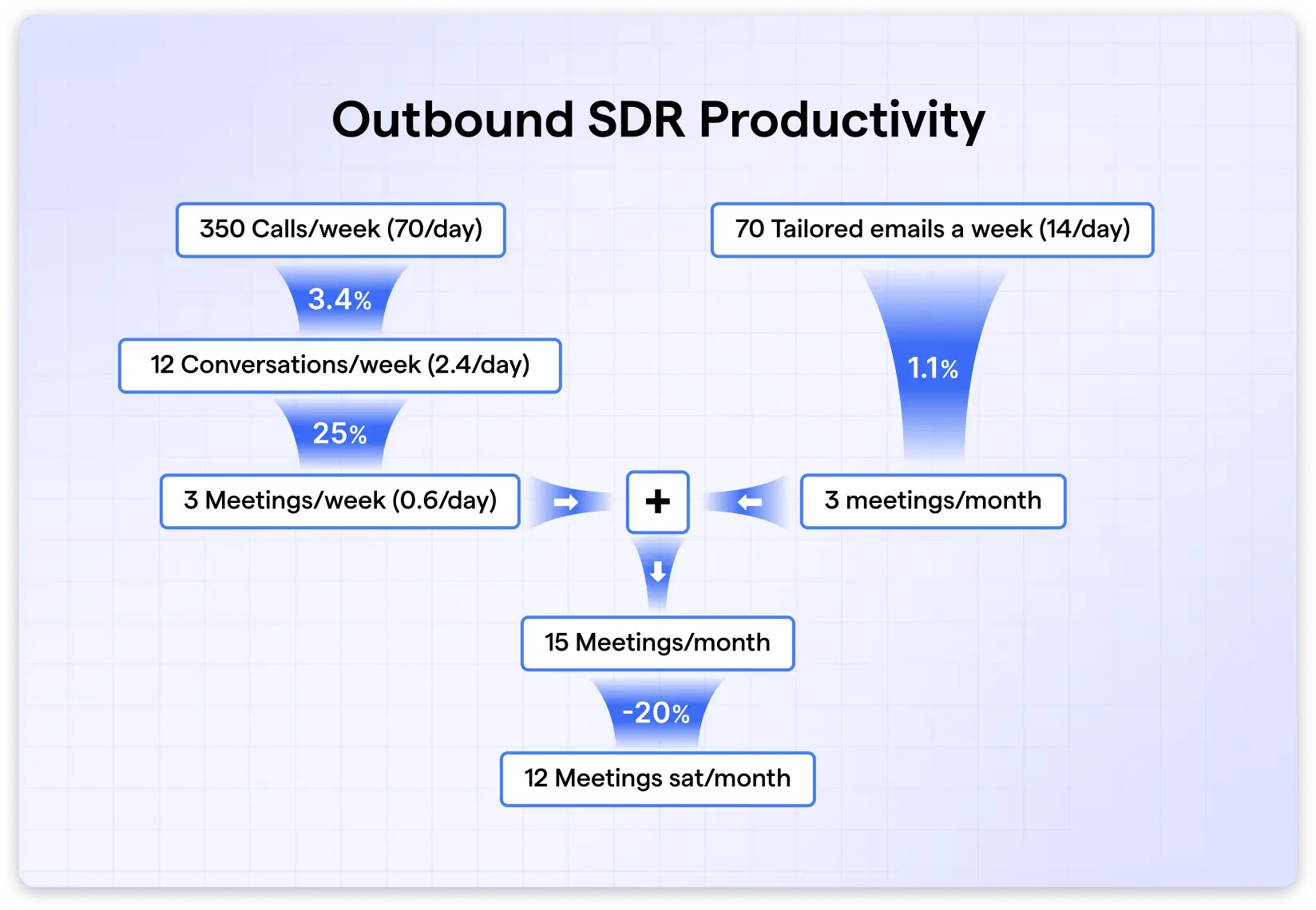
Conversation-intelligence research from platforms like Gong and Chorus has consistently shown the same pattern: the performance gap between top-quartile and bottom-quartile SDRs is driven far more by *talk-pattern variance* — opener structure, objection handling, and the meeting ask — than by raw Calling volume. Top performers routinely dial less than the bottom of the floor yet book multiples more meetings. The lever is skill, not speed. That is the premise the entire Reboot is built to install in your managers' heads.

Why does it matter now? Because Coaching is the highest-leverage, most-neglected part of an SDR manager's week. When a manager's calendar fills with pipeline reviews, forecast calls, and recruiting, live-call Coaching is the first thing cut — and it's the only thing that compounds. A rep who improves their opener once improves it on every call for the rest of their tenure. This Reboot exists to protect that time and give managers a concrete, non-negotiable ritual for it. It is designed for B2B SaaS teams in roughly the $25K–$500K ACV band, where cold Outbound Calling is still a primary pipeline source and a 5–10 percentage-point lift in connect-to-conversation rate meaningfully changes the number.
The philosophy borrows from practitioners who have pushed live-call Coaching for years — the "coach the moment, not the metric" school. SDRs rarely have a *Calling* problem in the abstract; they have a *moment* problem: a weak opener, a fumbled "not interested," a vague meeting ask. Isolate the moment, quote it back verbatim, and rehearse the fix. That's the whole game, and it's why this sits at the center of any serious sales-development operation.
The step-by-step process to run the session
Run the hour as four tight blocks so nothing drifts into lecture. Managers retain what they *do*, not what they hear.

Block 1 — Cold open (10 min): why dial counts lie. Put one fact on the screen — top SDRs make fewer dials but book far more meetings — and ask the room, *"If volume isn't the lever, what is?"* Write every answer on the whiteboard. You're priming managers to accept that Coaching the call, not counting the call, is the job. Name the failure mode out loud: managers default to dial dashboards because they're easy to pull, not because they predict revenue.
Block 2 — Live shadow-listen mechanics (15 min). This is the centerpiece. Walk managers through the silent-shadow ritual. Tools: Dialpad, Aircall, Outreach Voice, and most modern dialers support a manager "monitor" mode where the manager joins live with mic muted and the rep doesn't know which call is being shadowed. Cadence: three live shadows per rep per week, ~15 minutes each, rotated across morning, afternoon, and Friday blocks so you catch the rep tired, not just fresh. Give managers the verbatim expectation-setting line to deliver in a 1:1 (never mid-call): *"I'm going to silently shadow some of your live calls this quarter. I won't break in, and I won't ding you on dial count. I'm listening for your first 45 seconds and how you handle the first 'not interested.' We'll debrief Friday."* The unlock is the debrief: managers quote the rep back to themselves with a timestamp — *"On the Acme call at 2:47, you opened with 'How are you today' and the prospect's voice dropped"* — then role-play the fix on the spot.
Block 3 — Snippet dissection (15 min). Live shadowing is high-fidelity but low-volume; recorded snippets fill the gap. Gong, Chorus, and Salesloft Conversations all support clip-sharing. Pull three snippets per rep per week, each 60–90 seconds, time-stamped to the moment that matters — one best opener, one hardest objection, one best or worst close. Share each in a private Slack DM with a single sentence: *"Listen to 0:42–1:18 — clean objection handle, steal it for the next blitz."* In the Training, hand managers three 30-second clips from the team's worst call last week and have them rewrite the opener in under two minutes, then compare.
Block 4 — Role-play and commitment (20 min). Pick last month's top objection from pipeline data. Pair managers up: one plays the skeptical prospect, one practices the pivot; switch after five minutes. Close by having each manager write on a sticky note the three reps they'll shadow Monday, the time slot, and the Slack channel where the daily best-call goes. Read them aloud. Public commitment is the cheapest enforcement mechanism you have.
The 30/30/30 review mix is what managers apply every week after the Training. Coach the three moments in equal balance: 30% openers (score the first 45 seconds on three dimensions — pattern-interrupt yes/no, permission ask yes/no, reason for the call specific-or-generic); 30% objections (drill the rep's three most common handles — "not interested," "send me an email," "we already use a competitor" — using a label-and-validate move that acknowledges the objection before pivoting to a trigger event and a specific next step); and 30% closes (the meeting ask must name a specific time, date, and stakeholder — *"Does Tuesday at 10 or Thursday at 2 work better, and should we include your RevOps lead?"*). The final 10% is wildcard — a discovery question, a voicemail script, a LinkedIn follow-up — where reps are allowed to experiment.
Costs, timelines, and typical ranges
The Reboot is deliberately low-cost; its expense is manager time, not software.
Tooling. The core mechanisms — live shadowing and the public best-call award — require no special software beyond a dialer with monitor mode, which most teams already own. Snippet review benefits from a conversation-intelligence platform (Gong, Chorus, or Salesloft Conversations), which typically runs in the low-to-mid hundreds of dollars per seat per month at SMB and mid-market scale, but the Training is fully runnable without one: use manual call logs, or have reps replay a short segment from memory. Treat the platform as an accelerant, not a prerequisite.
Manager time budget. This is the real cost. For a manager running eight reps: three 15-minute shadows per rep per week (~45 min/rep), plus ~30 minutes pulling snippets, plus a 30-minute Friday 1:1 per rep. That lands near 12–14 hours a week — roughly a third of a manager's calendar. That third is the highest-ROI block they have; pipeline reviews and recruiting can wait, live Coaching can't. For smaller teams the number scales down cleanly: with four or fewer SDRs, a manager can shadow every rep in a single day and snippet reviews become even more personalized.
Spiff budget. The daily award and monthly bonus are cheap. A common structure: five best-call awards in a month earns a $250 spiff or an extra half-day of PTO. The physical trophy — a rotating desk object that sits with the winner for 24 hours — costs nothing and does most of the cultural work.
Timeline to results. Most managers report visible improvement in opener confidence and objection handling within one to two weeks. Full adoption of all four mechanisms usually takes three to four weeks. Conversion lift — measured as first-call-to-connect ratio and objection-to-next-step rate — tends to appear by the end of the first 30 days. Re-run the Training every quarter; the mechanics drift fast, and a floor that stops shadowing reverts to box-checking within a month.
How to measure ROI without vanity metrics. Track three lagging indicators over a 30-day window. First, first-call-to-connect ratio: does a rep's first call of the day turn into a conversation more often after the Training? Second, objection-to-next-step rate: when a rep hears "not interested" or "send me info," do they pivot into a qualifying question or a calendar invite rather than hanging up? Top performers convert a far higher share of objections into a next step than the bottom quartile. Third, snippet adoption: if the library holds ten proven openers, how many unique ones does each rep actually use per week — a count below three signals they're ignoring the Coaching. Cap it with a five-question day-30 survey ("Did the live shadow change how you open calls?"). Avoid measuring calls-per-hour; it rewards speed over skill and quietly kills the behavior change you just paid for.
Where teams get it wrong
Even with the right structure, most reboots fail within two weeks. Four traps account for nearly all of it.
Coaching the wrong call type. Managers gravitate toward booked-demo calls because they're already recorded and easy to access — but the real skill gap lives in cold first-touch Outbound outreach, the calls that open with a gatekeeper or a skeptical "who's this?" Limit live shadowing to first-touch and re-engagement Calling only. A polished demo call teaches you nothing about the opener that's actually leaking pipeline.
Feedback delivered too hot. A rep who just got hung up on is emotionally flooded and will hear any criticism as failure. Never coach in the ninety seconds after a bad call. Instead, make the rep self-diagnose first — *"Where did you feel the call slip?"* — then play back the 15-second clip where you actually heard the drop-off. Self-diagnosis before playback turns defensiveness into curiosity.
Fixing everything at once. If a rep stumbles on openers, objections, *and* closes, the instinct is to overhaul all three in one session — which guarantees none of them stick. Pick one mechanism per week. Sequence it: opener this week, objection handling next, meeting ask the week after. Behavior change is serial, not parallel.
Manager burnout and surveillance vibes. If every manager shadows five reps daily forever, they revert to checking boxes and the Coaching hollows out. Rotate shadowing duties, and lean on peer-to-peer review for lower-tenure reps. Just as important: without the public award, shadowing *feels* like surveillance. The daily best-call trophy is what flips the floor from "I'm being watched" to "I'm competing to be listened to." Skip the award and the whole system reads as monitoring — reps go quiet, sandbag their real calls, and the data you collect stops being representative.
A fifth, quieter failure: no verification loop. Shadowing a rep once and never re-checking means you never learn whether the fix took. Always re-shadow the same moment the following week; the loop that confirms the change is what separates Coaching from commentary.
Decision framework: when to choose what
Not every team needs all four mechanisms at full intensity from day one. Match the mechanism mix to team size, tooling, and rep tenure.
If you have no conversation-intelligence platform, lead with live shadowing plus the daily award — both are software-free — and defer heavy snippet review until you buy a tool. If you *do* have Gong or Chorus, front-load snippet review because it's high-volume and asynchronous, and reserve scarce live-shadow time for your newest reps. For a small floor (four or fewer SDRs), collapse the cadence: one manager can shadow everyone in a day, so run daily micro-shadows rather than a weekly three-per-rep schedule. For a large floor, protect manager capacity by rotating shadow duty and pushing peer review down to tenured reps.
Tenure is the other axis. New reps (0–90 days) need live shadowing weighted toward openers — the highest-frequency, highest-leverage moment. Mid-tenure reps (3–12 months) shift toward objection handling, where the marginal skill lives. Veteran reps often need the least shadowing and the most close discipline — the specific, stakeholder-named meeting ask that they've grown lazy about.
The guiding rule: choose the smallest mechanism set your managers can run *consistently* over the flashiest one they'll run for two weeks and abandon. Consistency compounds; intensity that collapses does not.
Related questions
How often should managers actually shadow each rep?
Three live shadows per rep per week, roughly 15 minutes each, rotated across morning, afternoon, and Friday time blocks. That cadence catches reps when they're tired, not just when they're fresh, without turning shadowing into constant surveillance that pushes reps to sandbag their real calls.
What's the single most important moment to coach?
The first 45 seconds. Opener structure — pattern-interrupt, permission ask, and a specific reason for the call — drives more variance in connect-to-conversation rate than any other moment. If you only have time to coach one thing, coach the opening on cold Outbound calls.
Do I need Gong or Chorus to run this?
No. Live shadowing and the daily best-call award require only a dialer with monitor mode, which most teams already own. A conversation-intelligence platform accelerates the 60–90 second snippet review, but you can substitute manual call logs or a rep replaying a segment from memory.
How is this different from normal sales Coaching?
Standard Coaching targets activity metrics — dials, talk time, meetings booked. This Reboot targets talk-pattern variance directly, using live shadow-listening and verbatim, timestamped snippet feedback instead of generic advice like "be more confident," which never changes what a rep actually says on the wire.
How long until I see conversion lift?
Opener confidence and objection handling usually improve within one to two weeks. Full adoption of all four mechanisms takes three to four weeks, with measurable conversion lift — first-call-to-connect and objection-to-next-step — typically appearing by the end of the first 30 days.
FAQ
How is this different from a standard sales coaching session? Most Coaching focuses on activity metrics like dials or meetings booked. This Reboot targets the specific talk-pattern variance that drives the gap between top- and bottom-quartile reps, using live shadow-listening and timestamped snippet review rather than generic feedback delivered in a group huddle.
Do I need expensive tools like Gong or Chorus to run this? No. A call-recording or transcription platform helps with the 60–90 second snippet review, but the core mechanisms — live shadowing on a dialer's monitor mode and the public best-call award — require no special software. Manual call logs or a rep replaying a short segment from memory work fine.
How long does it take to see results from this Training? Many managers report noticeable improvement in opener confidence and objection handling within one to two weeks. Full adoption of the four mechanisms typically takes three to four weeks, with conversion lift often appearing by the end of the first month.
Can this work for teams with fewer than five SDRs? Yes. The 30/30/30 review mix and daily best-call award scale down naturally. With a small team, the manager can shadow every rep in a single day, and snippet reviews become even more personalized because there are fewer reps competing for attention.
What if my reps resist being shadowed live? Frame it as a learning tool, not surveillance. Start with one shadow per rep per week and let reps choose which call to submit for the daily award. Most resistance fades after the first few sessions once reps see it's about improvement, not judgment — and once the award makes being listened to feel like winning.
Is this only for B2B SaaS companies in the $25K–$500K ACV range? The four-mechanism structure applies broadly, but the example scripts and objection patterns are tuned to that ACV band. For much lower or higher deal sizes, adjust the opener language and objection handling examples, but the shadowing, 30/30/30 mix, snippet review, and award structure stay effective.
Sources
- Gong Labs research and resources — https://www.gong.io/resources/
- The Bridge Group — SaaS SDR Metrics & Compensation research — https://blog.bridgegroupinc.com/
- Salesloft resource library — https://salesloft.com/resources/
- Chorus by ZoomInfo — conversation intelligence — https://www.chorus.ai/
- JB Sales — SDR training resources — https://jbarrows.com/
- Outreach resources and guides — https://www.outreach.io/resources
- Harvard Business Review — sales coaching research — https://hbr.org/
- Sales Hacker — SDR and outbound calling articles — https://www.saleshacker.com/
Related on PULSE
- [The SDR Daily Structure Reboot — 60-Min Training](/knowledge/st182)
- [The Outbound Sequence Design Reboot — 60-Min Training](/knowledge/st178)
- [The Outbound Email Reboot — 60-Min Training](/knowledge/st146)
- [Top 10 SDR facilitator guides for 2027](/knowledge/st0574)
- [Top 10 SDR workshop agendas for 2027](/knowledge/st0573)
- [Top 10 SDR role-play scenarios for 2027](/knowledge/st0572)
This page will be disappearing soon. Save it to your device for $1 — or read it free while it is here.
@Kory-White- · if Venmo asks, the last 4 of my number are 2012
 sales-trainingThe Trade Show Lead-Capture and Follow-Up Sprint — 60-Min Training
 sales-trainingConcrete and Foundation Repair Sales — 60-Min Training
 sales-training60-Min Sales Training: Multichannel Prospecting Cadences
 sales-trainingHardware Security Module (HSM) Selling to the CISO and Cryptography Lead — 60-Min Training
 sales-trainingAnnuity and Retirement Income Selling — 60-Min Training
 sales-trainingThe Inbound Speed-to-Lead Drill — 60-Min Training
 sales-trainingProperty Management Client Acquisition — 60-Min Training
 sales-trainingTree Service Estimate Selling — 60-Min Training
 sales-trainingRefinance and HELOC Conversion Selling — 60-Min Training
 sales-trainingCommercial Landscaping Maintenance Contract Selling — 60-Min Training