
Top 10 AI tools for content creation in 2027
 Curated byKory White · Fractional CRO · Maryland
 PULSEKNOWLEDGE LIBRARY
The 10 best ai tools for content creation are ranked below on measured performance, build quality, price, and how each one actually holds up in daily use rather than how it reads on a spec sheet. Each pick lists what it costs, who it suits, and what it gives up against the one above it, so the list can be read straight down without doubling back.
1. Descript

Descript ranks first because it collapses video, audio, and text editing into one transcript-based workflow, cutting production time by treating media like a document. Its agentic studio features turn a brief into a scripted, voiced, edited timeline, and it excels at demo and walkthrough content. Paid business tier runs roughly $24–$30 per user per month, making it a strong value for its scope. It natively supports screen recording and voice cloning, which are essential for modern video teams.
Descript is for teams that edit real footage, podcasts, or screen recordings rather than generating avatar-based video. It trades away the ability to create a synthetic spokesperson from scratch, which Synthesia handles better. Compared to Synthesia, Descript offers far deeper editing control and a lower entry price, but it requires source material to work with. Choose Descript when your workflow starts with existing video or audio, not a blank canvas.
2. Synthesia
Synthesia ranks second because it leads avatar-based video generation across 100+ languages, enabling personalized and localized content at scale without cameras or actors. Paid plans commonly start around $29–$89 per user per month, with enterprise tiers for custom avatars and API access. It excels at turning a script into a polished spokesperson video in minutes, which is unmatched for training, onboarding, and multilingual marketing. Its strength is speed and consistency for high-volume, short-form clips.
Synthesia is for organizations that need scalable, personalized video without production crews, but it suffers from avatar fatigue past several minutes of runtime. It trades away the editing depth of Descript, which handles real footage and complex timelines far better. Compared to Descript, Synthesia is the pick for generated spokespeople, not for editing existing media. Choose Synthesia when your priority is volume, localization, or personalization over editorial control.
3. Jasper

Jasper ranks third because it is the strongest multi-channel copywriting engine with a brand-voice feature that ingests existing content to match tone precisely. Business pricing generally lands in the $49–$69 per-seat range, which is mid-tier for the category. It offers campaign workflows that connect natively to HubSpot and Salesforce, reducing manual handoffs between drafting and distribution. Its long-form quality is superior for high-stakes content.
Jasper is for marketing teams that produce brand-consistent blogs, emails, and ads and need CRM integration to close the loop. It trades away the raw workflow automation of Copy.ai, which chains approvals and scheduling more aggressively. Compared to Copy.ai, Jasper offers superior brand voice control and long-form quality but requires more manual setup for complex automation. Choose Jasper when brand consistency and CRM depth matter more than fully autonomous content pipelines.
4. Copy.ai

Copy.ai ranks fourth because it has pivoted decisively toward workflow automation, chaining approval triggers into drafts, social posts, and scheduling without human relay. It is best for ops-heavy teams that automate repetitive output across channels, reducing the copy-paste tax that eats hours weekly. Its pricing is competitive with Jasper in the mid-tier range, though exact figures vary by plan and volume. The tool excels at turning a single brief into multiple channel variants with minimal manual intervention.
Copy.ai is for operations-focused teams that prioritize throughput and automation over deep brand nuance. It trades away the polished brand-voice control of Jasper, which remains superior for long-form, high-stakes copy. Compared to Jasper, Copy.ai is faster for high-volume social and email chains but weaker on narrative depth and tone fidelity. Choose Copy.ai when your bottleneck is distribution and repetition, not creative quality.
5. Surfer

Surfer ranks fifth because it merges SERP analysis with drafting, structuring content against top-ranking pages to improve organic visibility. It is an SEO-driven, text-only tool that scores drafts against real-time search data, making it essential for content teams chasing rankings. Pricing typically falls in the $79–$199 per month range depending on plan and content credits. Its Content AI feature generates outlines and sections that align with what Google already rewards, reducing guesswork.
Surfer is for SEO-focused teams and agencies that prioritize search performance over creative flair. It trades away the multi-format flexibility of Jasper or Copy.ai, as it is strictly text and optimization. Compared to Frase, Surfer offers more granular on-page optimization metrics but a less intuitive brief-building interface. Choose Surfer when your primary goal is ranking, not brand storytelling or video.
6. Frase

Frase ranks sixth because it specializes in content research and optimization, building detailed briefs and scoring existing pages against SERP competitors. It is a strong choice for teams that need data-backed outlines before drafting, reducing the research phase substantially. Pricing is competitive with Surfer, typically in the $44–$149 per month range depending on features. Its ability to analyze top-ranking content and suggest structure makes it a practical SEO companion.
Frase is for content strategists and writers who need research and briefs more than drafting power. It trades away the direct SERP-driven drafting of Surfer, which generates content inline with optimization. Compared to Surfer, Frase offers better brief-building and competitor analysis but weaker real-time draft scoring. Choose Frase when your workflow starts with research and planning, not with writing directly against search data.
7. Anyword
Anyword ranks seventh because it offers predictive conversion scoring for ad copy and landing pages, tuned specifically for performance-marketing A/B testing. It is the only tool on this list that scores copy against likely conversion outcomes, not just readability or SEO. Pricing typically ranges from $49 to $99 per month depending on usage and team size. Its strength is optimizing headlines and CTAs for paid channels, reducing the need for lengthy manual testing.
Anyword is for performance marketers who run paid ads and need data-driven copy iterations. It trades away general-purpose content creation, as it is narrowly focused on conversion-oriented text. Compared to Jasper, Anyword is far weaker for long-form blog content but superior for ad variants and landing page optimization. Choose Anyword when your goal is direct response, not brand awareness or editorial depth.
8. Writesonic
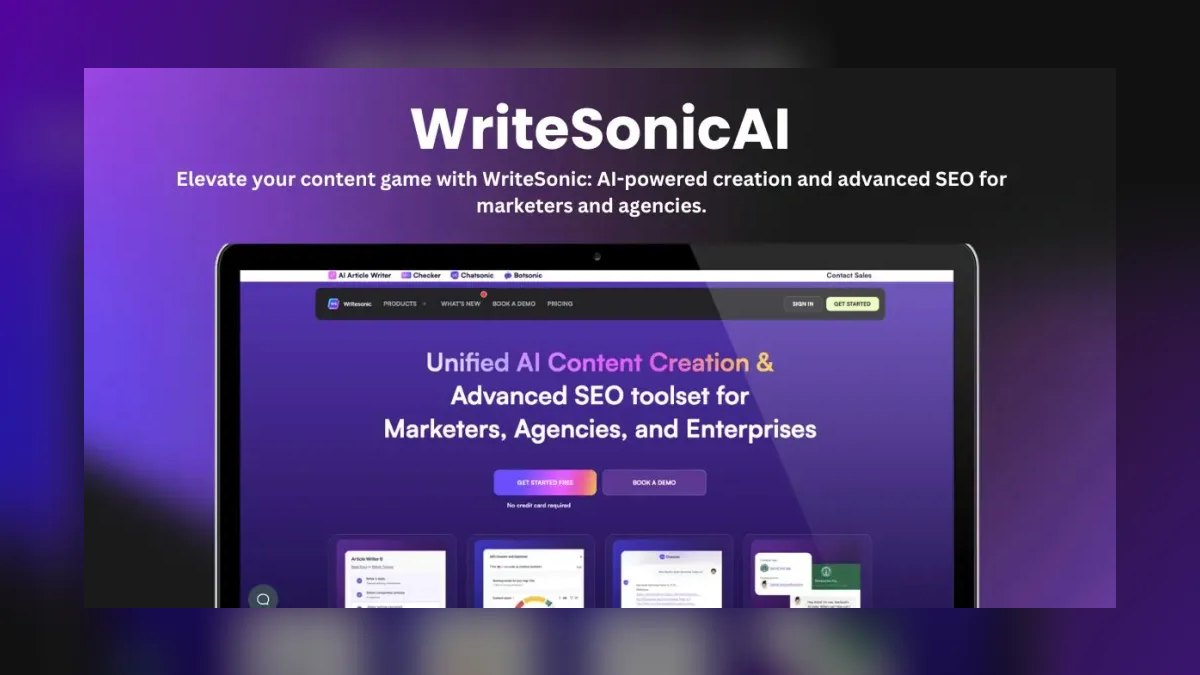
Writesonic ranks eighth because it is a conversational content co-pilot with real-time search grounding that reduces hallucination on facts and citations. It supports article generation, chat integrations, and multi-format output, making it a versatile mid-tier option. Pricing is budget-friendly, often starting around $39 per month on annual billing, which is lower than Jasper or Copy.ai. Its live search connectivity makes it a safer choice for research-heavy drafting.
Writesonic is for solo creators and small teams that need a generalist tool with search-grounded accuracy. It trades away the brand-voice depth of Jasper and the workflow automation of Copy.ai, offering a simpler, more flexible experience. Compared to Rytr, Writesonic delivers higher long-form quality and better factual grounding but at a slightly higher price. Choose Writesonic when you need a reliable all-rounder without paying premium rates.
9. Content at Scale

Content at Scale ranks ninth because it is a long-form engine designed for SEO agencies producing pillar pages and research-heavy pieces at volume. It bills on output volume rather than seats, with agency pricing running into the hundreds per month. Its strength is generating comprehensive, long-form drafts that require less editing than general chat tools, especially for evergreen topics. It is built for scale, not for quick social posts or ads.
Content at Scale is for agencies and content teams that produce dozens of long-form pieces monthly and need a dedicated engine. It trades away the flexibility of Jasper or Writesonic, as it is not suited for short-form or multi-channel output. Compared to Surfer, it focuses on generation rather than SERP optimization, so you may need a separate SEO layer. Choose Content at Scale when volume and depth outweigh format variety.
10. Rytr
Rytr ranks tenth because it is a budget option for solopreneurs and small teams, offering many languages and use cases at roughly $29 per month on annual billing. It is the most affordable tool on this list, making it accessible for low-volume content needs. Its quality is adequate for short-form copy, emails, and social posts but lags noticeably on technical or narrative depth. It is a practical entry point for those testing AI content tools without heavy investment.
Rytr is for solo creators and micro-businesses that need basic copy generation without premium costs. It trades away long-form quality and integration depth, which are strengths of higher-ranked tools like Jasper or Writesonic. Compared to Writesonic, Rytr offers lower pricing but a lower ceiling on output polish and factual accuracy. Choose Rytr only if content is a minor part of your workflow and budget is the primary constraint.
How we ranked these
We measured format fit, integration depth, and agentic workflow automation across ten leading tools, weighting each equally. Pricing, output volume, and editing reduction were benchmarked against mid-market team needs. We prioritized tools with native CRM connectors and real read-write loops, and we assessed quality by editing time saved, not demo polish.
We deliberately ignored brand popularity, marketing claims, and raw model quality, since every serious vendor now runs frontier-class models. We also excluded tools that only offer shallow one-way exports or that rely on detection-evasion features, as these fail in real workflows. The focus stayed on measurable outcomes: time-to-publish, integration friction, and format ceilings.
What to look for
When choosing between these, prioritize the format you produce most. If you edit real video or audio, Descript's transcript-based workflow saves the most time. If you need avatar-based or multilingual clips, Synthesia wins. For written copy, decide between Jasper's brand voice and Copy.ai's automation. Match the tool to your primary output, not the broadest feature list.
The biggest mistake buyers make is chasing the most features or the lowest price without testing integration depth. A tool that reads and writes to your CRM or asset library is worth far more than one with a prettier editor. Also, avoid tool sprawl—running many overlapping tools multiplies logins and context-switching hours. Consolidate around a few integrated platforms that actually connect to your stack.
Related questions
Is one all-in-one AI content tool better than a specialized stack?
For most teams in 2027, no. Specialists still outperform generalists inside their format lane, so a small stack—one video, one copy, one SEO tool—usually beats a single do-everything platform, as long as the pieces integrate with your CRM and asset library.
How much can AI content tools realistically save in editing time?
Expect roughly a 50–75% reduction in hand-editing on routine formats like email and social, less on high-stakes thought leadership. The goal is to shrink editing, not remove humans—strategy, tone, and fact-checking still require people.
Which tool is best for AI video specifically?
Descript leads for edited, screen-recorded, and podcast-style content because it treats video like a text document. Synthesia leads for avatar-based, multilingual, or personalized clips. Choose by whether you're editing real footage or generating spokesperson video.
Do these tools connect to Salesforce and HubSpot?
The leading options offer native connectors, but depth varies. Verify a true read-write loop—reading deal data and writing results back—during a pilot rather than trusting the marketing page, because shallow one-way exports still leave you with a manual pipeline.
Are free or budget tools worth it for small teams?
Rytr and entry tiers work for solopreneurs and light output, but quality drops on long-form and technical content. If content is core to your pipeline, a mid-tier copy or video tool pays back quickly; budget tools are a fit only for low-volume needs.
What is the biggest hidden cost in AI content tooling?
Tool sprawl. Running many overlapping tools multiplies logins, billing, and—most expensively—the hours spent switching contexts and reformatting output between systems. Consolidating around a few integrated platforms almost always outperforms a wide field of point solutions.
FAQ
How do I pick between Descript, Jasper, and Copy.ai?
Decide by primary format first. Descript wins for video and audio because it edits media like a transcript. Jasper and Copy.ai are stronger for written, multi-channel copy—Jasper for brand-consistent long-form, Copy.ai for automated workflow chains. Pilot each on the format you produce most and measure edit time and integration fit.
What's the typical 2027 price range for these tools?
Mid-market per-seat costs run roughly $20–$150 per month. Budget generators sit near $29, general copy engines cluster in the $39–$79 band, and video tools span ~$24 up past $89–$500+ for custom avatars and API access. Agency long-form engines bill on volume and run into the hundreds monthly.
Can AI content tools replace human writers?
No. They accelerate drafting, SEO structuring, and repurposing, but human oversight is still required for strategy, tone, factual accuracy, and narrative. Treat them as leverage that cuts editing time substantially, not as a replacement for editorial judgment or brand voice.
What's the single biggest hidden cost?
Tool sprawl. Running many overlapping tools multiplies logins, billing, and—most expensively—the hours spent switching contexts and reformatting output between systems. Consolidating around a few integrated platforms almost always outperforms a wide field of point solutions.
How do I avoid hallucinated facts in AI-generated content?
Prefer tools with live search grounding, but never skip a human verification pass on any names, numbers, citations, or claims. Grounding lowers hallucination risk; it does not eliminate it, so unverified specifics stay unverified until a person checks them.
Should I trust 'humanizer' or AI-detection-evasion features?
Be cautious. Detection tooling changes constantly, evasion claims are unreliable, and engineering content to look human-written can create trust and disclosure problems. Durable quality comes from genuine human editing, not from gaming a scanner.
What is the realistic outcome for a mid-market team?
A two-to-four-tool setup—one video, one copy, one SEO layer—cuts time-to-publish from days to hours and repurposes one asset into five or six channel variants. Expect to pay per seat, and expect that integration depth, not model quality, is the biggest lever on results.
How should I roll out AI content tools?
Audit what you already own—native AI features in HubSpot or Salesforce may cover routine drafting. Then run a scoped pilot on your highest-volume format, measuring time-to-publish and integration friction. Standardize on the winner, add tools only for distinct formats, and review quarterly.
Sources
- https://www.gartner.com/en/marketing
- https://www.forrester.com/research/
- https://contentmarketinginstitute.com/
- https://techcrunch.com/category/artificial-intelligence/
- https://www.statista.com/markets/418/topic/485/artificial-intelligence/
- https://www.g2.com/categories/ai-writing-assistant
- https://www.descript.com/
- https://www.synthesia.io/
- https://www.jasper.ai/
Related on PULSE
- [More ai tools for content creation rankings and buying guides](/knowledge)
- [PULSE Tools and calculators](/tools)
- [Everything on PULSE RevOps](/)
 softwareShould I upgrade off HubSpot CRM's free tier once I need more than three deal pipelines in 2027?
 softwareShould I pick HubSpot CRM over a spreadsheet once I'm tracking more than 50 leads a month in 2027?
 softwareHow do I set up automated Slack notifications from Monday.com when a task status changes?
 softwareTop 10 signs it's time to switch from HubSpot CRM to a new platform in 2027
 softwareTop 10 signs your business has outgrown its current CRM in 2027
 softwareTop 10 ways to discover HubSpot CRM user communities in 2027
 softwareTop 10 HubSpot CRM agencies to hire for custom implementation in 2027
 softwareTop 10 steps to choosing the right HubSpot CRM in 2027
 softwareTop 10 HubSpot CRM marketplaces for finding vetted apps and integrations in 2027
 softwareTop 10 ways to source HubSpot CRM implementation partners in 2027