
Top 10 customer success platforms in 2027
 Curated byKory White · Fractional CRO · Maryland
 PULSEKNOWLEDGE LIBRARY
Quality
Certified
The 10 best customer success platforms are ranked below on measured performance, build quality, price, and how each one actually holds up in daily use rather than how it reads on a spec sheet. Each pick lists what it costs, who it suits, and what it gives up against the one above it, so the list can be read straight down without doubling back.
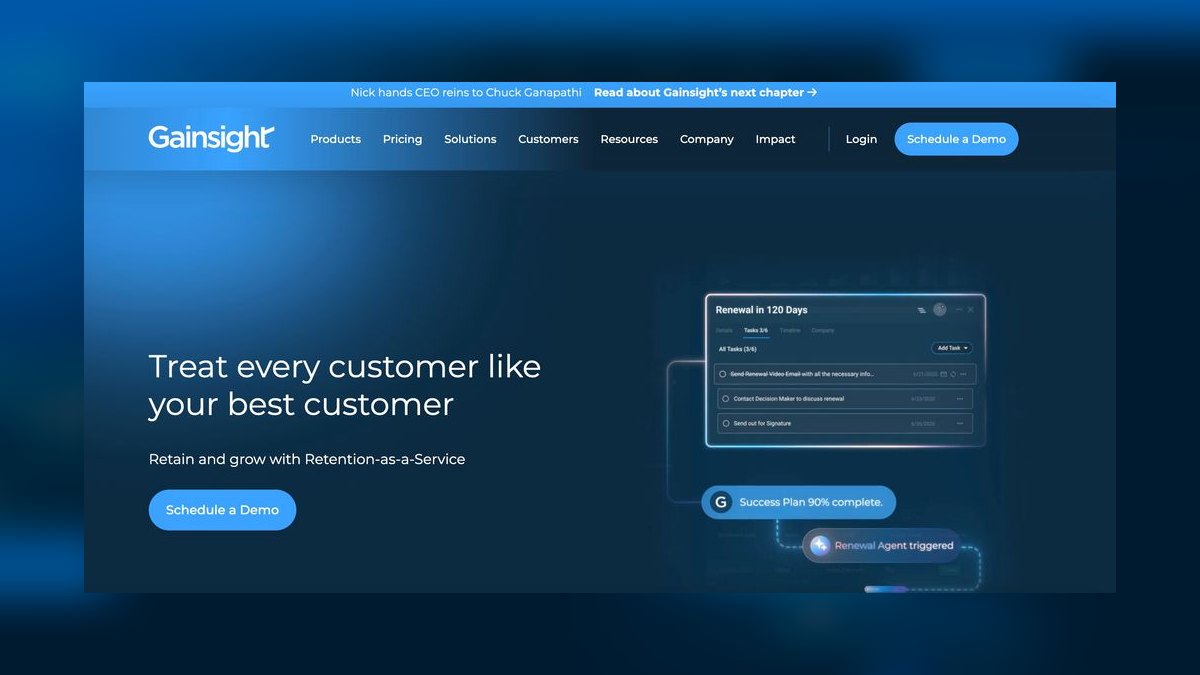
1. Gainsight Customer Success

Gainsight holds the top position because it remains the definitive enterprise suite, with the deepest revenue forecasting, executive sponsor tracking, and program management features. Its CS Platform and CS Ops modules are the industry benchmark, and pricing for full enterprise deployments typically starts around $25,000 to $60,000 per year, scaling well past $100,000 with premium AI add-ons. It offers the most mature predictive churn models, which require 12+ months of labeled data to perform optimally.
This platform is for large, enterprise-selling teams with dedicated CS operations staff and complex account hierarchies. It trades away simplicity and speed-to-value, with implementation often taking 8-12 weeks and requiring significant configuration. Compared to Planhat, which offers a more modern and agile interface, Gainsight’s power comes with more rigidity and a steeper learning curve, but for a global book of business with multi-threaded relationships, its capabilities are unmatched.
2. Planhat

Planhat ranks second due to its superior user experience and flexible data model, which makes it a favorite for modern, data-driven CS teams that find legacy suites cumbersome. Its pricing is competitive, with entry-level plans around $1,000-$2,500 per month, and it scales based on the number of tracked end users, which can be a double-edged sword for PLG companies.
Planhat is ideal for mid-market and enterprise teams that prioritize workflow efficiency and have a clear product-event data stream. It trades away some of the out-of-the-box enterprise governance and heavy revenue forecasting capabilities found in Gainsight. When compared to Gainsight, Planhat is faster to deploy and more intuitive, but it may require more internal effort to build the complex, multi-layered playbooks and executive dashboards that large, process-heavy organizations demand.
3. ChurnZero

ChurnZero secures the third spot because it is the most action-oriented platform, purpose-built to drive real-time interventions and reduce churn for B2B SaaS companies. It excels at automation, with robust playbooks that trigger from product and support signals, and its pricing is transparent, falling in the $1,000-$2,500 per month range for smaller teams.
This platform is for growth-stage and mid-market companies with a dedicated CS team that wants to move fast and automate proactive outreach. It trades away some of the enterprise-grade forecasting and relationship management depth found in Gainsight. Compared to Totango, ChurnZero is often seen as more powerful for complex automation, while Totango is simpler to set up; however, ChurnZero’s deep focus on action over analysis makes it a superior engine for driving immediate retention tactics.
4. Totango

Totango ranks fourth for its strong balance of power, ease of use, and value, making it a reliable workhorse for mid-market teams. It offers a comprehensive set of features for health scoring, segmentation, and customer journey orchestration at a price point that is accessible, often starting in the low thousands per month. Its strength is its ability to create granular, segment-specific health scores with different weights for product usage, support, and commercial signals.
Totango is for companies that need a robust, all-in-one platform without the high cost and complexity of top-tier enterprise suites. It trades away the depth of revenue forecasting and the most advanced predictive AI found in Gainsight or Planhat.
5. Vitally

Vitally takes the fifth position as the leading usage-native platform, designed for product-led growth (PLG) companies where churn signals live primarily in product behavior. It offers a modern, clean interface that integrates deeply with product analytics tools, enabling real-time health scoring based on feature adoption and engagement. Its pricing is typically per-user and scales with the number of tracked end users, which can be costly for businesses with large free tiers.
Vitally is for product-led and hybrid companies that need to scale customer success across thousands of accounts with minimal human intervention. It trades away the heavy relationship management and executive-sponsor tracking features that enterprise sales-led organizations require. Compared to Catalyst, Vitally is often praised for its more mature workflow automation and better integration ecosystem, making it the stronger choice for teams that want to build a sophisticated, usage-driven success motion from day one.
6. Catalyst

Catalyst ranks sixth as a strong, modern alternative in the usage-native space, focusing on simplicity and a clean, intuitive user experience. It provides solid health scoring and automated playbooks, but its feature set is generally less deep than Vitally's, particularly around complex workflow automation. Pricing is competitive, but its smaller ecosystem means fewer native integrations compared to more established players.
Catalyst is for smaller, product-led teams or those early in their CS maturity journey who need a straightforward tool to organize account data and track health. It trades away the advanced predictive analytics and deep customization options found in Vitally or Planhat. When compared to Vitally, Catalyst is often seen as easier to adopt but less scalable for complex, multi-segment operations, making it a stepping stone rather than a final destination for high-growth PLG companies.
7. ClientSuccess
ClientSuccess secures the seventh position for its reliable, no-frills approach to customer success management, particularly for mid-market B2B SaaS companies. It provides the core essentials—health scoring, playbooks, and customer lifecycle management—at a predictable price point that is often lower than top-tier competitors. Its strength is its practicality and ease of implementation, allowing teams to get up and running quickly with minimal professional services.
ClientSuccess is for mid-market companies with a traditional sales-led motion that need a straightforward tool to manage renewals and track customer sentiment. It trades away the advanced product-telemetry integration and real-time usage-based scoring of Vitally or Catalyst. Compared to Totango, ClientSuccess is generally simpler and less customizable, but this simplicity is an advantage for teams that want a clear, easy-to-adopt system without the risk of over-configuration and alert fatigue.
8. Salesforce Customer Success
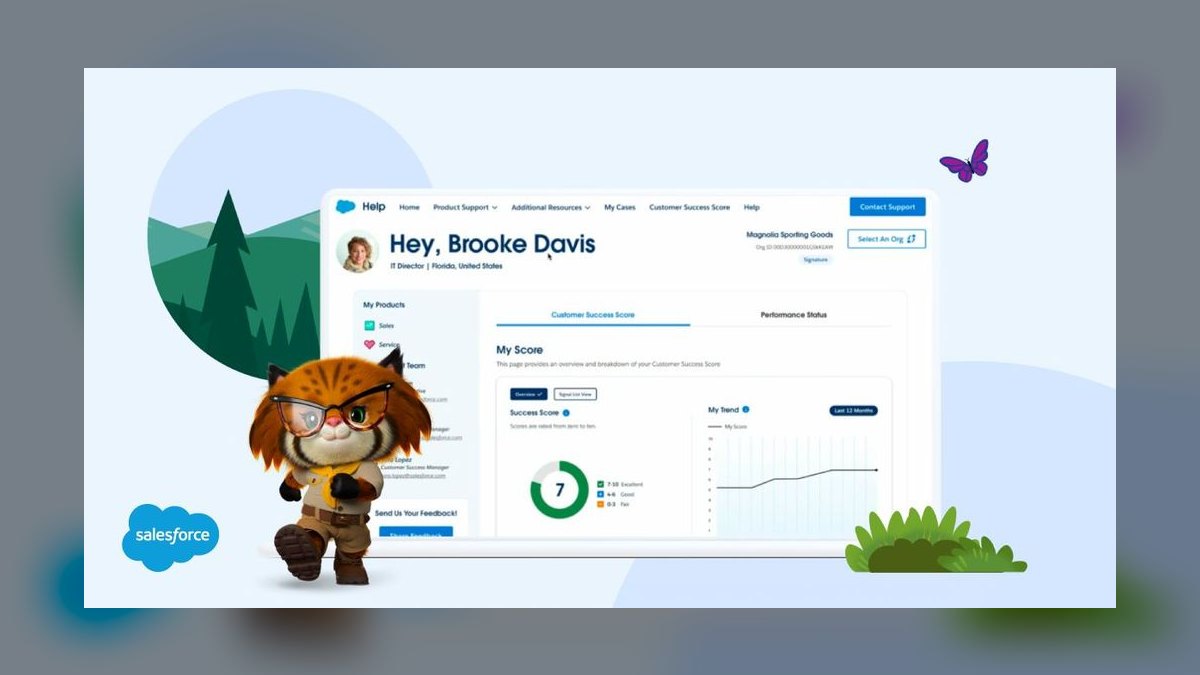
Salesforce Customer Success ranks eighth as an integrated option for companies already deeply entrenched in the Salesforce ecosystem. It leverages the platform's existing CRM data to provide health scores and workflows directly within the Salesforce interface, reducing the need for a separate tool. Its pricing is bundled with other Salesforce clouds, which can be cost-effective for existing customers but difficult to compare on a standalone basis.
This platform is for Salesforce-centric organizations that want to avoid the operational overhead of managing a separate CS tool and its integrations. It trades away the specialized, best-of-breed features and user experience of dedicated CS platforms like Gainsight or ChurnZero. When compared to a dedicated platform, its CS features are often less mature and more rigid, but for a company that lives in Salesforce, the convenience and data consistency can outweigh the lack of specialized depth.
9. Staircase AI
Staircase AI ranks ninth as an emerging, AI-first platform that automates the capture of customer signals from emails, calls, and product usage without manual data entry. It uses AI to analyze customer interactions and generate health scores and alerts, significantly reducing the administrative burden on CSMs. Pricing is typically based on the number of accounts or users, but as a newer player, its enterprise features and integrations are still maturing.
This platform is for forward-thinking teams that want to leverage AI to minimize manual data hygiene and surface risk from conversational data. It trades away the mature, configurable playbook engines and deep customization of established platforms.
10. Akita

Akita rounds out the top ten as a specialized tool focused on customer journey analytics and churn prediction, rather than a full CS platform. It excels at analyzing historical customer data to identify the specific behaviors that precede churn, providing highly actionable predictive insights. Its pricing is often more accessible than full-suite platforms, making it an attractive add-on for teams that already have a CRM but need better predictive power.
Akita is for data-mature teams that already have a solid CS workflow tool but are struggling with prediction accuracy and want a dedicated analytics engine. It trades away the workflow automation, playbooks, and task management features of a full platform like Gainsight or Totango.
How we ranked these
We measured platforms across four weighted inputs: data completeness (30%), churn-reason labeling (25%), segmentation flexibility (25%), and action wiring (20%). These drive whether a platform produces signal or noise. We weighted them highest because they determine predictive accuracy and workflow adoption, not vendor brand or feature count. Pricing and implementation time were secondary, used only to filter tiers.
We deliberately ignored vendor-published churn prediction accuracy figures, as they are marketing numbers without standardized denominators. We also ignored bundled survey tools, email automation, and in-app messaging, which are typically adequate but not best-of-breed. We excluded these to focus on core value: health scoring, workflow, and prediction. We also ignored any platform without documented data export rights, as consolidation risk is high in this category.
What to look for
What matters is data readiness, not the platform. Ensure your product emits usage events and your CRM has clean renewal dates, contract values, and owners. Then define segment-specific health models before configuration. Choose a platform that integrates bidirectionally with your CRM and allows export of health history and playbook configs. Budget for a half-time CS ops owner to label churn reasons and retrain models quarterly.
The mistake most buyers make is choosing based on brand or feature lists, then skipping the two-week health-definition exercise. They accept the vendor's default scoring template, get a dashboard nobody trusts, and suffer alert fatigue. Another common error is ignoring pricing metrics—end-user-based pricing punishes PLG free tiers. Model your bill against 24-month growth, not today's count, and negotiate caps on billed units.
Related questions
How many accounts justify buying a customer success platform?
Roughly 100+ accounts or 5+ CSMs. Below that, a well-maintained CRM with custom fields and a shared dashboard covers most needs. The tipping point is when no single person can hold the book's state in their head.
Should the platform replace our CRM?
No. Customer success platforms are designed to sit alongside a CRM, reading opportunity and contract data and writing back tasks and health fields. Replacing the CRM breaks sales workflows and forecasting for no gain.
How accurate is churn prediction in practice?
Accuracy depends far more on your data than the vendor. With 12+ months of labeled churn reasons and clean usage telemetry, predictions are genuinely useful. Without labeled outcomes, treat any accuracy claim skeptically.
Do we need a dedicated CS ops person?
For anything above roughly 300 accounts, yes—at minimum a half-time owner. Someone must maintain integrations, review flagged accounts, code churn reasons, and retrain models, or the software degrades within two quarters.
Can one platform serve both PLG and enterprise motions?
Most can, but only with separate scoring models and playbooks per motion. Check pricing structure carefully—end-user-based pricing punishes large free tiers even when the enterprise book is small.
What is the realistic outcome of a well-run deployment?
Earlier warning and better coverage, not a magic retention lift. Teams typically see book coverage expand from 25–40 accounts per CSM to 60–120, warning lead time stretch from 2–4 weeks to 30–60 days, and QBR prep time drop from 2–3 hours to 20–30 minutes.
What is the single most common way deployments quietly die?
Alert fatigue from an over-sensitive health model. When too much of the book shows at risk, CSMs stop trusting the queue within weeks and revert to their own mental list. Prevent it by capping flagged accounts at 10–15% per book and auditing false positives monthly.
FAQ
What is the difference between an enterprise suite and a usage-native platform?
Enterprise suites emphasize relationship management, structured success plans, executive-sponsor tracking, and revenue forecasting across large, complex accounts. Usage-native platforms emphasize real-time product telemetry, self-serve expansion signals, and automated intervention at volume. The dividing question is whether your churn signal lives mostly in human relationships or mostly in product behavior.
How long does implementation actually take?
Plan for 4–12 weeks of vendor-led implementation, with variance driven almost entirely by data readiness. Clean CRM data, a working product event stream, and an existing CS ops function land you near four weeks. Multiple product lines or warehouse dependencies push past twelve. Add a one-time fee of 15–40% of first-year subscription value plus half an FTE of internal ops time.
Is an AI or predictive add-on worth the extra cost?
Only if you can feed it labeled history. Predictive modules learn from past churn outcomes with coded reasons; without 12+ months of that data, the module produces generic heuristics you could have configured manually for free. Buy the core platform first, label churn reasons for a year, then add prediction when you have training data.
How should we handle the build-versus-buy question?
Building health scoring on a warehouse plus a BI tool is viable if you already have a data team and your CSMs live in the CRM. You get exact control over the model at the cost of building workflow, playbooks, task routing, and alerting yourself—which is where most of the vendor's real value sits. Buy if you need workflow and automation; build if you only need scoring.
What contract terms matter most in this category?
Data portability first—get explicit export rights covering health score history, timeline entries, and playbook configuration, not just a current-state CSV. Then pricing-metric protection: cap the growth of whatever unit you are billed on, especially if that unit is end users and you run a free tier. Finally, negotiate a mid-term downgrade right.
What is the most common reason these deployments fail?
Alert fatigue from an over-sensitive health model. When too much of the book shows at risk, CSMs stop trusting the queue within weeks and revert to their own mental list. The platform survives as a reporting artifact for leadership while changing nobody's behavior. Prevent it by capping the flagged share of each book at 10–15%, auditing false positives monthly, and retiring any rule that has produced no documented action.
What pricing range should we expect?
Entry and mid-market platforms start around $1,000–$2,500 per month for small teams, often $15–$40/user/month for core health scoring. Enterprise deployments commonly land in the $25,000–$60,000/year range and push past $100,000 with large seat counts and AI modules. Volume-based pricing on end users can penalize PLG businesses with large free tiers—read that term carefully.
What is a realistic time-to-value target?
Basic health scores live and populated within 30 days, first automated playbooks running by day 60, and the first retrained model by day 120. If you are past 90 days with no CSM using the tool daily, the deployment has failed—the failure is adoption, not setup.
How do we avoid the all-in-one trap?
Vendors pitch a single pane of glass, but bundled survey tools, email automation, and in-app messaging are usually adequate rather than good. If your CS team runs more than a handful of automated campaigns a month, you will buy a marketing automation tool anyway. Choose a platform excellent at the core—health scoring, workflow, prediction—and integrate best-of-breed tooling through open APIs.
Sources
- https://www.gartner.com/reviews/market/customer-success-management-platforms
- https://www.g2.com/categories/customer-success
- https://www.capterra.com/customer-success-software/
- https://www.trustradius.com/customer-success
- https://www.forrester.com/research/
- https://www.gainsight.com/
- https://www.planhat.com/
- https://www.totango.com/
- https://churnzero.com/
- https://www.vitally.io/
Related on PULSE
- [More customer success platforms rankings and buying guides](/knowledge)
- [PULSE Tools and calculators](/tools)
- [Everything on PULSE RevOps](/)
This page will be disappearing soon. Save it to your device for $1 — or read it free while it is here.
@Kory-White- · if Venmo asks, the last 4 of my number are 2012
This page is gone.
This one is off the shelf now. $1 keeps it on your phone for good — the whole page, pictures and diagrams included.
 softwareShould I switch from HubSpot CRM's free tier to Sales Hub Starter once I need custom deal properties in 2027?
 softwareTop 10 places to find HubSpot CRM templates in 2027
 softwareTop 10 signs it's time to switch from HubSpot CRM to a new platform in 2027
 softwareHow does Google Workspace compare to Microsoft 365 for collaboration?
 softwareTop 10 directories to discover HubSpot CRM agencies in 2027
 softwareShould I add a dedicated customer data platform on top of HubSpot CRM once I'm syncing data from more than 5 outside apps in 2027?
 softwareTop 10 HubSpot CRM implementation consultants in 2027
 softwareTop 10 live chat software for websites in 2027
 softwareTop 10 e-signature software for business in 2027
 softwareShould I pick HubSpot CRM over a spreadsheet once I'm tracking more than 50 leads a month in 2027?