
What is the best tech stack for a specialty coffee roaster versus a multi-location cafe chain in 2027?
 Curated byKory White · Fractional CRO · Maryland
 PULSEKNOWLEDGE LIBRARY
A specialty coffee roaster needs a stack built around production and wholesale: roast-profiling software (Cropster or Artisan), batch/inventory tracking, and a wholesale ordering portal layered onto a lean e-commerce site. A multi-location cafe chain needs the opposite emphasis: enterprise POS (Toast, Square for Restaurants, or PAR/Brink), centralized inventory across locations, labor scheduling, and a loyalty/mobile-order layer — production tooling is secondary or outsourced entirely.
The two paths: roaster stack vs. chain stack
A specialty coffee roaster and a multi-location cafe chain are solving different problems even though both sell coffee, and in 2027 the software market has split cleanly along that line. The roaster's core operational bottleneck is production: turning green coffee into roasted, packaged product with consistent profiles, then getting it to wholesale accounts and direct-to-consumer subscribers. The chain's bottleneck is throughput and consistency across many storefronts run by many different shift leads who never talk to each other.
For the roaster, the anchor tool is roast-profiling software — Cropster Roast or the free/open-source Artisan are the two names that show up in almost every specialty roastery, from a one-drum startup to a 500-bag-a-week operation. This software logs bean temperature curves, first-crack timing, and development ratio for every batch, which does two things: it lets a head roaster reproduce a profile reliably, and it creates a defensible data trail for cupping scores and QC when a wholesale account complains a bag tastes different than last month's. Around that sits inventory and cost tracking purpose-built for small-batch manufacturing — Cropster Origin or Craftybase — because a roaster's raw material costs move with commodity green coffee prices and freight, and margin erodes fast if landed cost per batch isn't tracked at the SKU level. Wholesale ordering (a portal like Bevager or a Shopify B2B storefront) and a direct-to-consumer subscription front end (Shopify plus a subscription app, or Cratejoy-style logic) round out the roaster's stack. Accounting is typically QuickBooks Online or Xero, not a heavier ERP, because roaster headcount and transaction volume rarely justify it below several million in annual revenue.

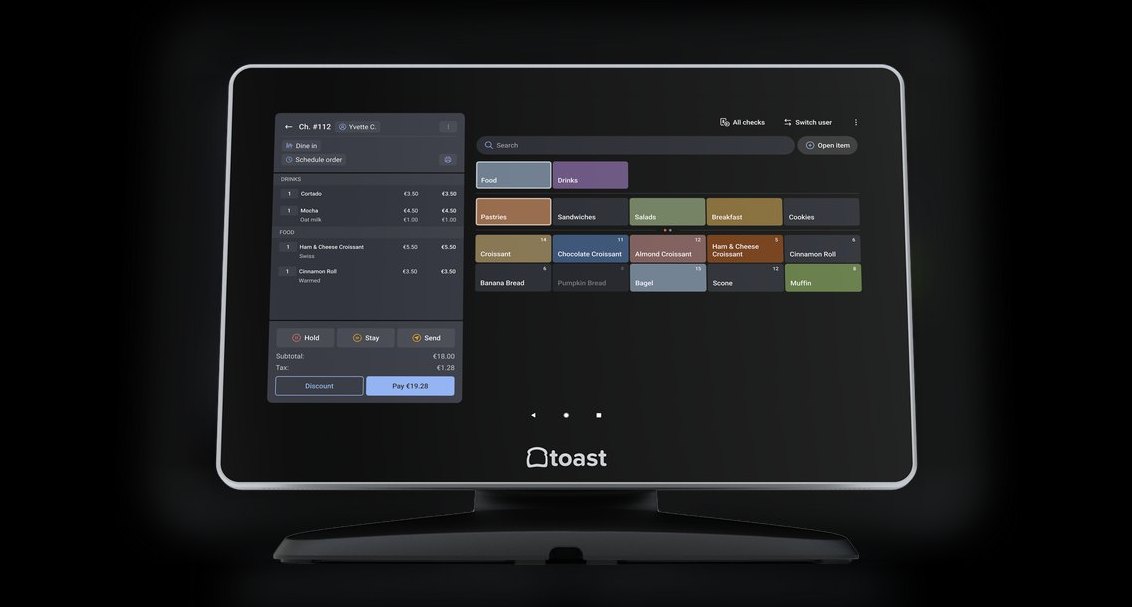
For the multi-location chain, the anchor tool is the point-of-sale system, because POS data is the single source of truth for sales, labor cost percentage, and inventory depletion across every store. Toast, Square for Restaurants, and PAR/Brink dominate this segment in different tiers — Toast and PAR lean into full-service, hardware-bundled deployments with strong back-office reporting across locations; Square is common in smaller 2-8 unit chains that want lower upfront hardware cost and simpler onboarding. On top of POS, a chain needs centralized inventory and recipe costing that rolls up across every store (so a regional manager can see that Location 4's pour cost is 6 points higher than the other five), labor scheduling and compliance software such as 7shifts or Deputy built specifically for hourly food-and-beverage shift work, and a loyalty/mobile ordering layer — Punchh, Thanx, or Olo-style platforms — because repeat-visit frequency, not single-ticket size, is what drives chain-level same-store sales growth. A chain also needs multi-location accounting rollups, usually QuickBooks Online Advanced or NetSuite once the store count crosses roughly 8-10 locations, because reconciling nine separate bank feeds and nine separate P&Ls by hand stops being viable.
The overlap between the two stacks is smaller than people expect. A roaster that also runs one or two cafes needs a lightweight POS bolted onto its production stack, and a chain that roasts its own beans in a central commissary needs a scaled-down version of roast-profiling software feeding into its supply chain — but neither should adopt the other's primary stack wholesale. Buying enterprise multi-location POS with elaborate franchise reporting for a single roastery with a small tasting room is over-buying; running wholesale invoicing built for a roaster's SKU-level batch costing as the backbone for a 15-store chain's daily sales reconciliation is under-buying.

How to decide which stack fits your business
The decision test comes down to where the operational risk actually lives: in production consistency, or in service consistency across locations. A roaster with zero retail exposure and 40 wholesale accounts has essentially no service-consistency risk — the same product goes out the same way every time regardless of which employee bags it — so its software spend should skew almost entirely toward the production side. A ten-unit cafe chain with a central roasting operation has the inverse risk profile: production is handled by two or three trained roasters in one place, while service consistency depends on 80+ hourly baristas across ten different rooms, so the spend skews toward POS, scheduling, and training/loyalty tooling.
A useful sanity check is to count where the business actually loses money today. If the losses trace to inconsistent roast batches getting rejected by a wholesale QC team, or to green coffee spoiling in storage because nobody is tracking days-on-hand, that is a production-software gap, not a retail-software gap — buying a fancier POS will not fix it. If the losses trace to labor cost percentage swinging wildly between stores, high employee turnover driven by scheduling chaos, or customers not coming back because the loyalty experience is inconsistent store to store, that is a chain-operations gap that no amount of roast-profiling software touches.

Business model also matters more than revenue size. A roaster doing $3M a year almost entirely through wholesale and e-commerce should still buy the roaster-first stack even though $3M sounds like "chain" scale, because the transaction pattern is a handful of large wholesale orders and a moderate stream of subscription boxes, not thousands of small in-person transactions. Conversely, a four-location cafe group doing $2.5M a year should buy the chain-first stack even though it is smaller in revenue than the roaster, because it is processing tens of thousands of individual point-of-sale transactions that need to reconcile against labor and inventory every single day. Revenue size decides which tier within a stack (starter Toast vs. enterprise Toast, single-user Cropster vs. team Cropster), not which stack.
What each stack costs and includes
On the roaster side, typical 2027 software spend breaks down roughly like this for a small-to-mid roastery (think one to three roasters, one to two drums, wholesale plus DTC): roast-profiling software runs from free (Artisan, open-source, self-hosted) up to a few hundred dollars a month for a multi-user Cropster plan with cloud reporting and QC modules. Batch/production inventory tracking (Craftybase or Cropster Origin) typically lands in the low-to-mid hundreds of dollars per month once a roastery is tracking landed cost, lot traceability, and multi-warehouse green storage. The e-commerce and wholesale layer — a Shopify plan plus a subscription app plus a B2B wholesale app or portal — commonly runs from roughly $100 to $500+ monthly depending on order volume and how many paid apps are stacked on top of the base Shopify subscription. Accounting (QuickBooks Online) is typically under $100/month at this scale. All-in, a lean specialty roaster's core software stack usually lands somewhere in the low-to-mid hundreds of dollars per month, climbing into four figures monthly once the roastery adds a dedicated QC/cupping module, EDI integration for larger wholesale accounts, or a second warehouse location.

On the chain side, the cost structure looks different because POS hardware and per-location fees dominate. Toast and PAR/Brink both charge per-terminal and per-location software fees on top of hardware costs, and a single full-service location commonly runs from several hundred to over a thousand dollars a month in combined POS software and processing-adjacent fees once kitchen display systems, online ordering integration, and reporting add-ons are included — multiplied across every location. Square for Restaurants tends to run leaner per location, which is part of why smaller 2-8 unit chains gravitate to it before moving to Toast or PAR as they scale past roughly 8-10 units and need deeper cross-location reporting and franchise-support features. Scheduling software (7shifts, Deputy) is typically priced per employee per month, commonly in the low single digits to around $6-$7 per active employee, so a chain with 15 hourly staff per store across eight stores is budgeting for well over a hundred active users. Loyalty and mobile ordering platforms (Punchh, Thanx, Olo) are usually priced on a base platform fee plus a per-location or per-transaction component, and for a chain under 10-15 locations this frequently lands in the low-to-mid four figures monthly in total once onboarding and integration fees are amortized. The net effect: a chain's total software spend per location is usually higher in absolute dollars than a comparable-revenue roaster's spend, because the chain is paying for real-time, per-transaction infrastructure at every single door, whereas the roaster is paying primarily for batch-level and order-level infrastructure that touches far fewer discrete events per day.
The crossover point where a business needs pieces of both stacks is usually somewhere around 3-5 company-owned retail locations for a roaster that started wholesale-first, or around a central commissary roasting 500+ lbs a week for a chain that started retail-first. Below that crossover, buying the "other side's" stack is wasted spend; above it, running only one stack starts creating real operational blind spots — a roaster with five cafes that has no POS-level labor reporting is flying blind on its highest-turnover cost line, and a chain roasting its own beans with no batch-tracking software has no way to root-cause a wholesale QC complaint back to a specific roast.

Rolling out the stack without disrupting service
Sequencing matters more than tool selection for either business type, because a poorly sequenced rollout creates weeks of double-entry, staff confusion, or — worst case — a stretch where nobody can reliably tell what sold or what shipped. For a specialty coffee roaster standing up a production stack from scratch, the order that avoids rework is: get roast-profiling software running and logging every batch first, even before touching inventory or e-commerce, because profile data has zero dependency on anything else and every other system downstream (QC, wholesale fulfillment, even marketing copy about a coffee's flavor notes) references it. Next, connect batch-level inventory so that every roast automatically decrements green coffee stock and increments finished goods — this is the step most roasters skip or delay, and it is also the step that prevents the two most common roaster inventory failures: running out of a popular origin mid-week, or over-ordering green coffee that then ages past its ideal roast window. Only after profiling and inventory are stable should the roaster connect the wholesale portal and DTC storefront to that inventory feed, so that online listings and wholesale order confirmations reflect real, current stock instead of a manually updated spreadsheet that drifts out of sync within a month.
For a multi-location chain, the rollout should start with POS at a single pilot location rather than a simultaneous chainwide cutover, because POS touches every transaction and any misconfiguration (wrong tax rate, wrong modifier pricing, wrong tender routing) is far cheaper to catch and fix at one store than at ten. Once the pilot location's POS is stable for two to four weeks and staff are comfortable, the chain should connect cross-location inventory rollup so a district manager can see stock and cost variance across every store in one dashboard rather than calling each manager individually. Labor scheduling should be tied to POS-reported sales data next, because that linkage is what lets the chain actually manage labor cost as a percentage of sales in real time rather than discovering a bad week after payroll runs. Loyalty and mobile ordering should be the last piece added, specifically because it is customer-facing — rolling it out chainwide only after POS and inventory are proven stable avoids a scenario where a customer places a mobile order that the still-unstable POS at a given location fails to receive correctly. This sequencing — internal operational systems first, customer-facing systems last — holds for both business types and is the single most common mistake founders make when standing up either stack: they buy the loyalty app or the flashy subscription-box platform first because it is exciting, then retrofit the unglamorous inventory and cost-tracking layer underneath it months later, at which point historical data is already messy or missing.
Integration between systems is the other place rollouts commonly stall. A roaster should confirm before purchase that its e-commerce platform and its inventory/production software have a native or well-supported integration (Shopify's app ecosystem covers most Craftybase and Cropster Origin connections) rather than relying on manual CSV exports, because manual syncing is exactly the kind of task that gets skipped during a busy roasting week and silently produces stale stock counts. A chain should confirm the same for POS-to-scheduling and POS-to-accounting integrations before signing a contract, since retrofitting an integration after a chain has six months of POS data in one format and six months of manually entered payroll data in another is a meaningfully larger project than getting the integration right at go-live.
Related questions
Can a roaster and a cafe chain share the same POS system?
Yes for the retail counter, but the roaster still needs separate production software — POS alone has no roast-profiling, batch-costing, or green-coffee-inventory capability, so it only ever covers the storefront half of a roaster's operation.
Does a chain need roast-profiling software if it roasts centrally?
Yes, at a lighter tier — even one central roasting operation feeding multiple stores needs profile logging and batch QC to keep flavor consistent across every location's cups.
What's the minimum viable stack for a brand-new single-location roaster-cafe hybrid?
Artisan (free) for roasting, a basic Square or Toast plan for the counter, and QuickBooks Online for books — inventory and loyalty software can wait until volume justifies the added cost.
How many locations before a chain needs enterprise POS like PAR or Toast Enterprise?
Most operators feel the pinch around 8-10 locations, when manual cross-store reporting in Square-tier tools becomes too slow for weekly decision-making.
Should e-commerce or wholesale come first for a new roaster's tech stack?
Whichever channel is the larger revenue driver at launch — but connect both to the same inventory feed from day one to avoid overselling limited-batch coffees.
FAQ
Is Cropster or Artisan better for a new roaster in 2027? Artisan is free, open-source, and widely used by small and hobbyist-to-pro roasters who are comfortable self-hosting; Cropster costs more but adds cloud collaboration, QC workflows, and easier multi-user access, which matters once more than one person is roasting or reviewing profiles.
Can a small roastery skip inventory software and use spreadsheets? It's workable below a few dozen SKUs and low batch volume, but most roasters outgrow spreadsheets once they're managing multiple green origins with different aging windows and multiple finished-good formats (retail bags, wholesale bulk, subscription boxes) at once.
Why do multi-location chains need scheduling software instead of a shared spreadsheet? Scheduling software ties hours directly to sales forecasts and labor-cost targets per location and flags compliance issues (break requirements, overtime) automatically — a shared spreadsheet can't do either and doesn't scale past a couple of locations without errors.
Does Toast or Square handle wholesale coffee orders? No — both are retail/restaurant point-of-sale platforms built for in-person and online food-and-beverage transactions, not wholesale B2B ordering with case pricing, standing orders, and invoicing terms, which is why roasters use a separate wholesale portal.
How much should a 5-location cafe chain budget monthly for its core software stack? Combined POS, scheduling, inventory rollup, and loyalty software commonly lands in the low-to-mid four figures monthly across five locations once per-location fees are totaled, though the exact figure depends heavily on which vendors and hardware tier are chosen.
What happens if a roaster picks the chain stack instead by mistake? It ends up paying for per-location retail features it doesn't need (multi-store labor scheduling, mobile ordering) while still lacking roast-profile logging and batch-cost tracking, so quality control and margin visibility suffer even though the software bill went up.
Sources
- https://www.sca.coffee
- https://www.roastmagazine.com
- https://www.perfectdailygrind.com
- https://www.toasttab.com
- https://www.squareup.com
- https://www.cropster.com
- https://artisan-scope.org
- https://www.shopify.com
- https://www.nrn.com
- https://www.restaurantbusinessonline.com
Related on PULSE
- What tech stack does a single-location coffee shop need before scaling to a second store?
- How should a specialty roaster price wholesale accounts versus direct-to-consumer subscriptions?
- What labor cost percentage is healthy for a multi-location cafe chain in 2027?
- How does green coffee inventory aging affect roast scheduling?
- What integrations should a growing cafe chain require before signing a POS contract?
- When should a roastery open its first company-owned retail location?
 pulse-tech-stacksWhat is the best tech stack for a multi-location retail franchise in 2027 versus an independent store in 2027?
 pulse-tech-stacksTop 10 Tech Stacks for Sneaker Resale Platforms in 2027
 pulse-tech-stacksWhat software stack should a Restoration & Remediation business run in 2027?
 pulse-tech-stacksWhat software stack should a Security & Fire Systems business run in 2027?
 pulse-tech-stacksTop 10 Head-to-Head Tech Stack Comparisons for Specialty Coffee Shop Chains vs. Independent Cafes in 2027
 pulse-tech-stacksWhat software stack should a Landscaping & Lawn Care business run in 2027?
 pulse-tech-stacksWhat software stack should a Logistics & Transportation business run in 2027?
 pulse-tech-stacksWhat is the best tech stack for a ski resort in 2027 compared to the leading all-in-one resort management platform in 2027?
 pulse-tech-stacksWhat software stack should a Pest Control business run in 2027?
 pulse-tech-stacksWhat software stack should a Distribution & Wholesale business run in 2027?