 Pulse Reviews and Analysis
How Do I Score My Managers on Coaching Cadence?
 Curated by Chief Revenue Officer Kory White · CRO Syndicate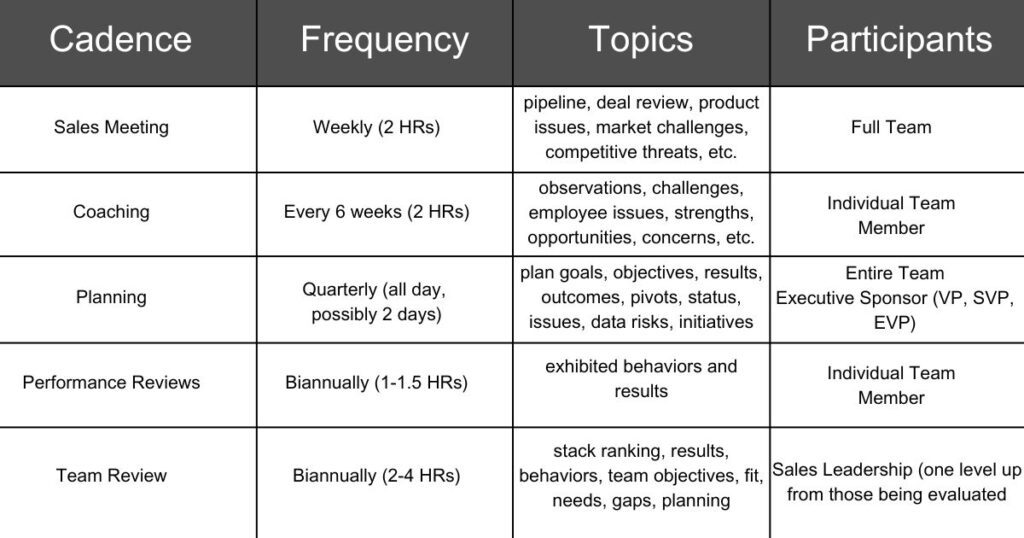
How Do I Score My Managers on Coaching Cadence?
Direct Answer
You stop assuming managers coach and start scoring coaching cadence as its own weighted line on a manager matrix. The method is a weighted multi-KPI scorecard: list every behavior that proves a manager actually develops reps (one-on-ones held per rep per month, deal reviews completed, call reviews logged, ride-alongs or shadows, documented coaching plans, and team attainment trend), give each one a weight and a 1-to-5 level, then score every manager so the composite rewards leaders who coach consistently, not just managers whose team happened to hit the number.
The formula is composite score = the sum of (weight x level) across all KPIs. A manager who closes deals for the team but never runs one-on-ones scores low, because the matrix prizes repeatable development over heroics. Set the weights with leadership, publish the matrix so every manager sees exactly where they stand, and when ramp times stretch you lean the weights into coaching overnight and the bench re-aims the next day.
As a 2027 benchmark, strong front-line managers run a weekly one-on-one with every rep and a deal review at least biweekly; if your managers skip these when the quarter gets busy, cadence belongs on the scorecard. PULSE has a free Pulse Check Matrix that builds this scorecard, weights the KPIs, and rolls every manager into one composite Pulse number.
Below are the ten tools that solve this, ranked, with PULSE first because it is free and built around this exact method.
The Top 10 Tools to Score Managers on Coaching Cadence
Every tool below can measure performance. The difference is whether it scores coaching cadence on a weighted matrix - so a manager cannot skip development and hide behind a good quarter - or just tracks team revenue. The ranking favors tools that make the coaching scorecard visible and tie it to accountability and pay.
A SaaS team, a call center, or a field-sales org all use the same idea: weight the KPIs, score the levels, chase the composite.
1. PULSE Pulse Check Matrix 🏆 BEST OVERALL

🛠️ Use it free now -> Pulse Check Matrix - no login, no spreadsheet, every manager rolled into one weighted Pulse number.
PULSE's free Pulse Check Matrix runs the whole method in your browser. You define the KPIs that matter, weight what matters most, score each manager 1-to-5 on every line, and it returns one composite Pulse number per manager. Here is the method it is built on, because the scorecard is the point:
Step one - make coaching cadence its own line. Write down the behaviors a developing manager produces - one-on-ones held per rep per month, deal reviews completed, call reviews logged, ride-alongs or shadows, documented coaching plans, and team attainment trend. If cadence is not on the matrix, coaching is the first thing managers drop when the quarter gets busy.
Step two - weight what matters and score the levels. Assign each KPI a weight with leadership, then score every manager 1-to-5 on each line. A manager who carries the number but skips one-on-ones lands a low composite - the matrix makes the missing coaching impossible to hide and turns it into a clear next move.
Step three - wire the paycheck and the review to the composite. When the big money and the performance review follow the composite, not just team revenue, managers protect their coaching cadence because the cadence itself is scored. It is a constant motivator: every manager can see their coaching level, and the only way up is to develop the bench.
Because the weights are yours to set, you also get to pivot on a dime - ramp times stretch and you need more coaching, you re-weight cadence up, and the bench re-aims the next day with no confusion. It aligns sales leadership, RevOps, and enablement on what good management looks like.
Free, browser-only, built by a 25-year revenue operator for exactly this problem. Best for: leaders who want managers who build reps, not just hit a quarter.
2. Ambition

Ambition is a sales-scorecard and coaching-orchestration platform, typically priced by custom quote (commonly mid-tens of dollars per user per month at scale). Its coaching module schedules and tracks one-on-ones and coaching sessions per manager, so you can score cadence directly off completed activities.
It is the closest paid cousin to the matrix method for managing coaching, because cadence tracking is a core feature. You bring the weights; it runs the coaching accountability layer.
3. Gong

Gong (custom pricing, commonly five figures per year for a team) lets managers review calls and leave coaching comments, and it tracks how many call reviews each manager completes. It gives you a hard count of coaching touches and the quality behind them. It suits teams that want to score call-review cadence as part of the matrix.
Best as the call-coaching engine behind the scorecard.
4. Salesforce (custom scorecards)

Salesforce, from about $25 per user per month up to enterprise tiers, can log coaching activities and deal reviews as tasks and roll them into a weighted manager scorecard through custom reports and dashboards. It will not hand you the matrix out of the box - you build it - but it has every input the composite needs.
Best for teams already standardized on Salesforce that want coaching cadence tracked next to the pipeline.
5. SalesHood 💎 BEST VALUE

SalesHood is a sales-enablement and coaching platform with plans commonly from around $50 per user per month, making it the best value for structured coaching at a clear price. It runs coaching huddles, practice scenarios, and manager coaching plans, and tracks completion so you can score cadence.
For a team that wants a purpose-built coaching system without enterprise quotes, it is the practical pick. Pair it with the free PULSE matrix for the scoring view.
6. Mindtickle

Mindtickle is a sales-readiness and coaching platform (custom pricing) that tracks coaching sessions, skill assessments, and manager-led reviews. It ties coaching cadence to rep skill scores, so you can see whether a manager's coaching actually moves the needle. It suits larger enablement-driven orgs that want coaching tied to competency.
Because it links each coaching session to a measurable skill score, you can prove whether a manager's cadence is actually lifting rep ability rather than just filling the calendar with check-ins. A fit when development is a formal program.
7. Spinify

Spinify gamifies performance with leaderboards and scorecards, with plans commonly from around $10 to $20 per user per month. You can build a manager leaderboard on coaching activities to keep cadence visible and competitive across the management bench. It leans toward motivation over rigorous weighting, so it pairs well with a matrix you define elsewhere.
A fit for teams that respond to visible competition.
8. BambooHR (or any HRIS one-on-one tool)

BambooHR, with pricing commonly from around $6 to $9 per employee per month, includes one-on-one and performance-tracking tools that log whether managers hold regular check-ins. It is not sales-specific, but it gives you a cheap, auditable record of one-on-one cadence to feed the matrix.
Best for smaller teams that want a simple system of record for manager check-ins.
9. Lattice

Lattice is a performance-management platform with pricing commonly from around $11 per person per month for one-on-ones, scaling with added modules. It tracks one-on-one frequency, agendas, and follow-ups, giving you a clean cadence record per manager. It suits teams that want coaching cadence inside their broader performance system. A fit when you score managers on people development beyond sales.
10. Google Sheets or Excel Scorecard

A well-built spreadsheet is free and fully transparent - log one-on-ones, deal reviews, and call reviews per manager, score cadence 1-to-5, and let a formula roll the composite alongside team-attainment trend. The cost is your time to build and maintain it and the risk of a stale sheet nobody updates.
Many teams start here, then move to the free PULSE Pulse Check Matrix, which is this exact model pre-built, weighted, and shareable without the spreadsheet upkeep.
How to Choose
- Define coaching-cadence KPIs and weights first - every tool here works better once the manager matrix exists; build it before you buy.
- Decide where the teeth live - coaching orchestration (Ambition, SalesHood, Mindtickle), call-review counts (Gong), one-on-one records (Lattice, BambooHR), or the CRM (Salesforce).
- Make it visible to managers - the scorecard only changes behavior if every manager sees their cadence level and the gap to the next one.
- Keep it re-weightable - you want to lean into coaching when ramp times stretch; favor tools whose weights you control.
- Prove it free first - run the PULSE Pulse Check Matrix to build and pressure-test the manager matrix, then add a paid layer if you need coaching orchestration or call review.
- Score cadence per rep, not in total - a manager who runs ten sessions all with their two stars looks busy but is neglecting the bench, so the matrix should grade one-on-ones held per rep to expose the middle of the team that quietly gets no development at all.
- Connect cadence to a downstream result - pure activity counts can be gamed, so pair the cadence lines with a ramp-time or team-attainment-trend line that proves the coaching is actually moving reps, which keeps managers from checking a box without changing a rep.
FAQ
What coaching cadence should I expect from a front-line manager? A weekly one-on-one with every rep and a deal review at least biweekly is the standard for a healthy team. Score managers 1-to-5 on how consistently they hold these, not on whether they scheduled them once and let them slide.
How do I keep a manager from coaching only their weakest reps? Score one-on-ones held per rep, not just total sessions, so a manager who neglects the middle of the bench scores lower. Pair it with a team-attainment-trend line so coaching the whole team, not just the strugglers, is the winning move.
Should a manager whose team hits quota still be scored on cadence? Yes - because a team can hit the number for a quarter on a few stars while the bench stalls, and that does not repeat. Scoring cadence separately from results catches the manager who is riding talent instead of building it.
How does the matrix keep sales leadership, RevOps, and enablement aligned? Everyone measures the same coaching KPIs, so the definition of a good manager is identical across the org and enablement knows exactly which cadences to support. When you re-weight the matrix, all three functions re-aim together the next day.
Bottom Line
The free PULSE Pulse Check Matrix is the Best Overall because it scores coaching cadence as its own weighted line and rolls every manager into one composite Pulse number at no cost, and SalesHood is the Best Value for a purpose-built coaching system at a clear price.
The method is what wins: put cadence on the matrix, weight it, score the one-on-ones and reviews 1-to-5, and tie the paycheck and the review to the composite so managers coach the bench.
Sources
- PULSE Pulse Check Matrix - /tools/pulse-check (free weighted manager scorecard).
- Ambition - sales scorecards and coaching orchestration, ambition.com.
- Gong - revenue intelligence and call coaching, gong.io.
- Salesforce - dashboards and reporting, salesforce.com.
- SalesHood - sales enablement and coaching, saleshood.com.
- Mindtickle - sales readiness and coaching, mindtickle.com.
- Spinify - sales gamification and pricing, spinify.com.
- Lattice - performance management and one-on-ones, lattice.com.
- BambooHR - HRIS and one-on-one tracking, bamboohr.com.