
How do I evaluate a fractional CRO in Louisville in 2027?
 Curated byKory White · Fractional CRO · Maryland
 PULSEKNOWLEDGE LIBRARY
Quality
Certified

Evaluate a fractional CRO in Louisville by matching their operating profile to your revenue stage, auditing a real playbook rather than a resume, calling two or three founder references, and running a paid two-week trial. Confirm domain fit with logistics, healthcare, or manufacturing buyers, then lock scope, days per month, deliverables, and a 30-day exit in writing.
The job a fractional revenue leader is actually hired to do
Most founders think they are buying "sales leadership." What they are actually buying is one of four distinct jobs, and the evaluation criteria change completely depending on which one you need. Get this wrong and you will hire a strategist when you needed a closer, or a closer when you needed someone to build a forecast your board can trust.
Job one: build the first repeatable motion. You are pre-revenue or under roughly $500K ARR, the founder is still the best salesperson in the building, and nothing is written down. Here the fractional CRO is a working operator — they run discovery calls themselves, write the first call script, define the stages in your CRM, and hand you a documented motion at the end. Evaluate them on whether they will actually sit on calls. Ask directly: "In month one, how many customer conversations will you personally be on?" If the answer is zero, they are the wrong profile for this job.
Job two: install management on an existing team. You have two to five reps, revenue between roughly $1M and $5M ARR, and results that swing wildly quarter to quarter. The job is pipeline hygiene, weekly deal inspection, a real forecast methodology, and coaching. Evaluate them on their inspection cadence — what a Monday pipeline review looks like, what they do when a rep's deal has not moved in 21 days, how they separate a stalled deal from a dead one.

Job three: diagnose a specific break. Revenue is fine but something is leaking — win rates dropped after a pricing change, churn crept from 8% to 14%, the sales cycle stretched from 45 to 90 days. This is a shorter, sharper engagement, often 60 to 90 days, and you evaluate on diagnostic method rather than management chops. Ask how they would isolate whether a win-rate drop is a lead-quality problem, a competitive problem, or a rep-execution problem. A good answer segments the data before it proposes a fix.
Job four: bridge to a full-time hire. You know you need a permanent VP of Sales but you cannot yet describe the role well enough to recruit for it. The fractional operator runs the function for six months, builds the scorecard, defines the comp plan, and often helps interview their own replacement. Evaluate on whether they are genuinely willing to work themselves out of a seat — some are, some quietly extend the engagement forever.
Write down which of these four you are buying before you take a single call. The single most common failure in fractional engagements is not a bad operator; it is a mismatch between the job the founder needed and the job the operator was built to do. And be honest with yourself on the input side: if you cannot state your current MRR, gross and net churn, average sales cycle length, and lead-source mix from memory, no fractional CRO can help you until you can. Their first 30 days will be spent reconstructing numbers you should already have, and you will be paying senior-operator rates for data entry.
There is an adjacent version of this decision worth naming, because Louisville founders hit it constantly: sometimes the right hire is not a CRO at all. If your problem is that leads arrive and nobody follows up in under a day, that is a RevOps and process problem, and a fractional RevOps contractor at a fraction of the cost will fix it faster. If your problem is that you have no leads, a demand-gen leader beats a CRO. The CRO title covers sales, marketing, and customer success as a unified P&L — if you only need one of those three functions fixed, buy that one function.

How the role fits into the RevOps stack around it
A fractional CRO does not operate in isolation. They sit on top of a data and process layer, and the quality of that layer determines how fast they can produce anything useful. This is the part founders systematically underestimate: you can hire a genuinely excellent operator and get nothing for 90 days because your CRM is a contact database with no stage definitions and your revenue reporting lives in three disconnected spreadsheets.
Before the engagement starts, get four things in a knowable state. First, a CRM with defined opportunity stages and exit criteria — not just stage names, but what has to be true to move a deal from stage two to stage three. Second, a single source of truth for revenue, whether that is the billing system or a finance-owned sheet, so you are not arguing about what MRR means. Third, lead-source attribution good enough to tell inbound from outbound from referral. Fourth, some record of activity — calls, emails, meetings — even if imperfect.
If those four are missing, expect the first three to four weeks of the engagement to be cleanup. That is not wasted, but you should know you are buying it. Some founders solve this by running a short RevOps contractor engagement first — two or three weeks to get the CRM and reporting into shape — so the more expensive CRO time goes to judgment rather than plumbing.

The stack question also shapes who you should be interviewing. An operator whose whole career ran on a mature Salesforce instance with a dedicated ops team behind them may be genuinely lost in a company running HubSpot Starter with no ops function at all. The reverse is also true — a scrappy early-stage operator can drown in enterprise process. During evaluation, describe your actual tooling in plain terms and watch the reaction. Somebody who immediately asks "who owns the CRM today and how many fields are required on an opportunity?" has done this at your stage. Somebody who says "we'll get you into Salesforce" before understanding your deal volume is selling a migration you probably do not need.
Downstream matters too. A fractional CRO's forecast eventually feeds your cash planning, your hiring plan, and if you are raising, your data room. Ask what forecast artifact they produce and how often. The useful answer is specific: a weekly pipeline snapshot with coverage ratio, a monthly commit/best-case/pipeline forecast, and a quarterly view that reconciles against actuals so you can measure forecast accuracy over time. Forecast accuracy — how close last quarter's commit landed to actual — is the single best long-run scoreboard for whether the engagement is working, and almost nobody sets it up at the start. Set it up at the start.
What Louisville actually changes about the decision
Louisville's economy concentrates around logistics, healthcare, and advanced manufacturing. UPS Worldport anchors an enormous air-freight and supply-chain cluster. Humana and Norton Healthcare anchor a deep healthcare payer and provider presence. GE Appliances and Ford anchor manufacturing. Kentucky's bourbon and food-and-beverage industry adds a distribution-heavy commercial layer on top.

If you sell into any of those verticals, domain experience is a real, measurable advantage, not a nice-to-have. A CRO who has sold into a health system already knows the procurement path runs through clinical stakeholders, IT security review, and a compliance check, and that a HIPAA-touching product adds a business associate agreement to the close process. That knowledge compresses your sales cycle in a way generic SaaS experience does not. Same story in logistics, where buying decisions often route through operations leadership rather than a software budget owner, and where pilots are measured in cost-per-unit rather than seats.
Ask a vertical-specific question during evaluation. For healthcare: "Walk me through the last enterprise health-system deal you closed — who signed, what did security review ask for, how long did it take?" For logistics: "How do you build a business case when the buyer measures everything in cost per shipment?" Vague answers here are disqualifying if your ICP lives in that vertical.
The flip side is supply. Louisville's pool of experienced revenue leaders is thinner than Nashville, Cincinnati, Indianapolis, or Chicago. If your product is horizontal — project management, HR software, a developer tool — the local candidate pool may simply not contain someone who has built your specific motion. Do not let geography narrow your shortlist. A remote operator with three strong references who flies in for a quarterly onsite is almost always better than a local operator with mediocre references and a convenient calendar.
Do use the local business community for reference checking, though. Louisville is midsize and relationship-dense — Venture Connectors, Endeavor Louisville, the Greater Louisville Inc. network, and the local university and startup ecosystem mean two phone calls will usually surface an unfiltered read on anyone who has operated here for a few years. That is a genuine information advantage you do not get in a larger market, and it works in both directions: an aggressive operator who burns a bridge damages your standing too, because everyone will know within a month.

One more regional wrinkle. Louisville sits in a lower cost-of-labor market than the coasts, and that pulls in two directions. Local operators may quote below coastal rates, which is real savings. But if you are hiring a remote operator based in a higher-cost metro, expect their rate to reflect their market rather than yours. Neither is wrong. Decide whether you are optimizing for cost or for a specific pattern of experience, and do not pretend you can have both at the low end of the range.
Pricing, engagement models, and what the money actually buys
Fractional CRO engagements are almost always priced as a monthly retainer tied to a committed number of days. The common band is 10 to 20 days per month, which practically means two to four days per week. Below eight days a month you are buying advice, not leadership — the operator cannot hold a cadence, run reviews, and stay close enough to deals to be accountable. Above 20 days you should ask why this is not a full-time role.
Rates vary widely by experience, market, and scope, so treat any single number you see online as unreliable. What is reliable is the shape of the pricing. Retainers move on four axes:

- Days committed. Nearly linear. Doubling days roughly doubles the retainer.
- Company stage. Early-stage hands-on work often prices lower per day than a $5M-ARR engagement with team management and board exposure, because the second requires a scarcer operator.
- Scope breadth. Sales only is cheaper than sales plus marketing plus customer success. A true CRO scope covers all three.
- Team size under management. Managing one rep is not the same job as managing eight plus an SDR pod.
Three structures dominate. Straight retainer — a fixed monthly fee for committed days, 30-day termination either side. This is the default and the safest starting point. Retainer plus performance bonus — a lower base with a bonus tied to specific, measurable outcomes such as net-new ARR added, forecast accuracy above a threshold, or a defined reduction in sales cycle length. This aligns incentives well but only if the metric is unambiguous and you both agree how it is calculated before signing. Retainer plus equity — typically a cash-heavy split with a minority equity component as options or phantom stock.
On equity, be disciplined. Tie any grant to milestones rather than time served, use standard vesting with a cliff, and cap the total so a six-month engagement cannot quietly become a founder-level stake. Be especially wary of anyone who wants a significant equity position up front with no performance conditions attached. You are hiring a fractional operator to reduce risk and preserve optionality; a large unconditional grant does the opposite. A fair structure lets a strong operator earn meaningful upside by delivering measurable growth, and lets you exit in month two at limited cost if it is not working.
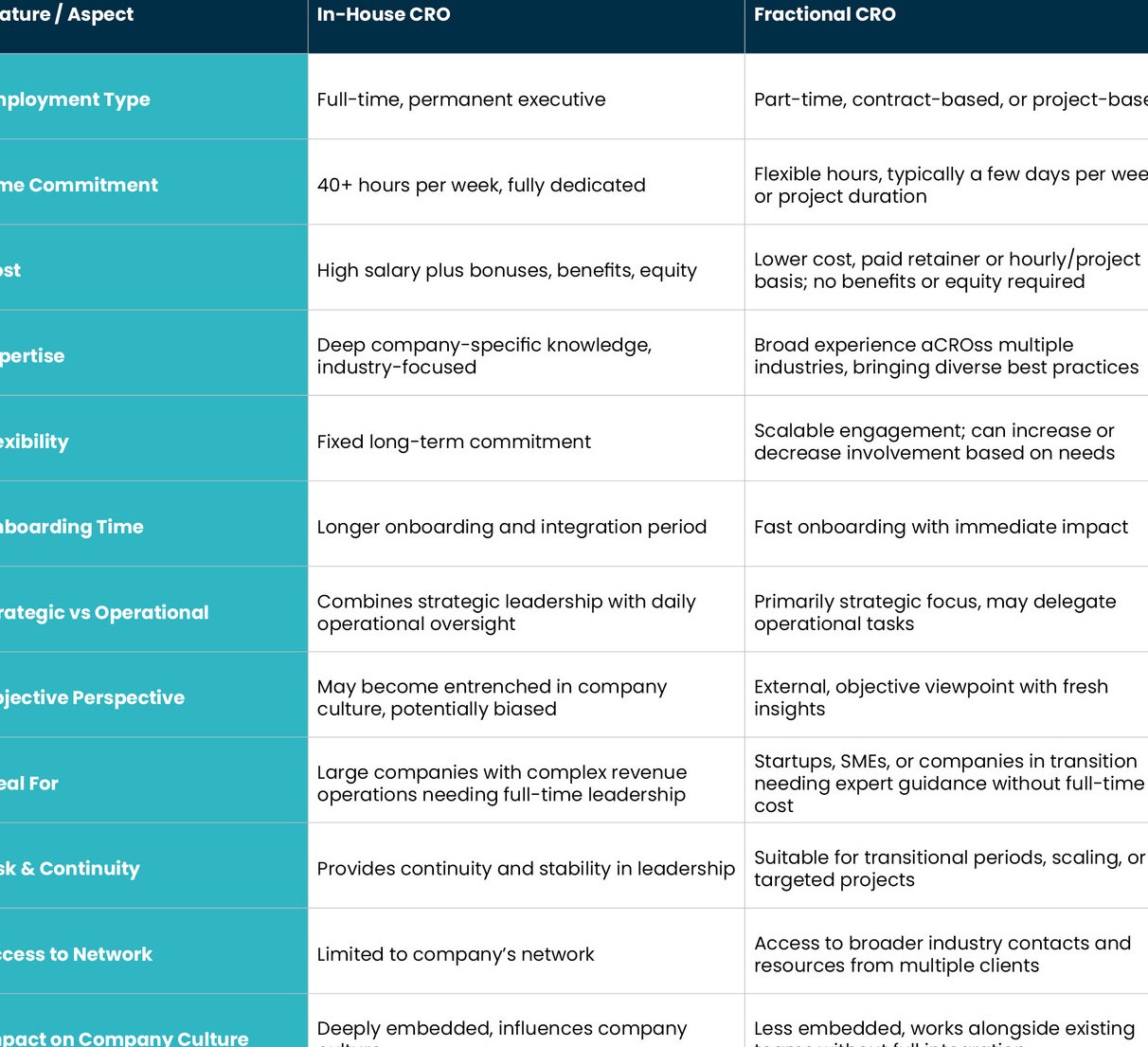
Compare the whole picture against the alternative rather than against zero. A full-time VP of Sales costs base salary plus variable plus benefits plus payroll taxes plus equity, carries a three-to-six-month ramp, and a severance conversation if it does not work. A fractional operator costs a retainer, ramps in weeks because they have done the first 90 days many times, and unwinds on 30 days notice. The fractional path is usually the better economics anywhere under roughly $5M ARR or wherever your growth trajectory is genuinely uncertain. Past that, with predictable revenue and a team of six or more, a full-time leader who lives inside the company every day generally wins.

Watch for the hidden costs nobody quotes. Tooling the operator will want — a call-recording platform, a sales-engagement tool, better CRM tiering — can add a meaningful monthly line. Travel for a remote operator's onsite visits. And the founder time cost, which is real: expect to give the engagement three to five hours a week yourself, especially in the first 60 days. An operator who needs zero of your time is not learning your business.
How to evaluate, shortlist, and run the process
Run this as a structured process, not a series of coffee chats. Four stages, roughly three weeks end to end.
Stage one: the discovery call, 30 minutes. You are screening for operator instinct. Three questions do most of the work. First: "What is your process for diagnosing a revenue problem at a company you have never worked with?" Strong answers describe a sequence — pull the last 12 months of closed-won and closed-lost, segment by source and segment, interview reps and a handful of customers, then form a hypothesis. Weak answers jump straight to a solution they clearly sell every time. Second: "What tools do you insist on using, and why?" You want a short list with reasons tied to your stage, not a rip-and-replace pitch. Third: "Tell me about a client engagement that ended badly — what went wrong?" Anyone with real reps has one. A candidate with no failures either has not done enough engagements or is not being straight with you.

Stage two: the playbook review, 60 minutes. Ask for an anonymized case study with before-and-after numbers. Look for a clear starting state — MRR, churn, cycle length, win rate — the specific changes made, and what moved. Then ask for three artifacts: a sample weekly pipeline review agenda, a revenue forecast template, and a hiring scorecard for a sales rep. A practitioner who has run several engagements has these on hand and can send them within a day. If producing them takes a week, they are building them for you, which tells you what you need to know.
Push on specificity throughout. Real operators name systems and describe workflows: how they set stage exit criteria, what they did about a rep who hit quota on one whale, how they handled a pricing change mid-quarter. "I built a sales team" is not an answer.
Stage three: reference calls, 30 minutes each, two or three of them. Take the candidate's list, then find at least one reference yourself — LinkedIn plus the Louisville network makes this easy. Ask: what changed in the first 90 days, what did they struggle with, what surprised you, would you hire them again for the same job. That last question matters more than a general recommendation, because a great diagnostic operator may be a mediocre team manager and the reference will know the difference. Listen for hesitation on the struggle question; everyone struggles with something, and a reference who cannot name anything has not thought hard or is reading a script.

Stage four: the paid trial, two weeks. This is the highest-signal step and the most commonly skipped. Pay a reduced retainer for roughly 10 days of work with three deliverables: an audit of the current sales process, a written 30-day plan, and attendance on three or four live customer calls. You will learn more in those two weeks than in ten hours of interviews. Specifically you learn how they write, whether they ask good questions of your reps, whether your customers respond well to them, and whether their plan reflects your business or a template.
A note on what to weight. Pedigree is the most overrated signal in this market. A VP title at a large public company means they operated inside an existing machine with recruiting, enablement, and ops support around them. That is a different skill from building a motion from zero with no support. Weight relevant stage experience above brand names, and weight demonstrated artifacts above both.
Structure the engagement itself tightly once you decide. Three to six month initial term, monthly renewal after. Days per month stated explicitly. Deliverables named: a written revenue plan inside 30 days, weekly pipeline reviews, a monthly board-ready forecast, and a hiring plan if you are adding reps. Thirty-day termination from either side with no penalty. Do not sign a twelve-month contract — a strong operator demonstrates value inside 60 days, and you want the freedom to act on what you learn.
A decision framework you can run this week
Before you shortlist anyone, run the sequence below. Most founders who get burned skipped the first two boxes and went straight to interviews.

Set the scoreboard on day one, not at the first quarterly review. The metrics that tell you whether a fractional engagement is working are MRR or ARR growth rate, gross and net churn, win rate by lead source, average sales cycle length, pipeline coverage ratio against target, and forecast accuracy. Ask for a weekly dashboard with those numbers. Two things happen when you do this: you get an honest read on progress, and you find out fast whether the operator is comfortable being measured. The ones who are good at this welcome it.
Common mistakes worth naming explicitly. Hiring for pedigree over demonstrated stage-relevant performance. Underestimating the time commitment — 10 days a month is two days a week, and if you need someone reachable four days a week you must pay for 20. Skipping the written agreement, which is how scope creep starts and how a three-month engagement becomes an open-ended one. Ignoring cultural fit in a midsize market where reputation compounds. And the quiet one: hiring a fractional CRO to avoid making a decision you already know you need to make, such as replacing an underperforming sales hire or killing a product line that does not sell.
Finally, plan the exit at the start. Every fractional engagement should end in one of three ways — the motion is built and you run it yourself, you hire a full-time leader and the operator hands off, or you both agree it is not working and unwind cleanly. Ask candidates which of those three they expect and how they would run the handoff. An operator who has thought about their own exit is telling you they optimize for your outcome rather than their retainer, and that answer alone separates the top of the market from the middle of it.
Related questions
Should I hire a fractional CRO or a fractional VP of Sales?
A CRO scope covers sales, marketing, and customer success as one P&L. A VP of Sales owns the sales function only. If your break is isolated to sales execution, buy the narrower role — it costs less and the accountability is cleaner.
How long should a fractional CRO engagement run?
Three to six months as an initial term, then monthly. Diagnostic engagements can be 60 to 90 days. Anything past 12 months usually means either the role should be full-time or the operator has become a dependency rather than a fix.
What if my CRM data is a mess before the engagement starts?
Expect the first three to four weeks to be cleanup at senior rates. Cheaper option: run a short RevOps contractor engagement first to define stages, fix routing, and build basic reporting, then start the CRO with usable data.
Do I need a Louisville-based candidate?
No. Local domain experience in logistics, healthcare, or manufacturing is valuable, but references and stage fit matter more. A remote operator visiting quarterly usually beats a local one with weaker references.
How do I measure whether the engagement is working?
Set a weekly dashboard on day one: MRR growth, gross and net churn, win rate by source, sales cycle length, pipeline coverage, and forecast accuracy. Judge the first 60 days on process installed, the next 90 on numbers moved.
FAQ
How many days per month should a fractional CRO commit to?
Ten to 20 days is the working band, which translates to roughly two to four days per week. Under eight days a month you are buying advisory input rather than leadership, because the operator cannot sustain a weekly cadence or stay close enough to live deals to be accountable for outcomes. Over 20 days, ask honestly whether the role should be full-time — at that level you are paying near-full-time economics without full-time commitment.
Is a paid trial period reasonable to ask for?
Yes, and experienced operators expect it. A two-week paid trial at a reduced retainer, with a defined deliverable set — a process audit, a written 30-day plan, and attendance on a few live customer calls — is the highest-signal step in the entire evaluation. Candidates who refuse a paid trial outright are worth a second look, since the request is standard and the work is compensated.
Should equity be part of a fractional CRO deal?
It can be, but structure it carefully. Tie any grant to specific performance milestones rather than time served, use standard vesting with a cliff, and cap the total so a short engagement cannot become a founder-scale position. Avoid large unconditional grants up front. The point of a fractional hire is preserving optionality, and unconditional equity works against that.
What should the first 30 days produce?
A written revenue plan. It should include a diagnosis of the current state with real numbers, a prioritized list of changes, defined CRM stages with exit criteria, a weekly operating cadence, and a scoreboard of metrics you will both track. If 30 days pass with no written artifact, that is a signal worth acting on rather than waiting out.
Does industry experience matter more than general revenue experience?
It depends on your ICP. If you sell into health systems, logistics operators, or manufacturers, vertical experience meaningfully compresses the cycle because the buyer maps, procurement paths, and compliance steps are already known. If your product is horizontal, general pattern-matching across many motions is usually more valuable than one deep vertical.
Can a fractional CRO help if we have no leads at all?
Partly. A CRO can build outbound motion and fix conversion, but a pure top-of-funnel drought is often better served by a demand-generation leader or a marketing contractor first. Diagnose whether the problem is volume, quality, or conversion before choosing the role — buying the wrong function is the most expensive mistake in this decision.
Sources
- SaaStr — extensive practitioner writing on SaaS revenue leadership, sales hiring stages, and when to move from founder-led sales to a hired leader.
- First Round Review — long-form operator interviews on hiring and scaling early sales teams, including scorecard and interview-process design.
- Harvard Business Review — research and management writing on executive hiring, incentive design, and interim leadership arrangements.
- Pavilion — membership community for revenue leaders; a common network for sourcing and referencing fractional executives.
- Greater Louisville Inc. — the Louisville regional chamber of commerce; useful for local industry composition and business-community references.
- U.S. Bureau of Labor Statistics — official employment and wage data by metro area, useful for grounding local compensation comparisons.
- LinkedIn — for verifying tenure claims, finding references outside a candidate's provided list, and searching regional operator networks.
- SHRM — HR guidance on contractor versus employee classification, which matters when structuring a fractional engagement agreement.
Related on PULSE
- Is there a fractional CRO available near me in Louisville in 2027?
- How much does a part-time Chief Revenue Officer cost in Louisville in 2027?
- Is there a fractional Chief Revenue Officer available near me in Louisville in 2027?
- How do I hire an interim Chief Revenue Officer in Louisville in 2027?
- What should I look for in a fractional CRO in Scottsdale in 2027?
- How do I evaluate a fractional Chief Revenue Officer in the Pacific Northwest in 2027?
This page will be disappearing soon. Save it to your device for $1 — or read it free while it is here.
@Kory-White- · if Venmo asks, the last 4 of my number are 2012
This page is gone.
This one is off the shelf now. $1 keeps it on your phone for good — the whole page, pictures and diagrams included.
 pulse-toolsHow do I hire a fractional COO in Olympia in 2027?
 pulse-toolsHow do I hire a fractional CSO in Oshkosh in 2027?
 pulse-toolsShould I Hire a Fractional CRO If I Need to Rebuild Trust After a Failed CRO in 2027?
 pulse-toolsHow do I hire a fractional COO in Roswell in 2027?
 pulse-toolsHow do I hire a fractional CCO in South Bend in 2027?
 pulse-toolsShould I Hire a Fractional CRO If I Need to Build a Partner Channel in 2027?
 pulse-toolsHow do I hire a fractional CCO in Pensacola in 2027?
 pulse-toolsHow do I hire a fractional CRO in Ogden in 2027?
 pulse-toolsHow do I hire a fractional Chief Revenue Officer in Ogden in 2027?
 pulse-toolsHow do I hire a fractional CSO in Monroe in 2027?