
How do I hire a fractional head of revenue for a real estate company in 2027?
 Curated byKory White · Fractional CRO · Maryland
 PULSEKNOWLEDGE LIBRARY
Quality
Certified

Hire a fractional head of revenue for a real estate company in 2027 by defining one revenue problem, sourcing from operator networks rather than freelance marketplaces, screening for commission-plan and brokerage fluency, and starting with a 90-day month-to-month trial at 10–20 hours per week tied to three written metrics you agree on before signing.
The job this role is actually hired to do
A fractional head of revenue is not a part-time closer, and confusing those two roles is the single most expensive hiring mistake a real estate operator makes. The role exists to install and run the revenue machinery that a founder-led company outgrew but cannot yet justify a full-time executive to own: forecasting, territory and market coverage, compensation design, recruiting funnels for agents, pipeline hygiene, and the reporting layer that tells you which of your offices, teams, or lead sources actually produces margin.
In practice the engagement breaks into three jobs. The first is diagnostic. In the opening two to four weeks a competent fractional leader should pull your last twelve to twenty-four months of closed transactions, segment them by source, agent, price band, and days-to-close, and hand you a written read on where revenue actually comes from versus where you believe it comes from. Real estate companies are unusually prone to this gap because the loudest producer is rarely the most profitable one once splits, marketing reimbursements, and transaction coordination costs are loaded in.
The second job is architectural. That means a written comp plan, a defined stage model for your pipeline that matches how property deals actually move, and a decision about which activities you are going to measure. For a residential brokerage the stage model might run from lead captured to appointment set to listing agreement signed to under contract to closed. For a commercial firm it might run from target identified to broker opinion of value delivered to exclusive signed to LOI to lease executed. The stages are not interchangeable, and a leader who tries to force a SaaS-style MQL-SQL-Opportunity model onto a brokerage will generate reports nobody trusts within a quarter.

The third job is operating cadence. A weekly pipeline review, a monthly forecast, a quarterly comp and territory check. This is the part founders underestimate. Ten to twenty hours a week is enough time to run a cadence and fix systems; it is not enough time to also carry a personal book of business, recruit twenty agents, and manage vendor relationships. When you write the scope, write what the role does *not* do with the same care you write what it does.
Adjacent to the core hire, it is worth naming the neighboring roles so you buy the right one. A fractional VP of Sales is closer to the floor — coaching, call reviews, deal desk, holding individual producers accountable. A fractional RevOps lead is systems-first — CRM architecture, data hygiene, reporting, integrations, and automation, with no people management. A revenue consultant delivers a diagnostic and a plan and leaves. A fractional head of revenue sits above all three and is accountable for the number, which is why the engagement should always carry a number.
How the role fits your RevOps stack
The reason a fractional revenue leader can produce disproportionate output in ten hours a week is that most of their leverage runs through systems rather than through meetings. Understanding where the role plugs into your stack tells you both what to buy and what to expect in the first ninety days.

Your stack in a real estate company generally has four layers. At the bottom sits the system of record for transactions — a transaction management platform, your back-office accounting, and whatever your brokerage or franchise requires. Above that sits the CRM, which holds relationships, leads, and activity. Above that sits the acquisition layer: portal leads, referral partners, sphere-of-influence campaigns, outbound to property owners or tenants, and agent recruiting if you are growing headcount. On top sits reporting — the forecast, the production dashboard, and the compensation calculation.
The failure mode in almost every mid-sized real estate company is that these four layers do not talk. Transactions close in one system, leads live in another, commissions are calculated in a spreadsheet, and the forecast is a founder's gut estimate reconciled monthly against the bank account. A fractional head of revenue's first structural move is usually to pick the single system that will hold the pipeline and make everything else feed it. That decision is worth more than any individual tool purchase.
What this means for the hire is concrete. Ask candidates to describe how they would wire lead source through to closed commission so that the same deal is countable at every stage. Ask what they would do if the CRM and the transaction system disagree about how many deals closed last month — because they will disagree, and the answer reveals whether the candidate has actually operated in this environment or only read about it.

A related point that founders miss: the fractional leader should be technology-opinionated but not technology-hungry. A ten-person team does not need a full revenue intelligence deployment. Call recording and conversation analytics earn their keep when you have a genuine outbound motion with enough call volume to produce patterns; they are shelfware in a referral-driven residential shop. The right expectation is a stack audit in the first two weeks that produces both a consolidation list and a deliberate "not yet" list. A candidate who arrives with a preferred vendor and no diagnostic is selling implementation hours, not leadership.
Upstream and downstream effects matter too. Marketing spend allocation changes once you can attribute closed commission to source. Recruiting changes once you can show a prospective agent your average days-on-market and lead-to-close conversion. Even lender and title partnerships change, because you can finally quantify what your volume is worth to a partner. The stack work is not an IT project; it is the substrate for every commercial conversation the company has.
Pricing, engagement models, and typical ranges
Fractional engagements in this role are priced on a monthly retainer against a committed hour band, and the honest answer on absolute dollars is that the range is wide enough that any single number quoted to you is marketing. What is stable and worth planning around is the *structure*, and the variables that move price.

The standard shape is a monthly retainer covering ten to twenty hours per week, billed monthly, with a thirty-day termination clause on either side. Some engagements start at a lower band during a diagnostic month and step up once the operating cadence begins. Others invert that — a heavier first month to do the audit and design work, then a lighter steady-state month once the systems are running. Both are reasonable; ask which the candidate prefers and why, because the answer tells you whether they think of themselves as a builder or an operator.
Five variables reliably move the number. Hours committed is the obvious one. Scope breadth is the second: a leader who owns only new business is cheaper than one who also owns retention, agent recruiting, and comp design. Geographic and entity complexity is the third — a single-market residential firm is a fundamentally simpler operating problem than a multi-state commercial shop with separate entities and licensing per state. On-site requirement is the fourth, and it is the one founders most often underprice; requiring one or two days a month in-market meaningfully changes what a candidate will accept. Deal complexity is the fifth: institutional commercial work with long cycles and committee-driven buyers demands a different caliber of leader than transactional residential volume.
On performance components, the common and workable structure is to hold roughly twenty to forty percent of total compensation against a metric you both control. The metric must be one the fractional leader can actually move within the engagement window. New listings signed, appointments set per agent, pipeline created, or agent retention are defensible. Closed revenue in a market with a nine-month commercial cycle is not — you will be arguing about attribution for a deal that started before the engagement began. Write the measurement definition into the agreement, including who pulls the number and from which system.

Equity is uncommon in fractional arrangements and you should be skeptical when a candidate leads with it. Fractional operators typically run a portfolio of two to four clients; an illiquid minority stake in one of them is poor compensation for someone with that structure. If a candidate wants equity, they are usually angling toward a full-time role, which may be fine — just name it and price it as a path rather than pretending it is a fractional deal.
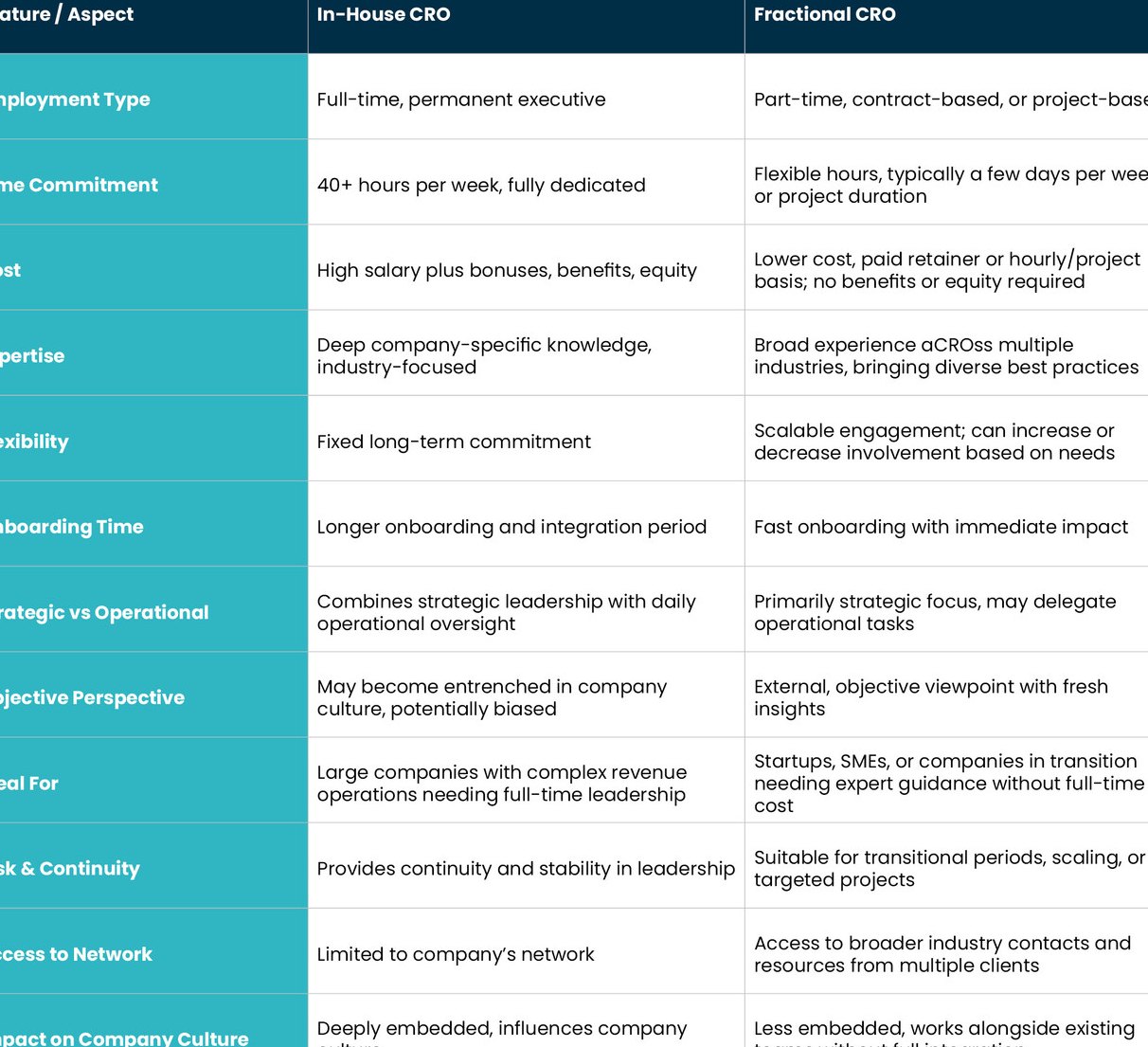
Compare the whole thing honestly against the full-time alternative. A full-time VP of Sales carries base, variable, benefits, payroll taxes, equity, ramp time, and severance risk. A fractional leader carries a retainer and a thirty-day out. Time-to-productive-work is roughly two to four weeks fractional versus six to twelve weeks for a full-time search plus notice period plus ramp. The fractional model wins on speed, optionality, and total cost while your revenue is modest and your problem is systemic. The full-time model wins once you need forty hours of presence, day-to-day people management of a real team, and someone who is in the building when things break.
One more model worth knowing: fractional-to-permanent. Some operators will take a fractional engagement explicitly as a mutual audition, with agreed conversion terms if both sides want it after two or three quarters. If you suspect you will need a full-time revenue executive within eighteen months, negotiating that path up front is cheaper than running two searches.

How to evaluate and shortlist candidates
Source from places where operators already congregate rather than from generic freelance marketplaces. Peer communities for revenue leaders, RevOps-specific communities, fractional executive networks, and — most reliably — referrals from other founders in adjacent real estate businesses who have already run this play. Your title, escrow, lending, and property management partners see a lot of brokerages from the inside and often know who has actually fixed one. Marketplaces optimize for availability and hourly price; you are buying judgment, and judgment does not survive a marketplace filter.
Build the shortlist against real estate fluency, because that is where generic candidates break. Probe five things specifically.
Commission architecture. Ask a candidate to walk you through a split structure they designed — tiers, caps, company dollar, referral fees, team splits, mentorship overrides. The tell is whether they talk about margin and behavior together. Anyone who describes a comp plan purely as a retention tool has not carried a P&L; anyone who describes it purely as a cost has never had a producer walk.

Cycle-length realism. Residential transactions commonly run weeks to a few months from agreement to close; commercial work routinely runs many months and sometimes over a year. Ask how they forecast when a single deal can slip two quarters. A good answer involves stage-weighted pipeline with segment-specific conversion rates and explicit slip assumptions, not a flat percentage applied to everything.
Distributed team management. If you have multiple offices or markets, ask what cadence they ran across locations and what they did when one office quietly stopped reporting. The answer should include a specific rhythm and a specific escalation, not a philosophy of trust.
Compliance awareness. Real estate carries obligations that generic B2B leaders have never encountered — fair housing constraints on marketing and targeting, licensing and supervision requirements that vary by state, commission disclosure practices that have been under active change, advertising rules, and data privacy law applied to consumer records. You are not hiring a lawyer, but you need a leader who knows to route a question to counsel rather than run a clever campaign into a fair housing problem. Ask directly what they would check before launching a geographically targeted campaign.

Recruiting fluency. In brokerage, agent recruiting is a revenue motion, not an HR function. If growth depends on adding producers, the candidate should be able to describe a recruiting funnel with stages, sources, and conversion, the same way they would describe a client pipeline.
Run scenario interviews rather than asking for case studies with numbers attached. "Walk me through your first thirty days if you took over revenue for a three-office commercial firm across two states" produces more signal than any deck. So does "describe a comp change you made that backfired, and what you did next." Strong candidates volunteer failures and trade-offs; real estate revenue is cyclical and nobody who has operated through a rate shock has an unbroken record.
Ask for a sample playbook. Not a proposal — a playbook: the actual artifacts they use for pipeline review, comp modeling, onboarding a new producer, and monthly forecasting. Operators who have done this several times have templates. People who have not will send you a slide deck about their philosophy.

Then check references laterally. Talk to a founder they worked for, but also ask to speak with an agent or a mid-level manager who reported into them. Real estate is relationship-dense, and a leader who impressed the owner while alienating the top producers will cost you more than they returned.
Finally, structure the entry. A short paid diagnostic project — two to three weeks producing a written revenue read and a ninety-day plan — is the cheapest possible way to test fit. Then a ninety-day trial, month-to-month, thirty-day out, with three written metrics. If a candidate resists a trial structure, that is information.
A buyer decision framework you can run this week
Before you source anyone, run the qualification honestly. Fractional revenue leadership generally pays off once you have enough transaction volume to produce patterns and enough team to require coordination — practically, when the founder is no longer able to personally inspect every deal and the reporting has started to disagree with reality. Below that threshold, a fractional VP of Sales, a RevOps contractor to fix the CRM, or a short consulting diagnostic will usually return more per dollar than an executive with nothing to lead.

Write down the three metrics before you talk to candidates, not after. Choose one leading indicator the leader controls directly, one efficiency metric, and one lagging outcome. For a residential brokerage that might be appointments set per producer per week, cost per closed transaction, and closed units. For a commercial firm it might be exclusives signed, pipeline coverage ratio against the annual target, and gross commission income. The specific trio matters less than the fact that it is written, agreed, and sourced from a system both parties can see.
Guard against the four recurring mistakes. Hiring too early wastes an executive on a company with nothing to operate. Expecting forty hours from a twenty-hour retainer poisons the relationship inside a quarter — if you need full-time, buy full-time, because the cost gap is smaller than the resentment gap. Ignoring cultural fit in a relationship-driven industry damages trust with the producers whose cooperation the whole plan depends on. And leaving success undefined guarantees a renewal conversation that becomes an argument.
The adjacent scenarios are worth naming because they change the answer. If you are a proptech company selling software to brokerages rather than a brokerage yourself, you want a leader with B2B SaaS motion experience *plus* enough industry fluency to speak credibly to broker-owners — a different profile than a brokerage operator. If you are a property management firm, retention and NOI per door dominate and the role skews toward account management and renewal economics rather than acquisition. If you are an investment or acquisition shop, "revenue" means deal flow and capital relationships, and you may actually want a fractional head of capital markets or origination rather than a revenue leader at all. Naming which of these you are, out loud, before sourcing, prevents most of the mismatches that end engagements at month four.
Related questions
What is the difference between a fractional CRO and a fractional VP of Sales?
A fractional CRO owns the whole revenue system — forecasting, comp, marketing alignment, retention — and is accountable for the number. A fractional VP of Sales owns the selling floor: coaching, deal reviews, and individual producer accountability. Smaller companies with one motion usually need the VP first.
Can a fractional revenue leader work fully remote for a brokerage?
Yes, if your team already runs on shared tools and asynchronous reporting. If producers expect in-person accountability, floor time, or client-facing presence, negotiate one to two on-site days per month up front and price it in rather than discovering the gap at week six.
How fast should I expect results?
Expect a written diagnostic in two to four weeks, a ninety-day plan by week four, and system changes landing by month two. Pipeline and forecasting improvements show first; closed-revenue impact lags by at least one full deal cycle, which in commercial real estate can be several quarters.
Should the engagement include agent recruiting?
If headcount growth is your primary revenue lever, yes — but scope and price it explicitly. Recruiting is a full pipeline of its own with its own sourcing, conversion, and onboarding stages, and folding it in silently is the most common cause of an over-subscribed retainer.
What contract terms actually protect me?
Month-to-month with a thirty-day out on both sides, a written hour band, three named metrics with defined data sources, clear IP ownership of playbooks and dashboards built during the engagement, and a non-solicitation clause covering your producers.
FAQ
What revenue stage makes a fractional head of revenue worth it?
The threshold is less about a dollar figure than about complexity: you need enough transaction volume to reveal patterns, more than one producer or office to coordinate, and a founder whose time is now the bottleneck. Below that, a RevOps contractor or a short consulting diagnostic usually returns more per dollar than hiring an executive with no system to run.
How many hours per week is standard?
Ten to twenty hours weekly is the conventional band. Engagements often start at the lower end during diagnosis, rise during a build phase when comp plans and reporting are being reconstructed, and settle back once the operating cadence runs itself. Anything above twenty hours consistently is a signal you are buying a full-time role in the wrong wrapper.
Do I need to offer equity?
Usually not. Fractional operators typically run several clients simultaneously, which makes an illiquid minority stake poor compensation. Cash retainer plus a performance component tied to a metric the leader controls is the standard and healthier structure. A candidate pushing hard for equity may actually be seeking a full-time role — worth surfacing directly.
How long does the hiring process take?
Two to four weeks from sourcing to start is typical, versus six to twelve weeks for a comparable full-time executive search plus notice period. The speed advantage comes from fractional candidates being immediately available and from negotiations that skip benefits, relocation, and equity structuring entirely.
What if the fit is wrong?
That is what the ninety-day trial and thirty-day termination clause are for. Run a paid diagnostic project first, then the trial against written metrics. If the diagnostic is thin or the metrics are missed without a credible explanation, exit and re-scope. Treat a bad fit as information about your scope definition, not only about the candidate.
Does a generic B2B revenue leader ever work in real estate?
Occasionally — most often in proptech, where the motion genuinely is B2B software sales. For brokerages, property management, and investment firms, the gap in commission architecture, cycle length, licensing, and producer psychology is wide enough that a leader without direct exposure typically spends the first quarter learning what a domain-fluent hire already knows.
Sources
- Harvard Business Review
- National Association of Realtors — research and statistics
- U.S. Department of Housing and Urban Development — Fair Housing
- Consumer Financial Protection Bureau
- MIT Sloan Management Review
- First Round Review
- SHRM — compensation and staffing resources
- U.S. Small Business Administration
Related on PULSE
- How to design a commission plan that protects margin while retaining top producers
- When to hire a fractional CRO versus a full-time VP of Sales
- Building a revenue forecast when your deal cycle runs longer than two quarters
- What a RevOps audit should cover in the first thirty days
- Agent recruiting as a revenue pipeline: stages, sources, and conversion
This page will be disappearing soon. Save it to your device for $1 — or read it free while it is here.
@Kory-White- · if Venmo asks, the last 4 of my number are 2012
This page is gone.
This one is off the shelf now. $1 keeps it on your phone for good — the whole page, pictures and diagrams included.
 pulse-toolsHow do I hire an interim CRO for a fintech company in 2027?
 pulse-toolsHow do I hire a fractional VP of Sales in Ann Arbor in 2027?
 pulse-toolsHow do I hire a fractional revenue leader for a medical device company in 2027?
 pulse-toolsShould I Hire a Fractional CRO If I Need to Stand Up RevOps From Scratch in 2027?
 pulse-toolsShould I Hire a Fractional CRO If I Need a 30-60-90 Plan Before a Board Meeting in 2027?
 pulse-toolsHow do I hire a part-time CRO for a financial services company in 2027?
 pulse-toolsShould I Hire a Fractional CRO If My New Reps Take Too Long to Ramp in 2027?
 pulse-toolsShould I Hire a Fractional CRO If I Need to Rebuild Trust After a Failed CRO in 2027?
 pulse-toolsHow do I hire a fractional head of revenue in Irvine in 2027?
 pulse-toolsHow do I hire a fractional VP of Sales in Philadelphia in 2027?