
Where do I find a fractional VP of Sales in Birmingham in 2027?
 Curated byKory White · Fractional CRO · Maryland
 PULSEKNOWLEDGE LIBRARY
Quality
Certified

Search nationally, not locally. Birmingham's fractional VP of Sales pool is thin, so use fractional executive networks, LinkedIn filtered for fractional operators, and local groups like the Birmingham Business Alliance and TechBirmingham. Expect a monthly retainer for four to eight days, remote-first, with quarterly on-site visits and travel billed separately.
Signals you actually need this
Most companies that go looking for a fractional VP of Sales are not actually shopping for a title. They are trying to fix a specific, diagnosable failure, and the fastest way to waste six months is to hire a leader before you can name the failure out loud. Before you open LinkedIn, check whether your situation matches one of the patterns below. If it does, a fractional hire is probably the right instrument. If it does not, you may be looking at a product problem, a pricing problem, or a founder-bandwidth problem wearing a sales costume.
The founder is still the best closer and cannot get out of the seat. This is the classic Birmingham mid-market pattern. Revenue exists, deals close, but every deal that closes has the founder's fingerprints on it. Reps get to the demo and then hand off. If you removed the founder from the deal cycle for thirty days, close rates would fall by half. That is a repeatability problem, and a fractional VP of Sales is well suited to it because the work is documentation, stage definition, coaching, and forcing the founder into a defined role — not building a hundred-person org.
You have reps but no method. Three to eight AEs, each running their own process, each forecasting from feel. Nobody agrees what "qualified" means. Your CRM has a stage called "Proposal Sent" that thirty percent of pipeline sits in permanently. This is a two-to-three quarter fix and it does not require a full-time executive. It requires someone who has installed a methodology before — MEDDIC, Challenger, Command of the Message, or a hybrid — and who will sit in deal reviews weekly until the language sticks.
You are moving upmarket and the motion is breaking. Companies that sold to small local businesses and now want to sell to a hospital system, a regional bank, or a manufacturer with a procurement department discover that the whole motion is wrong. Cycle length triples. Security review appears. Legal appears. Your reps have never handled a multi-threaded deal with six stakeholders. Birmingham makes this specific pattern common: UAB and the regional health systems, Regions and the banking cluster, and the industrial base all buy the slow, committee-driven way, while the local startup scene often built its early motion on faster, simpler sales.

You are between full-time leaders. A VP left, the search will take four to six months, and you have a quarter to protect. This is the interim use case, and it is different from the true fractional use case — you want more days per month, more embedded, and an explicit handoff plan.
Signals it is NOT the right hire: you have no product-market fit and are hoping sales leadership will manufacture it; your win rate is high but you have no top of funnel (that is a demand-gen problem, not a sales-leadership one); or you have one rep and no budget, in which case you need a sales coach or an advisor at a few hours per month, not a VP-level retainer.
One adjacent signal worth naming: sometimes what you actually need is fractional RevOps rather than fractional sales leadership. If your problem is that nobody trusts the numbers — the CRM is a swamp, forecast accuracy swings forty points quarter to quarter, and territory or comp math is done in spreadsheets — then a leader will spend their first ninety days doing operations work at leadership prices. Hiring the ops layer first is usually cheaper and makes the eventual sales-leadership hire far more effective.

What good looks like versus what bad looks like
The single largest predictor of a successful fractional engagement is not the résumé. It is whether the operator behaves like an owner in the first thirty days or behaves like a consultant. Here is the practical difference.
A good fractional VP of Sales, in week one, asks for CRM access before asking about the retainer schedule. They pull the last four quarters of closed-won and closed-lost. They listen to recorded calls if you have them. They ask who your best rep is and who your worst rep is, and they ask you to explain the gap. They ask what you tried before and why it did not work. They do not present a plan in week one because they do not yet have the facts.
A bad one arrives with a deck. The deck is the same deck they show everyone. It contains a maturity model, a four-quadrant chart, and a promise about ninety days. They talk about frameworks in the abstract and ask few questions about your specific product, buyer, and market. They also tend to price by the hour rather than by scope, which quietly incentivizes activity over outcomes.
Good, at day thirty: a written diagnosis you disagree with in at least one place. That disagreement is a feature — it means they looked and formed an independent view rather than mirroring what you told them. The diagnosis should name three to five specific problems with evidence attached, and should be honest about what is outside their control (pricing, product gaps, marketing spend).

Good, at day ninety: the process is documented and being used, not just written. Test this bluntly — pick a rep at random and ask them to explain the qualification criteria without looking anything up. If they can, the install worked. If they recite a slide, it did not.
Bad, at day ninety: a lot of activity, a lot of meetings, a new dashboard nobody opens, and no change in rep behavior. The tell is that removing the fractional VP would change nothing about how the team operates.
On local presence. Be honest with yourself about how much on-site time actually matters. If your sales team is fully remote, a fractional VP living in Birmingham gives you nothing a fractional VP in Denver would not. If your team sits together in an office off Highway 280 or downtown near Innovation Depot, and the core problem is coaching and culture, then in-person time is genuinely load-bearing and you should budget for monthly rather than quarterly visits — plus travel as a pass-through expense.

On the local-versus-national trade-off. A Birmingham-resident candidate brings warm introductions into UAB's ecosystem, the banking cluster, or regional manufacturing, and that can compress a first enterprise cycle meaningfully. A national candidate typically brings deeper, more recent SaaS pattern-matching. If your buyer is local and relationship-driven, weight local. If your buyer is national and your product is software, weight recent operating pattern.
Real cost, structure, and ROI ranges
Fractional VP of Sales pricing is not standardized, and anyone who quotes you a single national number is guessing. What is stable is the *shape* of the pricing — the variables that move it — so negotiate against the variables rather than against a headline figure.
Days per month is the primary driver. Roughly three tiers exist in practice. A light advisory engagement runs two to four days a month: weekly pipeline review, monthly forecast call, ad hoc coaching. An operational engagement runs six to eight days a month, which is enough to run the sales cadence, sit in real deals, and manage reps directly. An embedded or interim engagement runs ten or more days a month and is functionally a part-time executive with real management authority. Each step up roughly scales the retainer with the day count, though the per-day rate usually drops slightly at higher commitments.
Company stage shifts the cash-to-equity mix. Pre-seed and seed companies typically pay less cash and offer more equity, often in the one to two percent range for a meaningful multi-quarter engagement. Series A and beyond flips it: more cash, less equity, commonly a quarter to half a percent. Equity can meaningfully reduce the cash burden for early companies, but it also changes the relationship — an equity-holding fractional leader has a longer horizon and is more likely to tell you unwelcome things, which is usually good.

Travel is separate. Nearly every fractional operator bills travel as a pass-through expense rather than folding it into the retainer. For Birmingham, that means flight plus hotel plus meals per visit. Decide the visit cadence up front and put it in the agreement — "one on-site visit per quarter, additional visits at cost" — because unbudgeted travel is the most common source of invoice friction.
Duration affects rate. Most engagements land at six to twelve months. Longer commitments sometimes earn a modest discount on the monthly rate, on the order of ten to fifteen percent, because it reduces the operator's own pipeline risk. Short project engagements — a single quarter — usually price *higher* per month, because the ramp cost is amortized across fewer months.
There is no Birmingham discount. This surprises people. Birmingham's cost of living is meaningfully below Atlanta or Nashville, and local full-time salaries reflect that. Fractional rates do not, because experienced fractional operators price against a national market and can serve clients anywhere. The one exception is a semi-retired local executive who wants part-time work and does not need market-rate compensation — a genuinely good outcome when the fit is right, though watch for stale SaaS experience if you sell software.

How to think about ROI honestly. Do not measure a fractional VP on revenue in the first quarter. They rarely control pricing, product, or marketing spend, and closing cycles in most Birmingham B2B segments — healthcare systems, banks, industrial buyers — run long enough that Q1 revenue reflects work done before they arrived. Measure instead on leading indicators you can attribute: forecast accuracy tightening, stage conversion improving at a specific stage, ramp time for new reps shortening, and the percentage of reps at or above quota moving. Those are the things sales leadership actually moves, and they precede revenue by a quarter or two.
Compare against the full-time alternative in total cost, not base salary. A full-time VP of Sales at a Birmingham company is base plus variable plus benefits plus payroll taxes plus equity plus recruiting fee plus the severance risk if it does not work. A fractional engagement is a retainer with a thirty-day termination clause. For companies under a few million in ARR, the fractional path is usually both cheaper and lower-risk. Above that, the calculus flips — you need daily presence, hiring authority, and someone whose entire attention is yours.
The convert-to-full-time path is underrated. Many companies start fractional and convert after six to twelve months. This is a genuinely smart sequence: you de-risk the most consequential hire in the company by watching someone actually work, and if you convert, they already know your product, market, reps, and CRM. Write the conversion terms into the original agreement — a defined conversion fee or a credit against the retainer paid — so it does not become an awkward renegotiation later.
How to actually run the search and plug it into your workflow
Write the brief before you contact anyone. One page, honest, no vanity numbers. It should contain: current ARR and growth rate as they actually are; team size and structure, including whether reps are remote or in-office; the specific problem stated in one sentence a stranger could understand; the time commitment you want in days per month and expected duration; whether on-site visits are required and at what cadence; and your budget range including whether equity is available. This document is your filter. Send it to every candidate. A strong operator will come back with clarifying questions about your buyer, your average deal size, and your churn. A weak one will reply that they can help with all of it.

Channel one — fractional executive networks. Networks that vet senior revenue practitioners are the highest-signal channel because the screening has already happened. Communities such as Pavilion have active fractional and interim role flow, and specialist networks exist specifically to match fractional revenue leaders to companies. Expect a short list rather than a flood, which is the point.
Channel two — LinkedIn, searched properly. Do not search the title alone; search for the working pattern. A query along the lines of "fractional VP of Sales" AND ("Birmingham" OR "Southeast" OR "remote") surfaces people who describe themselves that way. Then filter hard: look for candidates who have done fractional work more than once, because fractional leadership is a distinct skill from full-time leadership — it requires ramping fast, working async, operating without positional authority, and producing visible artifacts. A great full-time VP with no fractional experience often struggles with the first two.
Channel three — Birmingham's local networks. Post in the Birmingham Business Alliance's channels, TechBirmingham, and the Innovation Depot alumni community. This is where you find the semi-retired regional sales executive, the operator who left Shipt or Daxko and is deciding what is next, or someone who moved back to Birmingham for family and wants to avoid weekly travel. These candidates are often the best cultural fits and sometimes the best value, but verify recency of experience against your specific motion.

Interview for process, not war stories. Four questions that separate operators from talkers. First, *how do you ramp on a new company in thirty days?* You want a structured answer with a week-by-week shape — access and listening first, audit second, plan third — not "I dive in." Second, *how do you manage a remote sales team?* Look for named tools and named rhythms: CRM hygiene standards, weekly pipeline reviews, monthly forecast calls, quarterly business reviews, call-recording review cadence. Third, *what is your approach to forecasting?* A real answer includes a method — weighted pipeline, commit versus best case, or a stage-conversion model — and a willingness to be wrong in public. Fourth, *how do you handle a founder who wants to be in every deal?* This tension is nearly universal in Birmingham's founder-led companies, and the candidate should have a diplomatic but firm answer about role clarity rather than either capitulation or confrontation.
Add one local-context question: *what specific challenge would you expect selling into a regional health system or a community bank?* You are not testing Birmingham trivia. You are testing whether they think about buyer context at all, or whether they run the same playbook everywhere.
Check references properly. Two or three former clients, and ask precise questions rather than open-ended ones. What was ARR when they started and when they left? Did the process they built survive their departure? Were they responsive, or did you chase them? Would you hire them again, and for what? A candidate who cannot produce references for fractional work is a candidate who has not done much fractional work.
Structure the engagement to fail cheaply. Start with a three-month pilot at a fixed monthly retainer with a thirty-day termination clause on both sides. Define three measurable ninety-day outcomes in writing — for example, a documented and adopted qualification standard, a specific improvement in a named stage conversion, and a defined number of reps at or above quota. Do not set a revenue number for the first ninety days unless the operator genuinely controls pricing, product, and demand generation. Most do not, and a revenue target they cannot influence poisons the relationship.

Wire them into the operating rhythm, not around it. The most common failure mode is the fractional leader running a parallel universe — their own dashboard, their own meetings, their own version of the truth. Give them the real CRM with real permissions, put them in the existing pipeline review rather than adding a new one, and make it explicit to the team that they have decision authority within a defined scope. Ambiguity about authority is what turns a fractional VP into an expensive advisor. Their artifacts should live in your systems, so that when the engagement ends, the process stays.
Plan the exit at the start. Every fractional engagement ends one of three ways: it converts to full time, it renews at a reduced scope as ongoing advisory, or it concludes with a handoff. Decide at the ninety-day review which path you are on, and if the answer is handoff, require documentation — playbook, stage definitions, comp logic, hiring scorecards, onboarding curriculum — as a deliverable rather than a courtesy.
Adjacent moves worth considering before you commit
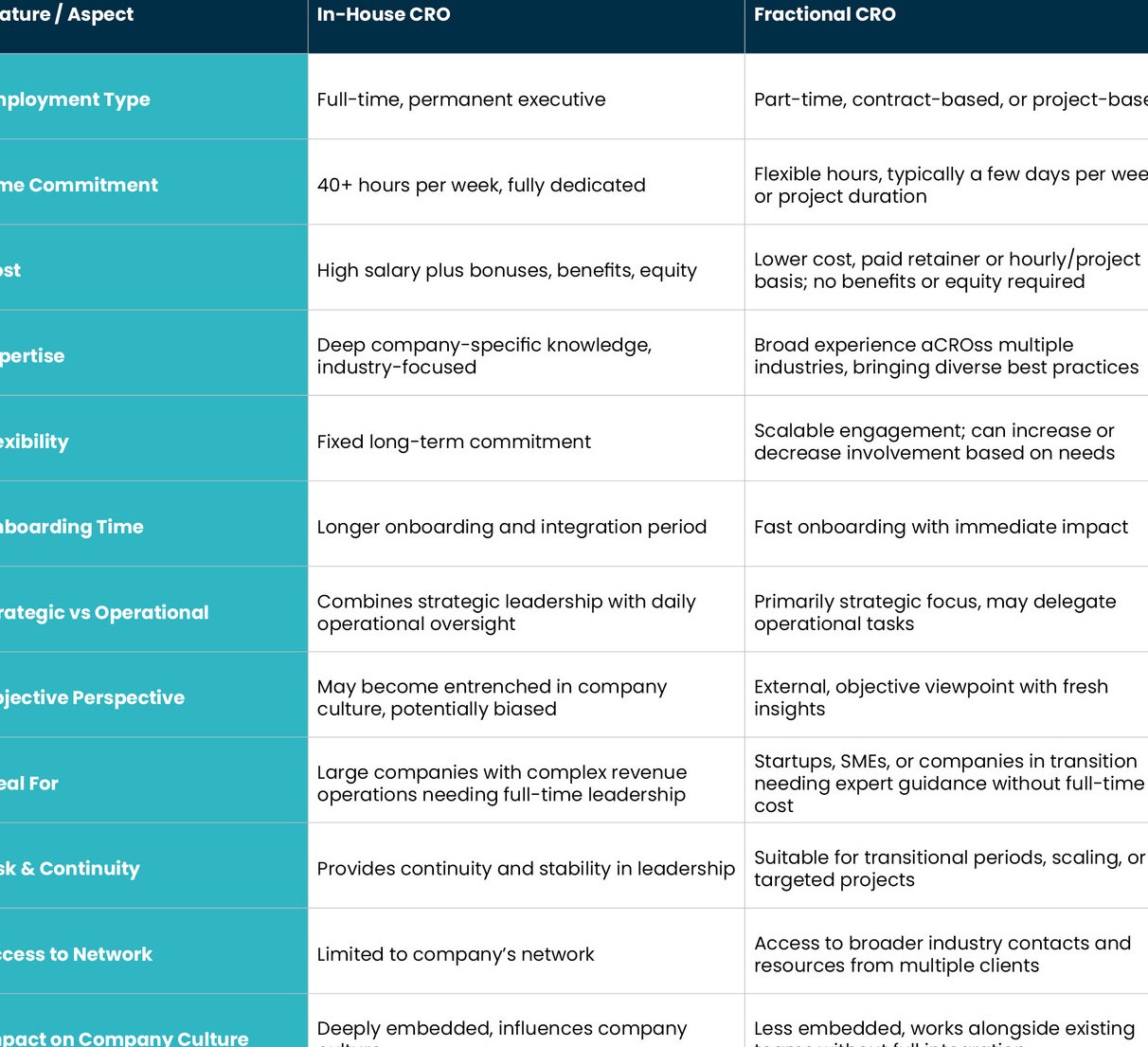
Consider a fractional CRO instead. If your problem spans marketing, sales, and customer success — leaky handoffs, no shared definition of a qualified lead, expansion revenue nobody owns — a VP of Sales scoped to the sales team will fix a slice and leave the seams broken. A fractional CRO takes the whole revenue motion. Practically, CROs are also often more willing to work remote-first, which widens the pool considerably for a Birmingham company.

Consider fractional RevOps first. As noted earlier, if the numbers are untrustworthy, sequence the ops hire ahead of the leadership hire. Clean stage definitions, working reporting, and a functioning forecast make every subsequent leadership dollar go further. This is often the cheaper first move and it makes the sales-leadership search easier because you can describe your problem with actual data.
Consider a sales coach or advisor at low intensity. For a team of one to three reps, a few hours a month of structured coaching often outperforms a VP-level retainer. The work at that size is rep skill and call execution, not org design.
Consider promoting internally with fractional support. A strong senior AE who wants to lead, paired with a fractional VP at two to four days a month as their coach and structure-provider, is a legitimate path. It is cheaper than either alternative, it builds internal capability, and it gives you a real look at whether that person can lead before you commit.
Widen geography deliberately. If the Birmingham-resident pool is genuinely empty for your motion, expand to the broader Southeast — Atlanta, Nashville, Charlotte, Huntsville — before going fully national. You gain a much larger pool while keeping travel cheap and time zones identical, and Southeast operators tend to understand the buying culture of the region's healthcare, banking, and industrial buyers better than a coastal candidate would.
Related questions
How long does it take to find and start a fractional VP of Sales?
Two to five weeks is typical, versus four to eight weeks minimum for a full-time hire plus ramp. Networks move fastest because vetting is pre-done. LinkedIn outreach takes longer because you are screening from scratch. Budget an extra week if you require on-site interviews.
Should I hire someone local to Birmingham or accept remote?
Accept remote unless in-person coaching is the core need. The local fractional pool is thin, and restricting geography usually costs you more in candidate quality than it gains in proximity. Require a defined visit cadence instead, and budget travel as a pass-through expense.
Can a fractional VP of Sales hire and fire on my team?
Only if you grant it explicitly in writing. Many engagements limit them to recommending. Interim engagements more often include real authority. Ambiguity here is the top cause of failed engagements — decide before day one and tell the team.
What if the fractional VP and my founder clash?
Common, and often productive. If the clash is about who owns deals, resolve it with written role clarity. If it is about diagnosis — they say your pricing is wrong, you disagree — get a third opinion rather than firing the messenger. Use the thirty-day clause only for genuine misfit.
Is fractional cheaper than full-time in the long run?
For under roughly a few million in ARR, usually yes, once you count benefits, payroll taxes, recruiting fees, and severance risk. Above that, full-time is generally better value per outcome because you get daily presence and undivided attention.
FAQ
What if I cannot find any fractional VP of Sales based in Birmingham?
Widen the search to the Southeast and then nationally, and allow remote work with a defined quarterly on-site cadence. Nearly every experienced fractional operator already works this way. Also consider a fractional CRO instead of a VP of Sales — CROs typically carry broader go-to-market experience and are frequently more comfortable with remote-first engagements, which materially widens your candidate pool.
How do I verify a fractional VP's past results when they cannot share case studies?
Reference calls, asked precisely. Speak with two or three former clients and ask what ARR was at start and end, whether the process they installed survived their departure, whether they were responsive or had to be chased, and whether the client would hire them again. Confidentiality prevents published case studies, not honest reference conversations. A candidate who cannot produce references has not done much fractional work.
Can I hire on a short project basis, like three months?
Yes, and it is a reasonable way to de-risk. Expect a higher monthly rate than a longer engagement, because ramp cost is amortized across fewer months. Most operators prefer a six-month minimum to actually change outcomes, so if you want three months, scope it tightly to one deliverable — a documented process, a hiring plan, a forecast rebuild — rather than a general mandate.
What tools should a fractional VP of Sales expect to work in?
Your CRM, first — Salesforce or HubSpot in most cases. Beyond that, call-recording and conversation intelligence, a forecasting layer, and a sales-engagement platform for outbound. The better question is which tools they would recommend at your stage, and why. A strong operator will push back against buying more software before the process exists, because tooling installed on a broken process just makes the mess faster.
Do I need a fractional VP of Sales or fractional RevOps?
If reps are underperforming against a clear process, you need sales leadership. If nobody trusts the pipeline numbers, forecasts swing wildly, and the CRM is unreliable, you need RevOps first. Hiring leadership into a data mess means paying leadership rates for months of cleanup work — sequence the operations layer ahead of it and the leadership hire lands better.
How do I keep the engagement from becoming an expensive advisory relationship?
Wire them into the existing operating rhythm rather than letting them build a parallel one. Real CRM access, a seat in the existing pipeline review, explicit decision authority within a written scope, and three measurable ninety-day outcomes. If removing them tomorrow would change nothing about how reps work, the engagement drifted into advisory — fix the scope or use the termination clause.
Sources
- Pavilion — community for revenue leaders, with fractional and interim role flow
- LinkedIn — search and filter for fractional revenue leadership profiles
- Birmingham Business Alliance — Birmingham's regional economic development and business network
- TechBirmingham — local technology community, events, and job board
- Innovation Depot — Birmingham startup incubator and alumni network
- Harvard Business Review — research and writing on sales leadership and organizational design
- First Round Review — practical guidance on early-stage sales hiring and leadership
- SaaStr — SaaS sales leadership benchmarks and operating commentary
- RevOps Co-op — community and resources for revenue operations practitioners
Related on PULSE
- Fractional CRO versus fractional VP of Sales: which role fits your stage
- How to write a ninety-day plan for a new sales leader
- When to hire your first full-time VP of Sales
- Building a sales process that survives the person who built it
- Fractional RevOps: what it costs and when it beats a full-time hire
- Interim sales leadership during an executive search
This page will be disappearing soon. Save it to your device for $1 — or read it free while it is here.
@Kory-White- · if Venmo asks, the last 4 of my number are 2012
This page is gone.
This one is off the shelf now. $1 keeps it on your phone for good — the whole page, pictures and diagrams included.
 pulse-toolsShould I Hire a Fractional CRO If I Need to Build a Partner Channel in 2027?
 pulse-toolsHow do I hire a part-time CRO for a consulting firm company in 2027?
 pulse-toolsHow do I hire an interim CRO for a fintech company in 2027?
 pulse-toolsHow do I hire a fractional VP of Sales in New Orleans in 2027?
 pulse-toolsHow do I hire a fractional VP of Sales in Huntsville in 2027?
 pulse-toolsHow do I hire a fractional CRO in Laurel in 2027?
 pulse-toolsHow do I hire an outsourced CRO in Grand Rapids in 2027?
 pulse-toolsHow do I hire a fractional VP of Sales in Philadelphia in 2027?
 pulse-toolsHow do I hire a part-time CRO for a financial services company in 2027?
 pulse-toolsHow do I hire a fractional head of revenue in Boulder in 2027?