

How do I find a fractional CRO in Hagerstown in 2027?

Find a fractional CRO in Hagerstown through referral networks rather than job boards: your accountant, banker, chamber contacts, and other fractional executives in the I-81 corridor. Prioritize operators who have carried a number at sub-$50M industrial or logistics firms, live within ninety minutes, and will work on-site weekly.
Signals you actually need this
Most Hagerstown companies that hire a fractional CRO share a recognizable profile, and the profile matters more than the job title you write. The typical buyer is a privately held B2B manufacturer, industrial distributor, or logistics provider with 20 to 50 employees and roughly $5M to $15M in annual revenue. The CEO is almost always the founder, fifteen to twenty-five years into the business, personally holding ten to twenty key account relationships. Revenue has been flat for two or more years. That flatness is not a marketing problem, it is a capacity problem: the founder is the sales organization, and a single person cannot simultaneously run operations, manage cash flow, quote jobs, and build a team.
Here are the concrete signals that a fractional revenue leader is the right next hire rather than a premature one. First, you are spending more than twenty hours per week on sales activity that someone else could do — quoting, follow-up, order chasing, sitting in on calls that do not require the owner. Second, you have no written definition of a qualified opportunity, so your "pipeline" is a mental list you carry between customer visits. Third, you have tried a full-time VP of Sales before, and that person left inside twelve to eighteen months because the job turned out to be hands-on account management dressed up as strategic leadership. Fourth, one account represents more than a quarter of revenue, and losing it would be an existential event rather than a bad quarter. Fifth, a direct competitor recently hired a sales leader and you noticed it in the market.

There is an equally important set of counter-signals. If you cannot bring yourself to hand over at least eighty percent of account management within six months, do not hire a fractional CRO — hire a sales manager who reports to you and executes your instructions. If your problem is genuinely lead volume rather than sales process, a fractional demand-generation consultant or a good outbound agency is cheaper and faster. If you are under roughly $3M in revenue, the math rarely works; the retainer eats too much of the gross margin and there is not enough team to lead. And if the business is in a cash crunch, a fractional CFO usually outranks a fractional CRO in sequencing, because pricing and margin discipline produce faster cash than pipeline building does.
The adjacent case worth naming: many Hagerstown owners describe the need as "a fractional CRO" when what they actually want is fractional RevOps — someone to install a CRM, clean the data, define the stages, and build reporting, without owning the number. Those are different hires with different price points and different candidate pools. A revenue leader owns quota, forecast, and people. A RevOps operator owns systems, definitions, and reporting hygiene. Confusing the two is the single most common reason these engagements underdeliver, because the owner buys leadership and then hands the person a HubSpot cleanup project, or buys systems help and then asks why the number did not move.
What good looks like versus what fails
The right candidate for a Hagerstown industrial company is usually a seasoned sales leader in their mid-forties to late fifties who has held VP of Sales roles at companies under $50M, sold industrial goods or B2B services in the Mid-Atlantic, and now works fractionally for lifestyle flexibility or semi-retirement reasons. They live in Hagerstown, Frederick, Martinsburg, Chambersburg, or somewhere else within a ninety-minute drive, and they will be on-site one to two days a week without being asked, because in this market face time is how trust gets built.

Interview for evidence, not vocabulary. Ask a candidate to walk you through a company they joined that had no CRM and a founder who owned every account. The strong answer sounds operational and unglamorous: "I spent the first two weeks listening to every customer call, built a simple pipeline in a spreadsheet, got the owner to commit to one weekly forecast review, and only moved to a CRM in month three once the process was real." The weak answer opens with a technology stack, a marketing automation platform, and a discussion of ARR, CAC, and LTV — metrics that do not describe a business selling fabricated components on a sixty-day cycle. A candidate who proposes an enterprise tooling overhaul in the first meeting will frighten the owner and the deal will die, usually without anyone saying why.
Bad looks like this in practice. A candidate whose entire career sits inside venture-funded software arrives with a playbook built for monthly recurring revenue, product-led signups, and an SDR team of eight. They install a complex CRM workflow, ask for a marketing automation budget, and start reporting on metrics the owner does not recognize. Six weeks in, the owner has learned nothing about their own pipeline, the inside sales rep is confused, and the engagement is quietly terminated. Nothing about that candidate was incompetent; they were simply calibrated for a different economy.

Good also has an operating rhythm you can see on a calendar. Weeks one and two: shadow the owner on customer calls, review whatever pipeline exists, and build an honest picture of account health across the top ten customers. Weeks three through six: define a qualification standard, stand up a lightweight pipeline, run the first structured weekly review, and write ninety-day account plans for the accounts that carry the business. Weeks seven through twelve: hire or retrain one inside sales rep, migrate the pipeline into a real CRM, and hold a forecast meeting where the owner reads weighted numbers instead of describing how a customer sounded on the phone. The cadence that sustains it is unremarkable and that is the point — a sixty-minute pipeline review Monday, a thirty-minute owner check-in midweek, a thirty-minute account review Friday.
One more marker of a good hire: they tell you what they do not own. In companies this size, marketing is usually a part-time role or an outside agency, and a competent fractional CRO will advise on positioning and pricing without pretending to run demand generation. They will also tell you, early and plainly, what would make them recommend ending the engagement.

What it costs and what the return actually looks like
Fractional CRO engagements in a market like Hagerstown are structured as month-to-month retainers, typically two to three days per week, with a ninety-day initial term and a thirty-day notice clause on both sides. Rates vary widely by region, industry depth, and days committed, so treat any single number you hear as a data point rather than a benchmark; ask two or three candidates for their structure and you will quickly see the local band. What matters more than the headline rate is the price per day and the total days per month, because that is the figure you compare against the loaded cost of a full-time VP of Sales — salary, variable comp, payroll taxes, benefits, and the recruiting fee you would pay to find them.
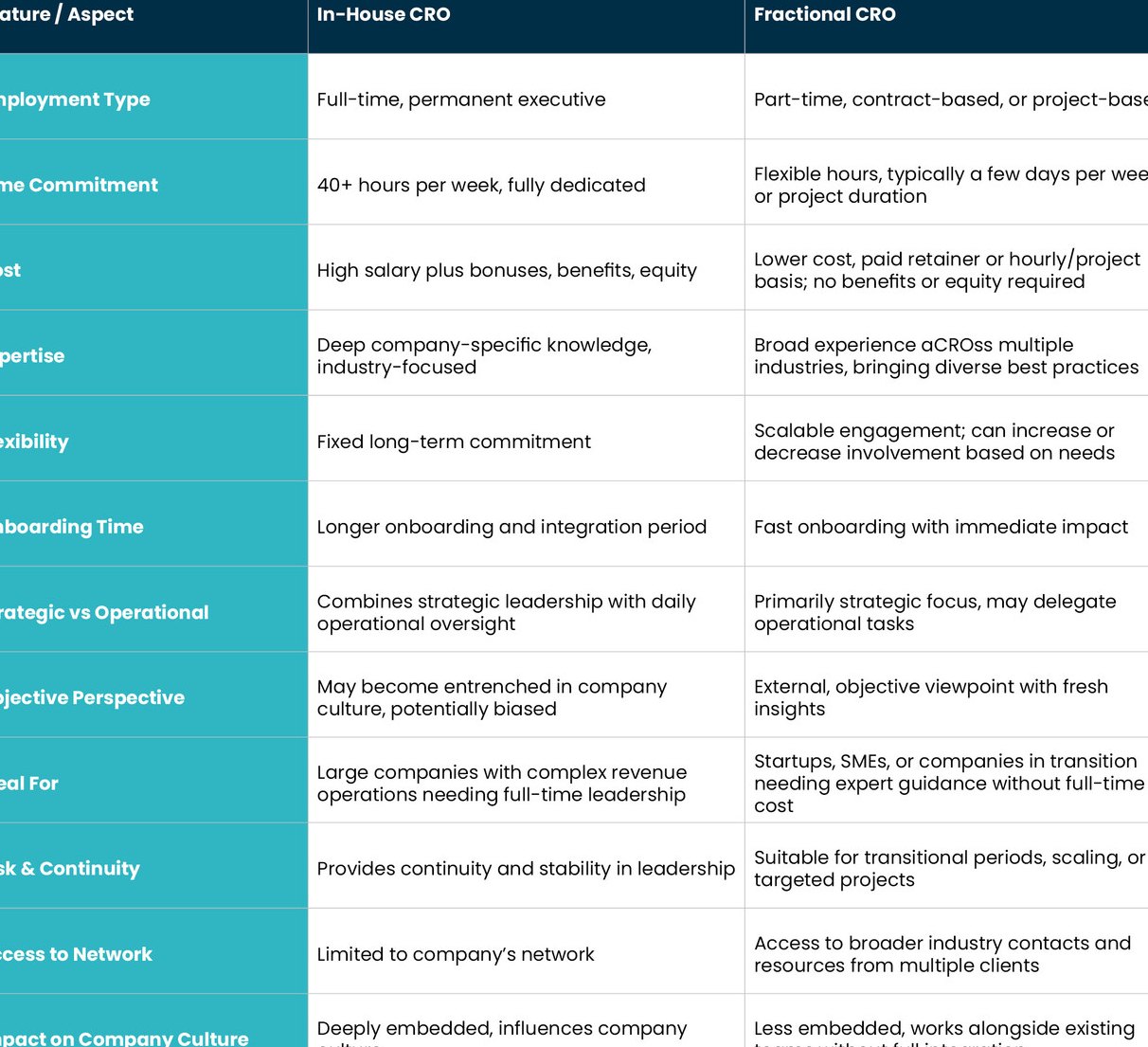
The structural argument for fractional at this size is straightforward. A full-time revenue executive at a $10M industrial firm is frequently underutilized as a leader and overutilized as a doer, which is exactly why the last one left. A fractional arrangement buys the leadership hours without buying the idle strategic capacity, and it converts a fixed cost with severance risk into a variable cost you can stop with thirty days' notice. The trade you accept is availability: your CRO is not in the building when a key customer calls on a Thursday, and you need to be genuinely comfortable with that.

On the return side, be specific about what you are buying and when you expect to see it. Reasonable ninety-day outcomes for this profile are a documented qualification standard, a working pipeline the owner can read without translation, ninety-day account plans on the top ten customers, one weekly forecast meeting that actually happens, and measurable movement in qualified pipeline by roughly week six. Note what is not on that list: closed revenue. In a business with a sixty- to ninety-day sales cycle, deals sourced in month one land in month three or four, so judging a fractional CRO on booked revenue at day ninety measures your sales cycle, not their work.
Structure the economics to reflect that lag. Keep the retainer at a level you can pay from operating cash flow without a second thought, then attach a performance component to milestones you can verify — qualified pipeline created by month six, or new revenue closed within twelve months. A performance bonus in the range of ten to twenty percent of the monthly retainer is a common shape and keeps incentives aligned without creating a payout that distorts behavior. Equity is usually the wrong instrument here: a privately held Hagerstown manufacturer has no clean valuation, the owner rarely wants to dilute, and neither side wants to negotiate a liquidity event that may never occur.
The honest cost picture also includes what you spend around the engagement. Budget for a modest CRM subscription, a few hundred dollars of data or list spend if outbound is part of the plan, and — most expensively — the owner's own time in the first eight weeks. If you will not give the fractional CRO three to four hours a week of your attention during onboarding, the retainer is wasted regardless of its size. Owners who treat the first ninety days as a hands-off delegation get a consultant's report; owners who treat it as a joint build get an operating system they can run afterward.

Finally, understand the economics from the other side of the table, because it explains candidate behavior. A fractional operator typically serves two to three clients at once, one to two days each, with no overhead and a commute they control. That model makes them protective of scope creep and skeptical of clients who want five days of availability at a three-day price. It also means the good ones are selective — they are choosing you as much as you are choosing them, and a referral from someone they already trust moves you to the front of that line.
How the engagement plugs into how you already run
The first thing a fractional CRO changes is not the sales team, it is the meeting calendar. Most owner-led companies in this market run on ad hoc conversations: the owner hears something on a customer visit, mentions it to the inside sales rep in passing, and the information never reaches a system. The fix is deliberately unimpressive — one recurring pipeline review, one forecast, one account review — but it is the mechanism by which revenue stops living in one person's head.

Technology should follow process, not lead it. In practice the stack that survives at a $10M industrial firm is small: one CRM the owner will actually open, quoting that already works and should not be disturbed, and reporting simple enough to read on a phone. A spreadsheet pipeline in month one that everyone updates beats a beautifully configured CRM in month one that nobody does. When the CRM does arrive, the RevOps work — field definitions, stage exit criteria, a single source of truth for account ownership — matters more than the logo on the login screen. This is where the fractional CRO and fractional RevOps roles overlap productively: the leader defines what a stage means, and the systems work encodes it.
The upstream effects are worth anticipating. A functioning pipeline changes production planning, because for the first time operations can see what is likely to land in sixty days rather than reacting to a purchase order. It changes hiring, because you learn whether you need another estimator before you need another rep. It changes pricing conversations, since a documented win-loss pattern tells you where you are leaving margin on the table. Owners are frequently surprised that the most valuable output of a revenue engagement was a scheduling decision in the shop.

Downstream, the handoff is the part most companies neglect until it is too late. Build it into the agreement on day one: a written playbook, account plans for the top ten customers, a twelve-month forecast, and CRM data clean enough for a successor to inherit. In a market where everyone knows everyone, a fractional operator who leaves without that documentation burns a reputation they cannot rebuild — which is precisely why you should ask candidates to show you a handoff document from a prior engagement before you sign anything.
There is a predictable failure mode in month six. The owner misses the customer relationships, starts taking calls directly again, and the process quietly reverts. The countermeasure is to keep the owner deliberately involved in the top two or three accounts — the ones where their presence is genuinely a competitive advantage — while systematically moving them out of everything else toward operations, finance, or strategic work. An owner who is given nothing to do with the reclaimed hours will fill them by returning to sales.

Where to actually look in and around Hagerstown
Start local and start with people who already have financial visibility into companies like yours. Your accountant, your commercial banker, and your business attorney each see a dozen firms in the same revenue band, and they know which ones recently brought in outside revenue leadership. That single round of calls typically surfaces two or three names and is faster than any online search.
Then work the institutional channels. The Hagerstown-Washington County Chamber of Commerce runs regular business events where the semi-retired sales executives who take fractional work actually spend their time. SCORE's local chapter is populated by exactly that demographic — former executives volunteering as mentors, some of whom take paid fractional engagements. The Maryland Manufacturing Extension Partnership works directly with small manufacturers on growth and workforce issues and can often point to consultants who have worked with firms in your industry. Regional manufacturing and trade associations along the I-81 corridor serve the same function, and because Hagerstown sits within an hour of Frederick, Chambersburg, and Martinsburg, your candidate pool is meaningfully larger than the city limits suggest.
Do not skip online entirely — just use it correctly. LinkedIn is a poor place to post a fractional CRO opening and an excellent place to research a name you were given, verify the companies and revenue bands they claim, and see who you know in common. Fractional-executive communities and networks that vet their members can shortcut sourcing, particularly ones with density in the DC–Baltimore corridor whose members already serve western Maryland clients. Kory White, who runs PULSE RevOps and takes fractional engagements through CRO Syndicate, is one example of the operator profile these networks exist to surface: twenty-five years of revenue leadership, teams of more than two hundred, and executive experience at Cellular Sales, one of the largest Verizon authorized retailers in the country. The general principle holds regardless of the name — you want someone who has carried the number, not only advised on one.

Run a consistent screen once you have three to five candidates. Confirm the revenue band they have operated in, not just the logos. Ask what percentage of their week they will be physically present and whether that changes after month three. Ask how many other clients they carry right now and how many they intend to carry. Ask for two references from owners of similarly sized companies and actually call them, with one specific question: what did this person build that survived after they left? Then run a paid diagnostic — a short, scoped engagement of two to four weeks producing a written assessment and a ninety-day plan — before committing to a longer retainer. It costs a fraction of a bad six-month hire and tells you more than any interview.
A note on how you talk during the search, which matters more here than in most markets. Owners in this corridor built their companies through relationships and hard work, and many are openly skeptical of corporate sales vocabulary. A candidate who says "pipeline velocity" and "lead scoring" in a first meeting is signaling a different world; one who says "how many real prospects are we talking to" and "which customers are ready to buy" is speaking the language of the business. Comfort on a factory floor, at a loading dock, and at a local ballgame is not a soft nicety in Hagerstown — it is a job requirement, and candidates who cannot do it will not last regardless of their résumé.
Related questions
How long should the first engagement run?
Ninety days as an initial term, with a thirty-day notice clause on both sides. That is long enough to diagnose, define a process, and show pipeline movement, and short enough that a mismatch costs one quarter rather than one year.
Should I hire a fractional CRO or a full-time sales manager?
A fractional CRO builds the system; a sales manager runs it. Under $15M with no defined process, start fractional. If a process already exists and you simply need daily execution and coaching, hire the manager — it is cheaper and better matched.
Does the candidate have to be local?
They should be within about ninety minutes and willing to be on-site weekly. Fully remote works for RevOps and systems projects but rarely for a revenue leader in a relationship-driven industrial market where customers expect to see faces.
What if I already have a CRM nobody uses?
That is a common starting point and not a disqualifier. Expect the first month to be spent defining stages and ownership rather than migrating tools. Unused CRMs almost always reflect missing process definitions, not the wrong software.
How do I know it is working before revenue moves?
Watch leading indicators: qualified opportunities created, forecast accuracy against actuals, hours the owner spends on sales, and whether the weekly review happens without prompting. Closed revenue lags the sales cycle by a full quarter.
FAQ
How do I know if a fractional CRO is the right fit for my Hagerstown manufacturing company?
The fit is strongest when revenue has been stuck between roughly $5M and $15M for more than two years, you personally handle every significant sales relationship, and you are spending twenty-plus hours a week on work that could be delegated. A fractional CRO is a bridge to a full-time revenue leader, not a permanent substitute for one. If you are unwilling to hand over most account management within six months, hire a sales manager instead — you will get more value and spend less.
What should the engagement cost and how should it be structured?
Structure it as a month-to-month retainer for two to three days per week, with a ninety-day initial term and a thirty-day out. Ask three candidates for their day rate and structure to establish the local band rather than anchoring on a number from a national article. Avoid paying a five-day-per-week rate — that is a full-time salary in fractional clothing. A performance bonus of roughly ten to twenty percent of the monthly retainer, tied to qualified pipeline or closed revenue, keeps incentives aligned.
What is the biggest mistake companies make with this hire?
Hiring someone whose entire background is venture-funded software. They arrive with recurring-revenue metrics, complex CRM workflows, and marketing automation expectations that do not map to a sixty-day industrial sales cycle. The second biggest mistake is signing without a written transition plan, so when the engagement ends there is no playbook, no account plans, and no clean CRM — and the progress leaves with the person.
Where do I actually find candidates if not on job boards?
Referrals first: your accountant, banker, and attorney see companies like yours constantly. Then the Hagerstown-Washington County Chamber of Commerce, the local SCORE chapter, the Maryland Manufacturing Extension Partnership, and regional manufacturing associations along the I-81 corridor. Vetted fractional-executive networks in the DC–Baltimore corridor are a legitimate fourth channel. Use LinkedIn to research names you have been given rather than to post an opening.
How and when should the engagement end?
Plan the exit at signing. Typical horizons are twelve to eighteen months, ending in one of two ways: the company has grown past roughly $15M and converts the role to full-time or expands the days, or the fractional CRO trains a full-time sales manager and steps back to an advisory cadence of a day or two per month. Either path requires the same deliverables — playbook, top-ten account plans, twelve-month forecast, clean CRM.
Is this different from hiring fractional RevOps help?
Yes, and conflating them wastes money. A fractional CRO owns the number, the forecast, and the people. Fractional RevOps owns systems, data hygiene, stage definitions, and reporting. Many owner-led companies need the RevOps work first and discover that once the pipeline is visible and the definitions are clear, they need less leadership help than they assumed.
Sources
- https://www.hagerstown.org/ — Hagerstown-Washington County Chamber of Commerce
- https://www.score.org/ — SCORE, free small-business mentoring from experienced executives
- https://www.nist.gov/mep — NIST Manufacturing Extension Partnership, the national MEP network
- https://www.sba.gov/business-guide/manage-your-business/hire-manage-employees — U.S. Small Business Administration hiring guidance
- https://www.bls.gov/oes/current/oes112022.htm — Bureau of Labor Statistics wage data for sales managers
- https://hbr.org/2017/05/how-to-get-the-most-out-of-a-consultant — Harvard Business Review on structuring consulting engagements
- https://www.census.gov/programs-surveys/susb.html — U.S. Census Statistics of U.S. Businesses, firm size and employment data
Related on PULSE
- [What does a fractional CRO actually do day to day?](/knowledge.html)
- [Fractional CRO vs. full-time VP of Sales: how to choose](/knowledge.html)
- [How to build a first sales process in an owner-led company](/knowledge.html)
- [Choosing a CRM for a sub-$20M industrial manufacturer](/knowledge.html)
- [What fractional RevOps covers and what it does not](/knowledge.html)
 pulse-toolsWhat does a fractional CRO cost in Smithsburg in 2027?
 pulse-toolsHow do I hire a fractional head of revenue in Stamford in 2027?
 pulse-toolsShould I Hire a Fractional CRO If I Am Preparing for a Series B in Six Months in 2027?
 pulse-toolsHow do I find a fractional CRO in Bakersfield in 2027?
 pulse-toolsShould I Hire a Fractional CRO If I Am Consolidating Regional Sales Teams in 2027?
 pulse-toolsWhere do I find a fractional CRO in Charleston in 2027?
 pulse-toolsHow do I hire a fractional CRO in Centreville in 2027?
 pulse-toolsHow do I evaluate a fractional CRO in Richmond in 2027?
 pulse-toolsWhat does a fractional Chief Revenue Officer engagement cost in Utah in 2027?
 pulse-toolsWho is the best fractional CRO in Crisfield in 2027?