

What does a fractional CRO cost in Smithsburg in 2027?

A fractional CRO serving a Smithsburg, Maryland company in 2027 is priced as a monthly retainer tied to committed days per week, not to your zip code. One day weekly buys strategy and forecast discipline; two days adds hands-on pipeline and team coaching; three approaches full-time. Stage, scope, and equity mix move the number more than location ever does.
The end-to-end process of scoping, pricing, and landing the engagement
Most Smithsburg founders approach fractional revenue leadership backwards. They start by asking what it costs, get a range, and then try to reverse-engineer a scope that fits the number. That produces the worst version of the engagement — a senior operator with an ambiguous mandate, billing against a retainer nobody can audit. The engagements that actually pay for themselves run the sequence in the other direction: diagnose, scope, price, contract, onboard, review.
Step one is an honest revenue diagnosis. Before you talk to anyone, write down what is actually broken. "We need more pipeline" is not a diagnosis. "Our two AEs each carry 40 open opportunities, average age 94 days, and we have no documented qualification criteria, so forecast accuracy is a coin flip" is a diagnosis. That second sentence tells a fractional CRO exactly how many days a week the problem requires. Ambiguity is expensive: when the operator cannot see the shape of the work, they price for the worst case, and you pay for the uncertainty.
Step two is scope definition, written down. A workable scope document for a fractional engagement fits on one page and names four things: the outcomes (forecast accuracy within a stated variance, a documented sales process, two hired AEs, a working CRM hygiene standard), the cadence (which meetings the CRO owns and which they merely attend), the boundaries (do they manage people directly, or do they coach a VP who manages people), and the decision rights (can they change pricing, approve discounts, terminate a rep). The decision-rights line is the one founders skip and later regret. A CRO with no authority to change compensation plans cannot fix a comp-driven behavior problem, and you will have paid a senior rate for advice you did not act on.

Step three is pricing the scope, not the person. Once the scope names days per week and decision rights, the retainer becomes arithmetic rather than negotiation. Fractional operators generally think in day-rates internally and quote in monthly retainers externally, because retainers are easier for a founder to budget and easier for the operator to defend when a heavy week follows a light one. Ask for the day-rate math behind the retainer. A candidate who cannot show you how the monthly figure decomposes into committed days is either padding or has not thought about their own economics — both are signals.
Step four is the contract mechanics, which matter more than founders expect. Standard terms in 2027 fractional revenue work include a three-month minimum with six months as the common default, thirty-day mutual termination after the minimum, a defined monthly hour or day floor, and an explicit statement about IP and CRM data ownership. Add a ramp clause: the first month is often 20–30% heavier in hours than steady state because the operator is reading your CRM, interviewing your reps, and sitting in on calls. Some fractional CROs bill that discovery month at a premium; others fold it in. Know which before you sign.
Step five is onboarding, and this is where the Smithsburg-specific cost actually shows up. A remote operator needs system access on day one — CRM admin or near-admin, call recording, the data warehouse or reporting layer, the comp plan documents, and the last four quarters of closed-won and closed-lost. If your RevOps function is one overworked ops analyst who also runs marketing automation, the CRO will spend their first two weeks doing archaeology instead of leadership. That archaeology is billable. The cheapest thing a Smithsburg founder can do to lower the effective cost of a fractional CRO is to clean the CRM before the engagement starts, not after.
Step six is the review rhythm. Monthly written recap, quarterly business review, and one standing weekly forecast call is the minimum that keeps an engagement honest. Without a written artifact, fractional engagements drift into a comfortable advisory relationship that neither party wants to end and neither party can measure.

Where a fractional CRO creates revenue and where the money leaks out
The value case for fractional revenue leadership is not "senior person, lower price." It is that a particular class of revenue problem responds to concentrated expert attention and does not require forty hours a week of presence. Understanding which class you are in tells you whether the retainer will return anything.
Where the value concentrates. Forecast accuracy is usually the fastest measurable win. A company running on gut-feel forecasting typically has stage definitions that describe seller activity rather than buyer behavior — "demo completed" instead of "buyer has confirmed budget and named a decision date." Rewriting stage exit criteria around buyer evidence is a two-week project for someone who has done it before, and it changes forecast variance materially within a quarter. That single change often justifies a quarter of retainer on its own, because a founder who can predict cash three months out makes better hiring and inventory decisions.
Pricing and packaging is the second concentration point. Small B2B companies in western Maryland — light manufacturing, logistics services, regional professional services, specialty distribution — frequently price by habit rather than by value, quoting the number they quoted last year plus inflation. A fractional operator who runs a proper win/loss review and a discount-distribution analysis often finds several points of margin sitting in the discount approval process. Margin recovery does not require new pipeline, which is why it is the highest-leverage early move.

Third is the sales-hiring correction. Founders hire the wrong seller profile constantly — a relationship-heavy account manager for a market that needs outbound hunting, or a hunter for a market that runs on renewals and expansion. A bad AE hire in this market costs base salary plus ramp plus opportunity cost on the territory, easily a six-figure mistake over a year. A fractional CRO who prevents one bad hire has paid for a meaningful stretch of their own retainer, and hiring judgment is exactly the thing that transfers cleanly from experience.
Where the money leaks. The most common leak is scope drift into execution. A founder hires a CRO for strategy, then starts routing individual deals to them because the CRO is good at deals. Six weeks later the operator is running two live negotiations, and the process work everyone agreed mattered has not started. The engagement still feels productive — deals are moving — but you are now paying an executive rate for senior individual contribution.
The second leak is the authority gap. A fractional CRO who cannot change compensation, cannot enforce CRM standards, and cannot make a personnel call becomes an expensive recommendation engine. The recommendations pile up in monthly recaps. Nothing changes. Founders then conclude that "fractional does not work," when what did not work was hiring a leader and withholding the ability to lead.

Third: tool sprawl disguised as progress. It is easy for any revenue leader — fractional or not — to open a new engagement by proposing a stack change, because tooling produces visible motion. For a company under a few million in revenue, the honest answer is usually that the existing CRM is fine and the problem is that nobody enters data into it. A CRO who proposes replacing your CRM in month one, before diagnosing usage, is solving for their own comfort with familiar tools. That migration cost — data, integrations, retraining, the productivity trough — routinely exceeds a year of the fractional retainer.
Fourth, and specific to a small-town operating base: the on-site expectation mismatch. A Smithsburg company with a physical operation — a warehouse, a plant floor, a service dispatch board — often genuinely needs its revenue leader in the building sometimes, because the sales problem is entangled with operations. If you need monthly on-sites and hire someone based three hours away who scoped for quarterly visits, you will renegotiate in month two, upward. Say the travel expectation out loud during scoping.
Concrete numbers, benchmarks, and the levers that move the retainer
Fractional CRO pricing is driven by a small number of variables that you can actually estimate before you talk to anyone. Nobody publishes a Smithsburg rate card, and you should distrust anyone who claims one exists. What follows is how the number is constructed.

Days per week is the dominant lever, and it is roughly linear with a discount at volume. One day per week means four to five days a month: a monthly revenue review, a weekly forecast call, a written recap, and asynchronous availability for judgment calls. Two days per week — eight to ten days a month — is the modal fractional engagement across the market, because it is the smallest commitment that supports both strategy and execution. At two days the operator can run pipeline reviews, sit in on live calls, coach individual sellers, and still deliver the strategic layer. Three days a week starts to resemble a part-time employee: direct management of a team, deal-level involvement, and enough presence that they become part of your culture. Most experienced fractional operators cap client count at three to five, so a three-day commitment consumes most of their capacity and they price it accordingly — often with a slight per-day discount in exchange for the stability.
Stage moves the number through cash availability, not through complexity. A pre-revenue or sub-seven-figure company is not buying less work; if anything it is buying more, because there is no process to improve, only process to invent. What changes is the ability to pay. That is why equity enters the conversation at the early stage and disappears later. When equity is part of a fractional arrangement, the common shape is a low-single-digit percentage grant of common stock or options, two-to-three-year vesting, one-year cliff, and a cash floor that does not go to zero. A fractional operator with three other clients cannot subsidize your payroll with their own; if a candidate agrees to a pure-equity fractional CRO arrangement, ask hard questions about their other commitments.
Scope depth is the third lever. Strategic-only work — diagnosis, process design, forecast governance, coaching a VP — prices lower per day than work that includes direct management, because direct management carries ongoing emotional and administrative load that cannot be batched. Add hiring, and the price moves again: running a full VP of Sales search is genuinely a project on top of the retainer, and many operators quote it separately or attach a placement-style fee.
Geography does almost nothing to the number, and this surprises people. Smithsburg sits in Washington County with a population in the low thousands, and the surrounding economy runs on manufacturing, distribution, agriculture, and healthcare rather than venture-backed software. There is essentially no local pool of resident fractional CROs. The realistic candidate pool lives in Hagerstown, Frederick, the Baltimore–Washington corridor, or works fully remote from anywhere in the country. Because the market for fractional revenue leadership priced itself nationally once remote work normalized, you are not going to find a rural discount. What you may find is a small travel premium if you require regular physical presence — and you should treat that as a separate line item with a defined cadence rather than letting it hide inside the retainer.

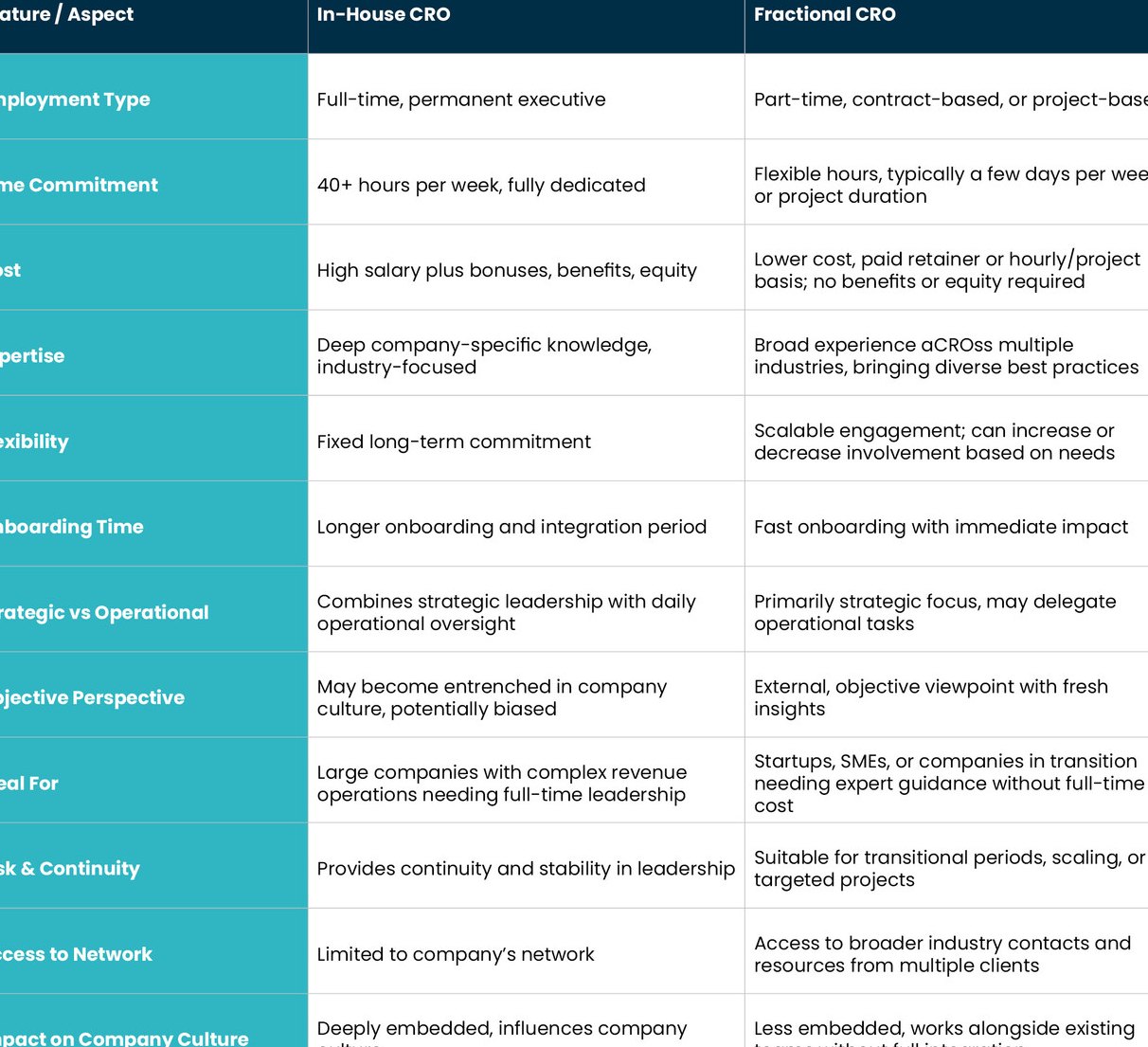
Benchmark the alternative honestly. The comparison that matters is not fractional-versus-nothing, it is fractional-versus-full-time-hire versus promote-from-within. A full-time CRO in the Hagerstown–Frederick corridor carries base salary, a variable component typically running twenty to thirty percent of base, equity in a venture-backed company, employer payroll taxes, health benefits, retirement match, and recruiting cost — commonly a search fee in the range of a quarter of first-year cash compensation. The fully loaded annual cost of a full-time revenue executive is substantially more than base salary suggests, and the exit cost if the hire is wrong includes severance, team disruption, and two quarters of lost momentum. Against that, a two-day-per-week fractional retainer with a thirty-day exit is a fundamentally different risk instrument. The break-even logic is straightforward: while the revenue organization is small enough that a leader's job is mostly judgment and process design, fractional wins. Once the job becomes forty hours of people management, hiring, cross-functional politics, and board work, full-time wins.
Adjacent roles worth pricing at the same time. Many companies that think they need a fractional CRO actually need a fractional RevOps lead first — someone to fix the CRM, build the reporting layer, and instrument the funnel — because a CRO with no data is guessing. A fractional RevOps operator generally prices below a fractional CRO for the same days per week. Sequencing RevOps first and CRO second is often cheaper in total and produces better results, since the CRO arrives to working instrumentation. Other adjacent options: a fractional VP of Sales (cheaper, execution-focused, no pricing or GTM strategy authority), a sales effectiveness consultant on a project fee for a defined training or process build, and an interim CRO — full-time hours, fixed term, priced above fractional per day because the operator clears their calendar.
Pitfalls, failure modes, and how to avoid paying for them twice
The ninety-day miracle promise. Any candidate who guarantees a specific revenue number in the first quarter is selling something other than revenue leadership. In most B2B sales cycles, changes made in month one do not show up in closed revenue until months four through nine, because the pipeline that closes this quarter was created last quarter under the old process. The honest early metrics are leading indicators: qualified pipeline created, stage conversion rates, forecast variance, sales cycle length, discount depth. Contract against those, not against bookings.

Paying for a network you never use. Fractional executives often sell access to their network — introductions to prospects, partners, or candidates. Sometimes this is real and enormously valuable. Often it is a line in a pitch deck. If network access is part of why you are paying, write it into scope with a number attached: introductions per quarter, or a named target account list they will work.
The invisible-week problem. Fractional engagements fail quietly when the operator's work becomes unobservable. Two days a week is not two days you watch. Insist on a written weekly or biweekly artifact — a short recap naming what was done, what was decided, what is blocked, and what needs you. This is not micromanagement; it is the basic accountability structure that makes a part-time senior relationship function. Operators who resist it are usually overcommitted across clients.
Over-indexing on industry match. Founders in specialized markets — a regional distributor, a niche manufacturer, a specialty service business — often insist on a CRO with direct industry experience and pay a premium or wait months for that profile. Industry knowledge is learnable in weeks by a strong operator; revenue leadership is not learnable in weeks by an industry insider. Weight stage experience and functional depth over vertical familiarity, with one exception: if your sale is genuinely technical or heavily regulated, domain fluency is not optional.

Ignoring the internal counterpart. Every successful fractional engagement has an internal owner — a founder, a VP, or an ops lead who implements between sessions. Without that person, recommendations do not become changes. If nobody on your team has bandwidth to be that counterpart, you either need more days from the fractional operator or you need to free someone up. Buying advice you cannot execute on is the single most expensive mistake in this category.
Mis-sequencing against your funding or cash calendar. A six-month retainer starting two months before a cash-tight season is a contract you will want to break at exactly the moment breaking it is most expensive. Align the engagement start with a period where you can fund the full minimum term without stress, and align the first QBR with a natural decision point — a planning cycle, a board meeting, a fiscal year boundary.
The handoff nobody plans. Fractional engagements should end. The good ones end because you hired the full-time leader the fractional operator helped you define and recruit. Build the transition into the original agreement: a documented playbook, a CRM in a known state, comp plans in writing, and a defined overlap period. Without it, the operator's departure takes the institutional knowledge with them and you buy the same diagnosis again eighteen months later.

Selection checklist: how to run the evaluation and make the call
Run every candidate through the same five filters, in order, and stop at the first hard fail.
Filter one — stage match. Ask what the revenue was when they arrived and what it was when they left, at their two most relevant engagements. You want someone who has operated at the stage you are entering, not the stage you left. An operator who scaled a company from twenty million to eighty million solves problems you do not have yet; an operator who took companies from one to five million repeatedly has muscle memory for your exact next twelve months.
Filter two — systems fluency. Ask them to describe, out loud, how they would audit your CRM in the first week: which reports they would pull, what a healthy stage-conversion curve looks like to them, how they detect stalled deals. A real operator answers this fluently and specifically. Someone who talks about the CRM abstractly has had analysts do it for them, which means your RevOps burden will not lighten.
Filter three — decision rights and honesty under pressure. Ask directly: "What would you need authority over to be effective here, and what would you do if I said no?" The answer tells you whether they will take the engagement on your terms and quietly underdeliver, or negotiate the scope honestly up front. You want the second.

Filter four — capacity and conflict. How many clients do they currently hold, and in what industries? Three to five is normal for a mature fractional practice. Eight is a red flag. Ask explicitly about competitive conflicts — a fractional operator serving two companies selling into the same buyer is a problem for both.
Filter five — references you actually call. Ask for two clients at your stage, ideally one where the engagement ended. The ended engagement is the more informative call. Ask that reference three questions: what changed measurably, what did not get done, and would you hire them again for the same scope.
Then price it. If two candidates clear all five filters and one is meaningfully cheaper, the cheaper one is not automatically better — ask what scope difference explains the gap, because it is usually days, decision rights, or travel. And whatever the retainer, hold it against a simple test: what revenue outcome, at what probability, makes this obviously worth it? If you cannot name that outcome in a sentence, you have not scoped the engagement yet.
Related questions
Should I hire a fractional RevOps lead before a fractional CRO?
Often yes. If your CRM data is unreliable, a CRO spends early weeks doing analysis a RevOps operator does faster and cheaper. Sequencing operations first usually lowers total cost and improves the CRO's results, because they arrive to working instrumentation instead of building it.
Does being in a small town like Smithsburg limit my candidate pool?
Not meaningfully. Fractional revenue leadership priced and staffed itself nationally once remote work normalized. Your realistic pool spans Hagerstown, Frederick, Baltimore, and fully remote operators nationwide. The only real constraint is on-site frequency — define it early, because travel expectations move the cost.
How long should a fractional CRO engagement last?
Three months is a typical minimum, six is the common default, and twelve to eighteen months is a healthy full arc. Beyond two years, either the role should convert to full-time or the operator has become a comfortable fixture rather than a change agent.
What is the difference between fractional and interim?
Interim means full-time hours for a fixed term, usually covering a vacancy or a transition. Fractional means part-time hours ongoing. Interim costs more per week because the operator clears their calendar; fractional costs less and carries lower switching risk.
Can a fractional CRO manage my sales team directly?
Yes at higher day commitments, typically two or three days per week, and only with explicit authority over comp, quota, and personnel decisions. Without those rights, they can coach but cannot lead, and you will pay executive rates for advisory output.
FAQ
What is the minimum engagement length for a fractional CRO?
Three months is the common floor and six months is the standard default. Shorter arrangements exist but usually carry a premium, because the operator absorbs discovery cost — reading your CRM, interviewing sellers, learning the market — without enough runway to amortize it. Month-to-month is rare and typically signals a project engagement rather than a leadership one.
Do fractional CROs charge extra for on-site visits in Smithsburg?
It depends on frequency. Quarterly on-sites are usually folded into the retainer as a normal cost of doing business. Monthly or weekly presence is a different arrangement and should be a separate, explicit line — travel time from Baltimore or the DC corridor is real working time, and pretending otherwise leads to a renegotiation in month two.
Is equity normal in a fractional CRO deal?
It is the exception, not the rule. Cash retainers dominate because fractional operators serve several clients and cannot concentrate risk. Where equity does appear — typically pre-revenue or very early companies — it supplements a reduced cash retainer rather than replacing it, with multi-year vesting and a cliff.
How do I know whether the retainer is working?
Track leading indicators for the first two quarters: qualified pipeline created, stage conversion rates, forecast variance against actuals, sales cycle length, and average discount depth. Closed revenue lags process change by roughly one full sales cycle, so judging month three on bookings will mislead you in both directions.
What is the fully loaded cost of a full-time CRO by comparison?
Base salary is roughly half the story. Add variable compensation, equity, employer payroll taxes, health and retirement benefits, and recruiting fees, plus severance risk if the hire is wrong. The comparison that matters is total annual loaded cost and exit risk against a fractional retainer with a thirty-day termination clause.
Can a fractional CRO help with non-software businesses in Washington County?
Yes, and it is common. Manufacturing, distribution, logistics, and regional professional services all have revenue processes — quoting, pipeline, pricing discipline, territory design — that respond to the same discipline. The vocabulary differs; the mechanics do not. Prioritize functional depth over vertical familiarity unless the sale is heavily technical or regulated.
Sources
- Harvard Business Review — Sales and Sales Management
- SaaStr
- First Round Review
- Pavilion
- RevOps Co-op
- U.S. Bureau of Labor Statistics — Occupational Employment and Wage Statistics
- Maryland Department of Commerce
- U.S. Census Bureau — QuickFacts
- Society for Human Resource Management
Related on PULSE
- [How do I hire a fractional Chief Revenue Officer in Smithsburg in 2027?](/knowledge/tl20843)
- [Should I hire a fractional Chief Revenue Officer in Smithsburg in 2027?](/knowledge/tl20845)
- [Who is the best fractional Chief Revenue Officer in Smithsburg in 2027?](/knowledge/tl20844)
- [How do I find a fractional Chief Revenue Officer in Smithsburg in 2027?](/knowledge/tl20841)
- [Does a 10M to 50M ARR services business company need a fractional CRO in 2027?](/knowledge/tl13530)
- [How much does an outsourced CRO cost in Vermont in 2027?](/knowledge/tl12855)
 pulse-toolsHow do I find a fractional CRO in Selbyville in 2027?
 pulse-toolsWhere do I find a fractional VP of Sales in Miami in 2027?
 pulse-toolsShould I Hire a Fractional CRO If My Pipeline Is All Late-Stage and Thin Early in 2027?
 pulse-toolsWhere do I find a fractional CRO in Arlington in 2027?
 pulse-toolsHow do I hire a fractional head of revenue in Reno in 2027?
 pulse-toolsHow do I hire a fractional head of revenue in Stamford in 2027?
 pulse-toolsShould I Hire a Fractional CRO If I Am Preparing for a Series B in Six Months in 2027?
 pulse-toolsHow do I find a fractional CRO in Bakersfield in 2027?
 pulse-toolsShould I Hire a Fractional CRO If I Am Consolidating Regional Sales Teams in 2027?
 pulse-toolsHow do I find a fractional CRO in Hagerstown in 2027?