
How do I find a fractional CRO in Anaheim in 2027?
 Curated byKory White · Fractional CRO · Maryland
 PULSEKNOWLEDGE LIBRARY
Quality
Certified

Finding a fractional CRO in Anaheim in 2027 means searching networks where these leaders actually gather — Pavilion, RevOps Co-op, and similar communities — rather than local job boards, since most work remotely with quarterly on-site visits. Filter candidates by revenue stage and vertical fit, expect a retainer for 5–10 days per month plus 0.5%–2.0% equity, and validate through a 60-day trial before committing long-term.
What a fractional CRO in Anaheim is hired to do
A fractional Chief Revenue Officer is not a part-time VP of Sales — the distinction matters when you start your search, because it changes who you should be talking to. A VP of Sales manages a team against an existing plan; a fractional CRO builds or repairs the plan itself, then hands off execution to whoever runs the day-to-day. In Anaheim's local economy, which spans hospitality-adjacent tech, growing B2B SaaS companies, medtech firms clustered around the broader Orange County health corridor, and a handful of entertainment-technology startups tied to the region's theme park and media presence, the job typically breaks into three buckets: diagnosing why revenue isn't scaling (usually a pipeline, messaging, or conversion problem), designing the go-to-market motion for the next 12–18 months, and building the operating cadence — forecasting, pipeline reviews, comp plans — that lets a full-time leader eventually take over.
The reason companies hire fractional instead of full-time is almost always timing and risk. A pre-revenue or early-revenue company (under roughly $2M ARR) usually cannot justify a $200K+ full-time executive salary, and even if it could, the company doesn't yet know exactly what kind of revenue leader it needs. A fractional engagement lets you buy senior judgment — someone who has built a sales org from zero, has run point on hiring the first five reps, or has navigated a channel-partner motion — without the multi-year commitment. For a company at $3M–$8M ARR with a stalled or inconsistent pipeline, the fractional CRO's job shifts toward diagnosis: pulling CRM data, reviewing call recordings, and identifying whether the problem is top-of-funnel volume, mid-funnel qualification, or back-end close rates. This diagnostic phase typically takes the first 30 days of any engagement and should produce a written assessment, not just verbal recommendations.

Because Anaheim itself has a thin bench of senior revenue operators physically based in the city, "finding" one in practice means finding someone who will serve Anaheim-based or Orange County companies remotely, with periodic travel. This is normal for the fractional executive model nationally — the same pattern holds in mid-size metros across the country — and it means your search radius should be functionally national even though your company is local.
How a fractional CRO fits into the RevOps stack
A fractional CRO doesn't operate in isolation — their effectiveness depends on how well they integrate with the RevOps function that already exists (or needs to be built) underneath them. In a company with no dedicated RevOps hire, the fractional CRO often ends up doing double duty: setting strategy and also configuring the CRM fields, defining the lead-routing rules, and building the reporting dashboards that make the strategy visible. In a company that already has a RevOps analyst or manager, the fractional CRO's first move should be to align with that person on data definitions — what counts as a qualified opportunity, how stages are defined, what "pipeline coverage" means for your specific sales cycle length — before making any strategic calls. Skipping this step is the single most common reason fractional engagements underperform: the CRO makes recommendations based on dashboard numbers that don't actually reflect reality on the ground.

The stack typically looks like this in a functioning engagement: the CRM (Salesforce or HubSpot are the most common in the $1M–$15M ARR range) sits at the center, call-intelligence tools like Gong or Chorus feed qualitative signal about what's actually happening in sales conversations, and a BI layer (native CRM reporting, or a tool like Looker or a spreadsheet-based model for smaller teams) turns raw data into the weekly and monthly metrics the CRO reviews with the board. A fractional CRO worth hiring will ask for read access to all three within the first week, not just a slide deck summarizing "how sales is going."
This loop — diagnose, set strategy, hand off execution, review, adjust — repeats on a monthly or quarterly cycle for the life of the engagement. The RevOps layer is what makes the loop possible; without accurate, agreed-upon data, the CRO is making decisions on anecdote, and the board review becomes a debate about whose numbers are right instead of what to do next.

Pricing, engagement models, and typical ranges in 2027
Cost is the question every buyer asks first, and the honest answer is that it varies more by scope than by geography — there is no "Anaheim discount" or premium versus what you'd pay in Austin or Denver. The two variables that actually move price are days-per-month commitment and equity.
Days per month. Most fractional CRO engagements fall into one of two bands. A strategic advisor role runs 2–4 days per month: board-level guidance, quarterly planning, occasional deal coaching. A hands-on, player-coach role runs 8–12 days per month and includes direct involvement in pipeline generation, rep coaching, and sometimes personally carrying a handful of key accounts. The hands-on model costs more in raw retainer dollars but tends to produce visible results faster, because the CRO is closer to the actual sales motion rather than reviewing it after the fact.

Retainer structure. Retainers are typically billed monthly and scale with days committed and the CRO's track record. A leader with a strong, verifiable history of scaling revenue in your specific vertical (SaaS, medtech, or entertainment tech, for Anaheim's local mix) commands a premium over a generalist. Rather than quoting a single number that will be stale by the time you read this, budget by the day-rate model: fractional executive day rates in 2027 commonly range from the low four figures to well above that for operators with a demonstrated track record scaling revenue past eight or nine figures — multiply by your committed days per month to estimate the monthly retainer.
Equity. Equity is the second lever and is where the biggest range shows up. For pre-revenue to $2M ARR companies, expect to offer 1.0%–2.0% equity, typically vesting over three to four years with a one-year cliff — the same structure you'd use for a senior full-time hire, just prorated for the fractional time commitment. For companies between $2M and $10M ARR, where the risk to the CRO is lower and the cash retainer is usually higher, equity typically drops to 0.5%–1.0%. Be wary of any fractional CRO who will only take cash with zero equity interest — it often signals they're overbooked across several clients and have no long-term stake in your specific outcome, which means you'll be deprioritized the moment a higher-paying client calls.

Engagement length. Most fractional CRO relationships run 6–12 months from the initial 60-day trial. The 60-day trial itself should have explicit, written KPIs — pipeline coverage ratio, win rate movement, or rep ramp time are the three most common — so that both sides have an objective basis for extending or ending the arrangement. Engagements that drift past 12–18 months without a defined off-ramp are a warning sign for both parties: either the company should transition to a full-time hire, or the relationship should formally shift to a lighter advisory retainer.
How to evaluate and shortlist candidates
Once you've identified three to five candidates through your network search, the evaluation process should filter hard on three dimensions: stage fit, diagnostic rigor, and communication range.

Stage fit is the single most disqualifying filter. A leader who spent the last five years scaling a company from $20M to $80M ARR has spent that time building process discipline, refining an already-working machine — that is a fundamentally different skill from finding product-market fit in a pre-revenue company where the sales motion doesn't exist yet. When you talk to candidates, state your ARR, growth rate, and the specific symptom you're trying to fix ("we have a product but no repeatable pipeline" is a different problem than "we have pipeline but can't close") and ask them to describe, specifically, the last time they solved that exact problem.
Diagnostic rigor separates real operators from pitch artists. A credible candidate will ask for access to your CRM and call-recording data before proposing anything — if someone gives you a confident 90-day plan without having seen a single one of your deals, that is a red flag, not a sign of expertise. A useful test: give a finalist candidate temporary read access to your CRM and call-recording tool for 48 hours and ask them to present a 15-minute assessment of pipeline health, win rate, and rep performance. Their ability to produce a specific, data-grounded analysis in that window tells you more than any reference call will.

Communication range matters because the role spans two audiences. A fractional CRO needs to deliver a board-level, metrics-driven update one day and run a tactical, coaching-oriented session with a rep the next. Ask a finalist to role-play both in the same interview — a two-minute board update on a hypothetical miss, followed by a coaching conversation with an underperforming rep. Candidates who only have one register (either overly strategic and vague, or overly tactical and unable to speak to a board) will create friction in whichever half of the job they're weaker at.
Reference checks should skip the flagship client. Ask for three references: one from a company that was pre-revenue when the candidate started, one mid-stage, and — critically — one where the engagement ended early or didn't work out. That third reference is the most revealing, because it shows you how the candidate handles a mismatch and whether they exit gracefully or leave a mess. A candidate unwilling to provide a reference where things didn't go well is telling you something.

The buyer decision framework: fractional vs. full-time
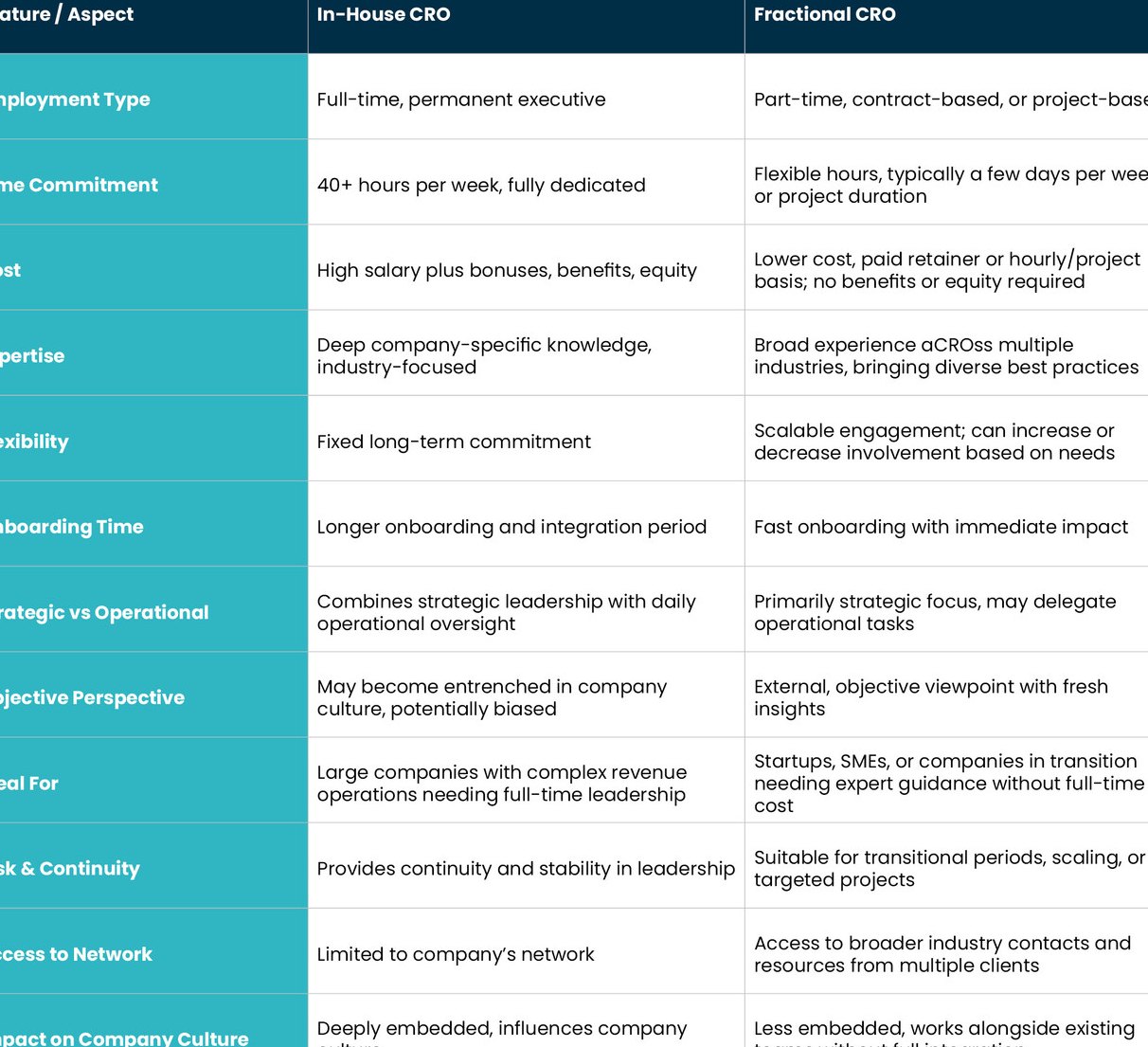
Before you commit to a search, it's worth explicitly deciding whether fractional is even the right model, because the two paths solve different problems and cost differently over time. Fractional makes the most sense when your trajectory is still uncertain — you don't yet know if you need a sales-led motion, a product-led motion, or a hybrid, and hiring a full-time executive against an unclear plan is expensive to get wrong. It also makes sense as a bridge: many companies use a fractional CRO for 6–12 months specifically to build the case, the job description, and the internal muscle needed to hire and onboard a strong full-time leader afterward.
Full-time makes more sense once you're above roughly $5M ARR with a repeatable, understood sales motion and you need someone in the building five days a week driving execution, hiring a team, and being accountable in a way a part-time arrangement structurally can't replicate. The tradeoff is commitment: a full-time CRO hire typically means a six-figure base salary plus benefits and a larger equity grant, a multi-month search and onboarding process, and meaningfully higher severance risk if the hire doesn't work out.

Whichever path you choose, put the off-ramp in writing at the start. The worst outcome in either model is ambiguity — a fractional arrangement that drifts indefinitely with no one quite sure when to convert to full-time, or a full-time hire made in a panic because a fractional search never happened first.
Related questions
How much does a fractional CRO cost per month?
Cost depends on days committed and equity offered, not geography. Expect a retainer scaled to 5–10 days per month plus 0.5%–2.0% equity vesting over three to four years, with hands-on player-coach roles costing more than strategic-advisor arrangements.
What's the difference between a fractional CRO and a fractional VP of Sales?
A fractional CRO typically owns cross-functional revenue strategy (sales, marketing alignment, customer success input), while a fractional VP of Sales focuses narrowly on the sales team's execution against an existing plan.
Can a fractional CRO become a full-time hire later?
Yes — many engagements are structured with an explicit off-ramp where the fractional leader either transitions to full-time once ARR or team size crosses a threshold, or shifts to a lighter advisory role.
How long should a fractional CRO trial period last?
60 days is standard, with written KPIs like pipeline coverage, win rate movement, or rep ramp time agreed upon before the trial starts, so both sides have an objective basis to extend or end the engagement.
FAQ
How much does a fractional CRO cost in Anaheim in 2027? Cost is driven by scope, days per month, and equity rather than local geography — expect a retainer for 5–10 days per month plus 0.5%–2.0% equity. There's no discount specific to Anaheim; fractional CROs price against market rates and their own track record, not the buyer's zip code.
Do I need to find a fractional CRO who physically lives in Anaheim? No. Most experienced fractional CROs work remotely across multiple clients and time zones, visiting in person quarterly for strategic reviews or board meetings. Limiting your search to Anaheim residents will significantly shrink your candidate pool without improving outcomes.
How long does a typical fractional CRO engagement last? Most run 6–12 months following an initial 60-day trial period. Some extend to 18 months when a company isn't yet ready to make a full-time hire, though engagements without a defined off-ramp are a warning sign.
What should I ask for before hiring a fractional CRO? Request a written 90-day plan (not just a pitch deck), references from a pre-revenue client, a scaling-stage client, and one where the engagement ended early, and a demonstration of their diagnostic process using sample access to your CRM and call recordings.
Is equity required, or can I pay cash-only? Equity is standard practice and signals long-term alignment. Fractional CROs who accept cash-only arrangements are often managing multiple concurrent clients and may deprioritize your company when a higher-paying or higher-equity client needs attention.
What size company should consider a fractional CRO instead of a full-time one? Companies from pre-revenue up to roughly $5M ARR with an uncertain growth trajectory typically get the most value from fractional leadership, since it provides senior judgment without the cost and commitment risk of a full-time executive hire made before the go-to-market motion is proven.
Sources
- Pavilion – Fractional CRO community and job board
- RevOps Co-op – Revenue operations community and directory
- Harvard Business Review – Articles on fractional leadership and executive hiring
- First Round Review – Founder advice on sales leadership and hiring
- SaaStr – Community and content for SaaS founders
- LinkedIn – Professional network for vetting fractional CRO candidates
- Harvard Business Review – The Rise of the Fractional Executive
Related on PULSE
- How do I find a fractional CRO in Millsboro in 2027?
- How do I hire a fractional CRO in Tulsa in 2027?
- How do I find a fractional CRO in Oakton in 2027?
- Where do I find an interim CRO in Durham in 2027?
- How do I find a fractional CRO in Montgomery Village in 2027?
- How do I hire a fractional CRO in Charlotte in 2027?
This page will be disappearing soon. Save it to your device for $1 — or read it free while it is here.
@Kory-White- · if Venmo asks, the last 4 of my number are 2012
This page is gone.
This one is off the shelf now. $1 keeps it on your phone for good — the whole page, pictures and diagrams included.
 pulse-toolsHow do I hire a fractional Chief Revenue Officer in Ogden in 2027?
 pulse-toolsWhat should I look for in a fractional CRO in Harrisburg, Pennsylvania in 2027?
 pulse-toolsShould I Hire a Fractional CRO If I Need to Stand Up RevOps From Scratch in 2027?
 pulse-toolsHow do I hire a fractional CRO in Pensacola in 2027?
 pulse-toolsShould I Hire a Fractional CRO If I Need a 30-60-90 Plan Before a Board Meeting in 2027?
 pulse-toolsHow do I hire a fractional CCO in Myrtle Beach in 2027?
 pulse-toolsHow do I hire a fractional CCO in Appleton in 2027?
 pulse-toolsShould I Hire a Fractional CRO If I Need Interim Coverage During a Medical Leave in 2027?
 pulse-toolsHow do I hire a fractional CSO in Roswell in 2027?
 pulse-toolsShould I Hire a Fractional CRO If I Am Scaling From 10 to 50 Reps in 2027?