
How do I hire an outsourced CRO for a clean energy company in 2027?
 Curated byKory White · Fractional CRO · Maryland
 PULSEKNOWLEDGE LIBRARY
Quality
Certified

Hire an outsourced CRO for a clean energy company by scoping the revenue gap first, then contracting a senior operator for 8–20 days per month on a 3–6 month term with a 30-day exit. Screen hard for project-based, utility, and regulatory selling experience — not SaaS-only backgrounds — and require a written revenue plan within 30 days.
Mapping the end-to-end hiring process
Most founders in solar, storage, grid software, and efficiency services start the search at the wrong end: they open LinkedIn, collect five impressive résumés, and only then try to figure out what the person is supposed to do. That sequence guarantees a mismatch, because a fractional revenue leader is not a role — it is a scope. The same title covers a strategist who never touches a deal and an operator who personally runs your Tuesday pipeline call. You have to decide which one you are buying before you talk to anyone.
Step one is diagnosing the revenue gap honestly. Write down where deals actually die today. If your problem is that you have inbound interest and no repeatable process to convert it, you need a systems builder. If the problem is that nobody except the founder can close a utility or municipal buyer, you need someone who will sit in those meetings. If the problem is that you have three reps and no forecast anyone believes, you need a forecasting and RevOps discipline, which is a different skill again. Founders routinely conflate all three and then complain that their hire "wasn't hands-on enough" when the contract they signed bought strategy days.
Step two is a written scope of work — one page, not ten. It should state your current ARR or bookings run rate, your target segment, your typical sales cycle length in months, the number of people who will report to or through this person, and three to five concrete deliverables. Deliverables should be nouns you can hold: a segmentation and pricing recommendation, a CRM rebuild with defined stages and exit criteria, a hiring scorecard and interview loop for your first two account executives, a channel partner agreement template, a 90-day forecast model. "Improve revenue" is not a deliverable. "A weekly forecast call with a documented commit/best-case/pipeline methodology, live by day 45" is.
Step three is sourcing. The realistic channels are peer referral from other founders in your sector, executive communities like Pavilion, fractional-executive networks, your investors' operating partners, and direct outreach on LinkedIn to people whose backgrounds already show energy, infrastructure, industrial equipment, or construction services revenue. Investor networks are underused here — a climate-focused fund has usually watched a dozen portfolio companies hire this exact role and knows who actually delivered. Ask them for the names that got re-hired, not the names on a curated list.
Step four is screening, which deserves its own section below. Step five is negotiating terms: days per month, an initial term of three to six months, a 30-day notice clause on both sides, a reporting cadence, IP and confidentiality terms, and whether any performance component exists. Step six is onboarding against a fixed 30-day deliverable set so that you learn within one billing cycle whether this is working.

The mistake to avoid across the whole sequence is treating the engagement like a vendor purchase. You are not buying a service; you are temporarily installing an executive inside your operating rhythm. That means calendar access, CRM admin rights, a Slack presence, attendance at your leadership meeting, and permission to tell your sales lead that the pipeline is fiction. A fractional leader with no authority produces decks, not revenue.
Why clean energy revenue behaves unlike software revenue
A clean energy company sells into a buying coalition, not a buyer. On a commercial solar or storage deal you may be simultaneously persuading a facilities director who cares about downtime, a CFO who cares about the capital stack and payback period, a sustainability officer who cares about reported emissions, a utility interconnection queue you do not control, and occasionally a state or municipal agency administering an incentive. Any one of them can stall the deal without killing it, which is why clean energy pipelines look healthy right up until the day someone counts closed revenue.
Cycle length is the first structural difference. Nine to eighteen months from first conversation to signature is normal for commercial and utility-scale work. Residential is far faster — days to weeks — but is a volume, local-permitting, and installer-capacity business rather than an enterprise selling business. Grid software and energy management platforms sit in between and often follow a pilot-to-production pattern where the pilot is easy and the production contract requires a procurement process the pilot never touched. An outsourced revenue leader who has only run 30- to 90-day SaaS cycles will build a cadence, a comp plan, and a forecast model calibrated to the wrong clock.
The second difference is that the sale is frequently a capital expenditure, not a subscription. That changes everything downstream. Your buyer is comparing your proposal against other uses of capital, financing terms matter as much as product, and the deal may be contingent on a tax credit, a rebate program, a power purchase agreement, or a third-party financier's underwriting. A revenue leader who cannot hold a coherent conversation about payback period, internal rate of return, or how an incentive changes the customer's model will be relegated to activity metrics because they cannot participate in the actual decision.

Third, seasonality and policy timing are real. Residential and commercial installation volume clusters in warmer quarters in most of North America. Utility and municipal budget cycles reset on fiscal calendars that rarely match yours. Incentive programs open, deplete, and close, and a program deadline can pull a quarter forward or push it out entirely. A competent outsourced CRO builds a pipeline model that explicitly accounts for these rhythms instead of applying flat monthly quotas that guarantee three bad months and one heroic one.
Fourth, your revenue team is heterogeneous. You may have field engineers who are effectively technical sellers, channel partners and EPC firms who source deals you never see until they are half-formed, independent reps in states where you have no office, and a small inside team qualifying inbound. Managing that mix is closer to distribution management than to a classic inside-sales org chart. Ask directly how a candidate has handled partner conflict — two channel partners bidding the same site is a weekly problem, not a hypothetical.
Fifth, technical validation is part of the sale. Site assessments, load analysis, interconnection studies, and performance modeling all sit inside the cycle. A revenue leader who treats engineering as a support function will burn your technical team's time on unqualified opportunities. The good ones install a qualification gate before engineering hours are spent, which is one of the highest-ROI process changes available in this sector.
Where an outsourced CRO creates and leaks revenue
The value shows up in four places, and it is worth being specific because the ROI case for this hire is not obvious in month one.
The first is pipeline hygiene and forecast credibility. Most companies under roughly $10M in bookings run a CRM where stages mean nothing, close dates are aspirational, and half the pipeline is stale. In clean energy the distortion is worse because long cycles hide dead deals for months. A capable operator will rebuild stages with exit criteria tied to observable buyer actions — site assessment scheduled, financing path identified, procurement process confirmed, contract in legal — and purge or re-date everything that fails. The immediate effect looks negative: your pipeline shrinks, sometimes by a third or more. The actual effect is that you can plan hiring and inventory against a number that is real.

The second is deal-level intervention. A senior person who has closed comparable deals will unstick specific opportunities in ways a junior team cannot. That means writing the business case the CFO actually needs, getting to the economic buyer instead of the champion, restructuring a proposal to fit a financing constraint, or knowing when a deal is genuinely dead and should stop consuming attention. On a business with six-figure average contract values, unsticking two deals a quarter can cover the retainer several times over.
The third is process and RevOps infrastructure that outlives the engagement. Lead routing, territory definition, a partner registration process, a proposal library, a pricing framework with approval thresholds, a commission plan that does not accidentally reward the wrong behavior. These are cheap to build with an experienced hand and expensive to fix later. Many founders undervalue this because it does not feel like selling — but the compounding is real, and it is the part of the engagement you keep after the contract ends.
The fourth is hiring leverage. An outsourced CRO who writes your scorecard, runs your interview loop, and onboards your first two sellers is transferring judgment you do not yet have. A bad first sales hire in a long-cycle business costs you not just salary but a year of pipeline you will never see, because you will not know the hire failed until cycle-length has elapsed.
Now the leaks. The engagement bleeds value when the scope is strategy-only but the founder expected execution — the single most common failure. It leaks when the person is spread across too many clients and your two days a month become two half-days of catch-up. It leaks when they never receive real authority, so every decision routes back to the founder and the "leader" is functionally a consultant. It leaks when there is no defined handoff plan, so the day the contract ends the process decays because nobody internal owns it. And it leaks when the founder uses the hire to avoid confronting an underlying product, pricing, or delivery-capacity problem that no revenue leader can sell around.

Two structural safeguards prevent most of this. First, insist on a documentation requirement: whatever they build lives in your systems, in writing, not in their head. Second, name an internal owner for every process created — even if that owner is you — so there is a person accountable after the engagement closes.
Concrete numbers, terms, and benchmarks
Public, verifiable pricing for fractional executive work does not exist in the way salary data does, so treat any number you read — including the shape below — as a starting frame to validate against three live quotes rather than a market rate. What is stable and worth anchoring on is the *structure* of the deal.
Engagements are almost always priced as a monthly retainer tied to a committed number of working days. The common bands are roughly 8–10 days per month for a strategy-weighted engagement at an early-stage company, 12–15 days for an engagement that includes direct deal involvement and managing one or two sellers, and 15–20 days when the person is effectively running a team of three to eight and owning the number. Below eight days a month, expect advisory value only; a person cannot own execution on one day a week. Above twenty days you are paying near-full-time rates for someone with divided loyalty, and you should be having the full-time conversation instead.
Term structure: three to six months initial, then month-to-month or a renewal. Thirty-day notice on both sides is standard and you should want it mutual — a person who will not accept a 30-day exit is asking you to underwrite their risk. Anything shorter than three months is not enough time to produce results in a sector with 9- to 18-month cycles; you would be paying for an audit and nothing else.
Equity: not required, and most experienced fractional operators with a full client roster will not need it. A modest grant with a standard vesting schedule can buy you deeper commitment or a lower cash retainer, and trading roughly 10–20% of cash for equity is a negotiation founders do make. Be cautious about grants large enough to matter to your cap table for a six-month engagement — the maths rarely favors you.

Performance components: common and reasonable, but design them for the cycle. Tying a bonus to closed-won revenue inside a six-month term in a business with twelve-month cycles rewards luck, not work. Better structures pay against leading indicators the person actually controls: qualified pipeline created against a defined qualification standard, sales cycle compression, forecast accuracy within a band, or successful hire-and-ramp of named roles. If you do tie to bookings, extend the measurement window past the contract term with a defined tail.
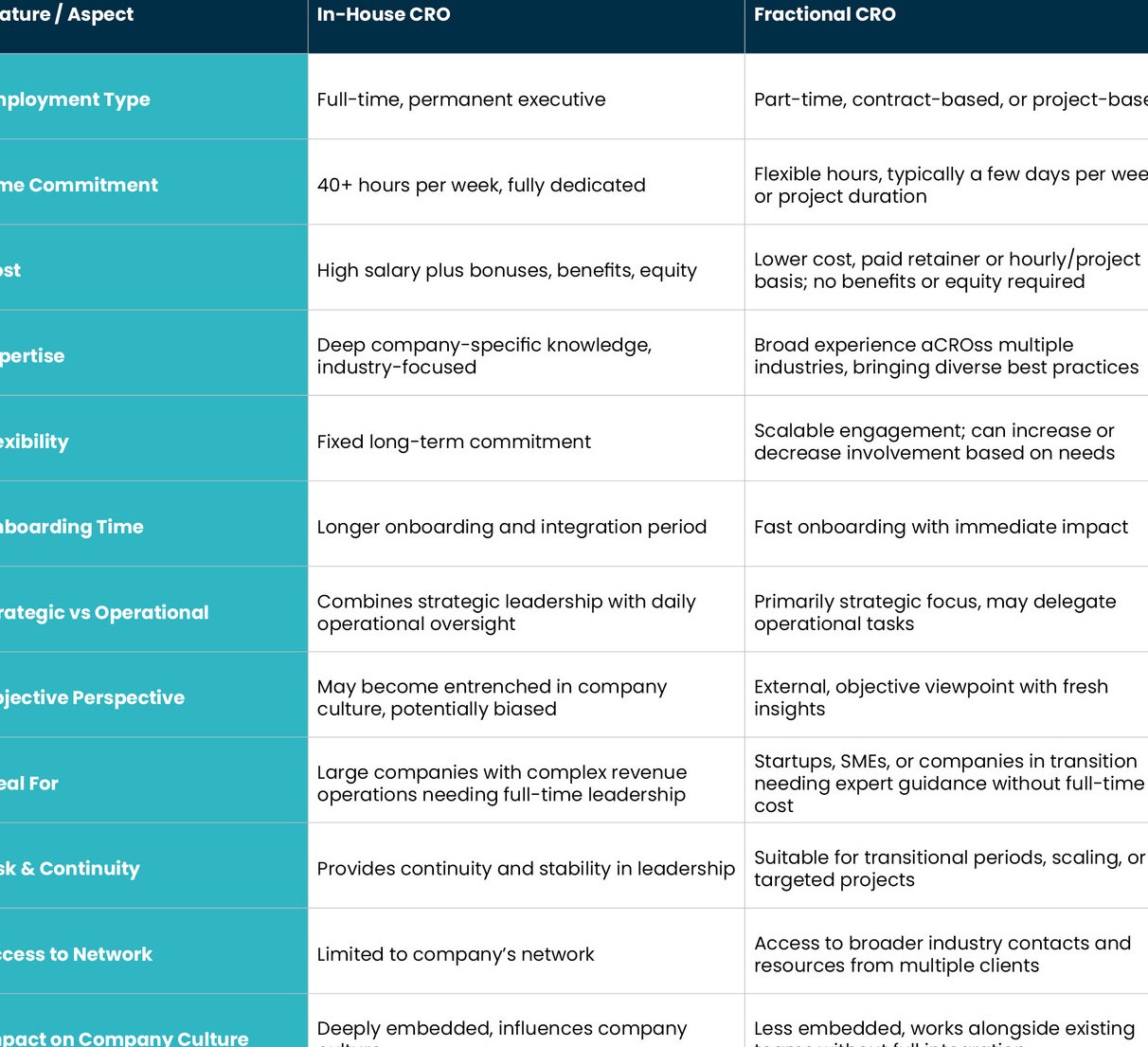
Comparison against the alternatives is where the decision usually resolves. A full-time VP of Sales is a substantial base salary plus variable, plus equity, plus benefits and payroll burden, plus recruiting cost, and typically four to eight weeks to ramp before producing anything. The downside case is worse than the cost: a mis-hire in a long-cycle business can consume six to twelve months before the failure is legible. A fractional engagement inverts that risk — two to four weeks to a written revenue plan, a 30-day exit, no severance, no cultural rupture. The trade is depth of ownership and the fact that they are not there every day.
The rough decision rule practitioners use: under about $10M ARR or in transition, fractional is usually right. Above that, or when you need someone building a multi-layer permanent organization with career paths and internal promotion, hire full-time — and consider using a fractional CRO to define the role, run the search, and onboard the person they hire. That handoff pattern is common and works well, provided the fractional operator knows from day one that building themselves out of the job is the assignment.
One more benchmark worth setting: define what "working" looks like before month one ends. Reasonable 90-day markers are a CRM that produces a forecast you would show a board, a documented and followed weekly pipeline cadence, a defined qualification standard applied to every open deal, at least one measurable process improvement in cycle stage conversion, and either a hire made or a hiring loop ready to run.

Pitfalls, screening questions, and how to avoid the expensive mistakes
The most expensive mistake is hiring a pure SaaS background into a project-based, capital-expenditure, regulated sale. It is not that software experience is worthless — process discipline transfers well — but a person whose entire model is product-led inbound with a 45-day cycle will misdiagnose your business for a full quarter. Backgrounds that transfer well: industrial equipment, construction and EPC services, capital equipment, infrastructure, utilities, and anything sold into public procurement. What you are testing for is comfort with long cycles, multi-stakeholder committees, technical validation gates, and financing-dependent decisions.
Screen with specifics, not credentials. Useful questions, and what a good answer sounds like:
Walk me through one clean energy or infrastructure deal you closed end to end — who was in the room, what stalled it, and how long did it take? A strong answer names roles, describes a specific stall (an interconnection queue, a financing contingency, a budget cycle), and gives a real timeline. A weak answer stays at the level of "we built a great relationship."
How have you handled a policy or incentive change that damaged a live deal? You are testing whether they have operated through the regulatory volatility that defines this sector. The honest answer usually includes a deal that died.
Explain a customer's decision economics back to me. Can they discuss payback, financing structure, and how an incentive shifts the model? If they cannot participate in that conversation, they cannot lead your sellers through it.

How do you manage a mixed team of direct sellers, field engineers, and channel partners? Look for concrete mechanics: partner registration and deal-conflict rules, engineering-time qualification gates, territory definitions, coaching cadence for people they rarely see.
What did you inherit in your last fractional engagement, and what did you leave behind? This surfaces whether they build durable systems or run on personal heroics.
What would make you decline this engagement? A senior operator has criteria. Someone who will take any work at any scope is telling you something.
Reference-check prior *fractional* clients specifically, not just full-time employers. The skills differ: integrating into an unfamiliar team in two weeks, working without a mandate, and delivering with limited days are distinct from running a department you built over three years. Ask references one question that gets past politeness: would you hire them again, and for what scope?

The other pitfalls, briefly. Beware anyone promising immediate revenue acceleration or guaranteed pipeline growth — clean energy cycles are long and partly outside anyone's control, and a responsible operator gives you a realistic 90-day plan rather than a doubling promise. Beware the tool-stack rebuild: your outsourced CRO should work with the Salesforce or HubSpot instance you already have, add Gong-style call recording or forecasting tools only when the current data problem justifies it, and never sell you a migration in month one. Beware the conflict-avoidant candidate; you are paying for someone who will tell you your pricing is inconsistent, your CRM is fiction, or your best rep is a liability. And beware overloading a single hire — if your actual problem is marketing demand generation, a revenue leader can diagnose it but cannot manufacture pipeline from nothing.
Finally, watch client concentration on their side. Ask how many engagements they hold and how many days that totals. Someone at capacity across four clients cannot absorb the week your biggest deal goes sideways.
A selection checklist you can run in a week
Compress the decision into a repeatable filter. Run every candidate through the same gates in the same order, and reject early rather than late — the cost of a slow no is weeks of founder time.
Gate one is domain reality. Has this person carried a number in a long-cycle, multi-stakeholder, capital-expenditure sale? Energy, infrastructure, industrial, construction, or public-sector procurement all qualify. Pure SaaS-only backgrounds do not pass this gate for a clean energy company unless the rest of the profile is exceptional and you are explicitly buying process discipline rather than domain judgment.
Gate two is scope match. Does the days-per-month commitment match the work you actually defined? Compare their proposal against your one-page scope line by line. A candidate who proposes a different scope than the one you wrote is not necessarily wrong — the good ones will push back on your diagnosis — but the disagreement must be resolved in writing before signing.

Gate three is the systems test. Ask them to describe, concretely, the RevOps foundation they would put in place in the first sixty days: stage definitions with exit criteria, qualification standard, forecast methodology, partner rules, reporting. If the answer is generic, they are a coach, not an operator.
Gate four is references from fractional clients, weighted toward re-hires and extensions.
Gate five is chemistry under disagreement. Give them a real problem from your business and argue about it for twenty minutes. You are hiring someone who will disagree with you weekly; find out now whether that is productive or exhausting.
Gate six is the exit test. Confirm mutual 30-day notice, confirm documentation lives in your systems, and confirm what handoff looks like if the engagement converts to a full-time hire or simply ends. An operator who has thought about their own exit is the one worth signing.

Adjacent decisions this hire touches
Hiring an outsourced revenue leader rarely stays contained to the sales function, and founders should anticipate three adjacent effects.
The first is marketing. A revenue leader who inherits weak demand generation will either ask you to fund it or will build an outbound and partner-sourced motion instead. Both are legitimate; drifting between them is not. Decide up front whether this person's remit includes demand generation, because in a long-cycle business the pipeline they need for a Q4 number has to be created in Q1.
The second is operations and delivery capacity. In installation and project businesses, selling faster than you can deliver destroys reference customers and creates cancellations. A good outsourced CRO will ask about your installation backlog, crew capacity, and permitting throughput in the first week. If they never ask, they are selling in a vacuum.
The third is finance. Long cycles, milestone billing, and financed deals mean that bookings, revenue, and cash are three different numbers. Align your CRM stages with how finance recognizes revenue before you start reporting against them, or you will spend every board meeting reconciling two versions of the truth.
There is also a sequencing question worth naming: many companies at this stage would benefit more from a fractional RevOps practitioner than from a fractional CRO. If your problem is genuinely data, systems, and reporting rather than strategy and deal leadership, a systems-focused operator costs less and fixes the actual constraint. The distinction is simple — a CRO decides what to sell, to whom, and how; a RevOps lead makes the machine that measures and supports it. Diagnose which one you are missing before you pay for the more expensive title.
Related questions
How long should the first contract term be?
Three to six months, with mutual 30-day notice. Anything shorter cannot produce results in a sector with nine- to eighteen-month cycles — you would fund an audit and end before the plan executes. Renew month-to-month afterward or convert to full-time if the fit holds.
Can an outsourced CRO work remotely for a field-heavy energy business?
Yes, if they have genuinely managed distributed and field teams before. Test for specifics: territory design, coaching people they rarely see in person, partner conflict resolution, and ride-along cadence. Expect and budget for periodic on-site weeks, particularly during onboarding.
Should I hire a fractional CRO or a fractional RevOps lead first?
If deals stall on strategy, pricing, or senior selling, hire the CRO. If deals close but you cannot see, measure, or forecast them, hire the RevOps lead — it costs less and fixes the real constraint. Diagnose the bottleneck before choosing the title.
What happens when the engagement ends?
Plan the handoff at signing. Every process, document, and system the person builds should live in your tools with a named internal owner. A clean exit either converts to a full-time hire the fractional leader helped recruit, or leaves a documented operating system your team keeps running.
Does this work for hardware or non-energy project businesses?
Largely yes. The pattern fits any long-cycle, multi-stakeholder, capital-expenditure sale — industrial equipment, construction services, infrastructure software. The transferable elements are qualification gates, financing literacy, and channel management; the sector-specific piece is regulatory and incentive fluency.
FAQ
Do I need to offer equity to attract a strong outsourced CRO?
Usually not. Experienced fractional operators typically maintain several clients and are compensated in cash. A modest equity grant with standard vesting can deepen commitment or reduce the cash retainer by a meaningful margin, but be careful about issuing a stake that outlives a six-month engagement. If you do grant equity, use the same vesting and cliff discipline you would apply to any hire.
How do I measure whether the engagement is working?
Set the metrics before day one and review them monthly. Reasonable measures are qualified pipeline created against a defined standard, forecast accuracy, stage conversion rates, sales cycle length, and hires made and ramped. Add process deliverables — a working forecast cadence, documented stage exit criteria, a partner registration process. In a long-cycle business, closed revenue inside the first two quarters is a lagging and partly luck-driven signal.
What is the difference between an outsourced CRO, an interim CRO, and a consultant?
An outsourced or fractional CRO holds an ongoing part-time executive role with real ownership. An interim CRO fills a vacated seat close to full-time while you recruit a permanent leader, usually at higher cost and shorter duration. A consultant advises and produces recommendations without owning outcomes. Choose based on whether you need decisions made, a seat filled, or analysis delivered.
Should the outsourced CRO have authority over my existing sales team?
Yes, or the arrangement will underperform. Give them the leadership meeting seat, CRM administrative access, and explicit authority to change process and cadence — announced to the team by you, not by them. A revenue leader without a mandate becomes an expensive commentator, and your team will quietly route around them within a month.
How many clients is too many for a fractional executive?
Ask directly and total the days. Someone committed to four clients at 12 days each is oversubscribed and cannot absorb the week your largest opportunity destabilizes. Two to three concurrent engagements is common and workable; beyond that, ask what they would deprioritize during a crunch and whether your engagement has scheduled, protected days.
Can I convert the engagement into a full-time hire?
Frequently, and it is worth discussing at signing. Some operators want the option; others deliberately do not and will instead recruit and onboard your permanent leader. Either is fine, but agree in advance on whether a conversion fee applies and what the handoff includes, so the conversation is not a negotiation held under pressure later.
Sources
- Pavilion — executive and revenue leader community
- RevOps Co-op
- Harvard Business Review
- First Round Review
- SaaStr
- U.S. Department of Energy — Solar Energy Technologies Office
- National Renewable Energy Laboratory (NREL)
- DSIRE — Database of State Incentives for Renewables & Efficiency
- Solar Energy Industries Association (SEIA)
- U.S. Energy Information Administration
Related on PULSE
- How do I find a fractional CRO in Millsboro in 2027?
- How do I hire a fractional CRO in Tulsa in 2027?
- How do I find a fractional CRO in Oakton in 2027?
- Where do I find an interim CRO in Durham in 2027?
- How do I find a fractional CRO in Montgomery Village in 2027?
- How do I hire a fractional CRO in Charlotte in 2027?
This page will be disappearing soon. Save it to your device for $1 — or read it free while it is here.
@Kory-White- · if Venmo asks, the last 4 of my number are 2012
This page is gone.
This one is off the shelf now. $1 keeps it on your phone for good — the whole page, pictures and diagrams included.
 pulse-toolsHow do I hire a fractional COO in Ogden in 2027?
 pulse-toolsHow do I hire a fractional COO in Olympia in 2027?
 pulse-toolsShould I Hire a Fractional CRO If I Am Scaling From 10 to 50 Reps in 2027?
 pulse-toolsHow do I hire a fractional COO in Oshkosh in 2027?
 pulse-toolsHow do I hire a fractional CCO in South Bend in 2027?
 pulse-toolsShould I Hire a Fractional CRO If I Need to Build a Partner Channel in 2027?
 pulse-toolsHow do I hire a fractional CSO in Pensacola in 2027?
 pulse-toolsWhat should I look for in a fractional CRO in Harrisburg, Pennsylvania in 2027?
 pulse-toolsHow do I hire a fractional COO in Roswell in 2027?
 pulse-toolsHow do I hire a fractional COO in Melbourne in 2027?