
How do I hire a fractional CRO for a media business?
 Curated byKory White · Fractional CRO · Maryland
 PULSEKNOWLEDGE LIBRARY
Quality
Certified

To hire a fractional CRO for a media business, filter hard for someone who has actually run media-specific revenue — advertising, subscription, sponsorship, or affiliate — rather than a generalist who scaled a software book of business. Confirm that fluency by asking them to diagnose a revenue stall live, vet through references from other media companies rather than any B2B firm, and wrap the hire in a scoped, paid pilot with KPIs tied to coverage, discount discipline, forecast accuracy, and renewals.
Hiring a fractional CRO for a media company is less about buying seniority and more about buying fluency in how attention converts to cash. The right operator can read a sell-through report, spot a make-good time bomb, and tell you within weeks whether your revenue is stuck at the top of the funnel, in the proposal stage, or at the collections desk. The wrong one applies a SaaS playbook to an ad-and-subscription business and quietly erodes your rate card. Everything below is a filter for telling the two apart, plus a structure for de-risking the hire with a short, paid, measurable trial before you commit a dollar of retainer.
How does media revenue differ from SaaS or e-commerce revenue?
Drop a pure-SaaS CRO into a media P&L and the friction shows up fast, because the unit of value is different. You are not renewing a per-seat license or shipping a physical SKU; you are selling audience attention, brand adjacency, and provable outcomes, usually packaged as a campaign, a sponsorship flight, or a retainer that renews on trust rather than contractual lock-in. The calendar drives everything. A software quarter closes on the last day of the month; a media quarter bends around upfront season, holiday ad budgets, an election cycle, or a tent-pole event, and a deal that looks dead in the summer is often just waiting for a fourth-quarter creative to clear the advertiser's legal review.
That is why media deals stall for reasons a SaaS forecast never models. Price is rarely the sole blocker. More often the advertiser's creative assets aren't finished, the audience guarantee doesn't line up with their target demo, or your sales team can't tell a sharp attribution story about why *your* property moves the needle versus the dozen other tabs open in the buyer's browser. A fractional CRO who has only sold subscriptions will misread those stalls as pricing objections and start discounting — exactly the wrong reflex. If you are still mapping how your funnel actually behaves, the pipeline-diagnosis walkthrough at pulserevops.com/knowledge/tl14941 is a useful companion here.
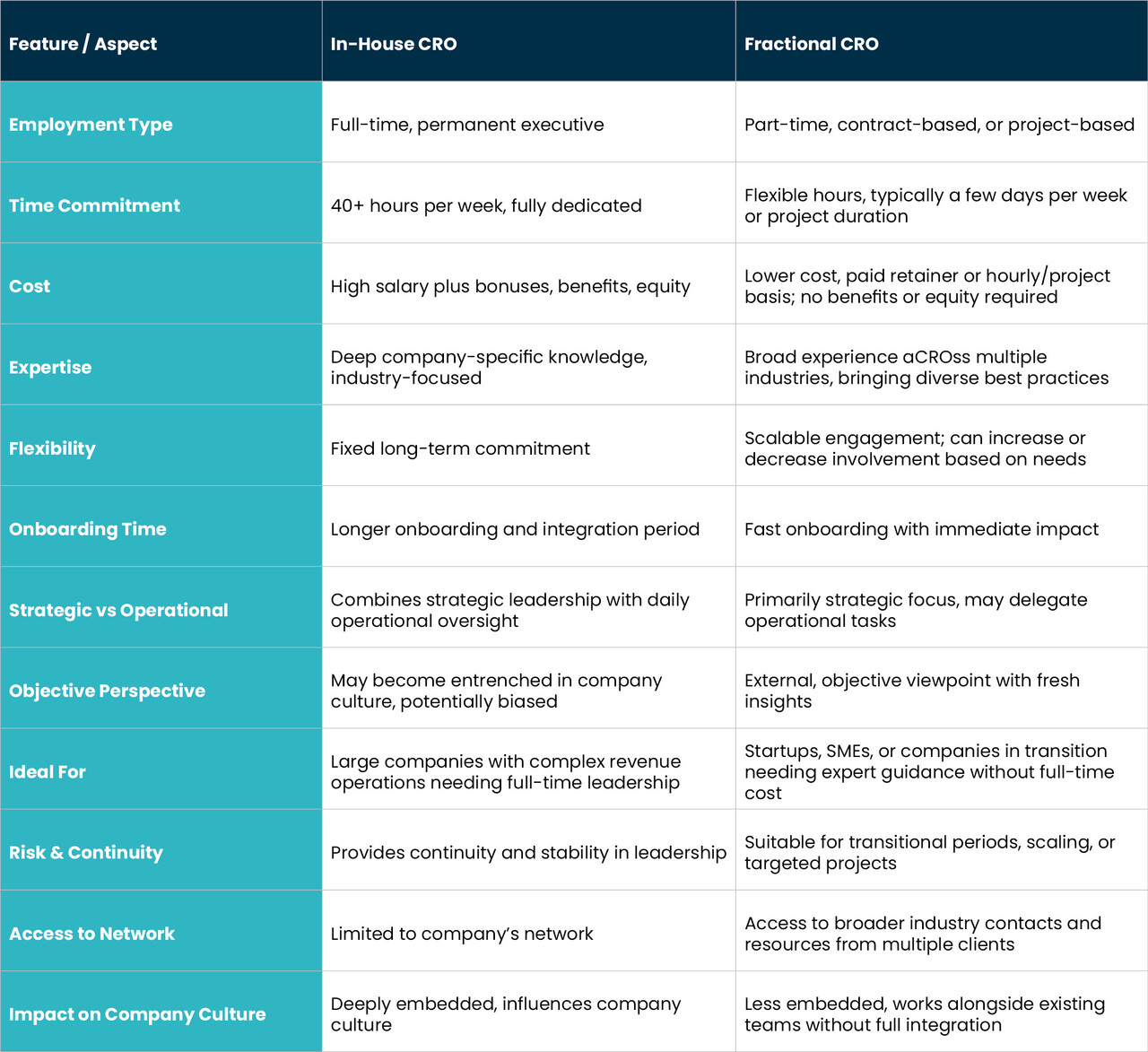
The operator you want speaks the ad-tech stack as a first language: ad servers, the programmatic plumbing of supply- and demand-side platforms, and the CRM integrations that keep direct sales honest. They know the difference between a guaranteed-delivery insertion order and a programmatic-guaranteed deal, and they can price inventory intelligently across display, video, native, newsletter, and podcast. Critically, they hold the tension between protecting premium, brand-safe inventory and clearing remnant slots without collapsing your CPM floor — a balancing act that has no clean analog in a SaaS pricing page.
Forecasting is its own dialect. Coverage in media isn't only a dollar figure; it is an impression commitment against a rate card that has to mean something. A capable CRO builds a forecast that absorbs under-delivery, make-goods, and cancellations as normal weather, not surprises. Ask them the concrete version: "If we lose a direct-sold display campaign, how many programmatic impressions replace it, and at what floor before the swap turns margin-negative?" A media operator answers with a mechanism and a caveat; a generalist changes the subject. Compensation is the final tell — a rep incentivized purely on closed-won will train themselves to dump cheap remnant volume and call it a win, so the plan you want rewards rate-card adherence and renewals over raw top-line volume.
How do you vet a fractional CRO for media-specific competence?
General CRO credentials are table stakes and tell you almost nothing about media fit, so the interview has to probe for depth on purpose. Open by handing them a live diagnostic: "Our revenue flattened last quarter — walk me through how you'd find the leak." Grade the specificity. A strong answer names a stage and a mechanism — "you're losing at proposal because the rate card outruns the audience you can actually deliver," or "leads are fine but repeat business is thin because your post-campaign reporting doesn't prove ROI." A weak answer stays abstract and gestures vaguely at "better process."
Then ask for a concrete pipeline-coverage story from a real media context. The candidate should be able to describe segmenting opportunities by ad product — display versus podcast versus newsletter versus branded content — setting a distinct coverage ratio for each and anchoring those ratios in historical close rates rather than a single imported multiple. If they reach straight for a blanket "3x pipeline" the way a SaaS deck would, treat it as a flag: media coverage swings with cycle length and seasonality, and a smart operator knows a fourth-quarter sponsorship pipeline behaves nothing like an evergreen display book.
Push hard on pricing and packaging, because rate-card erosion is where most media businesses bleed quietly. Pose the scenario: "A marquee advertiser demands a deep discount on our premium newsletter sponsorship — what do you do?" The answer you want protects the headline rate for premium placements and trades in value-adds instead — social amplification, a custom audience study, first-look placement — rather than simply slashing the number. Bonus points if they describe tiered packages that let advertisers buy *up* without feeling nickel-and-dimed, because that architecture is what keeps discounting from becoming a habit. Interrogate RevOps with equal specificity: "Which CRM and ad-server integrations have you actually stood up, and how did you wire lead-to-cash?" You want someone who can trace a dollar from first touch through delivery to collected payment — if they can't, they can only describe a broken revenue process, not repair one. The vetting-questions library at pulserevops.com/knowledge/tl10992 collects more of these live-diagnostic prompts.
Finally, demand references from media companies specifically, not a roster of generic B2B logos, and then actually place the calls. Ask each reference three pointed questions: did this person understand the buying cycle, did they tighten rate-card discipline, and did their forecast hold up under real make-goods and cancellations? If every reference comes from a SaaS or e-commerce background, slow down — you may be hiring a very good CRO for the wrong industry.

How should you structure the engagement and measure success?
Finding the right person is only half the job; the engagement structure decides whether that person can actually move your number. The most common failure mode is a foggy mandate — "just grow revenue" — handed to a part-time executive with no baseline and no scoreboard. Replace it with a tightly bounded, paid trial that produces evidence. Begin with a short paid diagnostic and make the deliverables explicit: the CRO should review your live pipeline and historical close rates by ad product, interview your top sellers and account managers to surface where deals actually snag, audit the CRM and ad-server data for gaps and double-counts, analyze the rate card against real discounting patterns, and produce a one-page revenue snapshot that names the single biggest gap instead of listing ten.
The diagnostic should end with an action plan written in measurable outcomes, not adjectives. Good examples read like commitments: "lift direct-sold display coverage by sourcing a defined number of qualified opportunities from top-of-funnel," or "compress the average discount by launching a tiered package structure." If the plan can't be graded numerically, it isn't a plan — it's a wish. From there, move into a focused pilot with a deliberately narrow scope, because a fractional operator who tries to fix everything fixes nothing. The highest-leverage scopes for media businesses tend to be a RevOps overhaul (real lead-to-cash tracking and an ad server integrated with the CRM), a sales-process redesign (a per-product playbook with clearly defined stages), or a compensation redesign that pays for rate-card adherence and renewals.

Run weekly check-ins with the CRO and your leadership through the pilot, and keep the agenda ruthlessly short: what moved this week, what's blocked, and what needs a decision. Resist the pull to drag them into daily firefighting or live sales calls — a fractional CRO's job is to install the system and coach the team through it, not to become your most expensive account rep. Close the pilot by grading against the agreed metrics. Positive results earn a longer retainer with a widened scope; flat results give you a clean, cheap exit and no sunk-cost trap. That optionality is the entire point of hiring fractionally: you buy senior revenue leadership on a trial basis and only convert it into a standing commitment once the evidence is in.
What scope should the fractional CRO's pilot actually cover?
The instinct to hand a new revenue leader everything at once is the surest way to get nothing back. A fractional operator works a limited number of hours a week, so scope is the lever that decides whether those hours compound into a system or evaporate into meetings. Pick the single scope where a fix cascades furthest. For most media businesses that is RevOps plumbing, because an ad server that isn't wired into the CRM makes every other function — forecasting, comp, attribution — run on guesswork. Fix the data spine first and the rest of the diagnosis sharpens automatically.

The second-best scope is usually sales-process redesign: codifying a per-product playbook so that selling a podcast sponsorship, a newsletter placement, and a branded-content package each follow defined stages rather than the founder's improvisation. The third is compensation, which you tackle once the pipeline and process are legible enough that you can actually see what behavior the plan is rewarding. Whatever you choose, name it out loud and write down what "done" looks like before the pilot starts. One pitfall worth stating twice: do not expect the fractional CRO to also be your top closer. Their value is repeatable, scalable revenue machinery that keeps running after they leave — the playbook, the forecast, the comp design, the coached team. If what you need is someone to personally carry a bag, hire a senior seller; confusing the two roles wastes both budgets. The engagement-scoping guide at pulserevops.com/knowledge/tl15485 breaks these three scopes down further.
When is a media business actually ready for a fractional CRO?
Readiness is mostly about having a revenue base worth optimizing. If you have a repeatable book of business but you've hit a plateau, your sales motion is improvised, or your forecast keeps missing, a fractional CRO can install the machinery that gets you unstuck. If you're pre-revenue or still hunting for product-market fit, the hire is premature — that stage still belongs to founder-led selling and direct customer conversations, and no amount of revenue architecture substitutes for learning what advertisers and subscribers will actually pay for.

The other readiness signal is organizational, not financial: someone internal has to own the relationship and act on the CRO's recommendations. A fractional operator installs systems and coaches, but they are not on-site every day to enforce adoption. If your team treats the engagement as an outside consultant's opinion to be politely ignored, even a brilliant hire stalls. Make sure a leader on your side is accountable for carrying the plan forward between check-ins — that single condition often separates the media businesses that get a compounding return from the ones that get an expensive slide deck.
Related questions
How do I know if my media business is ready for a fractional CRO?
You're ready when you have a repeatable revenue base but have hit a plateau, your sales motion is improvised, or your forecast keeps missing. Pre-revenue or still chasing product-market fit means it's premature — that stage belongs to founder-led selling.
Can a fractional CRO work part-time while I keep my current sales team?
Yes — that's the standard arrangement. They work a limited number of hours a week on strategy, process, and coaching while your existing reps continue to execute. The best ones make your current sellers measurably better rather than sidelining them.
How is a fractional CRO different from a sales consultant?
A consultant diagnoses, writes recommendations, and hands them off. A fractional CRO owns the number and executes against it — managing your team, sitting inside the pipeline weekly, and accountable for the outcome. That's the difference between a deck and a working system.
What's the first thing a good fractional CRO does after being hired?
They audit the current pipeline, forecast accuracy, and compensation structure to isolate the single biggest bottleneck, then propose a tightly focused pilot on one stuck metric or deal stage designed to produce a quick, measurable win.
Should the fractional CRO also carry a quota and close deals?
No. Their value is repeatable revenue machinery — playbook, forecast, comp design, coached team — that keeps running after they leave. If you need someone to personally hit a number, hire a senior seller instead; the roles are different.
FAQ
What exactly does a fractional CRO do for a media business? A fractional CRO takes ownership of the revenue function — pipeline generation, sales process, forecasting, and team management — without the cost or permanence of a full-time hire. In a media context that means owning sell-through, protecting the rate card, and building the forecast that ties impression commitments to collected cash, so revenue stops depending entirely on the founder's personal relationships.
How is a fractional CRO different from a sales consultant? A consultant diagnoses, writes recommendations, and hands them off; a fractional CRO owns the number and executes against it. They manage your team, sit inside the pipeline every week, and are accountable for the outcome. That is the difference between a slide deck and a system that actually ships and keeps running.
How long does a typical fractional CRO engagement last? Most begin with a short paid pilot to test fit and impact against a specific metric. When that proves out, the relationship commonly extends into a multi-month retainer, and some media businesses keep the arrangement running well beyond that when the CRO becomes the steady hand on revenue strategy through upfront and holiday cycles.
What should I look for when vetting a fractional CRO? Prioritize direct fluency in media buying cycles, impression-and-dollar pipeline forecasting, and RevOps tooling that retires the founder's spreadsheets. Ask for a sample one-page revenue snapshot so you can see how they diagnose and communicate revenue health — the clarity of that page is a reliable proxy for the clarity of their thinking.
How do we ensure a smooth handoff if we later hire a full-time CRO? A capable fractional CRO documents processes, builds scalable systems, and mentors your internal team from the first week, so the revenue engine is already running when the full-time hire arrives. Bake in an overlap period and the transition becomes a walkthrough of a working machine rather than a rebuild from scratch.
How do I handle confidentiality with a fractional CRO who works with other media companies? A standard NDA plus a narrow non-compete scoped to direct competitors covers the essentials. Experienced fractional CROs run a portfolio and are practiced at walling off client information — but verify it. Ask current and past clients directly whether the person kept their business discreet, and treat any hesitation in those references as a real signal.
What if the fractional CRO wants to bring in their own subcontractors? That's common and often a plus when they bring specialists like RevOps engineers or ad-ops help. Just insist on a clear agreement covering who's on the team, what each person does, and how they're paid. Avoid open-ended arrangements where you're quietly funding a bench you never interviewed or approved.
What's the biggest mistake companies make when hiring one? Handing over a foggy "just grow revenue" mandate with no baseline and no scoreboard. Replace it with a tightly scoped, paid pilot tied to one stuck metric and a measurable outcome. Without a defined finish line, even a strong operator can't prove value and you can't fairly judge the hire.
Sources
- Harvard Business Review — The Rise of Fractional Executives
- Deloitte Insights — Media & Entertainment Industry Outlook
- American Marketing Association — Marketing Resources
- Interactive Advertising Bureau (IAB) — Standards & Guidelines
- MediaPost — Media Sales & Advertising News
- Society for Human Resource Management (SHRM) — Interim & Contract Talent
- Forbes — Revenue Leadership & Fractional Executives
- McKinsey & Company — Media & Advertising Insights
Related on PULSE
- [How do I hire a fractional CRO for a media business in 2027?](/knowledge/tl9063)
- [How do I hire a fractional CRO for a martech business in 2027?](/knowledge/tl9039)
- [How do I hire a fractional CRO for a proptech business in 2027?](/knowledge/tl9059)
- [How do I hire a fractional CRO for a healthtech business in 2027?](/knowledge/tl9019)
- [How do I hire a fractional CRO for a logistics business in 2027?](/knowledge/tl9043)
- [How do I hire a fractional CRO for a insurtech business in 2027?](/knowledge/tl9055)
This page will be disappearing soon. Save it to your device for $1 — or read it free while it is here.
@Kory-White- · if Venmo asks, the last 4 of my number are 2012
This page is gone.
This one is off the shelf now. $1 keeps it on your phone for good — the whole page, pictures and diagrams included.
 tlHow do I train my sales team to work effectively with a fractional CRO in 2027?
 pulse-toolsHow Many Sales Reps Do I Need to Hire for My Janitorial Supply Company?
 pulse-toolsHow Many Salespeople Should I Schedule Each Day at My Apparel Boutique?
 pulse-toolsHow do I find a fractional CRO who can also cover interim VP of Sales duties in 2027?
 pulse-toolsWhat Service Fees Should a Law Firm Charge?
 pulse-toolsHow Many Sales Reps Do I Need to Hire for My Plumbing Company?
 pulse-toolsHow do I build a 30-60-90 day success plan for a fractional CRO's first quarter in 2027?
 pulse-toolsHow Many Sales Reps Do I Need to Hire for My Food Distribution Business?
 pulse-toolsHow Many Employees Should I Schedule Each Day at My Bookstore?
 pulse-toolsHow Many Sales Reps Do I Need to Hire for My Home Security and Alarm Company?