


How do I hire a fractional CRO in Wisconsin in 2027?
Quality
Certified

Hiring a fractional CRO in Wisconsin means buying part-time senior revenue leadership — typically five to fifteen days a month — instead of a full-time executive. Define the specific revenue gap, source through operator networks rather than job boards, interview for judgment over tactics, check references, and sign a scoped agreement with a thirty-day exit clause.
What a fractional CRO is, and what it is not
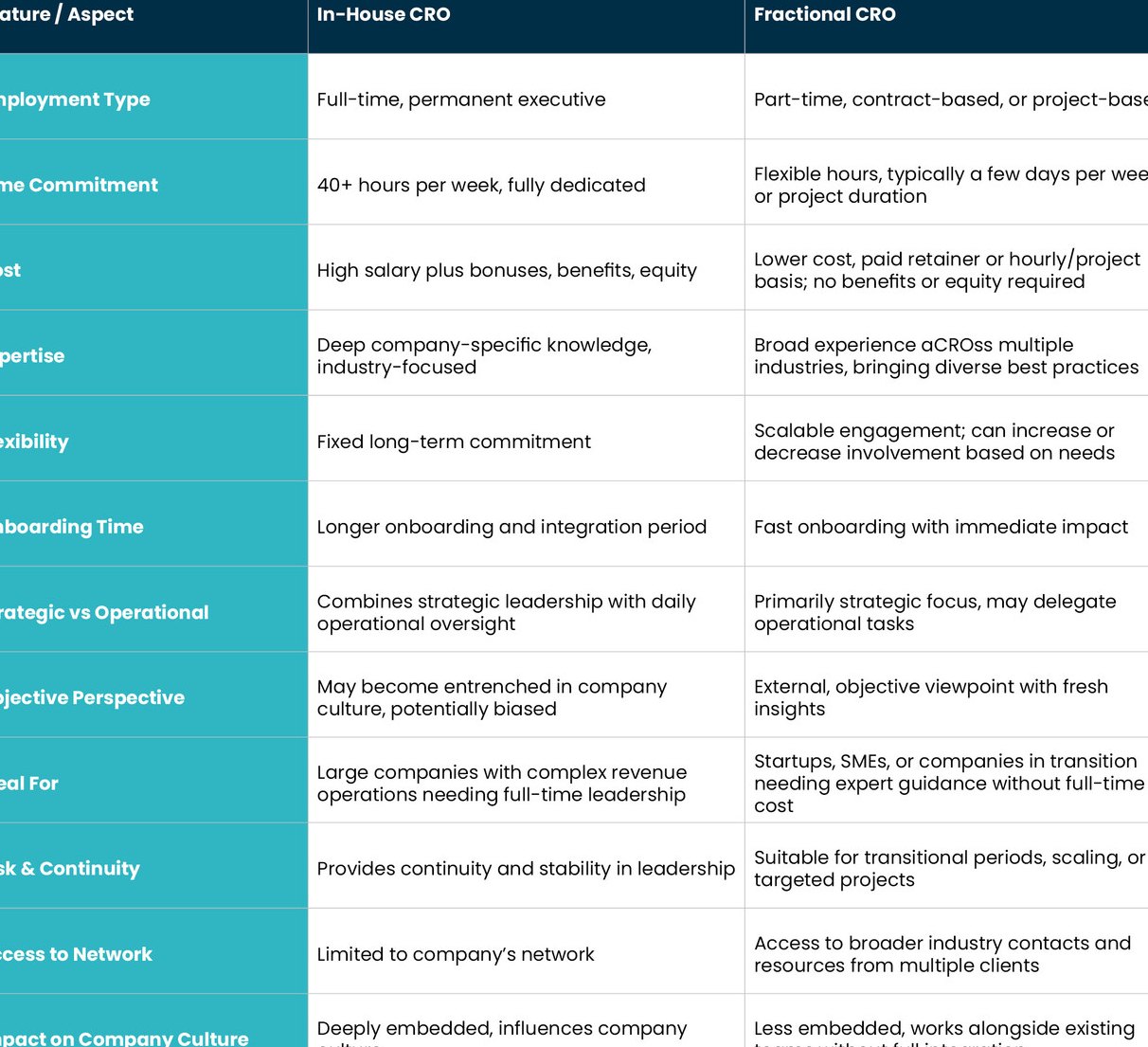
A fractional CRO owns the revenue function on a part-time basis. That means go-to-market strategy, sales process design, forecasting cadence, hiring and compensation structure, channel or partner motion where one exists, and the alignment between marketing and sales. They are an executive with reduced hours, not a contractor with an executive title. The distinction matters because the two produce completely different outcomes and completely different invoices.
What a fractional CRO generally does not do: daily prospecting, individual deal closing (except at very small companies where the founder is still the only seller and the CRO steps in temporarily to model the motion), CRM data hygiene and administration, marketing execution such as writing emails or running ad campaigns, and routine one-on-one coaching of individual reps beyond the first layer of management. If you find yourself asking a fractional CRO to update opportunity stages in HubSpot, you have hired the wrong role and you are burning executive-rate hours on a task an operations coordinator handles.
The typical first-ninety-day deliverable set looks like this: an audit of the existing pipeline, sales process, and team; a six-to-twelve-month revenue plan with stage definitions, conversion assumptions, and hiring needs; an implemented forecasting cadence, usually a weekly pipeline review plus a monthly business review; a decision on the first one or two sales hires or replacements; and a reporting configuration in whatever CRM you run so the numbers are visible without manual assembly. They configure reporting — they do not become your Salesforce administrator.

One behavioral marker separates a good fractional CRO from an expensive one. A good one pushes back on founder assumptions about growth speed, deal size, and sales cycle length within the first three weeks. If everything you say about your market is met with agreement, you are paying for validation rather than leadership. The pushback is the product.
This versus the common alternatives
Wisconsin founders considering this role are usually choosing among five options, and the wrong choice is expensive in both cash and lost quarters.
A full-time VP of Sales or CRO. This is the right answer once you have four to six quota-carrying reps and a sales motion that repeats — meaning you can predict roughly what happens when you add a rep. Below that headcount, a full-time revenue executive has more capacity than problems, and you have committed to a base salary, variable compensation, benefits, and equity for a role that is not yet full-time work. Above that headcount, a fractional CRO starts to hit a ceiling: managing six or more people, running enablement, and handling the interpersonal load of a real sales org is not a five-day-a-month job.
A sales consultant or advisory firm. A consultant diagnoses and delivers a report. That is genuinely useful when your question is narrow and analytical — is our pricing wrong, is our ICP definition wrong, why did win rates fall in one segment. It is the wrong purchase when the problem is that nobody owns the number. A consultant leaves; a fractional CRO stays and is accountable for whether the plan works. If you cannot name what the person is accountable for at the end of month three, you are buying consulting regardless of the title on the agreement.

A sales coach. A coach improves the performance of people who already exist in seats that already work. If your reps are hitting sixty percent of quota and you believe the process is right, coaching is cheaper and faster than an executive hire. If your reps are hitting sixty percent of quota and you are not sure the process is right, coaching optimizes a broken system.
Hiring another rep instead. This is the most common substitution founders make, and often the correct one. If the constraint is capacity — you have proven the motion, demand exceeds the hours available to work it, and your existing seller is above quota — hire a rep. A fractional CRO cannot manufacture demand you have not established. The rule of thumb: if adding a person would predictably add revenue, add the person. If adding a person would predictably add confusion, you have a leadership gap, not a capacity gap.
A RevOps hire instead. Sometimes the presenting symptom — bad forecasts, invisible pipeline, no reporting — is an operations problem, not a leadership problem. If the strategy is sound and the people are executing but you cannot see anything, a RevOps contractor or fractional operator solves that for meaningfully less than an executive retainer. The tell is whether your team knows what to do and simply cannot prove what happened, versus not knowing what to do at all.
An interim CRO. Different animal from fractional. Interim is near-full-time for a defined window — usually covering a departure, a transaction, or a turnaround — and it is priced closer to full-time. Choose interim when the job is genuinely full-time and temporary. Choose fractional when the job is genuinely part-time and ongoing.
Why Wisconsin changes the search, not the price

Wisconsin's revenue-leadership market is real but concentrated in three clusters, and knowing which one you are in shapes where you look and who fits.
Madison has a growing software, biotech, and agtech cluster built around the university, with the founder profile skewing technical and the sales motions skewing toward long, evidence-heavy enterprise cycles. Milwaukee is manufacturing, supply chain, insurance, and industrial technology, where the buyer is often a plant, a distributor, or a broker channel rather than a software buyer, and where channel and partner motions matter more than inbound funnels. The Fox Valley — Appleton, Oshkosh, Green Bay, Neenah — is dense with B2B services and industrial firms with relationship-driven, long-tenure customer bases and very little formal sales process.
The practical consequence: the pool of experienced revenue leaders physically located in Wisconsin is shallow compared with Chicago, the coasts, or Austin. Most Wisconsin companies end up hiring a fractional CRO who lives elsewhere — frequently Chicago, which is a ninety-minute-to-three-hour drive from most of the state and shares the Central time zone — and who visits monthly or quarterly. Remote fractional engagements are the norm now, not the compromise. What matters is not the ZIP code but the communication cadence you agree to and whether the person has run the motion your business actually uses.
Two Wisconsin-specific fit questions worth asking that coastal candidates often fail. First: have you sold through distributors, dealers, manufacturer's reps, or brokers? An enormous share of Wisconsin mid-market revenue moves through channel, and a pure direct-SaaS operator will try to install a motion your market does not run. Second: have you led a team where the average rep tenure is eight years and the customer relationships predate the CRM? Wisconsin industrial and services firms often have long-tenured salespeople who own relationships personally. A leader whose entire playbook assumes a young, high-turnover SDR-to-AE pipeline will attempt a reorganization that detonates your revenue base.
Do not expect a Wisconsin discount. Fractional executives price on value delivered and prevailing market rate for the role, not on local cost of living. The one real geographic saving is travel: a local or Chicago-based candidate who is willing to be on-site does not bake in flights and hotel nights the way a coastal candidate must. Ask explicitly whether travel is inside or outside the retainer — this is where budgets quietly break.
How to choose between the options

Work the decision in a fixed order rather than starting from the role you already decided you wanted. Write down the specific revenue gap in one sentence before you look at a single candidate — "our founder is the only person who can close," "pipeline is flat for three consecutive quarters," "we have no forecast we believe," "we have four reps and no process." The sentence determines the hire. A vague sentence produces a vague engagement, and a vague engagement is the single most common way this hire fails.
Once you land on fractional, the sourcing channel matters more than the volume of candidates. Operator communities and revenue-leader networks — Pavilion, RevOps Co-op, and specialist fractional-executive networks such as CRO Syndicate — surface people who have carried a number rather than people who market themselves well. General job boards and open LinkedIn postings produce volume without filtration, and you will spend the savings in screening hours. Your own investor and board network is the highest-signal source available to you and the one founders underuse; three warm referrals beat thirty applications.
Interview for judgment, not for tactics or personality fit. Four questions do most of the work. Walk me through the last revenue plan you built that failed — what went wrong, and what did you change? How do you decide whether the next hire is an AE, an SDR, or a customer success person? What is your actual process for building a forecast that lands within ten percent? Describe a time you had to remove someone from the sales team who was personally close to the founder. Specific, uncomfortable, detailed answers are the signal. Vague or purely conceptual answers are disqualifying at this level — a real operator has scar tissue and remembers the details.

Test tool fluency directly rather than accepting a list on a résumé. Ask them to walk you through how they would build a pipeline coverage report in Salesforce or HubSpot, how they use conversation intelligence such as Gong to diagnose a stalled stage, and how they would structure a forecast roll-up. Someone who cannot describe a pipeline report structure in five minutes has not been close to the numbers recently.
Check two or three references, and ask the reference the failure question rather than the praise question: what broke during the engagement, and how did they handle it? Every real engagement has a rough stretch. A reference who cannot name one either did not work closely with the person or is being polite.
Costs, timelines, and what to actually expect
Fractional CRO engagements are priced as a monthly retainer tied to a committed number of days. The market convention is five to fifteen days per month, with five to ten being the common band for companies under roughly ten million in revenue. The rate varies with three things, and it is worth understanding each so you can negotiate on substance rather than haggling.
Company stage and complexity. Earlier and simpler sits at the low end of whatever range a given candidate quotes; multiple product lines, channel or distributor motions, international sales, or a live turnaround sits at the high end. Complexity is the biggest single driver — a single-product direct motion is a fundamentally smaller job than a two-channel business with a dealer network.
Equity. Many fractional executives will trade cash for equity, commonly in a range of roughly half a percent to two percent depending on stage and commitment length, in exchange for reducing monthly cash by something like twenty to forty percent. This is common at seed and Series A. Two cautions: equity that vests over a period longer than the likely engagement is not real compensation to them and will show up as disengagement, and cash-poor companies sometimes over-issue equity for a six-month engagement they later regret at their next raise. Tie any equity grant to a vesting schedule that matches the engagement term with a cliff.

Duration. Most engagements run three to six months at minimum, because the first thirty days are diagnosis and nothing meaningful compounds before ninety. Twelve-month commitments often earn a ten to fifteen percent reduction in the monthly rate. Below three months, you are paying for an audit and calling it leadership.
Budget for the things outside the retainer, because they are where the surprise lives: travel and on-site days if you want physical presence, any tooling the plan requires, recruiting fees if the plan calls for hires, and the internal time of your own team. Ask for the day-rate for additional days beyond the committed number and the process for approving them, in writing. Otherwise the first busy month produces an invoice conversation.
The realistic timeline: days one through thirty are audit, listening, and data assembly — expect very little visible output and resist the urge to read that as inactivity. Days thirty through sixty produce the plan, the forecast cadence, and the first structural decisions, including any hiring or removal calls. Days sixty through ninety produce the first cycle of the new operating rhythm, and this is the earliest point at which you can honestly evaluate anything. Forecast accuracy and pipeline hygiene improve before revenue does, and that ordering is normal — if your bookings have not moved by day ninety but your forecast is now reliable and your pipeline definitions are clean, the engagement is on track.
When the math does not work: below roughly two hundred thousand in annual recurring revenue, an executive retainer consumes a share of revenue that no amount of competence justifies. Before product-market fit, the founder must keep selling because the selling conversation is the product-discovery conversation, and delegating it delays the thing you actually need. If you are unwilling to delegate revenue decisions — pricing, hiring, territory, who stays — the engagement will fail regardless of who you hire, and the failure will be attributed to them. And if you cannot commit to at least five days a month of their time, do not start; sub-threshold engagement produces sub-threshold results and a bad reference for both sides.
Implementation and handoff details

Write a short statement of work before the first invoice. It does not need to be long; it needs to be specific on six points.
Scope. Name what they own and what they explicitly do not. Ownership usually covers strategy, the revenue plan, forecasting, sales hiring, compensation design, and board or investor reporting on revenue. Explicit exclusions usually cover daily prospecting, CRM administration, individual deal closing, and marketing execution. Writing the exclusions down prevents the slow drift into expensive busywork.
Days per month and the process to add more. Exact number, exact day-rate for overage, and who approves it.
Deliverables with dates. The ninety-day audit, the revenue plan, the forecast cadence, and the hiring plan, each with a date. Deliverables are how you evaluate, because tracking hours on a fractional executive is both impossible and counterproductive — you are buying outcomes, not attendance.
Communication cadence. A standing weekly one-on-one with you, a weekly pipeline review with the sales team, a monthly business review, and their role in board reporting. Fix the recurring meetings in calendars in week one; engagements that never establish a rhythm never establish authority either.
Authority. State plainly what they can decide alone versus what needs your approval — hiring, firing, discounting thresholds, territory changes, comp plan changes. Ambiguous authority is the most common cause of a fractional executive being ignored by the team. Announce the scope of their authority to the team directly, from you, in the first week.

Exit and transition. Thirty days' notice from either side, plus a defined transition deliverable: documented process, handover of the forecast model, and a written state-of-the-business memo. Do not skip this. Fractional relationships end normally — because the company outgrows the arrangement, or because the founder was not ready to follow the plan — and a clean exit protects the value already built.
Plan the handoff from the start. There are three normal endings and you should know which you are aiming at: conversion to a full-time CRO or VP of Sales, promotion of an internal leader the fractional CRO has developed, or a straight wind-down once the process is installed and running on its own. Discuss conversion in the first conversation — many fractional executives prefer fractional work permanently and will tell you so, and a few will convert. If conversion is plausible, put the terms and the transition period in the agreement now rather than negotiating it later from a position where you are dependent.
Finally, run a real day-ninety review with written criteria set on day one. The criteria should be things like: is there a forecast we believe within ten percent, is the pipeline defined and hygienic, have the planned hires been made or deliberately deferred with reasoning, does the team know what the plan is. Revenue is a lagging measure and a poor ninety-day test. If the leading indicators are in place, extend. If they are not, use the exit clause without drama — that is what it is for.
Related questions
How much does a fractional CRO cost in Wisconsin?
Pricing is a monthly retainer tied to committed days, driven by stage, complexity, and whether equity offsets cash. Wisconsin location does not lower it — fractional executives price on market rate, not geography. Ask each candidate for their day-rate and overage terms in writing.
Can I hire a fractional CRO who lives outside Wisconsin?

Yes, and most Wisconsin companies do. Remote and hybrid fractional engagements are standard. Chicago-based candidates share the Central time zone and can be on-site within a few hours. Agree on the on-site cadence and whether travel is inside or outside the retainer.
How long should a fractional CRO engagement last?
Three to six months minimum. The first thirty days are diagnosis, days thirty to sixty produce the plan, and the first honest evaluation point is day ninety. Twelve-month commitments often reduce the monthly rate by ten to fifteen percent.
When should I hire a full-time VP of Sales instead?
Once you have roughly four to six quota-carrying reps and a motion that repeats predictably. Below that, the role is not yet full-time work. Above it, managing the team and enablement exceeds what five to fifteen days a month can cover.
What if I just need better reporting, not leadership?
Then hire a RevOps operator, not an executive. If your team knows what to do but cannot prove what happened, the gap is operational and costs meaningfully less to close than an executive retainer.
FAQ
What is the difference between a fractional CRO and a sales consultant?
A fractional CRO owns the revenue function and stays accountable for outcomes across months — the plan, the hires, the forecast, the number. A consultant diagnoses a defined problem, delivers findings, and leaves. Buy consulting when your question is narrow and analytical. Buy fractional leadership when nobody currently owns the number and you need someone who is still there when the plan meets reality.
How do I verify they are actually working their committed days?
Do not track hours — track deliverables and cadence. Did the ninety-day audit land on time? Is the revenue plan written and specific? Does the weekly pipeline review actually happen, and does the forecast tighten? If those hold, the day count is academic. If meetings slip and responses go quiet, raise it directly in the weekly one-on-one rather than auditing timesheets, which signals distrust and changes nothing.

Should I offer equity instead of cash?
Often yes at early stage, where a half-percent to two-percent grant can reduce monthly cash by roughly twenty to forty percent. Two conditions: the vesting schedule must match the realistic engagement length with a cliff, and you should model the dilution against your next raise before agreeing. Equity that vests over four years is not meaningful compensation for a six-month engagement and will not buy the commitment you think it does.
What Wisconsin-specific experience should I screen for?
Channel and distribution experience, and comfort with long-tenured relationship-owning salespeople. A large share of Wisconsin mid-market revenue moves through distributors, dealers, and manufacturer's reps, and many industrial and services firms have sellers whose customer relationships predate the CRM. A candidate whose only playbook is a direct SaaS SDR-to-AE funnel will install a motion your market does not run.
What are the clearest signs I am not ready for this hire?
No product-market fit, revenue below roughly two hundred thousand annually, unwillingness to delegate pricing and hiring decisions, or an inability to commit five days a month of the person's time. Any one of these predicts failure, and the failure will be blamed on the hire rather than the readiness. Fix the readiness gap first; the candidate pool will still be there.
Can a fractional CRO convert to full-time later?
Sometimes. Many prefer fractional work permanently and will say so if you ask directly in the first conversation. If conversion is plausible for both sides, write the terms and the transition period into the original agreement rather than negotiating later, when your dependence on them is at its peak and your leverage is at its lowest.
Sources
- Pavilion — membership community for revenue leaders, with regional chapters and executive networks
- RevOps Co-op — community and resources for revenue operations practitioners
- SaaStr — long-running library on SaaS revenue leadership, hiring, and scaling
- Harvard Business Review — research and practice on executive hiring, leadership transitions, and organizational design
- First Round Review — practitioner interviews on early-stage sales leadership and go-to-market hiring
- Wisconsin Economic Development Corporation — profiles of Wisconsin industry clusters and regional business composition
- U.S. Bureau of Labor Statistics — occupational and wage data for sales and executive roles, including Wisconsin metro areas
- LinkedIn — primary network for sourcing, vetting, and reference-checking fractional executives
Related on PULSE
- How much does a fractional CRO cost in Wisconsin in 2027?
- What should I look for in a fractional CRO in Wisconsin in 2027?
- How much does an interim Chief Revenue Officer cost in Wisconsin in 2027?
- What does a fractional CRO engagement cost in Wisconsin in 2027?
- How do I find a fractional CRO in Millsboro in 2027?
- How do I hire a fractional CRO in Tulsa in 2027?
This page will be disappearing soon. Save it to your device for $1 — or read it free while it is here.
@Kory-White- · if Venmo asks, the last 4 of my number are 2012
This page is gone.
This one is off the shelf now. $1 keeps it on your phone for good — the whole page, pictures and diagrams included.
 pulse-toolsHow do I evaluate a fractional Chief Revenue Officer in North Dakota in 2027?
 pulse-toolsIs there a fractional Chief Revenue Officer available near me in Michigan in 2027?
 pulse-toolsHow do I hire a fractional CRO in Philadelphia in 2027?
 pulse-toolsWhat does a fractional Chief Revenue Officer engagement cost in Utah in 2027?
 pulse-toolsWhat should I look for in a fractional CRO in Rhode Island in 2027?
 pulse-toolsShould I Hire a Fractional CRO If I Am Consolidating Regional Sales Teams in 2027?
 pulse-toolsHow do I evaluate a fractional Chief Revenue Officer in Wisconsin in 2027?
 pulse-toolsWhat should I look for in a fractional CRO in Oregon in 2027?
 pulse-toolsIs there a fractional Chief Revenue Officer available near me in Arkansas in 2027?
 pulse-toolsHow do I hire a fractional CRO in Denver in 2027?