
How do I set up a weekly communication cadence with a fractional CRO who works remotely in 2027?
 Curated byKory White · Fractional CRO · Maryland
 PULSEKNOWLEDGE LIBRARY
Quality
Certified

Set up a weekly communication cadence with a remote fractional CRO by locking four recurring touchpoints: a Monday async written update, a 60-minute Tuesday pipeline and forecast review, a Thursday 1:1 with the founder or CEO, and a Friday async scorecard. Give them live CRM access, require two to four hours of timezone overlap, and put the cadence in writing as a working agreement in week one.
The job this role is hired to do
A fractional CRO is an operator renting you a slice of their week, not an advisor handing over a deck. In a remote engagement that operator typically commits 10 to 25 hours per week across a six-to-twelve-month term, and every one of those hours has to be pointed at a revenue outcome you can name. The weekly communication cadence you build is the delivery mechanism for that outcome. Without it, a remote fractional leader drifts into producing status updates nobody reads.
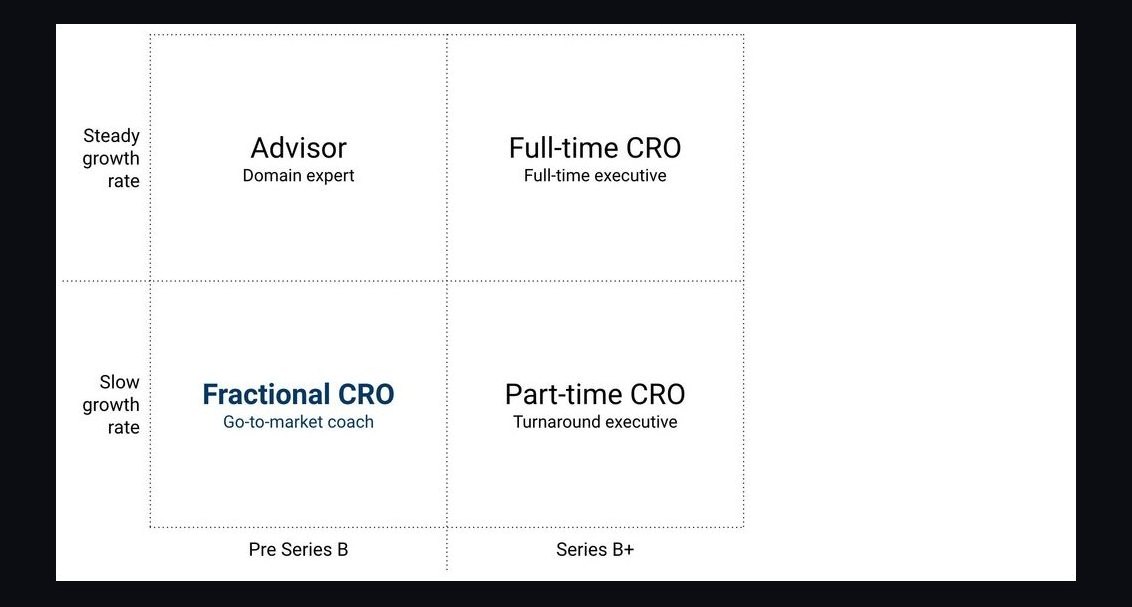
Start by writing down what the role owns. At pre-seed and seed stage, the job is usually "build the engine from parts": stand up a repeatable sales motion, define an ideal customer profile, hire the first two or three reps, and get the founder out of every deal. Between roughly $1M and $5M ARR the job shifts to "make the engine efficient": tighten qualification, fix CRM hygiene, install forecasting discipline, and lift win rates. Those are different jobs and they demand different weekly rhythms. A builder needs more live time with you in the first 60 days because they are making decisions with almost no data. An optimizer needs more async analytical time because they are mining a CRM that already has thousands of records in it.
The communication cadence has to match the job. If you are pre-seed and still closing 80% of deals yourself, a Tuesday pipeline review with a 12-stage funnel is theater. What you actually need is a 30-minute call where the two of you walk deals one by one and the CRO tells you what to stop doing. If you are at $3M ARR with three reps missing quota, you need a structured forecast call with a coverage ratio, a commit-versus-best-case split, and a written record of every deal that slipped and why.
Be explicit about the boundary between what the CRO owns and what you own. A fractional CRO who works remotely cannot read your mood in the hallway. They will not notice that your VP of Marketing is frustrated unless someone tells them. So the cadence has to carry information that would otherwise travel by osmosis in an office. That means you build in a channel for friction, not just a channel for metrics. A weekly 1:1 with you is where that friction surfaces. A weekly scorecard is where the metrics live. Do not try to do both in the same meeting.

One more scoping decision: decide in advance what the CRO is *not* doing. Fractional engagements fail when the scope creeps into "also run marketing, also own customer success, also fix the CRM data." Write the exclusions into the working agreement alongside the cadence. If your engagement runs alongside a fractional CFO or CMO, name the coordination point explicitly — usually a 30-minute monthly cross-functional sync — because two fractional leaders operating on separate rhythms with no shared forum will quietly contradict each other in front of your team.
How it fits the RevOps stack
A weekly communication cadence is not a meeting series bolted onto your RevOps stack. It is the layer that makes the stack legible. Your CRM holds the truth about pipeline. Your conversation-intelligence tool holds the truth about what reps actually said. Your forecasting tool holds the truth about what the number is likely to be. None of those produce a decision on their own. The cadence is the loop that turns raw system output into a commitment someone owns.
The practical architecture looks like this. The CRM is the system of record and the CRO needs write access, not a read-only seat. Conversation intelligence records and transcribes calls so the CRO can coach without sitting in on every demo. A forecasting or revenue-intelligence layer rolls up rep commits into a number with a confidence band. A shared document or project board holds the operating plan and the open decisions. A persistent chat channel holds the day-to-day. Your calendar holds the recurring rhythm. If any one of those five is missing, the cadence degrades — most commonly because the CRO is working from a stale export instead of live data.
The single most common failure is a read-only CRM seat. Founders grant it because they are nervous about an outsider editing records. The result is that the CRO prepares for Tuesday's forecast call by asking an admin for a CSV on Monday afternoon. That is a full day of latency on the only data that matters. Give them write access, log the changes, and review the audit trail monthly if you are worried. The alternative costs you more than the risk.
Build the cadence around the data flow, not around convenience. Monday's async update should be written by the CRO and should reference last week's scorecard plus what changed in the CRM over the weekend. Tuesday's live review should be the only meeting where the forecast number is debated. Thursday's 1:1 is for the things that do not belong in a group setting: your concerns about a specific rep, a board conversation coming up, a pricing decision you are wrestling with. Friday's scorecard is a short written artifact — five to eight numbers with a one-line commentary on each — that you can forward to your board without editing.
Timezones decide the shape. If your fractional CRO is two or three timezones away, the Tuesday review has to sit in the overlap window. A common pattern for a US-based company working with a CRO on Mountain or Central time is a Tuesday call at 8:00 or 9:00 a.m. Pacific, which is 9:00 or 10:00 a.m. Mountain and 11:00 a.m. or noon Eastern. That gives both coasts a live slot. If your CRO is in Europe, the overlap window collapses to your early morning, and you should move the live review to 7:00 a.m. your time and push everything else async.
The rule of thumb: if a touchpoint does not produce a decision, a number, or a documented status change, cut it. A remote fractional CRO's calendar is their inventory. Every recurring meeting you add is an hour they are not spending on pipeline, coaching, or analysis. Four touchpoints a week is the practical ceiling for a 15-to-20-hour engagement. Five or six is defensible only if the engagement is 25 hours or more and the company is large enough that the CRO is managing a team rather than carrying a number.

Pricing, engagement models, and typical ranges
Communication cadence and pricing are the same conversation. The number of hours you buy determines how many touchpoints are physically possible, and the touchpoint design determines whether those hours produce anything. Get the sequencing right: decide the job, design the cadence, then price the hours the cadence requires.
Fractional CRO engagements generally fall into three models. The light advisory model runs roughly 5 to 10 hours per month, usually a single monthly deep-dive plus async access. It suits a founder who already has a sales motion and wants a senior sounding board. The standard operating model runs 10 to 25 hours per week and is the model the weekly cadence above is designed for — this is where the CRO actually runs the revenue function. The embedded model runs 30 or more hours per week and starts to look like a part-time employee; at that point you should be comparing against a full-time hire on total cost.
Pricing scales with hours, seniority, and travel. A remote-only arrangement generally prices below one that requires regular on-site presence, and a lighter advisory cadence costs less than a hands-on, several-days-a-week engagement. Because full-time revenue-leader compensation runs well into the mid-six figures once salary, variable pay, and equity are counted, a fractional arrangement is most attractive precisely at the stage where you need senior judgment but cannot yet justify a full-time seat. Expect a monthly retainer scaled to a committed hours band rather than a salary, and expect a premium for operators who have run a comparable stage before.
Budget for more than the retainer. Factor in the tools the CRO will want — a conversation-intelligence seat, a forecasting layer, sometimes a data-enrichment subscription — because a weekly cadence built on bad data produces bad decisions at high speed. Add any occasional travel if you want quarterly on-site sessions, which are worth doing even in a remote-first engagement: one day in person every 90 days resets relationships faster than ten video calls. Add the ramp cost of the first month, which is largely diagnostic. A well-run first 30 days produces an audit, a prioritized problem list, and a 90-day plan; it does not produce much revenue yet, and you should not expect it to.
Tie the spend to outcomes. Attach two or three measurable targets to the opening 90-day pilot — a pipeline coverage ratio around 3x, a defined lift in win rate, a stated improvement in forecast accuracy — and make renewal contingent on hitting them. That structure protects you from an open-ended advisory relationship that drifts, and it gives the CRO a clear definition of success. It also justifies the cadence: a weekly scorecard is how you both track whether the pilot targets are moving.
Plan the exit at the start. A well-run fractional engagement should either hand off to a full-time CRO once you can afford one, or leave behind a self-sufficient team and documented playbooks. A common structure is a month-to-month agreement with a 30-day notice clause, an opening 90-day pilot, and then a six-to-twelve-month term if the numbers moved. Spell out intellectual-property ownership so the playbooks, sequences, and documentation stay with you when the engagement ends. The best fractional operators build toward their own obsolescence, and the weekly cadence should make that transition visible — if the CRO is doing their job, the scorecard should show the team needing them less over time, not more.
How to evaluate and shortlist
Evaluating a fractional CRO for a remote weekly cadence is mostly a test of whether they can operate a rhythm without being managed into it. Ask every candidate to describe their last engagement's weekly schedule in detail. The strong answer names specific days, specific artifacts, and specific owners. The weak answer says "I'm flexible" or "whatever the client needs." Flexibility sounds good and is actually a warning: it means they have no operating system of their own and will default to reacting to whoever messages them loudest.
Probe the async muscle specifically. A remote fractional leader who cannot write clearly is a liability, because half your cadence is written. Ask for a sample weekly update from a past engagement, redacted. Look for a document that leads with the number, names what changed, flags risks with an owner attached, and ends with a short list of decisions needed from the founder. If the sample reads like a status report with no asks, they will not push back on you, and a CRO who never pushes back is not worth the retainer.

Test the data fluency. Ask how they would audit your CRM in the first two weeks. A credible answer includes specific checks: how many deals have no next step, how many have a close date that has moved more than twice, what percentage of closed-lost deals have a documented reason, whether stage definitions are actually enforced. Ask which qualification framework they install and why — MEDDIC, MEDDPICC, or a lighter variant — and listen for whether they adapt it to deal size rather than applying it uniformly. A CRO who insists on a heavy framework for $8K deals is optimizing for their own comfort.
Verify claims before you sign. Ask for anonymized case studies with real numbers: starting ARR, ending ARR, timeframe, and what specifically changed. Cross-reference claimed tenure against public professional profiles and company records. Speak to two references who ran a comparable engagement, and ask them the uncomfortable questions: how did the weekly cadence actually work, what did the CRO miss, and what would you do differently. A credible operator will hand over those references without hesitation.
Screen for timezone honesty. Ask directly how many hours of live overlap they can commit to per week and where those hours fall on your calendar. Someone who says "I'm available whenever" across a nine-hour gap is either overcommitted or not thinking carefully. Two to four hours of genuine overlap is enough for a weekly live review plus ad hoc calls. Anything less and your live touchpoints become recordings you watch alone, which is not a cadence, it is a newsletter.

Finally, check the exit behavior. Ask what a clean handoff looks like at the end of an engagement and what artifacts they leave behind. The answer tells you whether they build for your independence or for their renewal.
Buyer decision framework
Use a short decision tree before you commit to a cadence design, because the wrong cadence is worse than none. The first branch is your ARR band, which determines whether you need a builder or an optimizer. The second is your team size, which determines how much of the CRO's week goes to managing people versus working deals. The third is your timezone gap, which determines how much of the cadence can be live. The fourth is whether you have a functioning CRM, because a cadence built on a CRM nobody updates will produce confident wrong answers every Tuesday.
Run the branches in order. If you are pre-seed with no repeatable motion, design a builder cadence: heavy live time, deal-by-deal review, light scorecard. If you are $2M to $5M ARR with a team, design an optimizer cadence: lighter live time on individual deals, heavier async analytical work, a rigorous scorecard, and structured coaching. If your timezone gap exceeds four hours, move the live review to your early morning and convert everything else to written form. If your CRM is a mess, make CRM cleanup the first 30-day deliverable and accept that the first month's scorecard will be unreliable.
The framework's real value is that it forces a conversation before the first Monday update. Founders who skip it tend to copy a cadence from a company at a different stage and then wonder why the meetings feel hollow. A pre-seed founder running a formal forecast review with a coverage ratio is measuring a pipeline that does not yet exist. A $4M ARR founder running deal-by-deal calls with three reps is doing work a sales manager should own and paying CRO rates for it.
Related questions
What is the minimum viable weekly cadence?
One 60-minute live pipeline and forecast review, one async written scorecard, and a persistent chat channel. That is the floor. Add the founder 1:1 and the Monday written update as the engagement grows past 15 hours per week or once the CRO is managing reps directly.
How much timezone overlap does a remote fractional CRO need?
Two to four hours of genuine live overlap per week. That covers one structured 60-minute review plus ad hoc calls. Below two hours, your live touchpoints degrade into recordings and the relationship becomes transactional. Albuquerque's Mountain Time overlaps cleanly with both coasts.
Should the weekly review be recorded?
Yes, record the pipeline and forecast review and share it with anyone who owns a deal. Recording creates a written-adjacent record of what was committed and when, which is the single best defense against forecast sandbagging. Keep recordings to 90 days.
Who writes the weekly scorecard?
The fractional CRO writes it and owns its accuracy. You read it and challenge the commentary, not the arithmetic. If you are the one assembling the numbers each week, you have hired an analyst, not a revenue leader.
How do I handle weeks when the CRO travels or is unavailable?
Cancel the live review, keep the async scorecard, and move the founder 1:1. Never cancel the scorecard — the written record is what keeps the cadence alive across gaps. Two consecutive skipped scorecards is a signal the engagement is drifting.
FAQ
How do I set up the weekly cadence in the first two weeks? Week one: agree the four touchpoints, put them on the calendar as recurring invites, grant live CRM write access, and open the shared channel. Week two: run the full cadence once and debrief it. Adjust the timing, not the structure, after the first full cycle.
What should the Monday async update actually contain? Three things: the current forecast number with a confidence note, the two or three deals or risks that changed since Friday, and any decision you need from the founder this week. Keep it under 300 words. If it is longer, it is a report and nobody will read it.
How do I keep a remote fractional CRO accountable between calls? Hold them to the scorecard. Every number on it has an owner and a target. If a number misses twice in a row, that becomes the first agenda item on the next live review. Accountability in a remote engagement comes from the written record, not from presence.
Does the cadence change as the engagement matures? Yes. Months one and two lean toward live time because the CRO is diagnosing. Months three through six shift toward async as the systems and scorecard stabilize. If the cadence is not shifting toward async by month four, the CRO is not building anything that outlasts them.
How does this interact with a fractional CFO or CMO? Add one 30-minute monthly cross-functional sync where all fractional leaders and the founder align on the shared number. Revenue, spend, and pipeline assumptions have to agree. Without that forum, two fractional leaders will quietly contradict each other in front of your team.
What is the biggest cadence mistake founders make? Adding meetings instead of artifacts. A fifth weekly call does not improve a remote engagement; a sharper scorecard does. The written record is what compounds. Meetings are just where you argue about it.
Sources
- Gartner: The B2B Buying Journey — research on buying-committee complexity and its effect on sales process design.
- Harvard Business Review — analysis of interim, fractional, and distributed leadership models.
- SaaStr — go-to-market benchmarks and revenue-leadership operating frameworks.
- Gong — conversation analytics and revenue-intelligence platform documentation.
- Clari — forecasting and revenue-operations platform documentation.
- LinkedIn Sales Navigator — filtered search and account-mapping tooling.
- Bessemer Venture Partners Atlas — cloud revenue growth and efficiency benchmarks.
- Toptal — vetted expert and executive network including fractional revenue leaders.
- Upwork — marketplace for project-based and retained fractional engagements.
Related on PULSE
- [How do I structure a fractional CRO engagement in 2027?](/knowledge/tl21448)
- [What should a fractional CRO's first 90 days look like?](/knowledge/tl21450)
- [How do I measure a fractional CRO's impact?](/knowledge/tl9685)
- [Fractional CRO vs. full-time CRO: which fits my stage?](/knowledge/tl14333)
- [How do I run a weekly forecast review that reps trust?](/knowledge/tl9756)
- [How do I coordinate multiple fractional leaders?](/knowledge/tl9755)
This page will be disappearing soon. Save it to your device for $1 — or read it free while it is here.
@Kory-White- · if Venmo asks, the last 4 of my number are 2012
 pulse-toolsHow do I hire a fractional CSO in Oshkosh in 2027?
 pulse-toolsWhat does a fractional CRO cost in Delmar in 2027?
 pulse-toolsWho is the best fractional CRO in Temple Hills in 2027?
 pulse-toolsHow much does a interim CRO charge in 2027?
 pulse-toolsHow do I set up a compensation model for a fractional CRO that ties pay to outcomes without a full-time salary in 2027?
 pulse-toolsWhere do I find a fractional CRO in Greenville in 2027?
 pulse-toolsHow do I hire a fractional VP of Sales in Tampa?
 pulse-toolsWhere do I find a fractional CRO in Scottsdale in 2027?
 pulse-toolsWhat should an SMB company look for in a fractional CRO in 2027?
 pulse-toolsHow do I handle a fractional CRO who wants to change the CRM before touching the pipeline in 2027?