
How do I remove brown diatom algae from aquarium glass without chemicals?
 Curated byKory White · Fractional CRO · Maryland
 PULSEKNOWLEDGE LIBRARY
Quality
Certified

Scrape the glass with a razor blade (glass tanks only) or magnet cleaner, then remove the fuel: switch water changes to RO/DI or run silicate-absorbing resin, keep the photoperiod on a timer, and add nerite snails or otocinclus. Diatoms are loosely attached and wipe off easily — no chemicals required.
Mechanical removal versus starving the bloom: the two real options
Every approach to brown diatom algae falls into one of two camps, and understanding the difference is what separates a tank that clears in two weeks from one that stays dusty for six months.
Option A — mechanical and biological removal. You physically take the diatoms off the glass and let cleanup animals eat what regrows. This is fast, cheap, and produces a visible result in about ninety seconds per session. A magnet cleaner costs roughly $10–$40 depending on tank thickness; a razor scraper on a handle runs $8–$20; a pack of ten replacement single-edge blades is a few dollars. Nerite snails typically sell for $3–$6 each, otocinclus for $4–$8. The entire kit sits under $60 for a mid-size tank.
The catch is that mechanical removal treats the surface only. Diatoms divide roughly once every twelve to twenty-four hours under favorable conditions, so a glass panel you cleared on Sunday can look hazy again by Wednesday. If the water still carries dissolved silica, you have signed up for a permanent chore. Some aquarists genuinely prefer this — a two-minute wipe before each water change is not a burden, and in a tank with heavy livestock and frequent tap-water top-offs it may be the pragmatic choice.

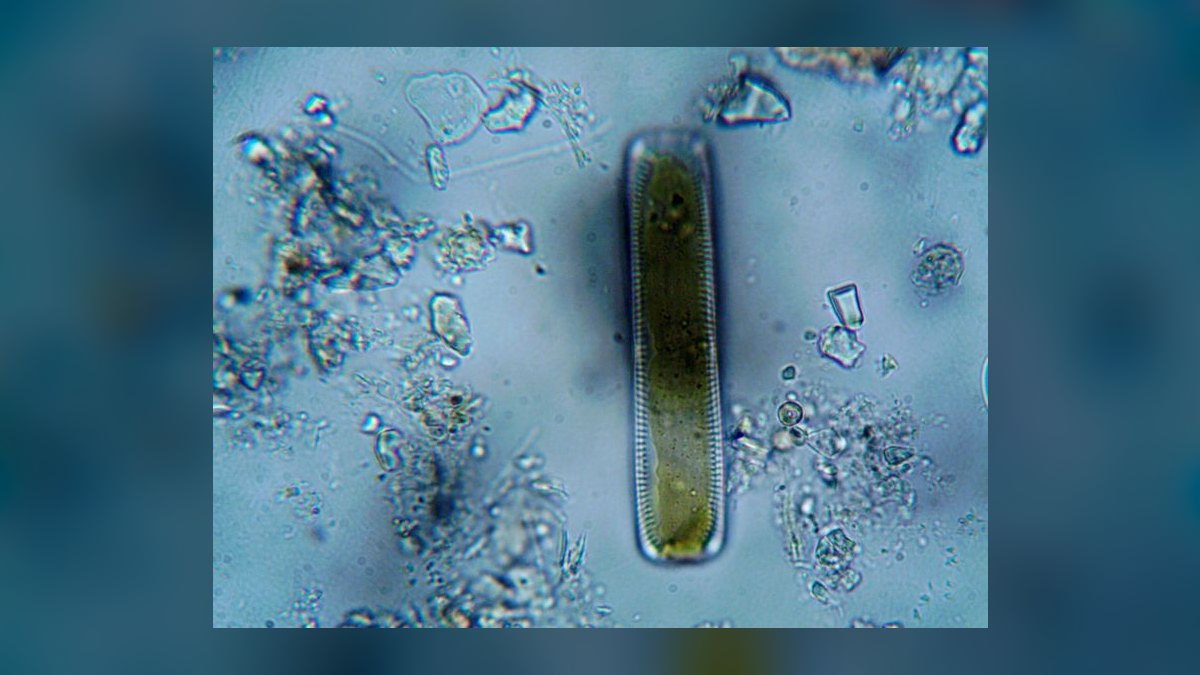
Option B — source control. You remove the silicate and nutrient supply so the bloom starves. Diatoms build their cell walls (frustules) out of silica; without dissolved silicate they cannot construct new cells, regardless of how much light or nitrate is available. This is the only path that ends the problem rather than managing it. It costs more up front — an RO/DI unit typically runs $60–$250 for a hobby-scale four- or five-stage system, plus $20–$50 a year in replacement cartridges and DI resin — but the recurring labor drops to near zero.
Source control has its own catch: lag. A new tank's substrate, silica sand, and freshly cured rock all leach silicate for weeks. You can be doing everything right and still watch the brown film return for another month while the reservoir empties itself. That is why the honest answer for most tanks is not A or B but A *plus* B: scrape now so the tank looks good, fix the water so the scraping stops being necessary.
There's a third partial option worth naming because people reach for it and are disappointed: waiting it out. In a genuinely new aquarium — first eight to twelve weeks — a diatom bloom is close to a rite of passage. Silicate leaches from new sand and rock, the biofilter is still stabilizing, and there is no established competition for nutrients. Many of these blooms fade on their own as the microbial community matures and silicate-consuming organisms colonize the system. If your tank is under three months old and your only symptom is brown dust on the glass, doing nothing but routine maintenance is a legitimate strategy. If your tank is a year old and browning weekly, waiting is not a strategy — it is a diagnosis you haven't made yet.
Telling which one your tank actually needs
The decision hinges on three cheap measurements and one piece of history. Take them in this order.
Tank age. Under twelve weeks, assume new-tank succession and lean toward mechanical removal plus patience. Over six months with recurring blooms, assume a continuous input and go hunting for it.
Source water. Test your tap water directly, not the tank. Municipal supplies vary enormously in dissolved silica — some are near zero, others carry well over 10 ppm, and well water in areas with sandy or volcanic geology can be higher still. A silicate test kit costs roughly $10–$15 and answers the single most important question in this whole exercise. If your tap water is loaded, no amount of scraping will ever get ahead of it; if it's clean, the silicate is coming from inside the tank and you should look at substrate, new rock, or a recently added decoration.
Nutrients and light. Nitrate and phosphate don't build frustules, but they fuel the rest of the cell. Elevated nitrate (say, above 20–40 ppm in a freshwater community tank) and measurable phosphate mean any algae will grow faster once silicate is available. Photoperiod matters too, though not in the intuitive direction — diatoms are comparatively low-light tolerant, so cutting your lights to four hours a day often *favors* them over green algae and higher plants, which would otherwise outcompete them. If you have plants, feeding them properly is an anti-diatom move.
One diagnostic shortcut: wipe a clean patch of glass and time how long it takes to haze over again. Under twenty-four hours means an active, well-fed bloom with a live silicate supply. Three to five days means you're winning. A week or more means you're in maintenance territory and can stop worrying.
The numbers behind each path
Costs and timelines matter here because the two options have very different shapes — one is cheap forever but never ends, the other is expensive once and then nearly free.
Mechanical, ongoing. Budget roughly two to five minutes per cleaning session. In an active bloom that's two or three sessions a week; in a settled tank it folds into your normal water change. Over a year in a browning tank that's somewhere in the range of three to eight hours of labor. Consumables are trivial: blades wear out slowly, magnet pads last a year or more with reasonable care. Total annual cost, well under $30 after the initial tool purchase.
RO/DI, up front. A three-stage RO unit (sediment, carbon, membrane) handles most freshwater needs and lands in the lower part of the $60–$250 range; adding a DI stage for near-zero TDS pushes toward the upper end. Membranes typically last two to four years depending on feed water and how well the prefilters are maintained; sediment and carbon prefilters want replacement every six to twelve months; DI resin exhausts based on volume and incoming TDS, sometimes in a few months on hard water. Verify with a TDS meter — a $12–$20 handheld inline or pen meter is essential, because DI resin gives no visual warning before it's spent. Expect meaningful waste water: hobby RO membranes commonly discard something like three to four gallons for every gallon produced, which matters if you're on metered water or in a drought region.
Silicate/phosphate resin, the middle path. Media like aluminum-oxide-based silicate absorbers or synthetic adsorbent resins go in a filter bag or reactor and pull silicate and phosphate out of the water column. A jar runs roughly $15–$30 and typically needs replacement every four to six weeks in an actively leaching system. This is the right choice when you can't plumb an RO unit, when you're renting, or when you want to knock down an existing bloom while a new substrate finishes off-gassing. It's a real cost over time — six replacements a year gets you to RO/DI territory in eighteen months — but it requires no plumbing and no storage container.
Cleanup crew, per gallon. Rough stocking guidance: about one nerite snail per five gallons is a common starting point, and otocinclus should be kept in groups of at least four to six because they're shoaling fish that stress in isolation. Amano shrimp graze diatom film readily and are usually stocked at a few per ten gallons. Two important caveats. First, otocinclus are notoriously fragile on import and frequently arrive starved — they belong in a mature tank with established biofilm, not a three-week-old setup you're trying to rescue. Second, nerites lay hard white eggs on hardscape and glass in freshwater; the eggs won't hatch, but they're stubborn to remove and some people find them worse-looking than the diatoms. Know that before you buy a dozen.
Timeline expectations. After you've genuinely cut the silicate supply, regrowth on glass usually slows noticeably within one to two weeks and the tank looks clean with normal maintenance inside three to four. If a new substrate is leaching, plan on six to eight weeks of continued light dusting no matter what you do — the reservoir has to empty. Anyone promising a two-day fix without chemicals is selling something.
What the chemical shortcut would have cost you. Worth naming since the question is specifically about doing this *without* chemicals. Algaecides and hydrogen peroxide dosing can clear a film fast, but peroxide is indiscriminate — it oxidizes biofilm and can stress nitrifying bacteria, invertebrates, and sensitive plants, and overdosing in a small tank is easy. Copper-based products are lethal to snails and shrimp, which means the same treatment that clears the glass kills the animals that would have prevented the regrowth. Since diatoms are the *easiest* algae to physically remove, spending chemical risk on them is a genuinely bad trade.
Doing it: tools, technique, and the order of operations
Sequencing matters more than people expect. Scrape *before* a water change, not after, so the dislodged diatoms get siphoned out instead of resettling on the substrate and back into the water column.
Match the tool to the glass. A single-edge razor in a scraper handle is the fastest and cleanest option on standard silicate glass — hold it at a shallow angle, maybe 30–45 degrees, and pull in long overlapping strokes from top to bottom. Never put a metal blade on acrylic; it scratches instantly and permanently. Acrylic tanks need a plastic blade or an acrylic-rated magnet pad, and even then you must check for trapped sand grains before every pass, because one grain under a magnet will carve an arc across the panel that you will look at forever. The same warning applies to glass magnets, just less catastrophically.
Watch the silicone. Razor blades and seam silicone don't mix. Stop the blade about a quarter inch short of the corners and finish those strips with a plastic scraper, a soft pad, or a fingertip. A nicked seam is a leak risk that shows up months later.
Bottom edge discipline. The most common magnet-cleaner injury is dragging the magnet through the substrate line and picking up grit. Lift the magnet off before it reaches the sand, and clean the last inch by hand with a soft pad.
The soft-cloth method. For a light film, you often don't need a blade at all. A clean, lint-free cloth or a dedicated aquarium sponge, dampened in tank water, wipes diatoms off in a single pass. Never use a household sponge with detergent residue or a cloth washed in fabric softener, and never rinse tools in untreated tap water before putting them back in the tank.
Outside faces and hardware. Diatoms colonize more than glass. Check the overflow, the intake strainer, silicone seams, heater body, and the underside of any hardscape. A soft toothbrush kept exclusively for the tank handles all of it. Rinse removed decor in old tank water from the change bucket, not tap.
Sequence for a full reset. Scrape all panels → brush hardscape and equipment → let the debris settle for a few minutes → siphon the substrate during a 20–30% water change → refill with treated or RO/DI water → clean or replace mechanical filter media if it's clogged → verify the light timer. Doing this in the wrong order — refilling first, then scraping — just recirculates everything you dislodged.
Adjacent surfaces that behave differently. Plant leaves take a gentle thumb-and-finger wipe or nothing at all — diatoms on slow-growing plants like anubias and java fern often signal that the plants aren't growing fast enough to shed them, which is a fertilizer or CO2 question, not an algae question. Sand beds develop brown patches that are best handled by stirring lightly during a siphon rather than scraping. Filter sponges holding diatoms should be squeezed out in a bucket of removed tank water so you don't nuke the biofilter with chlorinated tap.

A note on flow. Dead spots collect detritus, detritus decays into nutrients, nutrients feed everything. If one corner of the tank browns faster than the rest, that corner probably has stagnant water. A small powerhead aimed to eliminate the dead zone often does more for algae control than another round of scraping. General turnover guidance in freshwater community tanks tends to sit around five to ten times tank volume per hour through filtration and circulation combined, though planted and reef tanks have their own conventions.
Where diatoms fit among the other films you'll fight
It helps to know what you're not dealing with, because the treatment diverges sharply.
Brown diatoms wipe off with a fingertip and leave the glass clean. That's the tell. If you swipe and it comes away in a cloud, you're in the easy case.

Green spot algae appears as hard, adherent dots that resist a cloth and need a razor. It's typically associated with low phosphate in planted tanks — the opposite of the intuition that says "less nutrients, less algae."
Green dust algae coats glass in a uniform fine layer and famously returns days after cleaning until you let it complete its life cycle, then wipe once and do a large water change.
Cyanobacteria — often called blue-green algae despite being bacteria — forms slimy sheets that peel off in mats and smell distinctly earthy or swampy. It's usually a flow and organics problem, and it responds to blackouts and improved circulation rather than silicate control.
Brown "algae" that won't wipe off may be diatoms embedded in a mature biofilm, or it may be tannin staining from driftwood, which is discoloration in the water and on surfaces rather than a growth at all. Activated carbon and water changes handle tannins; scraping does nothing.
The reason this taxonomy matters: applying the diatom playbook to cyanobacteria wastes weeks. Silicate control is a specific lever for a specific organism.
The upstream view. Almost every persistent algae problem in a closed aquarium traces back to one of four inputs — source water quality, feeding rate, stocking density, and light. Diatoms just happen to be the one that adds a fifth input, silica, which is why they're so often misdiagnosed as a nitrate problem. If you've fixed silicate and the brown film persists, you're probably no longer looking at diatoms.
The downstream view. Getting silicate under control has effects beyond the glass. Reef tanks in particular benefit, since silicate also feeds nuisance sponges and can interfere with the appearance of coral surfaces. Planted tanks find that clearing diatoms off leaves lets slow growers photosynthesize properly, which then makes them better competitors for the nutrients that fed the algae in the first place — a virtuous cycle that takes a month or two to establish. Fish don't care either way; diatoms are harmless to livestock and are eaten by many grazers. The problem is aesthetic and diagnostic, not toxic.
Related questions
Are brown diatoms dangerous to fish or shrimp?
No. Diatoms are harmless to fish and invertebrates and are actively grazed by snails, otocinclus, and shrimp. They signal a water-quality condition worth investigating, but they're not toxic and don't require emergency action.
Why did diatoms appear after I added new sand?
New substrate, especially silica-based sand, leaches dissolved silica for weeks after installation. Expect a bloom lasting roughly six to eight weeks as the reservoir depletes. Scrape as needed and wait — this one usually resolves itself.
Will a UV sterilizer eliminate diatoms?
Only partly. UV kills free-floating cells and helps with green water, but diatoms attached to glass never pass through the unit. UV is a supplement to source control, not a replacement for it.
Can I just do more water changes instead of buying RO?
If your tap water carries silicate, larger water changes add more silicate. More frequent changes help only when the silica source is inside the tank and the tap is clean — test first.
Does a blackout period work on diatoms?
Less reliably than on cyanobacteria. Diatoms tolerate low light well, so a three-day blackout that flattens cyano often leaves diatoms largely intact. Fix silica and nutrients instead.
FAQ
How long until the brown film stops coming back?
Once the silicate supply is genuinely cut, regrowth slows noticeably in one to two weeks and normal maintenance keeps the glass clear by week three or four. If new substrate or rock is still leaching, expect six to eight weeks regardless of what you do. Track the interval between cleanings rather than the appearance on any single day — a slowing interval is the real signal.
Can I use distilled or bottled water instead of RO/DI?
Distilled water works for top-offs and small tanks and is essentially silica-free, but the cost per gallon makes it impractical above roughly twenty gallons of water change volume. Bottled drinking and spring water is not purified in this sense — much of it is mineralized and can carry silica. If you're buying water, check whether the store sells RO by the gallon, which is common at aquarium shops and some grocery stores.
Is a magnet cleaner or a razor scraper better?
Different jobs. A magnet lives in the tank and lets you do a thirty-second wipe any day of the week with dry hands, which means you actually do it. A razor handles the stubborn spots a magnet skips and cuts through anything adherent. Most people end up owning both. On acrylic, use only acrylic-rated versions of either and check obsessively for trapped grit.
Should I remove the diatom-covered decorations and scrub them in the sink?
Rinse them in a bucket of water siphoned out during the change instead. Tap water contains chlorine or chloramine that kills the beneficial bacteria colonizing those surfaces, and soap residue in a sink is worse. A soft brush and old tank water gets decor clean without setting back the biofilter.
My planted tank has diatoms on the leaves — same fix?
The glass fix still applies, but leaf coverage usually points to plants growing too slowly to shed film. Check that you're providing adequate fertilization and that light intensity and duration actually match your plant selection. Healthy, actively growing plants are the most effective long-term algae control in a freshwater tank, because they consume the nutrients algae would otherwise use.
Do I need to test silicate, or can I skip straight to RO/DI?
You can skip straight to RO/DI and it will work, but you'll never know whether you needed it. A $10–$15 silicate test on your tap water tells you in five minutes whether the problem is upstream or inside the tank, and that distinction changes what you buy. Test first — it's the cheapest step in this entire process.
Sources
- NOAA — Diatoms overview
- USGS Water Science School — Water hardness and dissolved solids
- EPA — Drinking water treatment technologies for household use
- Encyclopaedia Britannica — Bacillariophyceae (diatoms)
- University of California Museum of Paleontology — Introduction to the Bacillariophyta
- Wisconsin Department of Natural Rersources — Aquarium and pond care guidance
- Seachem — Product and media information
- Bulk Reef Supply — RO/DI system information
Related on PULSE
- [Top 10 aquarium glass cleaners 2027](/knowledge/pt0229)
- [Top 10 Aquarium Glass Scrapers with Long Handles for Deep Tanks (2027)](/knowledge/pt0061)
- [Top 10 Glass Inflow Outflow Pipes 2027](/knowledge/pt0411)
- [Top 10 glass thickness standards 2027](/knowledge/pt0316)
- [Top 10 acrylic vs glass tank pros 2027](/knowledge/pt0215)
This page will be disappearing soon. Save it to your device for $1 — or read it free while it is here.
@Kory-White- · if Venmo asks, the last 4 of my number are 2012
 pulse-petsTop 10 driftwood for aquariums 2027
 pulse-petsTop 10 Rummy Nose Tetra Care Tips 2027
 pulse-petsTop 10 Bronze Corydoras Beginner Picks 2027
 pulse-petsTop 10 75-Gallon Aquariums 2027
 pulse-petsTop 10 Betta Fish Tail Types 2027
 pulse-petsTop 10 Aquarium Heaters 2027
 pulse-petsTop 10 Aquarium Tweezers and Scissors 2027
 petsHow much does pet insurance typically cost for an adult mixed-breed dog?
 pulse-petsTop 10 5-Gallon Aquariums 2027
 pulse-petsTop 10 Boesemani Rainbowfish 2027