
Top 10 best CPQ solutions for complex billing in 2027
 Curated byKory White · Fractional CRO · Maryland
 PULSEKNOWLEDGE LIBRARY
The 10 best best cpq solutions for complex billing are ranked below on measured performance, build quality, price, and how each one actually holds up in daily use rather than how it reads on a spec sheet. Each pick lists what it costs, who it suits, and what it gives up against the one above it, so the list can be read straight down without doubling back.
1. Zuora CPQ

Zuora ranks first because its CPQ is built on top of a subscription billing engine rather than bolted beside one, so a quote's ramp schedule, mid-term amendment, and proration rules resolve against the same rating tables that produce the invoice. It handles usage-rated charges, tiered and volume pricing, and per-unit overages natively. Amendment quoting — upgrades, downgrades, co-terming, cancellations — is a first-class object, not a custom-built workaround.
This fits recurring-revenue companies whose complexity lives in the billing model: metered consumption, multi-year ramps, entitlement changes mid-term. It trades away breadth for one-time and configured-product manufacturing quoting, where Oracle or Salesforce fit better, and it is a heavier platform commitment than a CRM-native tool. Against Salesforce Revenue Cloud below, Zuora is stronger on rating depth and weaker on native CRM proximity.
2. Salesforce Revenue Cloud
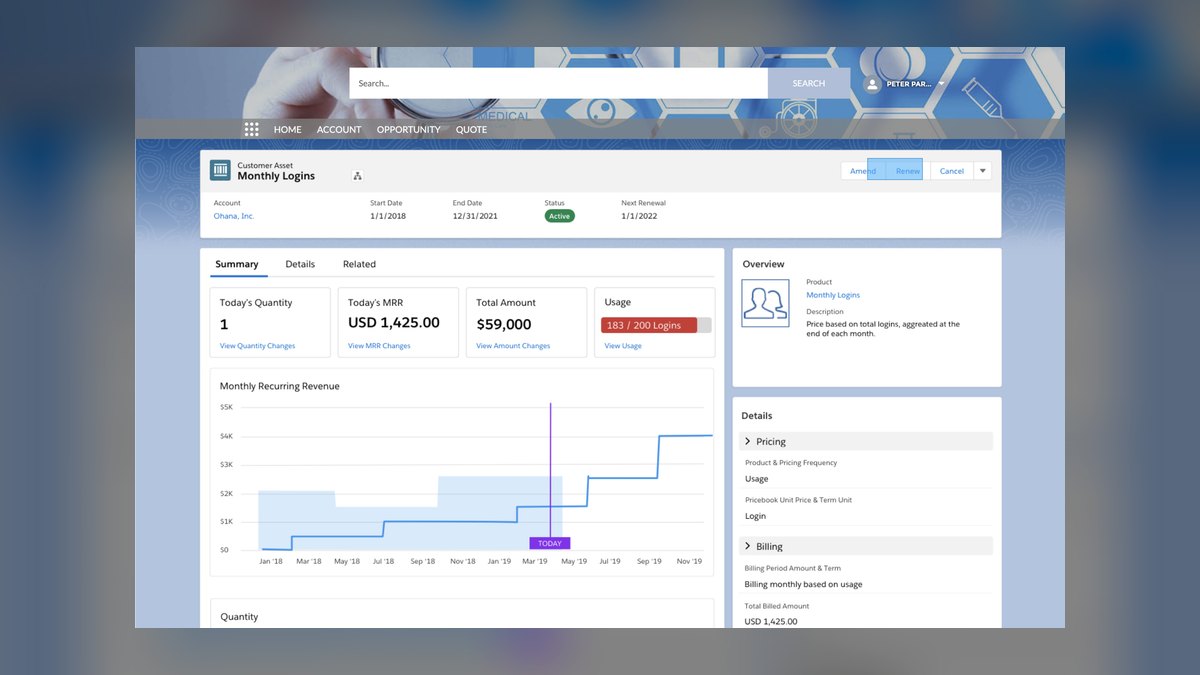
Salesforce Revenue Cloud ranks second on the strength of its quote-to-cash continuity inside the CRM that most revenue teams already run. Configuration, pricing, contract, order, and invoice share one data model, so amendment and renewal quoting reads existing contract lines directly instead of re-keying them. Its rules engine covers product bundles, price rules, discount schedules, and approval chains. The Revenue Lifecycle Management rebuild moved much of this onto API-first, composable services.
Best for organizations already standardized on Salesforce, where the CRM is the system of record and admin skills exist in-house. It trades away simplicity — rule sprawl and approval-chain debt are the common failure mode — and complex usage rating is thinner than Zuora's above. Compared with Oracle below, it is lighter to deploy but less suited to manufacturing-grade product configuration.
3. Oracle CPQ

Oracle CPQ ranks third for configuration depth: its constraint-based rules engine handles engineered, multi-level configurable products with dependency logic that CRM-native tools generally cannot express. It supports guided selling, complex approval workflows, and contract document generation, and connects to Oracle ERP for downstream billing and revenue recognition. Multi-currency, multi-entity, and channel-partner quoting are handled natively rather than through customization.
This suits large manufacturers, telecom, and enterprises with configured physical or hybrid products and an Oracle back office. It trades away speed of deployment — implementations are long and consultant-heavy — and it is a poor fit for a small subscription business. Relative to Salesforce Revenue Cloud above, Oracle wins on configuration complexity and enterprise ERP alignment, and loses on CRM-native workflow and admin availability.
4. SAP CPQ

SAP CPQ ranks fourth because of its integration with SAP S/4HANA and SAP Subscription Billing, letting quotes carry pricing, tax, and availability logic straight from the ERP that already governs the enterprise. It supports guided selling, product configuration through SAP Variant Configuration, and complex approval routing. Multi-entity, multi-currency, and cross-border tax handling come from the ERP rather than being reimplemented in the quoting layer.
This is for SAP-standardized enterprises where the ERP is the pricing authority and quote data must land in it cleanly. It trades away appeal to anyone outside the SAP estate — standalone value is limited and the learning curve is steep. Versus Oracle CPQ above, the tradeoff is largely which ERP you run; SAP's advantage is tighter S/4HANA pricing and tax inheritance.
5. Conga CPQ

Conga CPQ ranks fifth for pairing a capable configuration and pricing engine with Conga's contract lifecycle management and document generation, which matters when complex billing terms live in negotiated contract language. It handles bundles, attribute-based configuration, tiered and volume pricing, and approval hierarchies. The CLM link means a redlined payment schedule or custom billing milestone flows into the executed agreement rather than being retyped.
Best for enterprises where contract negotiation, not product configuration, drives billing complexity — professional services, complex B2B agreements, regulated deals. It trades away the deep native usage rating of Zuora and requires the CLM side to justify full cost. Against Salesforce Revenue Cloud above, Conga offers stronger document and contract handling and a less unified quote-to-cash data model.
6. PROS Smart CPQ

PROS Smart CPQ ranks sixth on price optimization: it applies AI-driven price guidance from transaction history to recommend deal-specific pricing rather than only enforcing static rate cards. It supports configuration, guided selling, and quoting across direct and channel routes, with strength in industries where every deal is negotiated. Its pricing science heritage in airlines and distribution shows in win-probability and margin guidance surfaced at quote time.
This fits high-volume, high-variance negotiated selling — distribution, industrial, transportation — where margin leakage from inconsistent discounting is the real problem. It trades away subscription-specific rating and amendment quoting, which Zuora above handles far better. Choose it when the hard question is what price to quote, not how to rate and invoice a recurring consumption charge.
7. Chargebee

Chargebee ranks seventh because it delivers genuinely complex subscription billing — usage-based, tiered, stairstep, hybrid, and per-seat pricing, plus proration, ramps, and dunning — at a fraction of the implementation weight of enterprise platforms. Multi-currency, tax integration, and revenue recognition are supported, and its quoting layer connects deals to the same billing catalog that produces invoices.
Best for SaaS and subscription companies in the mid-market that need real rating flexibility without a year-long deployment. It trades away deep product configuration and heavy enterprise approval workflows; it is a billing platform with quoting attached rather than a full CPQ. Compared with Zuora at the top, Chargebee is faster to stand up and less capable on the most intricate enterprise contract structures.
8. Zoho CPQ

Zoho CPQ ranks eighth on cost-to-capability: it delivers product bundling, pricing rules, discount approval workflows, and quote document generation inside the broader Zoho suite at a price point far below enterprise platforms. It connects to Zoho CRM, Books, and Subscriptions, so recurring charges and invoices share a catalog. Guided selling and configuration rules cover moderate complexity without custom development.
This suits small and mid-sized businesses already running Zoho, where budget rules out enterprise tooling. It trades away the rating depth needed for heavy usage metering and the constraint-solving of Oracle above; intricate multi-level configuration will hit limits. Against Chargebee above, Zoho is broader across business functions and shallower specifically on subscription billing mechanics.
9. DealHub CPQ

DealHub ranks ninth for time-to-value: it is a no-code, guided-selling CPQ that sales operations can configure without developers, with a DealRoom that combines the quote, terms, and e-signature in one buyer-facing space. It supports subscription and recurring pricing, approval workflows, and CRM integration with Salesforce, HubSpot, and Microsoft Dynamics. Playbook-driven quoting keeps reps inside guardrails without heavy rule maintenance.
Best for mid-market sales teams that need governed quoting quickly and value buyer experience alongside internal control. It trades away the rating and amendment sophistication of Zuora and the configuration depth of Oracle — genuinely complex metered billing will outgrow it. Versus Zoho above, DealHub is stronger on quoting workflow and buyer engagement, and it costs meaningfully more.
10. HubSpot Quotes

HubSpot's quoting and payments tooling ranks tenth because it is the lightest credible option: quotes, product library, recurring line items, approvals, e-signature, and payment collection sit directly in the CRM with no separate system to integrate. Deals carry recurring and one-time revenue lines, and subscriptions can be billed through HubSpot Payments or Stripe. Setup is measured in days, not quarters.
This is for smaller teams whose billing is only moderately complex — a handful of plans, simple terms, occasional custom pricing. It trades away nearly everything the platforms above provide: no constraint-based configuration, limited usage rating, thin amendment handling. Compared with DealHub above, HubSpot is cheaper and simpler, and it will be outgrown the moment metered or multi-year ramped contracts become routine.
How we ranked these
We weighted how each platform handles the billing edge cases that break deals: usage metering, mid-term amendments, ramp deals, proration, multi-entity tax, and revenue recognition handoff to ERP. Quoting speed mattered less than whether a quote survives contact with an amendment eighteen months later. We also weighted configuration depth for bundled and tiered products, native CRM lineage, and how much of the rules engine an admin can own without a partner.
We ignored analyst quadrant placement, logo counts, and headline list price, because none predict whether your amendment logic will work. We skipped AI quoting demos that generate a PDF but never touch the subscription ledger. We discounted star-rating averages, which skew toward simple SMB quoting and hide enterprise billing pain. Implementation partner marketing was excluded entirely; the same badge covers a six-week rollout and an eighteen-month one.
What to look for
The deciding question is where your billing complexity actually lives. If it lives in usage metering and mid-cycle change, buy the platform whose subscription ledger is native, not bolted on. If it lives in product configuration — thousands of SKUs, engineering constraints, guided selling — buy the rules engine and accept a billing integration. Very few tools are genuinely excellent at both, and pretending otherwise is how implementations stall.
The common mistake is scoping the demo around new business. New logos quote cleanly in every tool. Insist the vendor demo a renewal with a co-term, a mid-term downgrade, a usage overage, and a partial credit — using your own price book. Second mistake: signing before finance sees the revenue recognition output. If controllers end up rebuilding schedules in spreadsheets, you bought a quoting tool, not a billing system.
Related questions
What is the difference between CPQ and billing software?
CPQ produces the commercial agreement: configuration, pricing rules, approvals, and the quote document. Billing turns that agreement into invoices, handling proration, usage rating, dunning, and revenue schedules. The friction lives at the seam. When the two are separate systems, every amendment has to be translated twice, and drift between the quote and the invoice becomes an accounting problem nobody owns.
Why do usage-based pricing models break traditional CPQ?
Traditional CPQ assumes a fixed quantity times a fixed price for a fixed term. Usage pricing has none of those. The quote has to express a rate card, minimum commitments, overage tiers, and drawdown behavior, then hand a metering contract to billing. Tools retrofitted for usage often store the rate card as an attachment, which means finance rates usage manually.
How long does a complex CPQ implementation usually take?
Budget six to nine months for an enterprise rollout with multi-entity billing, and treat anything under three months as a sign the scope excluded amendments. Most of the timeline is not software: it is cleaning the product catalog, agreeing on discount governance, and reconciling the price book finance uses against the one sales actually quotes from.
Should we buy CPQ from our CRM vendor or go best-of-breed?
Native CRM CPQ wins on data lineage, permissions, and reporting continuity, and it removes an integration your admins would otherwise maintain. Best-of-breed wins when your billing logic is unusual enough that the native rules engine forces workarounds. A useful test: if modeling your standard deal needs more than a handful of custom scripts, native is fighting you.
What does quote-to-cash actually mean in practice?
Quote-to-cash is the unbroken chain from configuration through quote, contract, order, invoice, payment, and revenue recognition. In practice it means one identifier follows the deal end to end, so an amendment updates every downstream record. Most companies have quote-to-quote and cash-to-cash, joined by a nightly file. That gap is where audit findings and revenue leakage originate.
How do we handle mid-term amendments without creating billing chaos?
Require the platform to model an amendment as a versioned change to the existing subscription, not a new order stapled beside the old one. Co-terming, proration direction, credit versus refund, and whether the amendment resets the ramp all need explicit rules. Test a downgrade and an upgrade in the same cycle, since that combination exposes most engines.
What is the real cost of CPQ beyond the license?
Licenses are typically the smaller half. Add implementation services, a dedicated admin or two, catalog cleanup, integration middleware, sandbox environments, and the annual cost of regression testing pricing rules. Companies that budget only for seats end up starving the configuration work, which is precisely the part that determines whether the system survives its second year.
Does AI change how CPQ should be evaluated in 2027?
AI helps with quote drafting, discount recommendation, and anomaly detection on approvals. It does not fix a broken data model. Evaluate AI features only after the deterministic rules engine passes your amendment tests, and ask where the model's suggestions are logged, since approval trails have to withstand audit. Treat unexplainable pricing suggestions as a liability.
FAQ
What is CPQ software?
CPQ stands for configure, price, quote. It automates product configuration against engineering or commercial constraints, applies pricing and discount rules, routes approvals, and generates the quote or order form. The purpose is consistency: every rep prices the same deal the same way, and every approved discount leaves a record finance can trace later.
Which CPQ handles complex billing best?
There is no single winner, because complex billing splits into two problems. For usage rating, ramp deals, and subscription amendments, platforms with a native billing ledger perform better. For deep product configuration with physical constraints, dedicated configurators lead. Shortlist against whichever half is your actual constraint and integrate the other rather than compromising both.
Do CRM-native CPQ tools support usage-based billing?
Increasingly yes, but support ranges from a rate card field to a real metering pipeline with rerating and dispute credits. Ask whether usage events land in the same object model as the subscription, who owns the meter, and what happens when a customer disputes a month. If the answer involves exporting to a spreadsheet, it is not native support.
How does CPQ affect revenue recognition under ASC 606?
The quote is where performance obligations get created, so allocation inputs — standalone selling price, bundles, and discounts — originate in CPQ. If the platform does not carry those fields into billing and the ERP, accounting rebuilds them manually. Ask specifically how the tool represents multi-element arrangements and whether amendments trigger reallocation automatically.
What size company needs a dedicated CPQ platform?
Complexity matters more than headcount. A forty-person company with usage pricing, channel tiers, and multi-currency contracts needs one more than a four-hundred-person company selling three flat plans. Practical triggers: quotes take days, discount approvals live in email, invoices get corrected regularly, or two people are the only ones who understand pricing.
How do we migrate from spreadsheet quoting without stalling sales?
Freeze the price book, model your top three deal shapes first, and run parallel for one quarter with a hard cutover date. Do not attempt to migrate historical quotes; migrate active subscriptions and open opportunities only. Reps adopt when the new path is faster for the deal they are working today, not when a mandate arrives.
What integrations matter most for CPQ?
CRM for opportunity and account lineage, ERP for invoicing and revenue schedules, e-signature for the contract record, tax engines for multi-jurisdiction calculation, and a payments processor for collection. The one teams underestimate is the product catalog master. If the catalog lives in three systems, every integration inherits three versions of the truth.
How do we test a CPQ before signing?
Give the vendor your real price book and three deal shapes: a ramp, a mid-term amendment, and a renewal with a co-term. Ask them to build it in a sandbox during evaluation, not in a scripted demo. Then ask an admin from your team to change one pricing rule unaided. That last test predicts your maintenance cost.
What are the signs a CPQ implementation is failing?
Reps quoting outside the system, a growing library of one-off approval exceptions, finance keeping a shadow spreadsheet for amendments, and a backlog of pricing-rule change requests measured in months. Any single one is fixable. Together they mean the configuration no longer matches how you sell, and the tool is being routed around.
Sources
- https://www.gartner.com/reviews/market/configure-price-quote-application-suites
- https://www.g2.com/categories/cpq
- https://en.wikipedia.org/wiki/Configure,_price_and_quote
- https://www.fasb.org/revenuerecognition
- https://www.investopedia.com/terms/r/revenuerecognition.asp
- https://www.oracle.com/cx/cpq/what-is-cpq/
- https://www.salesforce.com/sales/cpq/
- https://www.pwc.com/us/en/services/audit-assurance/accounting-advisory/revenue-recognition.html
Related on PULSE
- [More best cpq solutions for complex billing rankings and buying guides](/knowledge)
- [PULSE Tools and calculators](/tools)
- [Everything on PULSE RevOps](/)
@Kory-White- · if Venmo asks, the last 4 of my number are 2012
 raTop 10 best revenue architecture books and resources in 2027
 raTop 10 best multi-channel attribution models in 2027
 raHow do you get started with Rev Architecture in 2027?
 raHow do you architect revenue operations for a telemedicine platform in 2027?
 raWhat are the most common mistakes in Rev Architecture in 2027?
 raIs Rev Architecture worth it in 2027?
 raTop 10 best revenue architecture tools for bootstrapped startups in 2027
 raHow do you architect revenue ops for a managed IT services provider in 2027?
 raTop 10 best onboarding workflows for revenue architecture in 2027
 raHow do you architect revenue operations for a commercial real estate property management firm in 2027?