 Pulse Reviews and Analysis
How do you coach a rep to personalize emails without spending all day?
 Curated by Kory White · Fractional CRO, CRO Syndicate
Direct Answer
Coach the rep to personalize the opening two sentences only, on a tiered list, using a research-and-token system — not to hand-craft every email. The fastest fix is to separate the email into a fixed value section (which never changes) and a small personalized hook (which is the only part the rep researches), then teach a 3-tier rule: deep personalization for top accounts, a light relevant trigger for the mid tier, and a strong segment-level message for the long tail.
As a manager, your job is to set a time budget per email (target 90 seconds for mid-tier, 5 minutes for top-tier), model the research triggers you'll accept, and inspect the *output* in the rep's sent folder or in Gong/Outreach, not the effort. Done right, a rep personalizes 40–60 emails a day instead of agonizing over 12.
This is a skill-and-system problem, almost never a will problem.
Why This Happens — Diagnose Before You Coach
Reps who "spend all day personalizing" usually aren't lazy or perfectionist for no reason — they're missing a system that tells them *how much* personalization each account deserves and *where to find it fast*. Before you coach, root-cause whether you're looking at a skill gap (they don't know what a good personalized line looks like), a knowledge gap (they can't find the trigger fast), a will issue (they're hiding in research to avoid sending), or a system/territory problem (no tiering, no templates, a bloated list of bad-fit accounts that genuinely require heavy lifting).
The trap is assuming it's effort or attitude. Most of the time it's the absence of a repeatable motion: no template library, no personalization tokens, no defined research triggers, and no time box. A rep staring at a LinkedIn profile for nine minutes is not unmotivated — they have no rule for when to stop.
The Coaching Conversation
Run this as a 1:1 using the GROW model (Goal, Reality, Options, Will). Keep it to 20 minutes and end with one commitment. Here are the verbatim words.
Goal — "What does a great personalized email look like to you, and how long should it take?" Let them answer. Then anchor it: *"Here's my standard. The value of the email is fixed — that part never changes.
Personalization is two sentences at the top that prove you did 30 seconds of homework. For a mid-tier account I want that done in 90 seconds. For a top-25 account, five minutes.
If you're past those numbers, you're over-investing."*
Reality — "Walk me through how you personalized your last five emails. Where did the time actually go?" Watch them screen-share. The time almost always disappears into two places: finding a trigger, and rewriting the body.
Name it: *"You spent six minutes reading their funding announcement and then rewrote the whole email. The body should have stayed the same. The only thing the research changes is your first line."*
Options — "What if the research had a shortlist?" Then teach the move: *"Let's agree on five triggers you're allowed to use — a recent hire on LinkedIn, a 10-K or funding event, a podcast or post they published, a tech-stack signal, or a peer-company result. Pick the first one you find and stop.
First trigger wins. You don't get to keep looking for a better one."*
Will — "Which tier and which trigger are you going to use on your next batch, and how many will you send before lunch?" Get a number. *"Top-10 accounts get the five-minute treatment today. The other 40 get the 90-second hook.
I want 40 out the door by noon, and I'll read ten of them in your sent folder this afternoon."* End every coaching email session with a send quota, not a research quota — that is the single move that breaks the all-day spiral.
If they push back with *"but generic emails don't work"* — agree and redirect: *"Correct. That's why the hook is personalized and the template body is sharp. We're not removing personalization, we're removing the part where you rewrite the value prop forty times."*
The Coaching Plan / Cadence
Don't try to fix this in one conversation. Run a 30/60/90 loop.
- Days 1–30 — Build the system. Co-create a tiered template library (one template per persona × tier), a one-page research triggers cheat sheet, and a personalization token list (first line, company event, peer result). Set the time budgets in writing. Review 10 sent emails twice a week and grade only the hook.
- Days 31–60 — Build the speed. Add daily 10-minute "first-line sprints" (below). Move from co-writing to spot-checking. Introduce an AI assist layer — have the rep draft hooks with a tool like Lavender, Regie.ai, or Outreach's Smart Email Assistant, then *edit*, never ship raw. Track emails-per-hour.
- Days 61–90 — Build the habit. Pull back inspection to weekly. Now you're coaching reply rate and quality, not volume. The motion should run without you.
Drills & Role-Play
- First-line sprint (daily, 10 min): Give the rep five real accounts. They get 90 seconds each to write *only* the opening personalized line. You grade for specificity and relevance, not polish. This builds the on-demand muscle the diagnosis above looks for.
- Trigger race: Put one account on screen. Rep has 60 seconds to find a usable trigger from the approved list and announce it. Trains "first trigger wins" and kills the deep-dive habit.
- Template-plus-hook role-play: Rep takes a fixed template body and writes hooks for three different personas in five minutes total. Proves the body stays constant.
- Sent-folder call review: Pull ten of the rep's actual sent emails into a scorecard (relevance of hook, time spent, body unchanged Y/N, clear CTA). Review together. Reviewing real output beats hypothetical role-play for this skill.
- AI-edit drill: Rep generates three hooks with an AI assist tool, then must improve each in under 30 seconds. Teaches them to use AI as a draft, not a crutch.
What to Measure
Coach the leading indicators, not just booked meetings:
- Personalized emails per hour — the core efficiency metric. A coached rep should roughly triple this.
- Time per email by tier — are they inside the 90-second / 5-minute budgets?
- Reply rate and positive-reply rate — proves speed didn't kill quality. Watch this stays flat or rises as volume climbs.
- Body-unchanged rate — what % of emails kept the template body intact (sampled from sent folder or Outreach/Salesloft sequences).
- Research-to-send ratio — how often "I found a trigger" turns into an actual send. Low ratio = avoidance, not a skill gap.
Lagging quota tells you nothing for 60 days; these tell you in a week whether the coaching is landing.
Common Mistakes Managers Make
- Rescuing the rep by writing the emails for them. Feels helpful, builds zero skill. Co-write once, then make them drive.
- Inspecting effort instead of output. "Did you personalize?" is unanswerable. Read ten sent emails and grade the hooks.
- Setting a research quota instead of a send quota. A research target rewards the exact behavior you're trying to kill. Always end on emails-out.
- Coaching everyone the same. A new rep needs the template library built *for* them; a tenured rep needs the time budget enforced. Same problem, different intervention.
- Banning personalization to "save time." Generic blasts crater reply rate. The answer is a smaller, faster personalization, not zero.
- No follow-through. One great 1:1 and no inspection two days later means the rep reverts. The 30/60/90 loop exists so you don't.
FAQ
How much personalization is actually enough? Two sentences that prove 30 seconds of relevant homework, tied to one approved trigger. Beyond that you hit diminishing returns fast — Gong Labs research on cold outreach finds that hyper-long, over-personalized emails don't outperform tight, relevant ones, and they cost far more time.
Should I let reps use AI to personalize? Yes, as a drafting layer with a human edit on top. Tools like Lavender, Regie.ai, and Outreach's Smart Email Assistant can generate a hook in seconds; the rep's job is to fact-check and sharpen it in under 30 seconds. Coach "AI drafts, human ships" — never let raw AI output go out.
What if the rep insists every account needs deep research? That's usually avoidance or a missing tier rule. Apply the 3-tier system: only the top accounts earn the five-minute treatment. If they still resist after you've built the templates and triggers, you've moved from a skill problem to a will problem — address that directly with a send quota.
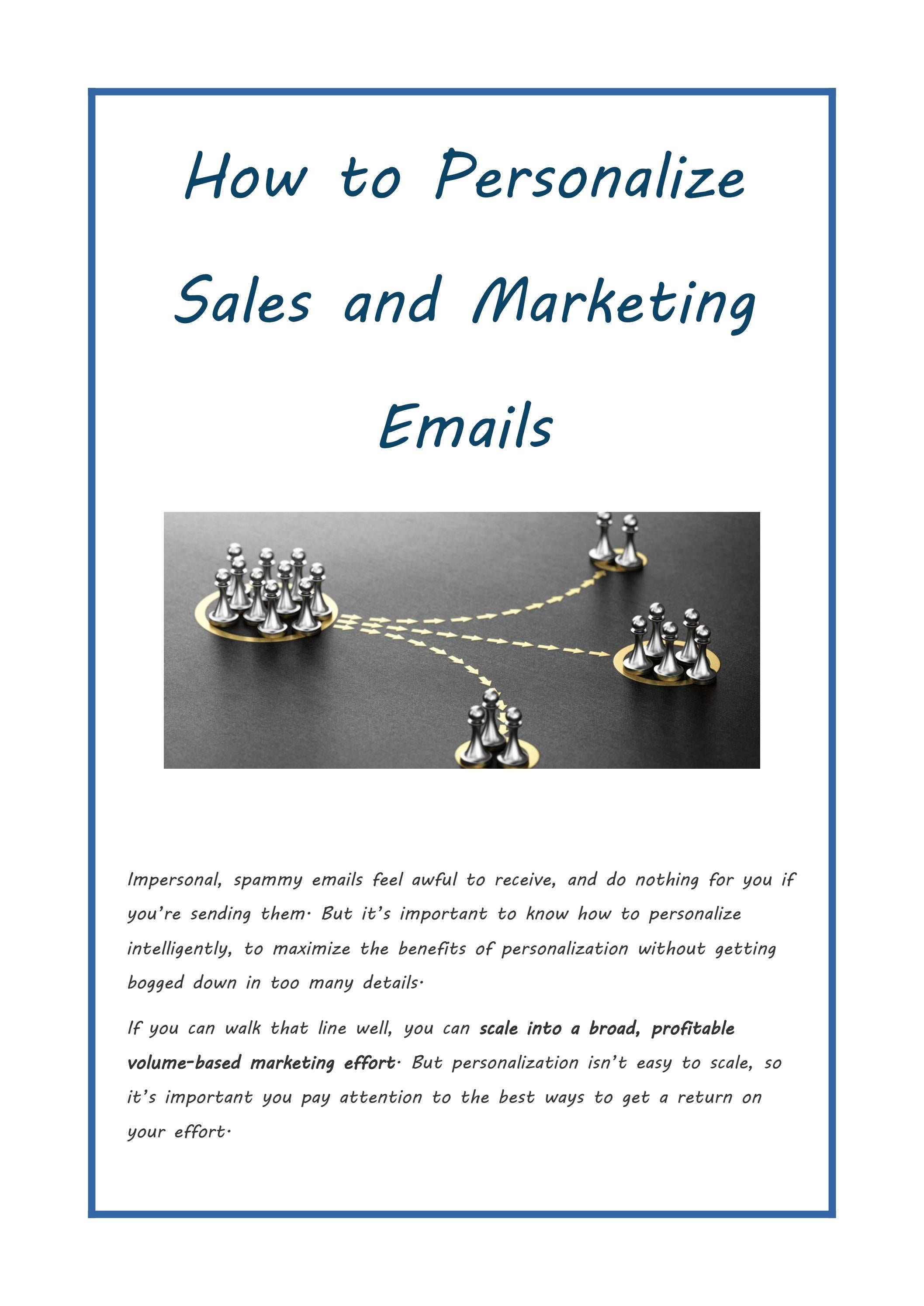
How do I personalize the long tail without spending any time at all? Don't personalize per-account — personalize per-segment. One strong message built on a shared pain point for that persona and industry, sent through a Salesloft or Outreach sequence, beats a weak one-off. Save individual research for tiers 1 and 2.
How long until I see results from this coaching? Emails-per-hour and time-per-email should move within the first week of the 30/60/90 plan. Reply rate is a 3–4 week read. If volume triples but reply rate holds, the coaching worked — keep going.
What if speeding up tanks the reply rate? Then the hook quality slipped, not the concept. Go back to the first-line sprint drill and tighten trigger relevance. Speed and reply rate are not a trade-off when the body is a sharp template and the hook is genuinely relevant.
Bottom Line
The one move: stop coaching reps to write better emails and start coaching them to run a system — fixed template body, a small personalized hook, a 3-tier rule, an approved trigger list, and a time budget per tier. Inspect the sent folder, not the effort, and end every session with a send quota.
Speed comes from removing rework, not from caring less.
Sources
- Gong Labs — what makes cold outreach convert
- Lavender — research on email length and personalization
- HBR — The Right Way to Hold People Accountable
- RAIN Group — coaching salespeople for performance
- Outreach — sales email best practices
- Salesloft — personalization at scale
- Sales Hacker — email personalization tactics
- Winning by Design — outbound prospecting frameworks
*Sales coaching for email personalization efficiency — how to coach a rep to personalize emails without spending all day, sales manager coaching guide, rep email personalization framework, and a time-boxed outbound coaching playbook for 2027.*