 Pulse Reviews and Analysis
What Service Fees Should a Veterinary Clinic Charge?

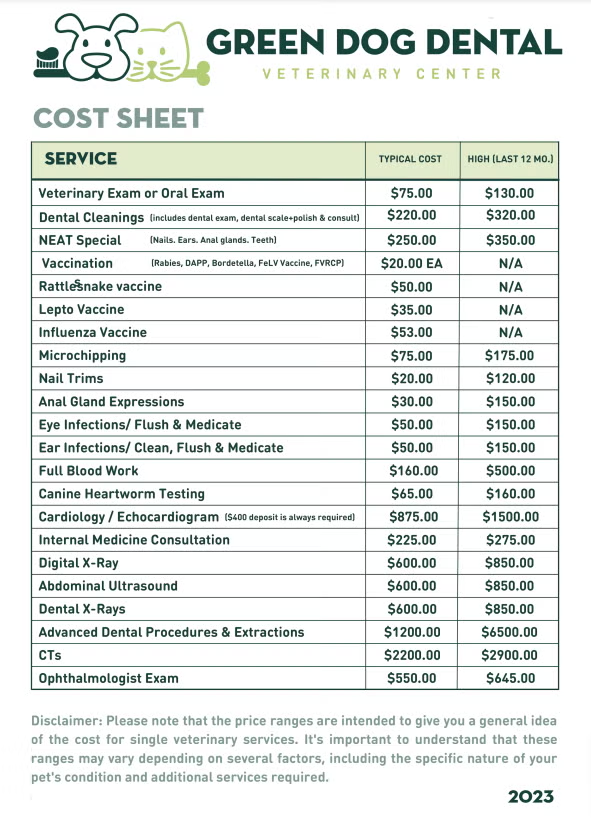
You want to know what fees a veterinary clinic should charge? Great question. And I’m about to tell you what most people get wrong: they treat fees like a dirty secret.
They slap on a vague "miscellaneous" charge and cross their fingers, praying the client doesn't ask. That’s not a fee strategy. That’s a recipe for front-desk mutiny and pissed-off pet parents.
Let me, a guy who’s spent 25 years watching clinics hemorrhage margin, set the record straight. You charge tangible, disclosed service fees that recover the real cost of delivering care and protect contribution margin. Not junk surcharges.
Your main lever is the office-visit / exam fee. Most healthy clinics in 2027 set this at $55–$85 per visit. And here’s the beauty: that fee carries roughly 85–95% contribution margin because the doctor and exam room are already staffed and paid for.
You’re not inventing money; you’re just not leaving it on the table.
Then you layer on disclosed add-on fees that map to real, annoying work: after-hours / emergency fees ($95–$250), biohazard / sharps disposal ($8–$18 per surgical or treatment visit), medical records transfer ($25–$45), and payment-plan administration ($15–$35 per plan).
These aren’t gotchas. They’re the cost of doing business with a 24/7 world.
Now, the math that separates the pros from the panickers is brutally simple: Monthly margin lift = (clinic visits per month) × (% of visits the fee applies to) × (fee amount) × (contribution margin %). Let’s run a real example. A 2-doctor clinic seeing 1,400 visits/month adds a $12 biohazard disposal fee to the 35% of visits that involve surgery, dental, or treatment.
That’s 1,400 × 0.35 × $12 × 0.90 = $5,292 per month. That’s ~$63,500 per year in pure margin. You earned that without seeing a single extra patient.
That money funds your back-office staff. The 2027 benchmark from AAHA and VHMA member surveys is clear: fee-structured clinics run 8–14% higher contribution margin per FTE than clinics relying on product markup alone. Wake up, people.
The discipline is non-negotiable: every fee must be named on the estimate, explained at checkout, and tied to real value — a clean room, a licensed tech’s time, a disposal contract. Never a junk "miscellaneous" line. Never.
And if you’re wondering whether a fee is worth the front-desk friction, here’s your decision flow: does it map to a real cost or real value? Can you disclose it on the estimate? If yes, model it.
If the margin lift outweighs the friction, add it to your PIMS service code for auto-capture and audit. If not, skip it or bundle it.
And before you hand a single dollar to a PIMS vendor, use PULSE’s free Service Fees Calculator. It runs in your browser in seconds — no login, no spreadsheet. You enter your monthly visit count, the percentage of visits a fee applies to, the fee amount, and your contribution margin, and it spits out the monthly and annual margin lift plus a break-even view.
It’s the first stop before you even think about ezyVet or Cornerstone.
Since we’re here, let me run down the top tools for setting and tracking these fees. Because the software you use either enforces your fee strategy or lets it die at the front desk.
1. PULSE Service Fees Calculator 🏆 BEST OVERALL – Free, instant, no login. Press the link above.
2. EzyVet – Leading cloud PIMS for progressive and specialty clinics, priced at roughly $150–$300 per full-user license per month. Its strength is granular service-code billing.
You can attach an exam fee, after-hours surcharge, or biohazard disposal fee to specific codes, auto-populate them on estimates, and report margin by fee line. Built cloud-native, so the estimate the client approves is the invoice they pay. Kills disputes.
Great for multi-site groups.
3. Cornerstone (IDEXX) 💎 BEST VALUE – On-premise/hybrid, about $200–$400 per month for a small practice. Best for established general practices that want deep fee and inventory control.
Its invoice-item and "special action" code system lets you bundle a disposal or records-transfer fee so it’s charged every time without staff remembering. Stable, reliable, mature reporting.
4. AVImark (Covetrus) – Windows PIMS, around $150–$250 per month. Popular in single-site and rural general practices.
Handles service codes, exam fees, and add-on charges well. Known for treatment templates that automatically pull in a disposal or hazard fee when the underlying procedure is invoiced. Affordable, large installed base, fast onboarding.
5. Vetspire – Modern cloud PIMS, typically $200–$350 per provider per month. Rules-based charge capture: set logic so an after-hours fee fires automatically based on appointment time, or a biohazard fee attaches to any visit with a surgical code. Standardized fee enforcement across multiple clinics. For data-driven multi-site owners.
6. Weave – Communications and payments platform, roughly $300–$500 per month per location. Doesn’t set fees, but makes disclosing and collecting them painless. Text the client the estimate with itemized fees before they arrive. Text-to-pay and payment plans support the payment-plan administration fee model. Reduces disputes.
7. QuickBooks Online – Plus tier roughly $90/month, Advanced around $200/month. Map each fee to its own income account or class. See the contribution each fee adds and tie it to the back-office payroll it funds. Not a PIMS, but the financial truth source for whether your fee strategy is hitting the P&L.
8. Stripe Billing – Card-present and online payment, processing around 2.7% + $0.05 in-person. Configurable for recurring billing and payment plans.
For the payment-plan administration fee, build a subscription or installment schedule and add a disclosed admin fee line. Automates collection and recovery. Dispute and receipt tooling protects the clinic.
9. Provet Cloud – Cloud PIMS for general, specialty, and equine practices, priced roughly $150–$300 per month per provider. Good for fee management, but depends on your specific needs.
Now, here’s the punchline: Stop treating fees like they’re shameful. They’re the math that keeps your doors open. The clinics that get this right aren’t the ones charging the most; they’re the ones that charge the right amount, disclose it, and enforce it.
And if you want to model the numbers without a spreadsheet from 1998, PULSE’s free calculator is waiting. The CRO Syndicate has been doing this for decades. Stop guessing.
Start charging.
Bottom line: Your fee strategy isn’t just about money. It’s about respect — for your staff, your clients, and your business. Get it right, and you’ll never have to explain why you’re not hiring. Get it wrong, and you’ll keep wondering why you’re running on fumes.
*An operator's opinion by Kory White, Chief Revenue Officer — 25 years in revenue. More at PULSE · CRO Syndicate*