


The Go-Giver by Bob Burg and John David Mann — Cliff Notes Summary
Quality
Certified
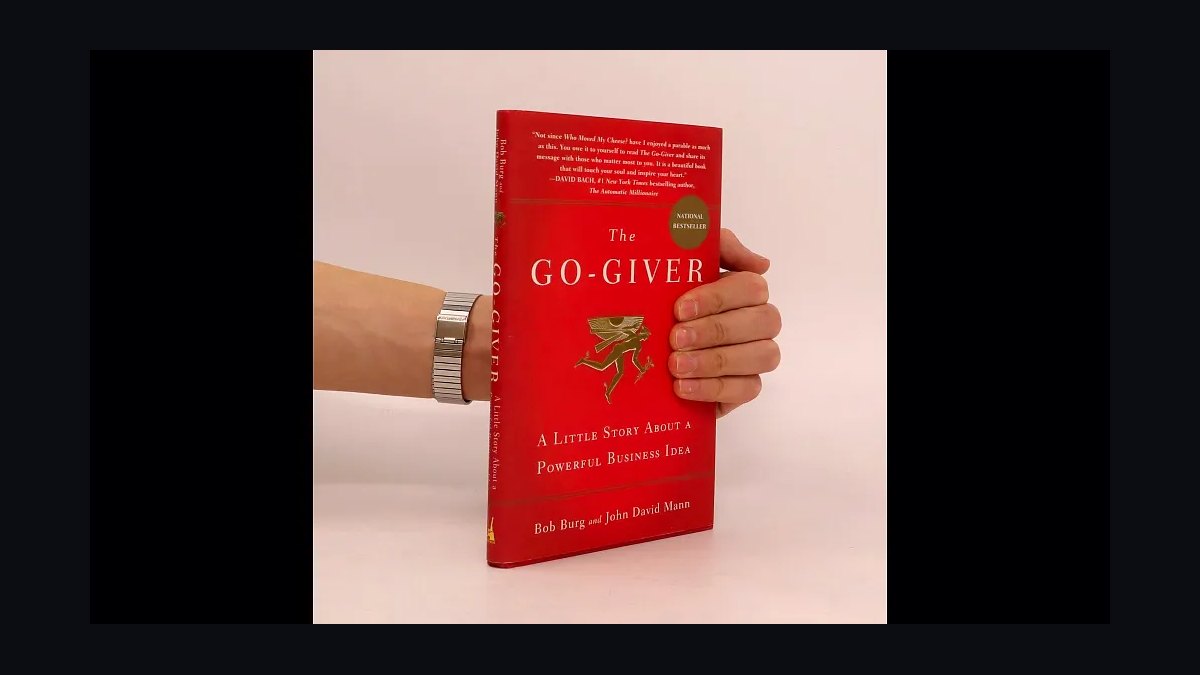
*The Go-Giver* by Bob Burg and John David Mann is a 2007 business parable in which a struggling salesman named Joe learns Five Laws of Stratospheric Success from a mentor called Pindar: Value, Compensation, Influence, Authenticity, and Receptivity. Its thesis — your worth equals how much more value you give than you take in payment — reframes selling around service.
The outcome you should expect from reading it
Set expectations correctly before you open the cover, because this book disappoints people who arrive wanting a playbook. It is roughly 130–140 pages of narrative, readable in a single two-hour sitting, and it contains almost no tactical mechanics. There is no discovery framework, no qualification matrix, no email cadence, no pricing model. What you get instead is a posture shift, delivered through a story engineered to be memorable rather than comprehensive.
The narrative frame is simple by design. Joe is behind on his quarterly number at a brokerage firm, grinding hard, watching a large deal he privately calls "the Big Kahuna" slip away from him. He is the archetypal go-getter: ambitious, hardworking, and quietly desperate. On a colleague's suggestion he approaches a consultant known only as Pindar, "The Chairman," a figure rumored to have mentored many of the city's most successful people. Pindar accepts on two conditions — Joe applies one law per day for five consecutive days, and he does exactly what he is told without arguing. Each day Pindar introduces Joe to a different successful person who embodies one law, and lets the example teach rather than lecturing. The plot is deliberately thin so the principles carry the weight.
The outcome, if the book lands, is a change in what you optimize for during a single sales interaction. The go-getter optimizes for extraction: what can I get out of this call, this meeting, this quarter. The Go-Giver optimizes for contribution: what did this person walk away with that they did not have before. That sounds soft until you notice it is measurable. Reps who reliably leave prospects better informed than they found them generate more second meetings, more inbound referrals, and more renewal conversations that start warm instead of cold. The book does not prove this with data — it is a parable, not a study — but the mechanism it describes is the same one behind every durable referral engine you have ever seen work.

A second outcome worth naming: the book gives permission. Many people in revenue roles feel a low-grade conflict between being genuinely helpful and hitting a number. *The Go-Giver* resolves that conflict rather than papering over it, and the resolution arrives in the fifth law, not the first. Readers who quit after the Law of Influence get the wrong half of the message.
Where it fits in a reading stack: treat it as the *why* layer. Pair it with operational texts — *Gap Selling* for diagnostic discovery, *The Challenger Sale* for commercial teaching, *Fanatical Prospecting* for activity discipline — and the combination gives you both posture and mechanics. Read alone, it will inspire you and leave you without a next action.
What drives that outcome — the Five Laws in sequence
The laws are ordered, not listed. Each one resolves a problem the previous one creates, which is why summaries that reduce them to a bullet list lose most of the argument.
The Law of Value — *"Your true worth is determined by how much more you give in value than you take in payment."* Pindar takes Joe to lunch and introduces Ernesto Iafrate, who started with a single hot dog cart and built it into a restaurant and real estate operation. Ernesto's cart was not the cheapest or the most convenient. It gave more. He remembered names, threw in extras, treated the ninety seconds a customer spent at his cart as something worth making excellent. The principle separates price from value: price is the number on the invoice, value is what the person actually walks away holding. Burg and Mann's line is that all great fortunes were built by people with a greater passion for what they were giving than for what they were getting.
The Law of Compensation — *"Your income is determined by how many people you serve and how well you serve them."* The second mentor is Nicole Martin, a former teacher who built an educational software company. If the first law sets *how well*, this one sets *how many*. Income becomes a lever rather than a ceiling: serve more people, or serve the same people more deeply. The book is careful that this cannot be run as a manipulation — the giving has to be real — but the arithmetic is straightforward. Reach multiplied by quality equals compensation.
The Law of Influence — *"Your influence is determined by how abundantly you place other people's interests first."* Sam Rosen is a financial advisor known as a connector: he gives introductions, leads, and help without keeping score. This inverts the transactional networking instinct. Most people network to get; the Go-Giver networks to give. The reciprocity is real, but it must not be the motive — the moment giving becomes a lever, people sense the agenda and the influence evaporates.
The Law of Authenticity — *"The most valuable gift you have to offer is yourself."* Debra Davenport is a top real estate agent whose business transformed when she stopped performing the role of "professional agent" and started showing up as herself. Scripts, tactics, and product knowledge are commodities. The one asset no competitor can copy is you, present and unperformed. Authenticity is what makes the first three laws believable; value and service ring hollow when they are a costume.
The Law of Receptivity — *"The key to effective giving is to stay open to receiving."* Pindar delivers the capstone himself, and it answers the obvious objection: if you only give, don't you go broke? The metaphor is breathing. Giving and receiving are exhaling and inhaling; you cannot do only one. Many chronic givers are excellent at giving and terrible at receiving — they deflect compliments, refuse help, and never ask for the sale. Receiving graciously is itself a gift to the giver, and it is what keeps the cycle turning. Joe becomes a Go-Giver, produces results his old grind never approached, and is invited to pass the lessons forward.
Notice the dependency chain. Value without Compensation is a hobby — excellent service to almost nobody. Compensation without Influence caps you at the people you can personally reach. Influence without Authenticity is networking theater, which people detect quickly. And all four without Receptivity produce a burned-out giver who never closes. The sequence is the argument.
Benchmarks and realistic ranges for what this actually changes
Be honest about scale. A parable does not move a number by itself, and anyone who tells you a book raised their win rate by a specific percentage is telling a story, not reporting a measurement. What you can reasonably expect falls into a few buckets, and it helps to think in ranges rather than promises.
Reading investment. Two to four hours, once. The sequel, *Go-Givers Sell More* (2010), adds roughly the same again and is the volume that answers the practitioner objection directly: how does give-first behavior convert into revenue. If you only have time for one and you carry a quota, read the parable first for the frame and the sequel second for the application. The later series entries — *The Go-Giver Leader* (2016) and *The Go-Giver Influencer* (2018) — extend the frame into management and negotiation and are optional.
Behavior change window. Posture shifts show up in outbound and discovery language within days, because they are cheap to adopt. They show up in pipeline over quarters, because trust compounds on the buyer's clock, not yours. If you rewrite your outreach on Monday around usefulness instead of asks, expect reply-quality changes before you expect reply-rate changes: fewer polite deflections, more actual conversations, roughly the same volume of responses at first.
Where the compounding actually lives. The Law of Compensation is a retention and expansion argument dressed as a personal-income argument. Serving existing customers more deeply is mathematically the same move as serving more customers, and it is cheaper. Teams that operationalize give-first behavior tend to see it in the composition of pipeline rather than its raw size — a rising share sourced from referrals, champions who changed companies, and inbound from people who read something useful you published. That composition shift is the benchmark to watch, and it is slow.
Where it does not help. Transactional, high-velocity, low-consideration sales with no repeat purchase and no referral surface get very little from this book. If your buyer will never talk to another buyer, never renew, and never come back, the compounding mechanism has nothing to compound through. The laws still describe a decent way to treat people; they just stop being a commercial strategy in that context.
Adjacent motions where the frame transfers cleanly. Community-led growth is the Law of Influence at organizational scale — you seed value into a group with no per-interaction attribution and harvest trust later. Product-led growth is the Law of Value with the giving automated: a free tier is structurally a hot dog cart that remembers your name. Partner ecosystems run entirely on give-first connecting; the partner managers who route deals they cannot personally close are the ones with a pipeline two years later. Customer advisory boards, developer relations, and technical content programs all share the same shape: give abundantly, attribute loosely, receive eventually.
Risks, edge cases, and failure modes
The book has real failure modes, and most of them come from partial reading rather than from the ideas themselves.
Skipping the fifth law. This is the dominant failure. A reader absorbs Value, Compensation, Influence, and Authenticity, decides that asking for anything is contamination, and becomes a giver who never closes. This person is genuinely useful to everyone around them and quietly falls behind on their number until they burn out or leave. The Law of Receptivity exists specifically to prevent this, and it is the last chapter, which means the people most likely to skip it are the ones who most need it. If you are a natural giver, read the fifth law first.
Give-to-get, disguised. Running the laws as a technique produces worse results than not running them at all, because people detect the agenda and now they distrust you specifically. The book states this plainly — the reciprocity is real but must not be the motive — and it is the hardest instruction in the whole text to follow honestly, because you cannot verify your own motives by introspection. A workable proxy: notice how you feel when a gift produces nothing. If the answer is resentment, you were trading.
Mistaking the parable for a method. The book supplies posture, not mechanics. Teams that adopt it as a sales methodology end up with a values poster and no change in how discovery calls run. The fix is pairing: use *The Go-Giver* to answer why, use a tactical text to answer how, and be explicit about which document governs which decision.
Dated surface examples. The 2007 illustrations — a hot dog cart, a real estate agent, a financial advisor — predate product-led, community-led, and AI-augmented motions entirely. The underlying laws map onto those motions cleanly, but the translation is left to the reader, and some readers will bounce off examples that feel like a different economy.
Organizational incentive conflict. An individual can adopt give-first behavior unilaterally. A team cannot, if the comp plan pays only on closed-won this quarter and the CRM has no field for "helped a customer who will never buy." Give-first behavior in a pure extraction incentive structure gets punished quietly: the giver's activity metrics look worse, their pipeline looks thinner for two quarters, and they get coached toward the behavior the book argues against. If you are a leader deploying this, change something structural — referral credit, a longer measurement window, recognition for assists — or do not deploy it.
Authenticity as an excuse. "Being myself" occasionally becomes cover for skipping preparation, ignoring process, or being blunt in ways that cost deals. The Law of Authenticity is about not performing a false persona; it is not a license to skip the work. Debra Davenport did not stop being competent when she stopped performing competence.
Survivorship in the examples. Every mentor Joe meets is spectacularly successful. The book never shows a Go-Giver who gave abundantly and got nothing back, and those people exist. The honest version of the thesis is that give-first behavior improves your odds and your working life considerably; it does not guarantee outcomes, and treating it as a guarantee sets up disillusionment when a generous quarter still misses.
A practical rollout plan for a team

If you want more than a book club, treat the Five Laws as a small operating change rather than an inspirational event. Here is a sequence that works at the level of a single team.
Week one — read and translate. Everyone reads the parable; it costs one evening. Then run a ninety-minute session where the team translates each law into one observable behavior in *your* motion, not in general. Value might become "every discovery call ends with the prospect knowing one thing they did not know, whether or not we are a fit." Compensation might become "every solved problem gets written up once so it serves the next fifty people." Keep the list to five behaviors, one per law, stated concretely enough that a manager could tell whether it happened.
Week two — instrument receptivity. Before anything else, fix the ask. Give the team explicit language for closing, for requesting referrals, and for accepting help. This inverted order is deliberate: teams that start with giving and add asking later never add it. Make the ask a required, unembarrassing part of the sequence first.
Weeks three through six — run it and log it. Add one lightweight field to the CRM: what did we give here. Not a scored metric, just a record. This does two things — it makes give-first behavior visible to managers who would otherwise read a low-activity week as slacking, and it builds a corpus you can review later to see which kinds of giving actually preceded revenue.

Quarter boundary — change one incentive. Pick the smallest structural change that survives the enthusiasm fading. Referral credit is usually the highest-leverage: if a rep sources a deal for a colleague, the comp plan should notice. Second best is a recognition ritual for assists. Third is extending the measurement window on anything you can extend.
Ongoing — review composition, not volume. Quarterly, look at where pipeline came from rather than how much there was. Referral share, champion-sourced share, inbound-from-content share. Those are the numbers the Five Laws move, and they move slowly enough that you need a year of them before the trend is readable.
Two cautions on rollout. First, a leader who mandates give-first behavior while personally running an extraction playbook will get compliance theater and nothing else — the Law of Authenticity applies upward. Second, resist turning "value given" into a scored KPI. The moment giving is measured and ranked, it becomes a trade, and the mechanism the book describes stops working. Log it, review it, do not rank it.
Related questions
Is *The Go-Giver* worth reading if I already read *To Sell Is Human*?
Yes, though they overlap. Daniel Pink's book argues the same buyer-first case with research and breadth; Burg and Mann argue it with a story that sticks. Pink explains why give-first works; *The Go-Giver* makes you feel it. Read Pink for evidence, this for retention.
What is the difference between *The Go-Giver* and *Go-Givers Sell More*?
The first is a parable establishing the Five Laws with no sales mechanics. *Go-Givers Sell More* (2010) applies those laws directly to the sales process and answers the practitioner objection about converting giving into revenue. Read the parable for frame, the sequel for application.
Does the give-first approach work in transactional or high-velocity sales?

Partially. The laws compound through referrals, renewals, and reputation, so a motion with no repeat purchase and no buyer-to-buyer conversation has little for them to compound through. The behavior still improves individual interactions; it just stops functioning as a commercial strategy.
How do the Five Laws map to referral and partner programs?
Almost directly. The Law of Influence is the whole thesis of partner ecosystems: route opportunities you cannot close, make introductions without scorekeeping, and accept that attribution will be loose. Programs that demand per-introduction attribution reliably kill the behavior they were built to create.
Who is Pindar supposed to be?
Pindar is a fictional composite mentor — "The Chairman" — not a real consultant. He functions as the frame device that introduces each Go-Giver and delivers the fifth law himself. The name echoes the ancient Greek poet, but the book does not draw the connection explicitly.
FAQ
**Is *The Go-Giver* a religious or spiritual book?**
No. It is a secular business parable. It touches on generosity and purpose, but stays grounded in practical selling, leadership, and relationship concepts. No faith or doctrine is promoted, and the laws are framed as observable dynamics rather than moral commandments.
Do the Five Laws apply only to salespeople?
No. They work in RevOps, engineering, management, customer success, and independent consulting — anywhere relationships determine outcomes. The Law of Compensation in particular reads naturally as a career-leverage argument: your impact scales with how many people your work reaches and how well it serves them.
How long does it take to read?
Two to four hours. It runs roughly 130–140 pages of narrative and is designed to be finished in one sitting. The Cliff Notes version — the Five Laws and their order — takes ten minutes, but the story is what makes the laws stick, so the full read is worth the evening.
Is this just "fake it till you make it" positivity?
No, and the Law of Authenticity explicitly forecloses that reading. The book requires genuine value creation and self-awareness. Manufactured generosity is treated as worse than none, because buyers detect the agenda and the resulting distrust is specific to you rather than general.
Can I apply the laws if I am introverted?
Yes. The laws reward listening, attention, and usefulness rather than volume or assertiveness. Several of the successful characters are quiet operators. The connector in the Law of Influence chapter succeeds by remembering what people need and making introductions, which is a low-key behavior, not a performative one.
Does the book give step-by-step tactics?
Mostly not. It is philosophy and posture, and it is honest about that. For scripts, sequences, or discovery frameworks, pair it with a tactical text — Jeb Blount's *Fanatical Prospecting* for activity discipline, or *Gap Selling* for diagnostic conversations — and let each book govern its own layer.
Sources
- https://burg.com/books/the-go-giver/
- https://www.penguinrandomhouse.com/books/302768/the-go-giver-expanded-edition-by-bob-burg-and-john-david-mann/
- https://www.goodreads.com/book/show/1873279.The_Go_Giver
- https://www.danpink.com/books/to-sell-is-human/
- https://hbr.org/2011/07/are-you-a-giver-or-a-taker
- https://www.britannica.com/biography/Pindar
- https://www.forbes.com/sites/forbesbooksauthors/
- https://www.inc.com/bob-burg
Related on PULSE
- Demand-Side Sales 101 by Bob Moesta: Summary, Key Lessons, and RevOps Takeaways
- Built to Sell by John Warrillow — Cliff Notes Summary for Founders
- The Qualified Sales Leader by John McMahon — Cliff Notes Summary for CROs
- Measure What Matters by John Doerr — Cliff Notes Summary
- Insight Selling by Mike Schultz and John Doerr — Cliff Notes Summary
This page will be disappearing soon. Save it to your device for $1 — or read it free while it is here.
@Kory-White- · if Venmo asks, the last 4 of my number are 2012
This page is gone.
This one is off the shelf now. $1 keeps it on your phone for good — the whole page, pictures and diagrams included.
 pulse-recentWhat are the concrete steps to implement the Sandler Rules for Sales Leaders by David Mattson in 2027?
 pulse-recent$100M Offers by Alex Hormozi — Top 10 Key Takeaways for Sales Leaders in 2027
 pulse-recentPredictable Revenue by Aaron Ross — Top 10 Key Takeaways for Sales Leaders in 2027
 pulse-recentThe Transparency Sale by Todd Caponi — Top 10 Key Takeaways for Sales Leaders in 2027
 pulse-recentHyper Sales Growth by Jack Daly — Top 10 Key Takeaways for Sales Leaders in 2027
 pulse-recentSales EQ by Jeb Blount — Top 10 Key Takeaways for Sales Leaders in 2027
 pulse-recentWhat are the first three concrete steps in Sandler Rule #1 for a new sales rep in 2027?
 pulse-recentSandler Rule #1: What is the first concrete step to build a prospect's trust in a sales conversation in 2027?
 pulse-recentSnap Selling by Jill Konrath — Top 10 Key Takeaways for Sales Leaders in 2027
 pulse-recentTo Sell Is Human by Daniel Pink — Top 10 Key Takeaways for Sales Leaders in 2027