
Objection Overdrive: A High-Impact Template for Handling Price Pushback
 Curated byKory White · Fractional CRO · Maryland
 PULSEKNOWLEDGE LIBRARY
Quality
Certified

Objection Overdrive is a three-phase template — Diagnose, Reframe, Commit — for handling price pushback without discounting. Diagnose whether the objection is budget, value, or authority; reframe by quantifying the cost of inaction rather than defending price; commit to a specific, dated next step. Most "too expensive" objections signal a qualification gap, not a pricing one.
What it is and why it matters
Price pushback is the most predictable moment in a B2B sales cycle and the one most reps handle by reflex. A prospect says "that's more than we budgeted," and within eight seconds the rep has either defended the price line-by-line or floated a discount. Both responses lose. Defending price turns the conversation into a debate the buyer controls. Discounting resolves the tension instantly, which is exactly why it feels good and why it costs so much.
Objection Overdrive exists to replace that reflex with structure. It is a template in the operational sense: a fixed sequence a rep can run under pressure, in a live call, without improvising. Three phases, in order, no skipping.
Diagnose — establish what the objection actually is before responding to it. "Too expensive" is a symptom sentence. It can mean the money genuinely does not exist this fiscal year, or the buyer has not internalized the value, or the person you're talking to cannot authorize the spend and is using price as a socially acceptable exit. These three root causes require three completely different responses, and treating them identically is why price objections feel unwinnable.
Reframe — shift the comparison set. Buyers evaluate price against the number in their head. Your job is to change the denominator: not "is $80K a lot?" but "is $80K a lot relative to what the unsolved problem costs per month?" This is where qualification frameworks earn their keep. MEDDPICC — Metrics, Economic Buyer, Decision Criteria, Decision Process, Paper Process, Identify Pain, Champion, Competition — is useful here not as a checklist but as a diagnostic index. A price objection almost always maps to a specific missing letter. No agreed Metrics means no shared definition of value, so any price looks arbitrary. No Economic Buyer access means you're negotiating with someone who can only say no. Weak Identify Pain means the status quo is free in the buyer's mind, and anything above free is expensive.
Commit — convert the resolved objection into a dated action. The failure mode here is subtle: reps handle the objection beautifully, the prospect nods, and the call ends with "let me circulate this internally." That's not a close, it's a deferral with good manners. Commit means naming the next step, the participant, and the date before the call ends.
Why this matters beyond individual deals: price behavior compounds across a book of business. A team that discounts habitually trains its market to wait for discounts. Procurement organizations share notes, buyers talk, and within a few quarters your list price becomes a fiction everyone negotiates down from. The revenue-operations consequence is that forecast accuracy degrades — if every deal's final value is unknowable until the last week, pipeline coverage math stops meaning anything. Discount discipline is a forecasting problem disguised as a sales-skills problem.
The adjacent workflow worth noting: renewals and expansions inherit whatever you did at first sale. A discounted new logo creates a renewal conversation that starts from the discounted number, so the "one-time" concession is actually an annuity you gave away. Customer success teams inherit the consequence without having been in the room. This is the strongest internal argument for holding price — it's not about this quarter's margin, it's about the next six renewal cycles.

The step-by-step process
Run the template in sequence. Each phase has an exit condition; do not advance until it's met.
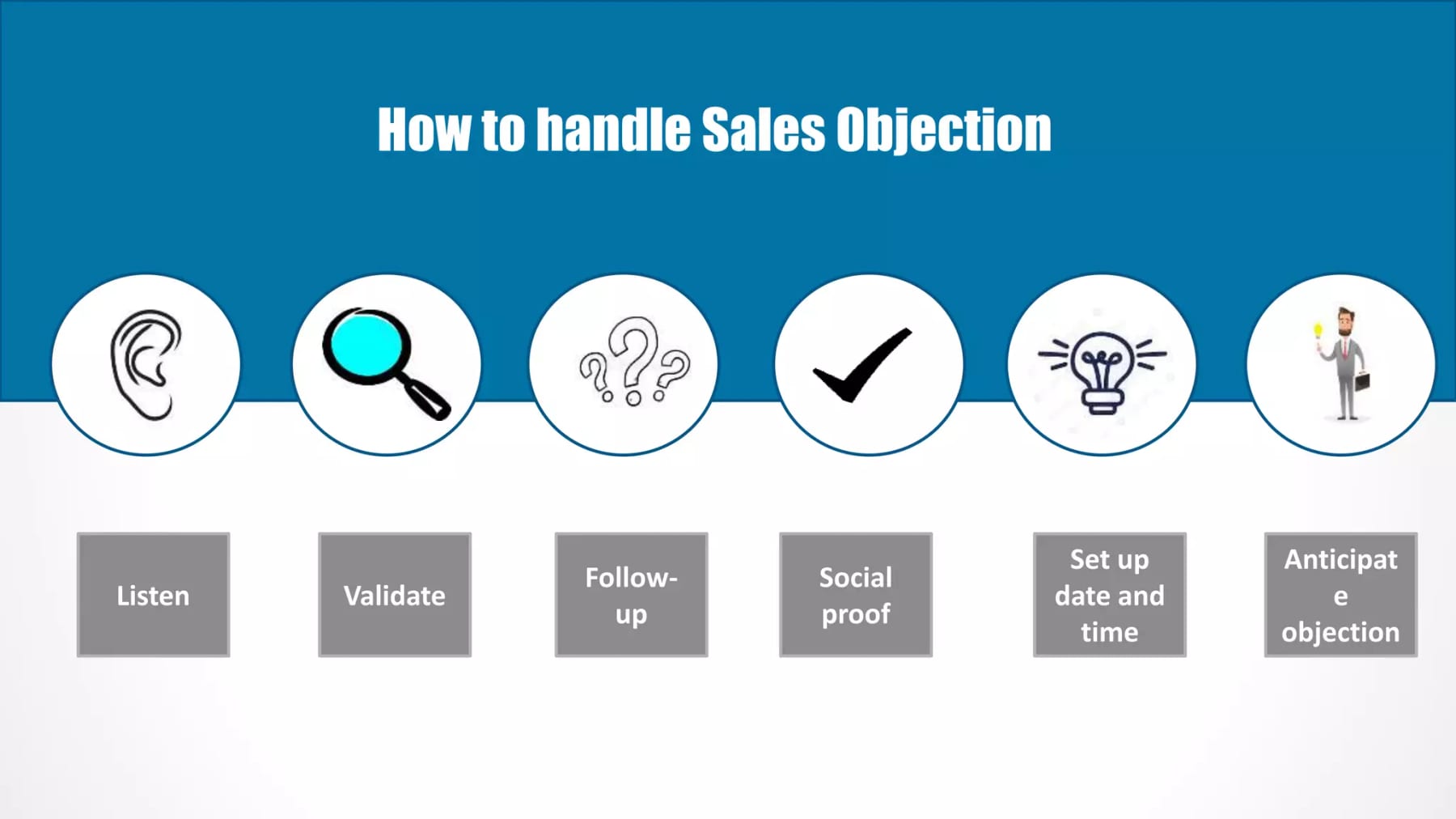
Step 1 — Absorb, don't answer (5 seconds). Say "okay" and stop talking. The most common unforced error is answering a price objection in the first breath. Silence does two things: it signals you're not rattled, and it frequently produces the real objection unprompted. Buyers often fill the pause with the actual constraint — "honestly, we spent our tooling budget in Q2."
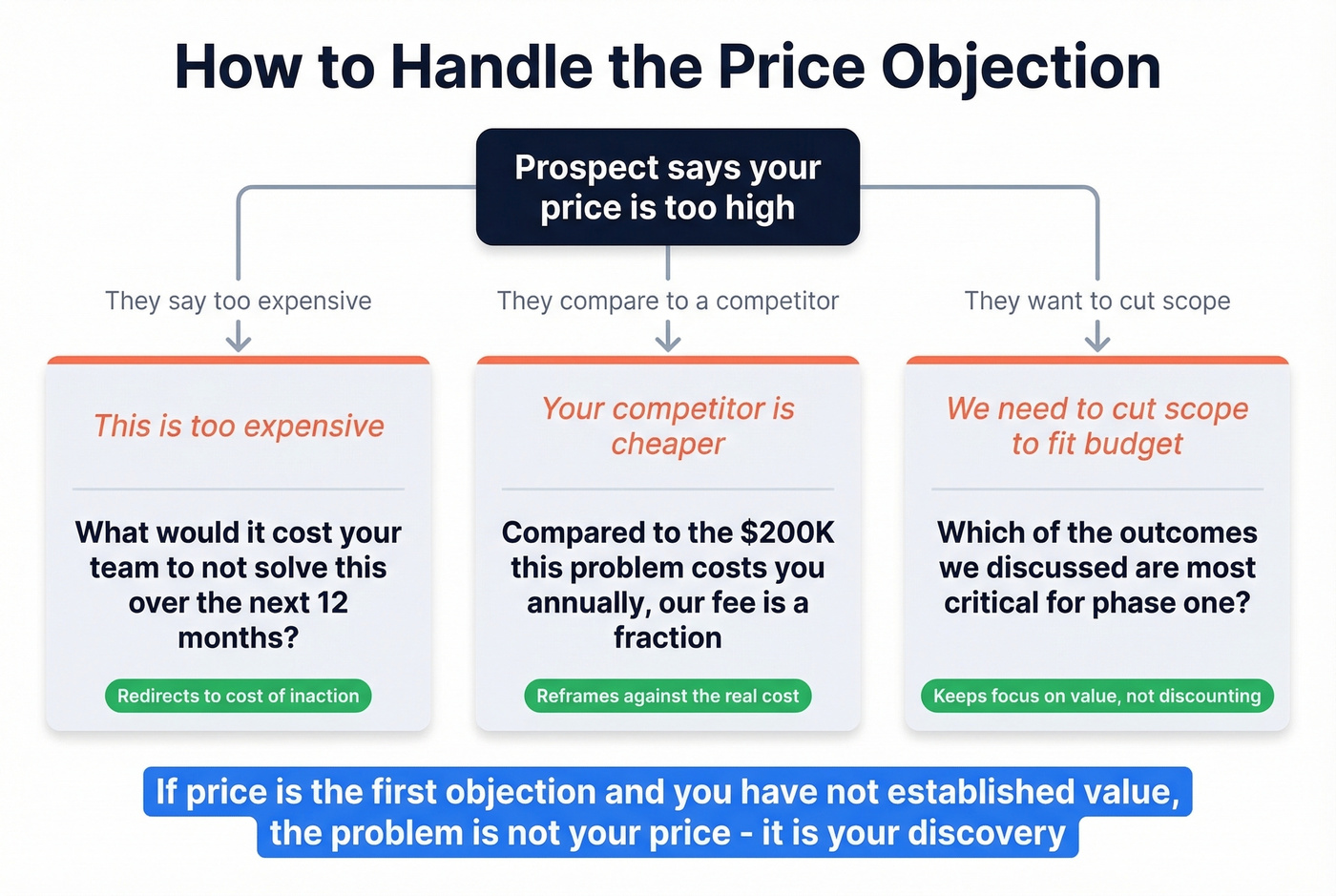
Step 2 — Isolate the comparison. Ask which baseline they're measuring against: "When you say too expensive, is that relative to what you're spending today, relative to the budget line you have approved, or relative to another quote?" Three answers, three branches. This single question does most of the diagnostic work, and it's the one step reps skip most often.

Step 3 — Confirm it's the only objection. "If we solved the commercial piece entirely, is there anything else that would stop this from moving forward?" If the answer is anything other than a clean no, price was never the blocker — it was the presentable one. Chase the real one instead.
Step 4 — Branch by root cause.
*Budget branch.* Establish whether the budget is truly locked or merely unallocated. Ask when the planning cycle reopens and who owns reallocation authority. Genuinely locked budget is not an objection, it's a timeline fact — the correct response is to move the deal to the right, keep the champion warm, and pre-build the business case for the cycle that reopens. Trying to force a locked-budget deal in-quarter is how reps end up discounting for nothing.
*Value branch.* Move to total cost of ownership. Enumerate what's inside your price that isn't inside theirs — implementation, support tier, integration work, migration effort — and attach an internal-labor cost to each. If a competitor excludes onboarding that you include, the delta isn't zero, it's whatever their team's time is worth. Ask the buyer to price it; buyer-generated numbers survive scrutiny better than vendor-generated ones.
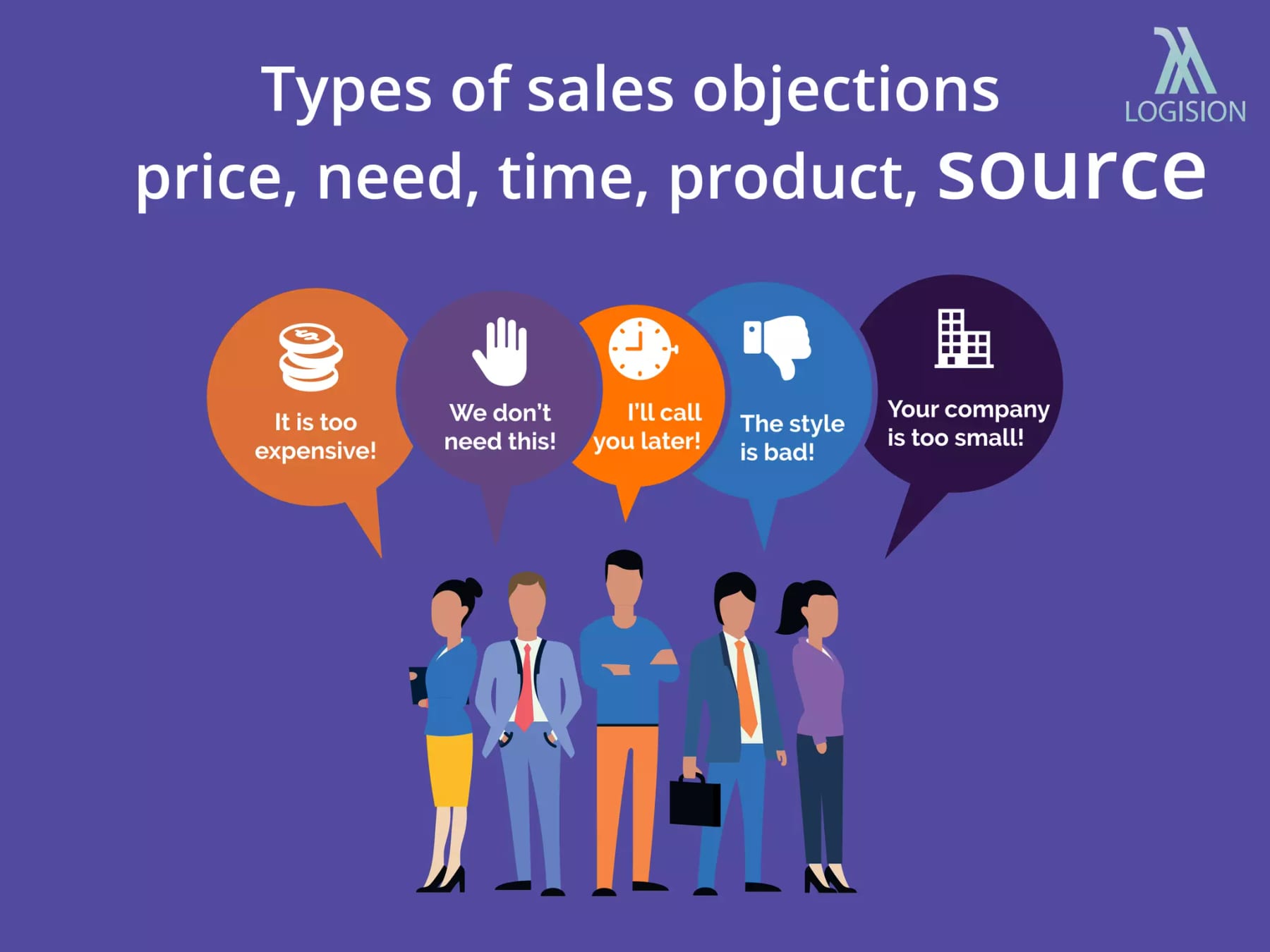
*Authority branch.* You've hit the Economic Buyer gap. Do not try to win the argument with the person in front of you — arm them instead. Build a one-page business case in their format, offer a short joint call with the approver, and ask explicitly what objection the approver will raise. Multithreading is the fix, and it works better before the price conversation than after.
Step 5 — Quantify the cost of delay. Ask the buyer to size the monthly impact of the unsolved problem. Not your estimate — theirs. "If nothing changes for two quarters, what does that cost you?" A buyer who cannot answer this has not been qualified on pain, which means the deal was fragile before price ever came up.
Step 6 — Commit with a date and a name. "I'll build the ROI model against your numbers by Thursday. Can you get your CFO on a 20-minute call next week?" Both halves matter: what you'll do, and what they'll do.
Costs, timelines, and typical ranges
Enablement teams want to know what running this costs and how long before it shows up in numbers. Honest ranges, stated as ranges because the specifics vary by org:
Session design. Objection Overdrive fits a 60-to-75-minute team session: a short warm-up poll, framework walkthrough, three timed roleplay rounds at roughly three minutes each with two-minute debriefs, and a commitment close. Under 45 minutes there isn't enough repetition for the sequence to stick. Over 90 and attention collapses. If you only have 30 minutes, cut the framework walkthrough and run pure reps — the sequence is learned by doing it, not by hearing it explained.
Ramp to competence. Reps typically need three to five live attempts before the sequence stops feeling scripted. Plan on a two-to-four-week window between the training and any meaningful signal in win rates, and a full sales cycle before you can attribute anything. If your average cycle is 90 days, resist reading the numbers at 30.
Reinforcement cadence. One session produces almost nothing durable. Budget for a 15-minute recurring segment in the weekly pipeline meeting where one rep replays a real price objection and the team critiques the diagnose step specifically. Sustained skill change tracks with reinforcement frequency far more than with initial session quality.
Approval thresholds. Most teams that hold price well have a written discount ladder rather than case-by-case judgment. A common structure: reps hold authority up to a small single-digit percentage, managers to low double digits, and anything beyond that requires a VP or deal-desk sign-off with a written justification. The mechanism that matters isn't the threshold number — it's the friction. Requiring a short written case for why the discount is necessary kills a meaningful share of requests before they're submitted, because the rep can't articulate a reason beyond "they asked."
Tooling. Conversation-intelligence platforms such as Gong or Chorus can tag price mentions and let managers review how the objection was handled rather than relying on the rep's recollection. Forecasting tools like Clari surface deals where discount requests correlate with slipped close dates. Salesforce or HubSpot should carry a required field capturing the objection type and the MEDDPICC gap. None of this is necessary to run the template — a whiteboard and honest debriefs work — but without a system of record you can't tell whether the training changed anything.
The concession-currency principle. When a discount genuinely is warranted, never give it unilaterally. Trade it: a longer term, a multi-year commitment, a faster paper process, a reference agreement, a case study, prepayment, or a reduced scope. The rule stated plainly — nothing comes off the price without something coming back across the table. This single habit changes discounting from a leak into a negotiation.
Where teams get it wrong
Answering the objection instead of diagnosing it. The rep hears "too expensive," starts justifying the price, and thirty seconds later is deep in a feature-by-feature defense. Once you're defending, the buyer is grading. Diagnose first, always.
Asking "what's your budget?" It sounds like discovery. It functions as an invitation to anchor low. The buyer names a number below your price, and now that number is the reference point for the rest of the negotiation. Ask what outcome would justify the investment instead.
Treating price objections as a late-stage problem. By the time price comes up in a proposal review, most of the damage is already done — the value framing either happened in discovery or it didn't. Teams that struggle here usually have a discovery problem, not an objection-handling problem. If your reps can't state, in the buyer's own numbers, what the problem costs per month, price will feel arbitrary no matter how good the closing script is.
Discounting to hit a date. End-of-quarter discounting is the most expensive habit in enterprise selling because buyers learn the calendar. Sophisticated procurement teams simply wait. If your discount rate spikes in the last two weeks of every quarter, that pattern is visible in your own CRM data and it's almost certainly visible to your repeat buyers too.
Confusing a stall with an objection. "I need to think about it" is not price pushback; it's an absence of information or an absence of authority. Reframing it as a price objection and offering a discount rewards ambiguity. Ask what specifically needs consideration, then handle that.
Over-scripting the roleplay. Teams that hand reps verbatim scripts produce reps who sound like reps. The template is a sequence, not a script — the phases are fixed, the language is theirs. In roleplay, grade the sequence, not the wording.
Single-threading through a champion who can't buy. Every authority-branch objection traces back to a multithreading failure earlier in the cycle. The fix belongs in discovery: identify the approver, understand their criteria, and get exposure to them before pricing is on the table.
Not tracking the trap. Debriefs that don't count discount slips don't change behavior. Track how often reps reach for a concession in practice, and name it out loud. What gets counted in roleplay gets noticed in live calls.
Decision framework: when to choose what
Not every price objection deserves the full sequence, and not every deal deserves to be saved. A rough decision framework:
Hold firm when the buyer has quantified pain, the economic buyer is engaged, and you're differentiated on something they've said matters. Here the objection is usually a routine procurement test. Restate value, offer a trade-off, and wait.
Trade, don't discount when there's real budget pressure but genuine intent. Reduce scope, adjust term length, phase the rollout, or move a start date — all of these lower the invoice without lowering the unit price, which protects your price integrity and your renewal baseline.
Walk or park when the buyer can't articulate the cost of inaction, you have no economic-buyer access, and the only lever available is price. This deal is not close-able at a healthy margin. Parking it and reallocating the hours to a qualified opportunity is usually the higher-expected-value move, even though it feels like giving up.
Escalate to deal desk when the deal is strategically valuable — a marquee logo, a beachhead in a new segment, a competitive displacement — and the concession requested exceeds standard authority. That's a business decision, not a rep decision, and it should be made deliberately with a written rationale rather than absorbed quietly into a rep's discretion.
The same logic transfers to adjacent commercial conversations. Renewal negotiations with a price uplift, expansion deals where the buyer wants existing-customer pricing, partner and reseller margin discussions, and even professional-services scoping all follow the diagnose-reframe-commit shape. What changes is the reframe content: in a renewal, the cost of inaction is switching cost and lost adoption; in an expansion, it's the incremental value per new seat or workload.
Related questions
How do I run this as a team training session?
Sixty to seventy-five minutes: opening poll on recent price losses, ten-minute framework walkthrough, three timed roleplay rounds covering budget, value, and authority pushback, then individual commitments applied to one real open deal each. Track discount slips during roleplay and name them in debrief.
What if the prospect genuinely has no budget?
That's a timeline fact, not an objection. Find out when the planning cycle reopens and who owns reallocation. Keep the champion warm, co-build the business case for the next cycle, and move the close date honestly rather than discounting into a budget that doesn't exist.
Does this work for renewals and expansions?
Yes, with a different reframe. In renewals the cost of inaction is switching cost, retraining, and lost adoption momentum. In expansions it's the incremental value of each additional seat or workload. The diagnose-reframe-commit sequence is unchanged.
How do I measure whether the training worked?
Track average discount percentage, the share of deals closing at list, and the frequency of price objections that end in a dated next step versus a vague deferral. Read results after a full sales cycle, not after thirty days.
Should the objection ever be answered with a straight no?
Rarely. "No" ends the conversation; "yes, and here's the trade-off" keeps it open while protecting margin. Naming what would have to come out — scope, term, support tier — makes the buyer price their own request, and many withdraw it.
FAQ
Why does diagnosing come before responding?
Because "too expensive" describes three unrelated problems that look identical from the outside. Budget absence, value gap, and authority gap each require a different response, and responding to the wrong one wastes your best material. Thirty seconds of diagnosis routinely saves an entire deal cycle.
What's the single most damaging habit in price conversations?
Reflex discounting — conceding before understanding. It resolves the discomfort immediately, which is why it's so persistent, and it teaches the buyer that your list price is negotiable. Every subsequent conversation with that account, and often with their peers, starts from the discounted number.
How do I handle a cheaper competitor quote?
Shift to total cost of ownership. Enumerate what's included in your price and excluded from theirs — implementation, support tier, integrations, migration — and ask the buyer to price the internal labor those exclusions create. Buyer-generated numbers hold up in an internal approval meeting; vendor-generated ones get discounted.
Is discounting ever the right call?
Sometimes — strategic logos, competitive displacements, or multi-year commitments can justify it. The rule is that it's never unilateral and never quiet. Trade for term length, prepayment, a reference agreement, or reduced scope, and document the rationale so the pattern stays visible to leadership.
What if the economic buyer refuses to join a call?
Treat that refusal as data about deal health. Arm your champion with a one-page business case in the approver's own language, and ask directly what objection the approver will raise. If access is permanently blocked and the deal is large, forecast it conservatively — you are selling to someone who can only say no.
How is this different from a generic objection-handling script?
Scripts supply words; this template supplies a sequence with exit conditions. Reps keep their own language and personality but cannot skip diagnosis, cannot reframe before isolating the comparison, and cannot end the call without a dated commitment. Sequence discipline survives pressure better than memorized phrasing.
Sources
- Gartner — Sales Insights and Research
- Harvard Business Review — Sales and Negotiation
- Gong Labs — Sales Research
- Salesforce — Sales Resources and Guides
- HubSpot Sales Blog
- Winning by Design — Resources
- Harvard Program on Negotiation — Daily Blog
- McKinsey — Growth, Marketing and Sales Insights
Related on PULSE
- [Objection Handling Bootcamp: Template for a One-Hour Team Sales Session](/knowledge/st0777)
- [Top 10 sales role-play templates for objection handling practice](/knowledge/st0753)
- [Objection Handling Roleplay Session Blueprint](/knowledge/st0752)
- [Top 10 team-meeting templates to boost objection handling skills](/knowledge/st0654)
- [Handling the 'Not Interested' Objection: A Ready-to-Run Roleplay Session](/knowledge/st0653)
- [Top 10 objection handling role-play scenarios for sales teams](/knowledge/st0538)
This page will be disappearing soon. Save it to your device for $1 — or read it free while it is here.
@Kory-White- · if Venmo asks, the last 4 of my number are 2012
 pulse-sales-trainingsTop 10 CSM workshop agendas for 2027
 pulse-sales-trainingsTop 10 underperformer training drills for 2027
 pulse-sales-trainingsCompetitive Battle Card Review: A Gamified Team Quiz Template
 pulse-sales-trainingsTop 10 ready-to-run sales training templates for consultative selling in 2027
 pulse-sales-trainingsTop 10 demo training drills for B2B sales reps in 2027
 pulse-sales-trainingsOvercoming Call Reluctance: Coaching Template for a Weekly Morning Huddle
 pulse-sales-trainingsTop 10 SDR facilitator guides for 2027
 pulse-sales-trainingsProduct Knowledge Quick-Start Training Kit
 pulse-sales-trainingsSales Negotiation Tactics: Step-by-Step Meeting Script for Trainers
 pulse-sales-trainingsTop 10 ramping rep workshop agendas for 2027