


The Deal Desk Operations Reboot — 60-Min Training
Quality
Certified
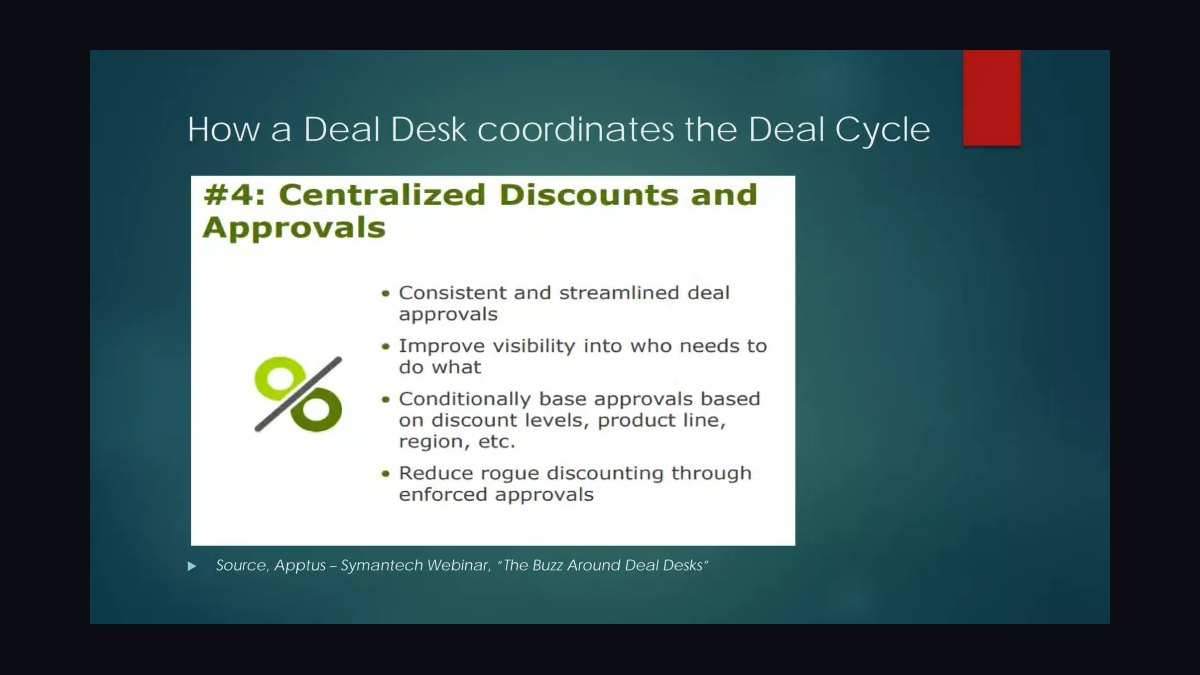
Stand up a Deal Desk when non-standard terms exceed roughly a quarter of your bookings, blended discounts drift past 15-20%, or exception approvals take more than 48 hours. Run a three-tier matrix — rep autonomy under 15%, manager to 25%, VP plus Finance above — with published SLAs and a "desk said no" recovery script.
The outcome you should expect
A well-run Deal Desk Operations Reboot is not a compliance drill — it changes what the sales team can promise and how quickly it can promise it. The single measurable outcome to expect inside 60 to 90 days is a shorter, more predictable path from "I need an exception" to "here is your answer," paired with tighter margin control on the exact deals that used to leak it. The 60-minute Training is the ignition point, not the whole engine, but everything downstream traces back to what the room agrees to in that hour.
Concretely, by the end of the Training every attendee should leave with three artifacts on paper: a tiered approval matrix, named SLA owners for each tier, and a recovery playbook for when the desk denies a request. Nothing exits the session as "we'll figure it out later." That is the contract you set at minute five, and it is the outcome you hold the team to for the following quarter.

The behavioral shift matters more than the document. Today, in most mid-market SaaS orgs, a rep who hits a non-standard term routes it through a Slack DM to whoever is online. The result is inconsistent answers, no audit trail, and reps who stop surfacing edge cases — they quietly promise a term to the buyer and hope Finance blesses it after signature. A Reboot replaces that reflex with a named path: every exception has a tier, a timer, and a log. The rep knows exactly where to send it and when the answer lands.
You should also expect fewer post-sale surprises. When discounting, payment terms, and revenue-recognition risk get reviewed before signature instead of discovered at booking, margin erosion and revrec cleanup both drop. The Operations goal is never to say "no" more often — it is to say "yes" faster, with terms the company can actually deliver and defend. If reps leave the Training treating the desk as a partner that unblocks them rather than a gate that stalls them, the Reboot worked. If they leave dreading it, you rebuilt the bottleneck with a nicer name.
What drives that outcome

Three levers drive the result, and the Training should make each explicit on the whiteboard. First, deal variability — the trigger for needing a desk is not headcount, it is how often deals deviate from standard paper. A ten-rep team closing wildly bespoke enterprise contracts needs a desk more than a fifty-rep team selling one SKU at list. Second, structured routing — every deal follows a named branch instead of an ad-hoc DM, so the same exception gets the same treatment on a Tuesday morning and a quarter-end Friday night. Third, enforced SLAs — a tier without a clock is just a suggestion, and suggestions get ignored the moment a quarter-end crunch hits.
Walk the room through the routing logic live so reps internalize the branches rather than reading them off a slide. The point of the diagram is that no path ever ends in "ask someone" — every path is named, timed, and logged. A rep should be able to look at any live deal and know instantly which lane it belongs in, before they ever quote the buyer.
The fourth and softer driver is where Finance sits in the process. When Finance first sees a deal at signature, its only remaining tool is a veto. When Finance attends pipeline reviews from Stage 3 onward — say on any opportunity above $100K ACV — it shapes the deal in flight instead of blocking it at the gate. That shift, from gatekeeper to co-owner of revenue, is the cultural driver that makes the mechanical drivers stick. Reps stop hiding edge cases because the desk is helping them win the deal, not hunting them for breaking a rule. Get this one wrong and the other three levers quietly rust.
Benchmarks and realistic ranges

Treat these as operating starting points to calibrate in your first two quarters, not universal constants — every business's mix of ACV, segment, and product complexity shifts the thresholds. Use them to seed the conversation in the Training, then let your own closed-won data tune them by the second retro.
Trigger diagnostics — the four questions that tell you a desk is overdue:
- Percent of deals on standard paper: below roughly 75% standard is a strong signal you need a formal desk. Above 90% and a lightweight manager-approval flow may suffice.
- Average blended discount: above 15% blended usually justifies a desk; sustained 20%+ almost always does, because a point of blended discount at scale is real gross margin.
- People touching a non-standard quote: more than three hands on a single exception means the routing is broken and the deal is aging in handoffs.
- Time from "I need an exception" to "approved": above 48 hours and you are losing cycle time you cannot recover, especially against a competitor already quoting.
Tier thresholds — a defensible default matrix:

- Tier 1 (rep autonomous, CRM-logged): 0-15% off list, 12-month annual prepay, Net 30, quote valid 30 days. Target a 24-hour acknowledgment even though no human approval is required, so the audit log stays clean and the desk sees the volume.
- Tier 2 (manager, 48-hour SLA): 15.01-25% discount, multi-year with annual prepay, Net 45, one non-standard SOW clause such as logo rights or a minor MSA tweak.
- Tier 3 (desk plus VP Sales plus Finance, 72-hour SLA): discount above 25%, any deferred or quarterly payment, custom MSA redlines beyond pre-approved fallbacks, multi-year with a ramp, any revrec risk (POC milestones, success criteria, opt-outs), or ACV above $250K regardless of discount.
Cadence ranges — a daily 15-minute standup at 9:00 AM with the desk lead, Finance partner, and Sales Ops to triage the queue; anything aging past 50% of its SLA gets a named owner and a deadline that morning. A weekly 30-minute Friday retro reviews every decision so recurring exceptions become policy rather than repeated one-offs. Two identical exceptions in a month is a signal to promote that trade into the standard fallback set.
Team size — a lean desk of two to three people (a sales ops lead, a finance analyst, a legal point person) can carry a mid-market book. When non-standard volume climbs past roughly 50-75 deals per month, plan for dedicated headcount rather than borrowed time from people with day jobs. The right number is the one that keeps every tier inside its SLA at quarter-end, which is precisely when the whole Operations system gets stress-tested hardest.
Risks, edge cases, and failure modes

The most common failure is treating the desk as a "no" factory. If the only outcome reps experience is denial, they route around it — back to Slack DMs, back to promising terms and praying at signature. The Reboot dies within a quarter. Guard against this by making the recovery playbook — Reframe, Trade, Escalate, Walk — a first-class part of the Training, not an afterthought squeezed into the last five minutes. A denial should feel like the opening of a negotiation with your own desk, not a dead end.
The second failure mode is unenforced SLAs. A published 48-hour window that routinely slips to five days trains reps to ignore the clock and escalate through side channels. Build automatic escalation into the process: a Tier 2 request with no decision at hour 47 rolls up to Tier 3 rather than sitting idle in an inbox. Publish the SLA dashboard company-wide so aging deals are visible to everyone, and review every miss in the Friday retro with a named owner and a concrete fix, not a shrug.
Third, watch the edge cases that don't fit the matrix cleanly. A deal can be small on ACV but carry heavy revrec risk — a $120K contract with milestone-based acceptance and an opt-out clause belongs in Tier 3 even though its dollar value reads like Tier 1. Train reps to route on the riskiest attribute, not the headline number. Ramps (year one priced below year two), success criteria, and payment deferral are all Tier 3 triggers regardless of discount size, because each one moves recognized revenue or bakes in a future clawback.

Fourth is quarter-end collapse. When 40% of the quarter's bookings land in the final week, a well-behaved desk buckles unless it has surge capacity and pre-approved fallback positions. Prepare a standing set of "if the buyer asks for X, you may offer Y" fallbacks so reps self-serve the common late-quarter trades without a full Tier 3 cycle. Without them, the desk becomes the bottleneck that costs you the exact deals you most wanted to close, and the whole Reboot gets blamed for a staffing gap.
Finally, beware Finance-as-adversary drift. If Finance only shows up to deny, the partnership erodes and the desk reverts to a gate. The specific edge case to avoid is a Finance partner who attends the daily standup but skips the Stage 3 pipeline review — they inherit the deal too late to shape it, so all they can do is object at the end. Embed Finance early in the sales motion or the cultural benefit never materializes and you are left with expensive process theater.
A practical rollout plan
Sequence the Reboot so the team leaves the 60-minute Training with usable artifacts and a Monday start. The rollout runs four phases: diagnose with real data, ratify the matrix, drill the recovery scripts, and commit to the operating cadence. Each phase produces something concrete, and the recovery drill is where reps build the muscle memory that survives a live buyer call under pressure.
Phase one is a live exercise, not a lecture: pull last quarter's closed-won data and have the table count how many deals hit two or more triggers. If more than a third of bookings touched any non-standard term, the desk pays for itself in cycle compression alone, and you now have the evidence sitting in the room instead of buried on a slide the team will forget.

Phase two ratifies the matrix. Read the tiers aloud verbatim — ambiguity is exactly what burns SLAs later. Hand each rep the copy-paste approval-request template so every ticket arrives with the fields the desk needs: account, ACV, tier, the specific deviation, buyer rationale, competitor in the deal, the decision needed by a date, and the fallback ask if denied. That fallback line is the unlock — it lets the desk approve a counter without a second round trip, which is where most of the saved cycle time actually comes from.
Phase three drills recovery. Pair the reps: one plays the denied rep, one plays the desk, and they run Reframe, Trade, Escalate, Walk end to end, then swap seats. The room should hear the actual scripts spoken aloud, awkwardly at first. Reframe rebuilds the ask with the margin math the rep may have skipped. Trade asks the buyer what they can give back — a longer term, prepay, a case study, a reference logo. Escalate takes an exhausted Tier 3 to a joint VP-and-CFO review only with a documented business case attached. Walk protects margin and logs the loss reason honestly so the next retro can learn from it.
Phase four commits the cadence: name a Finance partner per segment who attends the weekly pipeline review, publish the SLA dashboard by Friday, and schedule a monthly denial retro where every denied exception gets examined for a policy gap or a coaching moment. Close the Operations Training on the reframe that a Deal Desk is the function that lets the company say yes faster, smarter, and at a margin it can defend — and that the whole thing starts Monday, not "sometime next quarter."
Related questions

How is a Deal Desk different from CPQ automation?
CPQ enforces pricing rules and auto-approves standard quotes; a Deal Desk handles the judgment calls CPQ can't — non-standard terms, redlines, revrec risk, and strategic trade-offs. CPQ clears the standard path so the desk's human attention goes only to genuine exceptions instead of routine paperwork.
Who should own the Deal Desk — Sales, Finance, or RevOps?
RevOps typically owns the process and SLAs, with Finance and Sales leadership as co-decision-makers on Tier 3. The owner runs the daily standup and the Friday retro; Finance co-owns the margin outcomes. Ownership without cross-functional decision rights just recreates the bottleneck under a new title.
What should a rep put in an exception request?
Account, ACV, tier, the exact deviation (discount, term, payment), a one-sentence buyer rationale, any competitor in the deal, the decision needed by a specific date, and a fallback ask if denied. Structured tickets clear far faster than free-text Slack messages the desk has to interrogate.
How do you keep the desk from becoming a bottleneck at quarter-end?
Pre-approve fallback positions so reps self-serve common trades, build automatic tier escalation on SLA breach, and staff surge capacity for the final week. Publish the SLA dashboard so aging deals are visible before they stall the last-week rush.
When is a company too small for a Deal Desk?
If more than 90% of deals close on standard paper and blended discounts stay under 15%, a lightweight manager-approval flow beats a formal desk. Stand one up when variability — not revenue — crosses the thresholds above; headcount alone never justifies it.
FAQ
What exactly is a Deal Desk, and when does a company need one? A Deal Desk is a cross-functional team — sales ops, finance, legal — that reviews and approves non-standard deals. You typically need one when more than a quarter of deals require non-standard terms, blended discounts exceed 15-20%, or exception cycles drag past 48 hours. The trigger is deal variability, not headcount.
How do I set up an approval matrix without slowing down sales? Use a strict three-tier system: reps approve up to 15% autonomously with only a CRM log, managers handle up to 25%, and anything above 25% or involving multi-year and term modifications goes to VP plus Finance. Publish SLAs — 24, 48, and 72 hours — so everyone knows the timeline and can plan the buyer conversation around it.
What happens when the Deal Desk says no?
Run the four-step Reframe, Trade, Escalate, Walk playbook. Reframe the ask with the margin math you may have skipped, propose a trade such as a longer term for a deeper discount, escalate to a joint VP-and-CFO review only with a documented business case, and if terms still don't work, walk while protecting margin and logging the loss reason honestly.
How do I get Finance to act as a partner, not a gatekeeper? Embed Finance in pipeline reviews starting at Stage 3 on opportunities above roughly $100K ACV. When Finance shapes the deal in flight instead of blocking it at signature, denials drop and trust rises. Treat them as co-owners of revenue, and name a Finance partner per segment who attends the weekly review.
What metrics prove the Deal Desk is working? Track approval cycle time against each SLA, discount variance from standard, deal velocity from proposal to close, and win rate on deals that went through the desk. A healthy desk improves margin without hurting close rates — if either one degrades, revisit the tier thresholds or the SLA enforcement.
Can a small team run a Deal Desk, or do I need dedicated headcount? A lean team of two to three — a sales ops lead, a finance analyst, and a legal point person — can run it with clear processes and enforced SLAs. When non-standard volume climbs past roughly 50-75 deals per month, add dedicated resources before the queue starts breaching its SLAs at quarter-end.
Sources
- Jason Jordan & Michelle Vazzana — *Cracking the Sales Management Code* (McGraw-Hill) — https://www.mhprofessional.com
- Mark Roberge — *The Sales Acceleration Formula* (Wiley) — https://www.wiley.com
- Tomasz Tunguz — enterprise SaaS discounting and margin analysis — https://tomtunguz.com
- Pavilion — RevOps community resources and benchmarks — https://www.joinpavilion.com
- Salesforce — CPQ and Revenue Cloud documentation — https://www.salesforce.com
- Forrester — Revenue Operations research and benchmarks — https://www.forrester.com
- Harvard Business Review — negotiation and pricing discipline — https://hbr.org
- Gartner — sales operations and quote-to-cash research — https://www.gartner.com
Related on PULSE
- Deal Desk Simulation: Cross-Functional Approval Process Roleplay
- The Lost Deal Retrospective Reboot — 60-Min Training
- The Stalled Deal Recovery Reboot — 60-Min Training
- The Deal Strategy Review Reboot — 60-Min Training
- Deal Doctor: A Diagnostic Template for At-Risk Opportunities in the Pipeline
- Top 10 deal review role-play scenarios for sales teams
This page will be disappearing soon. Save it to your device for $1 — or read it free while it is here.
@Kory-White- · if Venmo asks, the last 4 of my number are 2012
This page is gone.
This one is off the shelf now. $1 keeps it on your phone for good — the whole page, pictures and diagrams included.
 sales-trainingThe Annual Sales Planning Reboot — 60-Min Training
 sales-trainingFixing Pricing Exception Chaos — 60-Min Training
 sales-trainingThe Top-of-Funnel Math Reboot — 60-Min Training
 sales-trainingThe Sales Playbook Reboot — 60-Min Training
 sales-trainingThe Contract Pre-Flight — 60-Min Training
 sales-trainingThe CRM Hygiene and Adoption Reboot — 60-Min Training
 sales-trainingThe Quota and Comp Plan Communication Reboot — 60-Min Training
 sales-trainingThe Sales Process Audit Reboot — 60-Min Training
 sales-trainingThe Sales Tech Stack Reboot — 60-Min Training
 sales-trainingThe Territory Plan Reboot — 60-Min Training