

How much more does out-of-state tuition cost than in-state tuition at public universities in 2027?
 Curated byKory White · Fractional CRO · Maryland
Quality
Certified
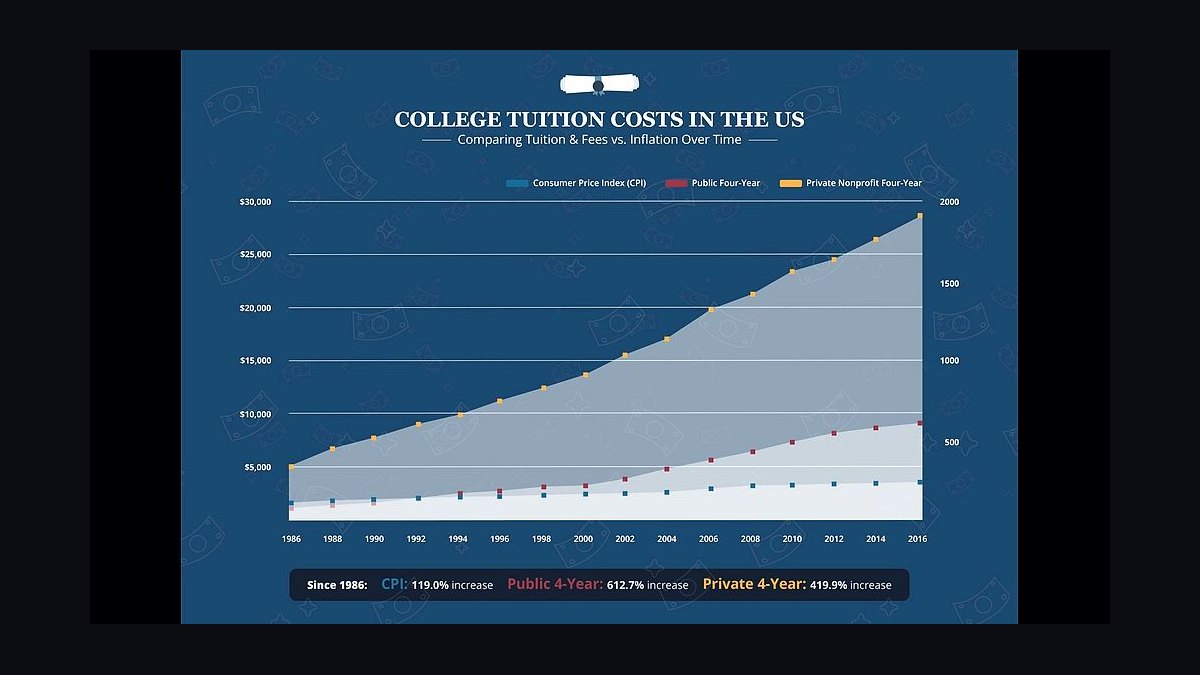
For 2027, out-of-state students at public universities should expect to pay roughly 2.5 to 3 times what in-state students pay, a gap commonly in the $18,000 to $30,000 per year range. Flagship campuses can push that difference past $35,000, while regional publics often stay under $15,000. The exact premium depends on the state, the campus, and whether the student qualifies for any reciprocity or waiver program.
The outcome you should expect
The single most useful number to carry into 2027 planning is the out-of-state tuition premium: the dollar difference between what a nonresident pays and what a resident pays at the same public university. At most public four-year institutions, that premium lands between $18,000 and $30,000 per year. In percentage terms, nonresident tuition typically runs 2.5x to 3x resident tuition, though the multiplier stretches higher at the most heavily subsidized flagships and compresses at regional campuses that recruit nonresidents aggressively.
It helps to separate the sticker price from the net price. The published out-of-state tuition figure is what appears on the university's cost-of-attendance page. The net price is what a family actually pays after institutional aid, state grants, and federal aid. Public universities increasingly use nonresident tuition as a revenue lever while discounting it back down for strong applicants, so the headline premium and the realized premium can differ by thousands of dollars. A family comparing a $12,000 in-state rate against a $38,000 out-of-state rate may see a $26,000 sticker gap that shrinks to $10,000 or less once a nonresident merit award is applied.
The premium also compounds over four years. A $25,000 annual difference becomes roughly $100,000 across a four-year degree before any tuition escalation. Because public tuition tends to rise faster than general inflation in many states, the later years of a degree often carry a higher premium than the first. That is why the annual figure matters less than the four-year cumulative gap when a family is deciding whether an out-of-state public is worth it relative to an in-state option or a private university with a larger discount.

Finally, the premium is not uniform across states. Some states set nonresident tuition at a modest markup over resident tuition, while others treat nonresident enrollment as a near-market-rate product. The variation between the cheapest and most expensive nonresident premiums at comparable public universities can exceed $20,000 per year, which means the question "how much more" genuinely has a range rather than a single answer.
What drives that outcome
Three forces set the size of the out-of-state premium at any given public university: the level of state subsidy, the institution's enrollment and revenue strategy, and the presence of reciprocity agreements that cap or waive the nonresident rate.
State subsidy is the foundation. Public universities receive appropriations from their state legislatures to hold resident tuition below the true cost of instruction. The deeper that subsidy, the lower resident tuition can be set, and the larger the gap between resident and nonresident rates. A state that funds its flagship generously can keep resident tuition in the low five figures while charging nonresidents a rate closer to the true cost of attendance. A state that has cut higher-education appropriations pushes resident tuition up, which narrows the percentage gap even as the dollar gap persists.

Enrollment strategy is the second driver. Many public universities, particularly flagships in the Midwest and South, deliberately enroll nonresident students because they pay a higher rate and help balance the budget when state appropriations are flat or declining. When a campus is under enrollment pressure, it may hold nonresident tuition flat or offer large nonresident merit awards, shrinking the effective premium. When a campus is oversubscribed, it can raise nonresident tuition and reduce discounting, widening the premium. This is why the same university's premium can move by several thousand dollars over a few admissions cycles.
Reciprocity and waiver programs are the third driver, and they are the most underappreciated. Regional exchange programs let residents of participating states attend public universities in neighboring states at a reduced rate, sometimes close to the resident rate. Some states also offer nonresident tuition waivers for specific programs, veterans, or students from counties that border the state. A student who qualifies for one of these programs may face a premium of only a few thousand dollars, or none at all, which is why the generic national figure can badly mislead an individual family.
The diagram above shows how the three drivers converge on a single premium figure and then compound across a degree. Notice that reciprocity acts on the effective rate rather than the published rate, which is why two students at the same university can face very different real premiums.
A fourth, quieter driver is program-level pricing. Some public universities charge differential tuition for majors such as engineering, business, nursing, or computer science, and that differential can apply to nonresidents on top of the base nonresident rate. A nonresident engineering student may pay a premium that is several thousand dollars higher than the university's general nonresident premium. Families comparing programs rather than institutions need to check the program-level rate, not just the campus-wide figure.
Benchmarks and realistic ranges

Concrete ranges help ground the 2027 estimate. The figures below are planning benchmarks derived from the long-running pattern of public tuition pricing, not predictions for a specific campus. Treat them as a starting frame and then verify against the actual cost-of-attendance page for any university under consideration.
At regional public universities, the annual out-of-state premium commonly falls between $8,000 and $18,000. These campuses often recruit nonresidents to fill seats and may discount heavily, so the realized premium can be lower than the published one. A regional campus with resident tuition around $9,000 might publish nonresident tuition around $20,000, a premium near $11,000, and then award a $4,000 nonresident scholarship that brings the realized premium to about $7,000.
At mid-tier public universities, the premium typically lands between $15,000 and $25,000 per year. These institutions sit in the middle of the subsidy spectrum: they receive meaningful state support but also lean on nonresident revenue. Resident tuition might be $11,000 and nonresident tuition $32,000, a premium of $21,000. Discounting is common but less aggressive than at regional campuses.
At flagship public universities, the premium commonly ranges from $25,000 to $40,000 per year, and at the most selective and least subsidized flagships it can exceed $40,000. A flagship with resident tuition of $13,000 might charge nonresidents $45,000 or more, producing a premium above $30,000. These campuses often have the strongest brand and the weakest need to discount for nonresidents, so the published premium is closer to the realized premium.

In percentage terms, the pattern is remarkably stable: nonresident tuition at public universities generally runs 2.5x to 3x resident tuition. A 2.5x multiplier on a $10,000 resident rate yields a $25,000 nonresident rate and a $15,000 premium. A 3x multiplier on a $14,000 resident rate yields a $42,000 nonresident rate and a $28,000 premium. The multiplier is a faster way to estimate the premium than memorizing dollar figures, because it scales with whatever the resident rate happens to be.
Reciprocity programs change the benchmark entirely. A student using a regional exchange rate may pay a premium of $2,000 to $8,000 instead of $20,000 or more. Some exchange programs set the nonresident rate at a fixed percentage above the resident rate, often in the range of 125% to 150% of resident tuition. On a $10,000 resident rate, that produces a nonresident rate of $12,500 to $15,000 and a premium of $2,500 to $5,000, an order of magnitude below the national average.
Cumulative four-year figures are the most decision-relevant benchmark. At a $20,000 annual premium, four years cost about $80,000 more than the in-state alternative. At a $30,000 annual premium, four years cost about $120,000 more. If tuition rises 3% to 5% per year, the cumulative figure grows further, and the senior-year premium can be 10% to 20% higher than the freshman-year premium. Families comparing offers should model the four-year total, not the first-year number.
Risks, edge cases, and failure modes

The biggest risk is comparing sticker prices instead of net prices. A family that rules out an out-of-state public because the published nonresident tuition is $40,000 may be walking away from a package that brings the realized cost to $22,000 through a nonresident merit award. Conversely, a family that assumes a large nonresident scholarship will renew for four years may be exposed if the award carries a GPA requirement the student later fails to meet. Always read the renewal terms: minimum credit hours, minimum GPA, and whether the award is fixed or percentage-based.
A second risk is assuming the premium is stable across all four years. Many public universities freeze resident tuition for continuing students while allowing nonresident tuition to rise, or vice versa. Some states have implemented tuition freezes or caps for residents that do not apply to nonresidents. A nonresident student can therefore see the premium widen each year even if the published first-year figures looked manageable. Ask the admissions office directly whether nonresident rates are guaranteed for four years and whether the nonresident scholarship is guaranteed for the same period.
A third risk is missing a residency reclassification opportunity. Some states allow students to establish residency after a certain number of months, which can convert a nonresident rate to a resident rate partway through a degree. The rules are strict and vary widely: some states require financial independence from parents, some require a full year of continuous residency before enrollment, and some effectively prohibit reclassification for out-of-state undergraduates. Where reclassification is possible, it can cut the premium dramatically in the later years, but counting on it without verifying the statute is a common and expensive mistake.

A fourth risk is overlooking program-level differential tuition and fees. The premium quoted for the university as a whole may not apply to a competitive major. Engineering, business, and nursing programs frequently carry differential tuition that stacks on top of the nonresident rate. A student admitted to a differential-tuition program can face a premium several thousand dollars higher than the campus average, and that differential may not be covered by a general nonresident scholarship.
A fifth risk is the reciprocity trap. Exchange programs often have application deadlines, eligible-major restrictions, and limited seats. A student who assumes eligibility for a regional exchange rate may find the program full or the major excluded, leaving them at the full nonresident rate. Verify eligibility in writing before relying on a reciprocity figure in a financial plan.
Finally, watch for the aid-portability problem. State grants and some institutional need-based aid are often restricted to residents, so a nonresident student may lose access to aid that would have applied in-state. The premium is therefore not just the tuition difference; it is the tuition difference minus any aid lost by going out of state. For a student who would have received a generous in-state grant, the true premium can be higher than the sticker gap suggests.
A practical rollout plan
For a family or a financial-aid practitioner, the premium question resolves into a repeatable process. The steps below turn the national range into a specific, defensible number for a specific student.
Step one: build a shortlist of four to six public universities, mixing in-state options with out-of-state options. For each, pull the current cost-of-attendance page and record resident tuition, nonresident tuition, mandatory fees, and the published premium. Do this from the official bursar or financial-aid page, not a third-party summary, because third-party figures lag by a year or more.

Step two: check reciprocity eligibility for every out-of-state campus on the list. Determine whether the student's home state participates in a regional exchange with the destination state, whether the intended major is eligible, and what the exchange rate would be. Record the exchange-adjusted premium alongside the published premium.
Step three: estimate the net premium by subtracting any nonresident merit award the student is likely to receive. Use the university's net-price calculator and any published scholarship grid. Be conservative: assume the award is at the lower end of the plausible range, and confirm the renewal terms.
Step four: model four years, not one. Apply a reasonable annual escalation to both resident and nonresident tuition, and check whether either rate is frozen or capped. Produce a cumulative premium figure for each out-of-state option relative to the best in-state option.
Step five: stress-test the plan against the failure modes. What happens if the nonresident scholarship is lost after year one? What happens if residency reclassification is denied? What happens if the student switches into a differential-tuition major? A plan that only works under the best-case assumptions is not a plan.
Step six: compare the cumulative premium against the alternatives, including a private university with a large discount and an in-state public with a strong program. The out-of-state premium is only worth paying if the program, outcomes, or fit justify the four-year cost relative to those alternatives.
The sequence matters. Families that jump straight to comparing sticker prices skip the reciprocity and net-price steps, which are where the largest corrections happen. A disciplined pass through all six steps typically changes the ranking of options, because the campus with the highest published premium is often not the campus with the highest realized premium.

One practical note on timing: cost-of-attendance pages for a given academic year are usually published in the late fall or winter before that year begins. For 2027 entry, the authoritative figures will appear during the 2026-2027 publishing cycle. Until then, the best available estimate is the prior year's figure plus a reasonable escalation, verified against the university's own published tuition schedule. Practitioners who build the estimate from the official schedule rather than a news summary will be within a few hundred dollars of the final number.
Related questions
How much more does out-of-state tuition cost than in-state tuition at public universities in 2027?
Expect a premium of roughly $18,000 to $30,000 per year at most public universities, with flagships often exceeding $35,000 and regional campuses sometimes staying under $15,000. Nonresident tuition typically runs 2.5x to 3x resident tuition, and reciprocity programs can shrink the gap to a few thousand dollars.
Do nonresident scholarships reduce the out-of-state premium?
Yes, often substantially. Many public universities award nonresident merit scholarships that cut the realized premium by $5,000 to $15,000 or more. The published premium and the realized premium can differ by thousands, so always check the net-price calculator and the scholarship's renewal terms.
Can an out-of-state student become a resident and pay in-state tuition?
Sometimes, but the rules are strict. Many states require a full year of continuous residency, financial independence from parents, and intent to remain permanently. Some states effectively bar reclassification for out-of-state undergraduates. Verify the specific statute before counting on it.
Is the out-of-state premium the same at every public university?

No. It varies widely by state and campus. Deeply subsidized flagships tend to have the largest premiums, while regional campuses that recruit nonresidents aggressively often have smaller ones. Program-level differential tuition can raise the premium further for majors like engineering or business.
How do I estimate the four-year cost of the premium?
Multiply the annual premium by four, then add escalation. At a $25,000 annual premium with 4% annual tuition growth, the four-year cumulative gap can exceed $105,000. Model each year separately rather than multiplying the first-year figure by four.
FAQ
How much more does out-of-state tuition cost than in-state tuition at public universities in 2027? At most public universities, nonresident students should expect to pay about $18,000 to $30,000 more per year than residents, with flagship campuses often exceeding $35,000 and regional campuses sometimes staying below $15,000. In percentage terms, nonresident tuition generally runs 2.5x to 3x resident tuition. Reciprocity agreements and nonresident scholarships can reduce the effective premium considerably.
Why is out-of-state tuition so much higher than in-state tuition? Resident tuition is subsidized by state appropriations, which hold it below the true cost of instruction. Nonresidents generally do not benefit from that subsidy, so universities charge them a rate closer to the actual cost. The deeper the state subsidy, the larger the gap between resident and nonresident rates tends to be.

Do reciprocity programs really lower the out-of-state premium? Yes. Regional exchange programs let residents of participating states attend public universities in neighboring states at a reduced rate, often 125% to 150% of resident tuition. That can cut a $25,000 premium to $2,500 to $5,000. Eligibility depends on the states involved, the major, and program capacity, so verify before relying on it.
Is the out-of-state premium worth paying? It depends on what the extra cost buys. If the out-of-state program has materially stronger outcomes, a better fit, or a specific major unavailable in state, the premium may be justified. If the programs are comparable, the four-year cumulative premium of $80,000 to $120,000 is hard to justify on cost alone.
How has the out-of-state premium changed over time? The premium has generally widened as state appropriations have failed to keep pace with enrollment growth, pushing universities to rely more on nonresident revenue. Percentage gaps have stayed in the 2.5x to 3x range, but dollar gaps have grown because both resident and nonresident tuition have risen.
What is the cheapest way for an out-of-state student to attend a public university? The lowest-cost paths are reciprocity programs, nonresident merit scholarships, and residency reclassification where permitted. Combining a reciprocity rate with a modest nonresident award can bring the premium close to zero. Attending a regional public rather than a flagship also typically lowers the premium.
Sources
- College Board, Trends in College Pricing and Student Aid: https://research.collegeboard.org/trends/college-pricing
- National Center for Education Statistics, College Navigator: https://nces.ed.gov/collegenavigator/
- U.S. Department of Education, College Scorecard: https://collegescorecard.ed.gov/
- Western Interstate Commission for Higher Education, Western Undergraduate Exchange: https://www.wiche.edu/tuition-savings/wue/
- Midwestern Higher Education Compact, Midwest Student Exchange Program: https://www.mhec.org/programs/midwest-student-exchange-program
- New England Board of Higher Education, Tuition Break: https://nebhe.org/tuitionbreak/
- Southern Regional Education Board, Academic Common Market: https://www.sreb.org/academic-common-market
- State Higher Education Executive Officers Association, State Higher Education Finance: https://shef.sheeo.org/
Related on PULSE
- How do public universities set nonresident tuition rates?
- What is the average net price at public four-year universities?
- How do reciprocity agreements affect college costs?
- Comparing in-state versus out-of-state college costs
- How to appeal a financial aid offer at a public university
- Understanding cost of attendance versus sticker price
This page will be disappearing soon. Save it to your device for $1 — or read it free while it is here.
@Kory-White- · if Venmo asks, the last 4 of my number are 2012
This page is gone.
This one is off the shelf now. $1 keeps it on your phone for good — the whole page, pictures and diagrams included.
 pulse-schoolsTop 10 Universities for Nursing in 2027
 schoolsHow much less do parishioners pay for Catholic high school tuition than non-parishioners in 2027?
 pulse-schoolsTop 10 Catholic Schools in Arkansas in 2027
 pulse-schoolsTop 10 Sororities at Wake Forest University in 2027
 schoolsWhat percentage of boarding school students receive need-based financial aid in 2027?
 pulse-schoolsTop 10 Fraternities at the University of Texas at Austin in 2027
 schoolsHow much does a semester at a military boarding school cost in 2027?
 schoolsHow much does it actually cost per year to send a kid to public high school in 2027?
 pulse-schoolsTop 10 Fraternities at Wake Forest University in 2027
 pulse-schoolsTop 10 Sororities at the University of Arizona in 2027