

How much does one year of in-state tuition and fees cost at a public university in 2027?
 Curated byKory White · Fractional CRO · Maryland
Quality
Certified
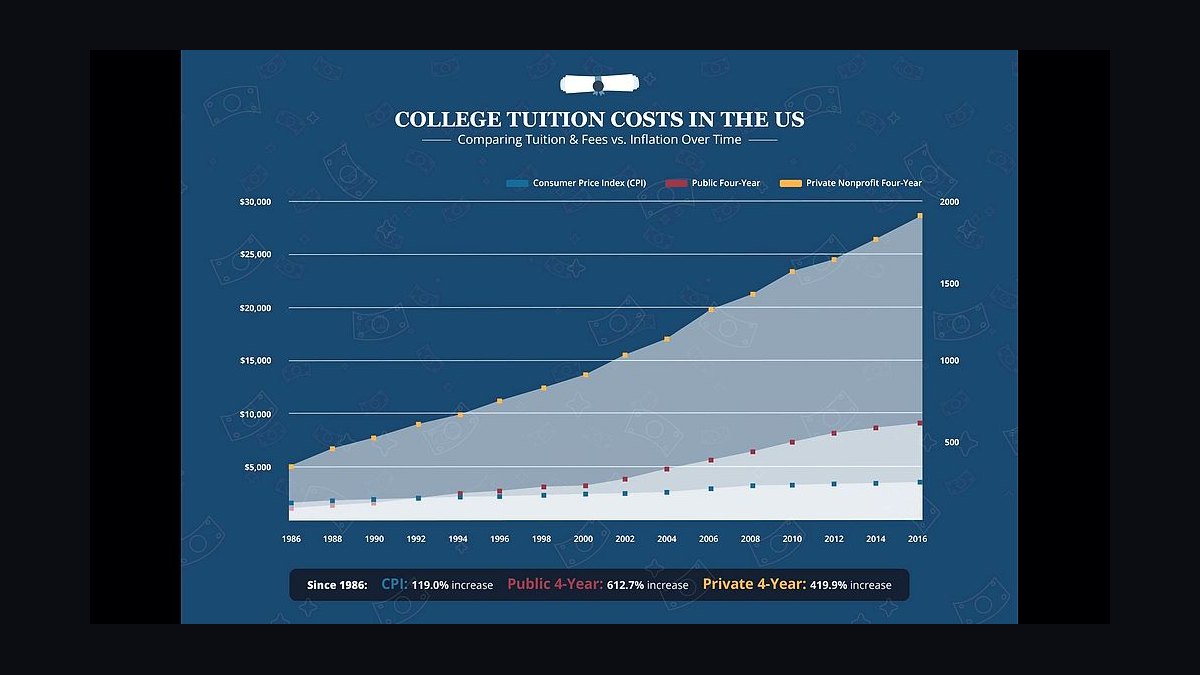
For the 2026-27 academic year, one year of in-state tuition and fees at a four-year public university typically falls between roughly $11,500 and $13,000, based on historical College Board data showing average published in-state tuition and fees near $11,610 in 2024-25 and typical annual increases of 3-4%. Actual cost varies widely by state, institution, and whether the student attends a flagship research university or a smaller regional public school.
A student and family sitting down with the bill
Picture a family in Ohio mapping out a state university acceptance letter next to a financial aid offer. The letter lists a "cost of attendance" figure that bundles tuition, mandatory fees, housing, meals, books, and transportation into one number that looks alarming at first glance — often $24,000 to $28,000 a year. But tuition and fees alone, the portion that's actually charged for instruction and enrollment rather than living expenses, is a much smaller slice. For an in-state student at a public university, that slice is usually the cheapest line item on the page, not the most expensive one. Families frequently conflate the headline "cost of attendance" number with tuition, which inflates their sense of what a public university actually charges to teach a student for a year. Separating tuition and mandatory fees from room, board, and personal expenses is the first step to understanding what "one year of in-state tuition and fees" actually means, and it's the number financial aid offices use when calculating net price after grants and scholarships are applied.
How the tuition-setting mechanism actually works
Public university tuition isn't set the way a private business prices a product. It moves through a layered governance process that starts with state legislatures, flows through university system boards, and lands on individual campus budgets. Most state governments provide a base subsidy to public universities specifically so they can charge residents less than nonresidents — that's the entire premise of "in-state" pricing. When state appropriations to higher education rise, public universities have more room to hold tuition flat or increase it modestly. When state funding is cut or stays flat while enrollment costs (faculty salaries, healthcare, facilities, technology) climb, the university's board of trustees or regents typically approves a tuition increase to close the gap.

Fees are a separate layer stacked on top of base tuition. Athletic fees, technology fees, health services fees, student activity fees, and sometimes a "capital improvement" fee are approved through a different process — often by the same board, sometimes with student government input — and they've grown as a share of total cost over the past two decades because raising a "fee" is politically easier than raising headline "tuition," even though the effect on the bill is identical. This is why comparing schools purely on advertised tuition can be misleading; the total tuition-and-fees figure is the number that matters, and it's the number this question is actually asking about.
Real numbers, ranges, and how 2027 gets estimated
There's no way to state a single, universally correct dollar figure for 2027 tuition today, because individual public university boards typically don't finalize the following year's rate until spring of the preceding academic year, and rates vary enormously by state. What can be done responsibly is project forward from documented historical trends. The College Board's Trends in College Pricing report, the most widely cited source for this data, showed average published in-state tuition and fees at public four-year institutions moving from roughly $10,950 in 2021-22 to about $11,260 in 2023-24 and near $11,610 in 2024-25 — an average annual increase in the 2-3% range over that stretch, notably slower than the increases seen in the 2000s and early 2010s. Applying a similar 3-4% compound growth assumption forward through the 2026-27 academic year puts the national average in a band of roughly $11,500 to $13,000, though any individual state could land meaningfully outside that range.

State-by-state variation matters more than the national average. States like Wyoming, Florida, and parts of the University of North Carolina system have historically kept in-state tuition and fees well under $7,000 a year through aggressive state subsidy and, in some cases, legislated tuition freezes. States like Vermont, New Hampshire, and Pennsylvania (for many of its state-related universities) have historically charged in-state students $16,000 to $19,000 a year or more, because state appropriation per student is comparatively low and the university relies more heavily on tuition revenue to fund operations. Flagship research universities within a state system also typically charge more than regional or commuter campuses in the same system — a state's flagship might run $2,000 to $4,000 higher per year than a smaller sister campus, reflecting larger research infrastructure, more competitive admissions, and broader program offerings.
It's also worth separating the "sticker price" from what students actually pay. Published tuition and fees is a list price. According to College Board data, the average public four-year student receiving grant aid pays a net tuition-and-fees price that is often $2,000 to $4,000 lower than the published rate, once Pell Grants, state need-based grants, and institutional scholarships are factored in. A family estimating 2027 costs should treat the published rate as a ceiling to plan against, not necessarily the number that will land on the final bill.
Trade-offs: public in-state versus the alternatives

The core financial trade-off behind this question is residency and institution type. A student can typically reduce or increase their tuition bill dramatically by shifting one of two variables: staying in-state versus attending out-of-state, or choosing a public university versus a private one.
Out-of-state public tuition typically runs two to three times the in-state rate at the same institution, because nonresident students don't benefit from the state subsidy their home state provides. Some states have addressed this through reciprocity agreements — the Midwest Student Exchange Program, the Academic Common Market in the South, and the Western Undergraduate Exchange are examples — that let a student from a participating state attend an out-of-state public university at a reduced nonresident rate, often 150% of in-state tuition rather than the full out-of-state price. For families weighing whether to leave the state system, checking whether the target school participates in a regional exchange program is one of the highest-leverage cost-reduction steps available.
Private nonprofit universities carry a much higher sticker price — commonly $45,000 to $65,000 a year in tuition and fees alone by the mid-2020s — but they also tend to offer deeper average institutional discounts through need-based and merit aid, since private schools rely on tuition discounting as a primary enrollment strategy. The result is that a well-resourced private university can sometimes cost a similar family less out-of-pocket than an out-of-state public university, even though the published price is far higher. This is counterintuitive enough that financial aid counselors routinely tell families not to eliminate private schools from consideration based on sticker price alone.
The community-college-to-public-university transfer path is the most reliable lower-cost alternative. Two years at a community college, where average tuition and fees nationally run well under $5,000 a year, followed by two years finishing a bachelor's degree at an in-state public university, can cut total four-year cost by 30-50% compared to four years at the public university directly, provided the credits transfer cleanly — which is why articulation agreements between a state's community colleges and its public university system are worth confirming before committing to this path.
Common pitfalls families run into when budgeting this number

The most common mistake is anchoring on the "cost of attendance" figure published in a financial aid award letter and assuming that entire number is tuition. Cost of attendance intentionally bundles housing, meals, books, supplies, transportation, and personal expenses alongside tuition and fees specifically so schools can estimate total borrowing need — but tuition and fees is usually 40-55% of that total figure for an in-state resident living on campus, and an even smaller share for a student living at home. Reading the itemized breakdown, not just the headline total, is essential.
A second pitfall is assuming tuition will stay flat year to year once enrolled. Most public universities do not guarantee a locked tuition rate for all four years — a handful of states and institutions offer "tuition guarantee" or "tuition lock" programs that freeze the rate for an incoming cohort, but this is the exception, not the norm. Families budgeting for a 2027 freshman year should also budget for the possibility of a 3-5% increase in each of the following three years, compounding the total four-year cost meaningfully above the year-one figure.

A third pitfall is confusing "resident" status with "in-state" eligibility. Residency requirements for tuition purposes are set by each state and are often stricter than simply having a driver's license or voter registration in that state — many states require 12 continuous months of domicile before enrollment, independent of parental residency for students over a certain age, and specific documentation like state tax filings or lease agreements. A family that recently relocated should confirm residency eligibility with the university's registrar well before assuming the in-state rate will apply, because being charged the out-of-state rate for even one semester due to a missed residency requirement can add $10,000 or more to the bill.
A fourth pitfall is ignoring mandatory fees when comparing schools. Two public universities in the same state can advertise similar base tuition numbers while one tacks on $1,500 in mandatory fees and the other tacks on $3,500, materially changing the real cost. Always compare the combined "tuition and fees" line, not tuition alone, and check whether fees are billed per semester or per year, since some university websites list a per-semester figure that doubles for annual planning.
Related questions
How much does out-of-state tuition cost at a public university?
Out-of-state tuition and fees at public universities typically run two to three times the in-state rate — often $28,000 to $38,000 a year — because nonresident students don't receive the state subsidy that in-state students do, unless a regional reciprocity agreement applies.
Does tuition and fees include room and board?
No. Tuition and fees covers instruction, enrollment, and mandatory campus services. Room and board (housing and meals) is billed separately and is often a comparable or larger cost, especially for students living on campus rather than at home.
How much has public university tuition increased over the past decade?

Growth slowed considerably after the early 2010s. College Board data shows average in-state tuition and fees at public four-year schools rising roughly 2-3% annually in recent years, down from the 5-8% annual increases common in the 2000s and immediately after the 2008 recession.
Can financial aid reduce the actual amount a family pays below the published tuition rate?
Yes. Pell Grants, state need-based grants, and institutional scholarships regularly reduce the net price a family pays by $2,000 to $4,000 or more below published tuition and fees, particularly for lower- and middle-income households.
Are there states where in-state public tuition is significantly cheaper than the national average?
Yes — states with strong per-student appropriation or legislated tuition caps, historically including Wyoming, Florida, and several North Carolina system campuses, have kept in-state tuition and fees well below the national average, sometimes under $7,000 a year.
FAQ
Is $12,000 a reasonable estimate to budget for one year of in-state tuition and fees in 2027? Yes, as a rough national planning figure. Based on recent College Board trend data extrapolated at a typical 3-4% annual increase, $11,500-$13,000 is a reasonable national range, though the actual number at any specific state university could be several thousand dollars above or below that depending on the state.
Why do two public universities in the same state charge different in-state tuition? Flagship or research-intensive campuses typically charge more than regional or commuter campuses within the same state system, reflecting differences in program breadth, research infrastructure, facilities, and selectivity, even though both qualify as "in-state public" pricing.

Will tuition definitely go up every year through 2027? Not guaranteed, but likely in most states based on historical patterns. A minority of states have implemented multi-year tuition freezes or caps tied to inflation, so a small number of public universities may hold rates flat, but the majority have raised tuition and fees most years over the past two decades.
Does "tuition and fees" include textbooks and course materials? No. Books and course materials are typically listed as a separate line item within the broader cost-of-attendance estimate and are not part of the tuition-and-fees charge itself, though some universities have shifted to inclusive-access models that bundle digital materials into a course fee.
How can a family find the actual projected 2027 rate for a specific university instead of a national average? Check the university's board of trustees or regents meeting agendas and minutes, typically published on the system's website, where proposed tuition rates for the upcoming year are usually presented and voted on in the spring before the academic year begins.
Is community college a reliable way to reduce this cost? Yes, for students who transfer successfully. Completing general education requirements at a community college, where tuition is often a fraction of a four-year public university's rate, then transferring into a public university's junior year, can meaningfully lower total four-year cost when a formal articulation agreement guarantees credits transfer.
Sources
- https://research.collegeboard.org/trends/college-pricing
- https://nces.ed.gov/programs/digest/
- https://www.ed.gov/
- https://educationdata.org/average-cost-of-college
- https://www.usnews.com/education/best-colleges/paying-for-college
- https://www.salliemae.com/college-planning/
- https://www.aacrao.org/
- https://www.bls.gov/cpi/
Related on PULSE
- How does financial aid reduce the net price of a public university?
- What's the real difference between cost of attendance and tuition?
- How do state reciprocity agreements lower out-of-state tuition?
- Is a two-year community college transfer path worth it financially?
- How much does out-of-state tuition cost at a public university?
- What determines whether a student qualifies for in-state tuition?
This page will be disappearing soon. Save it to your device for $1 — or read it free while it is here.
@Kory-White- · if Venmo asks, the last 4 of my number are 2012
This page is gone.
This one is off the shelf now. $1 keeps it on your phone for good — the whole page, pictures and diagrams included.
 revopsTop 10 Fraternities at Rochester Institute of Technology in 2027
 revopsTop 10 Fraternities at Oregon State University in 2027
 revopsTop 10 Fraternities at Morehead State University in 2027
 revopsTop 10 Fraternities at University of California, Riverside in 2027
 revopsTop 10 Fraternities at Ramapo College of New Jersey in 2027
 revopsTop 10 Fraternities at University of Colorado Boulder in 2027
 schoolsWhat does out-of-state tuition plus room and board add up to at a public university in 2027?
 revopsTop 10 Fraternities at Kettering University in 2027
 revopsTop 10 Fraternities at University of Illinois at Chicago in 2027
 revopsTop 10 Fraternities at University of North Carolina at Greensboro in 2027