
Top 10 Password Managers for Enterprises in 2027
 Curated byKory White · Fractional CRO · Maryland
 PULSEKNOWLEDGE LIBRARY
Quality
Certified

The 10 best password managers for enterprises are ranked below on measured performance, build quality, price, and how each one actually holds up in daily use rather than how it reads on a spec sheet. Each pick lists what it costs, who it suits, and what it gives up against the one above it, so the list can be read straight down without doubling back.
1. 1Password Business

1Password Business ranks first because it pairs a mature enterprise control plane with the least painful end-user experience in the field, which is what actually drives the enrollment rate that predicts rollout success. It ships SAML 2.0 and OIDC federation, SCIM provisioning and deprovisioning, passkey support for phishing-resistant unlock, and Travel Mode for border-crossing risk. Per-seat pricing sits inside the $4-$9 monthly band typical of cloud business tiers.
It fits organizations of a few hundred to several thousand seats that authenticate through one identity provider and want a cloud vendor running availability and patching. The trade is hosting: ciphertext lives on vendor infrastructure, so a sovereignty requirement eliminates it on question one. Against Bitwarden below, you pay more per seat and give up self-hosting, and you buy back the 0.1 to 0.25 FTE that running your own vault costs indefinitely.
2. Bitwarden Enterprise

Bitwarden ranks second because it is the only product here that credibly serves both hosting models: an open-source core you can self-host for data sovereignty, or a managed cloud tier with the same SAML, OIDC, and SCIM integration. Enterprise pricing sits at the lower end of the $4-$9 per-user-per-month band. The open-source codebase means published KDF and encryption parameters are independently inspectable rather than taken on a whitepaper's word.
It suits security teams with a regulatory or contractual requirement that encrypted vault data stay inside infrastructure they control. Self-hosting is not free: budget two or more replicas, a replicated database, TLS lifecycle, tested off-site restores, and a days-not-weeks patch cadence. Against 1Password above, the interface is plainer and adoption takes more change-management work; against Dashlane below, the admin depth is stronger.
3. Dashlane Business

Dashlane ranks third on adoption mechanics rather than admin depth. Its interface is the most consumer-familiar in the enterprise field, which directly attacks the failure mode that kills most deployments: a signed contract and a 40% enrollment rate. Business tiers carry SAML-based SSO, SCIM provisioning, dark web credential monitoring, and admin reporting. Per-seat pricing sits toward the upper end of the $4-$9 monthly band typical of design-forward crossover brands.
It fits organizations where adoption risk outweighs privileged-access depth — sales-heavy or non-technical headcounts that have quietly been using spreadsheets. What it trades away is self-hosting entirely and the rotation, approval-workflow, and session-recording controls a privileged-access platform provides. Against Keeper below, the admin console is simpler and the compliance reporting thinner; against Bitwarden above, you pay more and lose the sovereignty option.
4. Keeper Security Enterprise

Keeper ranks fourth because its admin and compliance surface is the deepest of the cloud vaults here — role-based enforcement policies, granular sharing controls, and reporting built to produce the countable artifacts auditors ask for: rotation evidence, approval-gated grants, export counts with justification. It extends past human credentials into privileged-account and secrets territory, covering service accounts and connection strings that a browser-autofill vault cannot manage.
It fits regulated organizations answering security questionnaires about whether privileged credentials are vaulted, rotated, and audited. The trade is end-user experience: the console's density is aimed at administrators, and rollout takes more training than Dashlane above. The privileged-access and human-vault paths are genuinely different subsystems, so evaluate each separately rather than assuming the bundled module matches a dedicated secrets manager.
5. NordPass Business

NordPass ranks fifth on architecture rather than admin breadth. It uses XChaCha20 for vault encryption instead of the AES-256 the rest of this field standardized on, and pairs zero-knowledge client-side encryption with Azure AD, Google Workspace, and Okta directory integration plus SCIM provisioning. Pricing sits at the lower-to-middle part of the $4-$9 per-user-per-month band, and the product line is backed by an established consumer security vendor.
It fits small to mid-sized organizations that need federation and automated deprovisioning without the administrative weight of a compliance-first platform. What it trades away is depth: privileged-account rotation, approval workflows, and session records are outside its scope, and self-hosting is not offered. Against Keeper above, the audit output is materially thinner — adequate for an internal policy, light for a formal SOC 2 evidence request.
6. LastPass Enterprise

LastPass ranks sixth because the platform's enterprise feature set — SAML federation, SCIM, directory sync, granular policy controls, admin reporting — remains genuinely mature, while its security history imposes a real diligence burden. The 2022 breach exposed encrypted vault backups, making it the field's clearest demonstration that zero-knowledge protects you only as far as master-secret strength and KDF iteration counts allow. The company has since restructured and rebuilt its security posture.
It fits organizations already deployed on it at scale, where migration cost genuinely exceeds the risk delta. Anyone evaluating fresh should demand the current SOC 2 Type II report, a recent independent penetration test summary, and the production KDF parameters in writing. Against NordPass above, admin tooling is deeper and better proven at thousands of seats; the reputational cost is the trade.
7. Zoho Vault
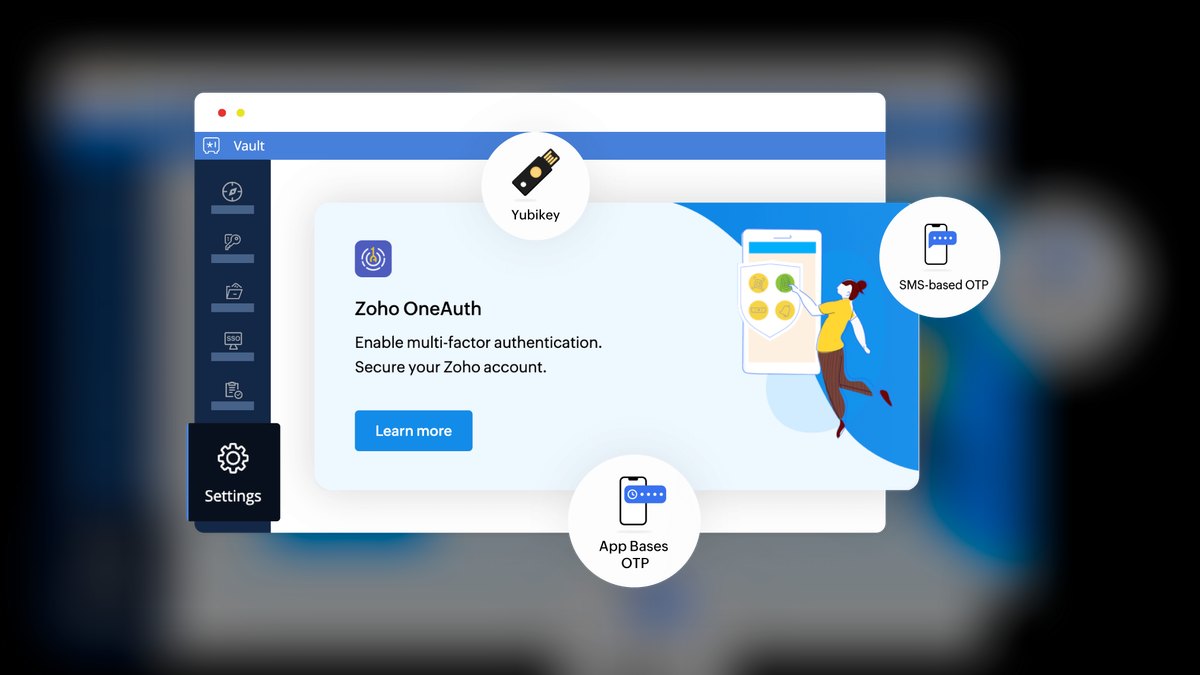
Zoho Vault ranks seventh on economics inside a specific boundary: for organizations already running Zoho One or Zoho CRM, it prices below the $4-$9 band the standalone cloud vaults occupy and integrates natively with the surrounding suite. It provides SAML SSO, Active Directory and Azure AD sync for user provisioning, role-based sharing, password policy enforcement, and access audit trails covering who opened which credential and when.
It fits mid-market companies already inside the Zoho ecosystem where consolidating vendor count matters more than best-in-class depth. The trade is exactly that bundling: the integration advantage evaporates outside the suite, and the standalone product competes weakly against dedicated vaults on admin tooling and enterprise support responsiveness. Against LastPass above, the deployment scale ceiling is lower and the reference base at several thousand seats thinner.
8. Psono
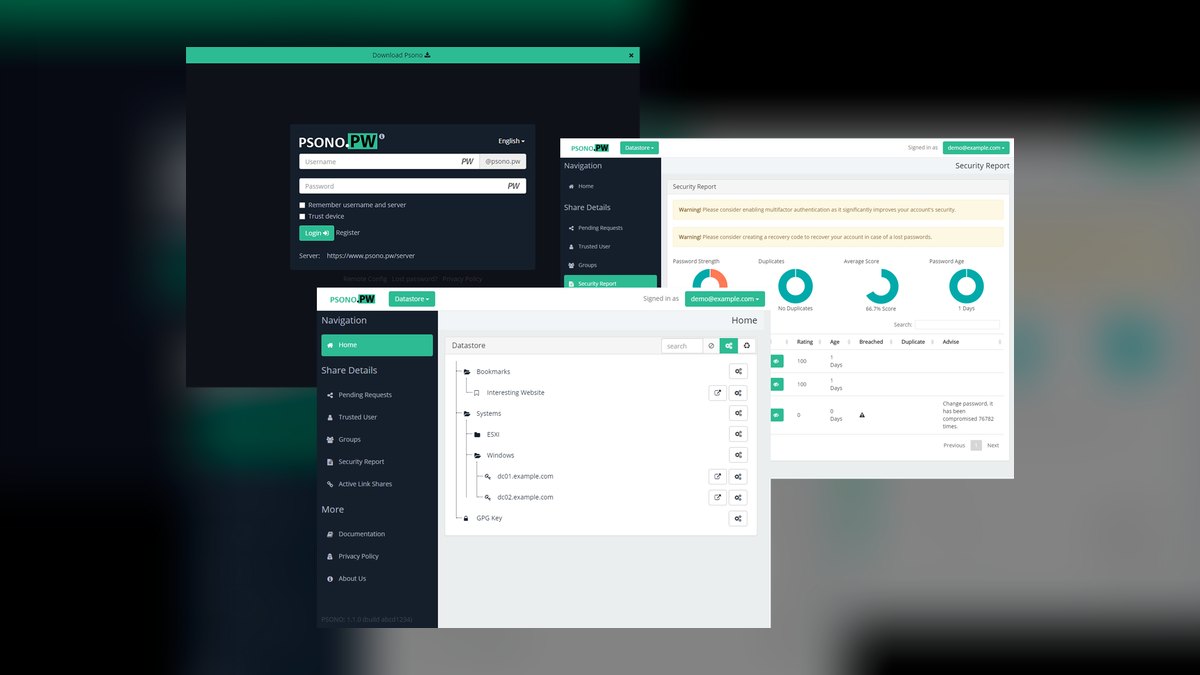
Psono ranks eighth as the strongest of the self-hosted-only open-source vaults on access control. It is built for on-premises deployment with client-side encryption, and supports LDAP and Active Directory integration, SAML and OIDC federation, granular per-share permissions, and an API for programmatic secret retrieval — which pushes it further toward machine-credential use cases than most human-vault products reach. The server code is open, so encryption parameters are directly auditable.
It fits engineering-led organizations with a hard sovereignty requirement and staff who already run production services. The trade is that everything Bitwarden's cloud tier handles becomes yours: availability, patch latency, backup restore testing, and on-call. Against Bitwarden above, the ecosystem, mobile clients, and browser extensions are less polished, and adoption outside technical teams is measurably harder.
9. TeamPass
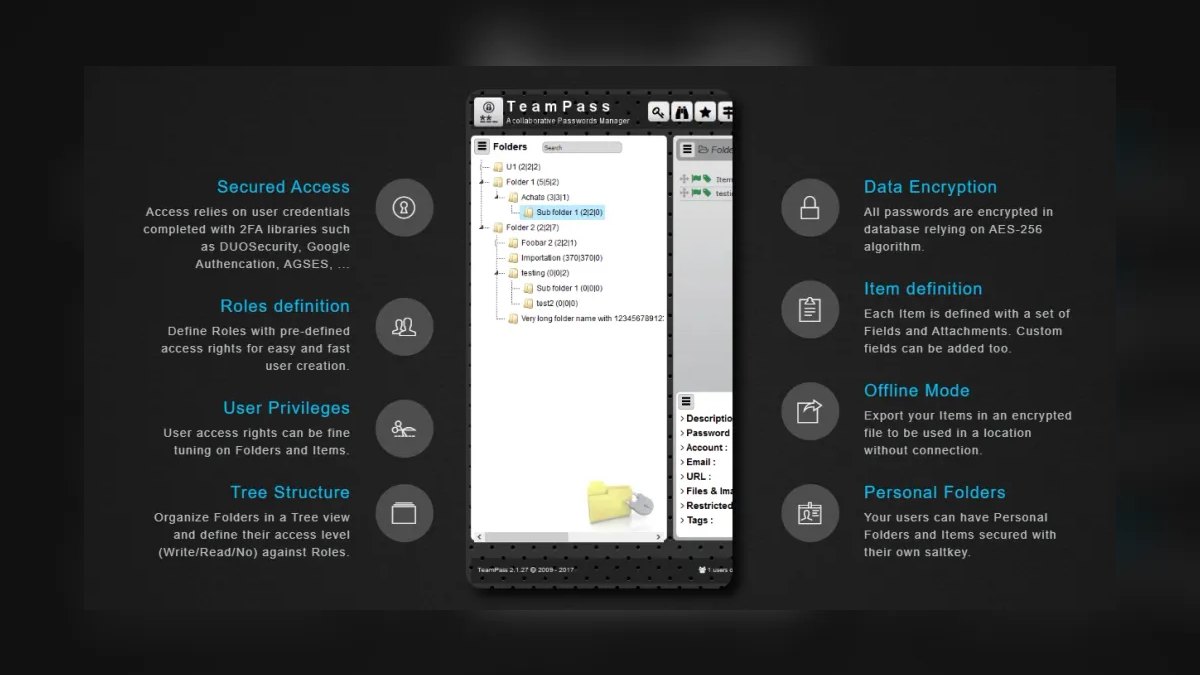
TeamPass ranks ninth because it delivers self-hosted collaborative credential sharing with LDAP and Active Directory integration at zero license cost, running on a conventional PHP and MySQL stack most IT teams can already operate. Folder-level permissions, per-item access rules, and an activity log covering reads and edits cover the baseline audit questions. Its long deployment history means the migration and import paths are well documented.
It fits small IT departments and MSPs sharing infrastructure credentials among a handful of technicians, where the alternative is genuinely a spreadsheet. The trade is scope: no SCIM, weaker mobile and browser-extension support, and a security model that depends heavily on how carefully you configure the server. Against Psono above, the cryptographic architecture and access-control granularity are both meaningfully behind.
10. Passbolt
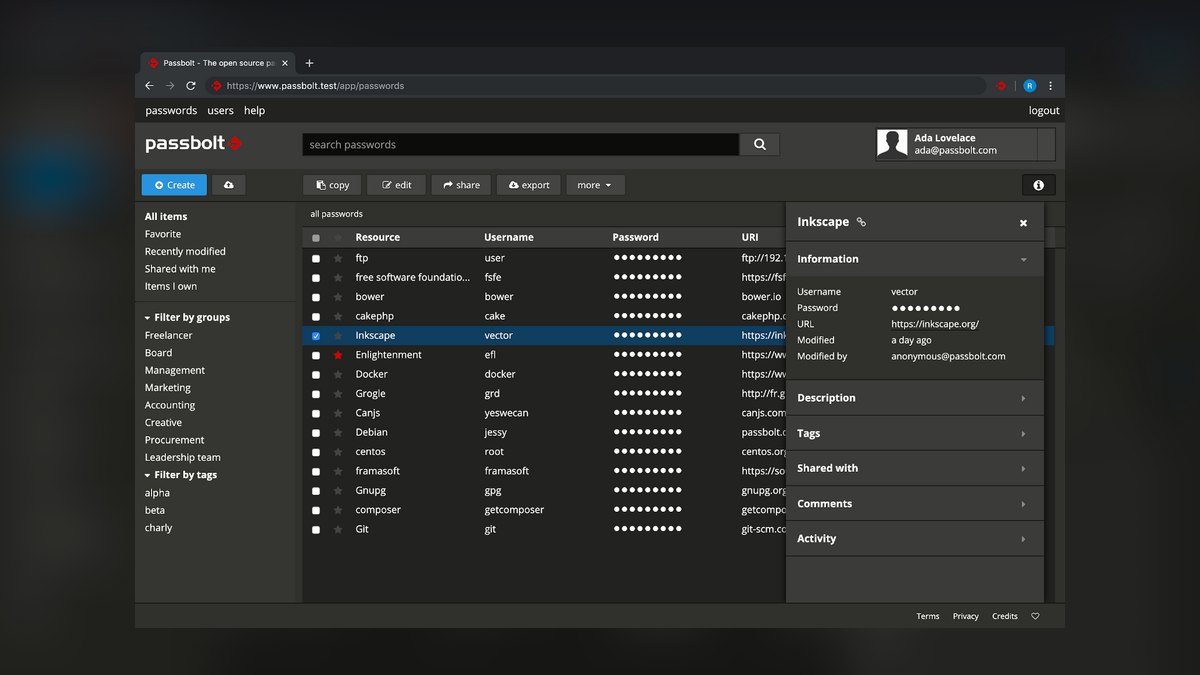
Passbolt ranks tenth because its scope is deliberately narrow: self-hosted, open-source team credential sharing built on OpenPGP, where every secret is encrypted to each authorized member's public key. That model makes sharing and revocation cryptographically explicit rather than server-mediated. It offers LDAP and Active Directory sync, a documented API, and a browser extension that holds the private key locally rather than relying on a server session.
It fits development and DevOps teams of roughly ten to a hundred people who want sovereignty and a transparent crypto model. The trade is enterprise breadth: no privileged-account rotation, no session recording, and the OpenPGP key model adds onboarding friction that non-technical staff feel immediately. Against TeamPass above, the cryptography is stronger and better documented; against every cloud vault here, the operational burden is yours entirely.
How we ranked these
Ten products were scored against four gating criteria in order: hosting boundary (can ciphertext sit in infrastructure you control), identity integration depth (SAML 2.0 or OIDC federation plus SCIM provisioning and deprovisioning), machine-secret scope (programmatic retrieval, leases, scheduled rotation), and audit output fidelity — which fields reach a SIEM, how fast, in what format. Recovery design and key-escrow honesty were weighted alongside, since every enterprise recovery path cracks the zero-knowledge claim.
Deliberately ignored: browser-extension polish, autofill hit rates, mobile app design, and consumer review scores. Per-seat list price was noted but not ranked on — business tiers cluster tightly around $4 to $9 monthly, so a two-dollar delta at 3,000 seats is roughly $72,000 over three years and is routinely erased by a fraction of one self-hosting engineer's time. Feature counts were excluded entirely; the storage layer is commoditized.
What to look for
Work the gating questions in sequence and the field collapses from ten to two or three before anyone opens a trial. If policy demands the encrypted database sit in your infrastructure, most cloud-only candidates are gone on question one, leaving Bitwarden, Psono, Passbolt, TeamPass, and on-premises privileged-access platforms. Then ask whether the vault must deprovision through SCIM automatically, and whether service accounts and CI secrets are in scope at all.
The common mistake is buying on a feature matrix and deploying on nothing — a signed contract and a 40% enrollment rate. The second mistake is testing SSO login without ever testing offboarding: deactivate a directory test user and time how long until vault access disappears. Hours, or a manual step by someone on vacation, is an audit finding. Revocation is also not containment; rotate what the departing person read.
Related questions
Does self-hosting a password vault actually save money?
Usually not. Budget two or more VMs or container replicas for availability, a replicated database, TLS certificate lifecycle, off-site encrypted backup with a tested restore, monitoring with someone on call, and security patching measured in days. That is roughly 0.1 to 0.25 FTE indefinitely, more in the first quarter. What self-hosting buys is data sovereignty, which is a different good and should be justified on its own terms.
What does zero-knowledge encryption really protect against?
A master secret runs through a key derivation function — PBKDF2 at high iteration count, or a memory-hard function like Argon2 — producing a key that never leaves the device. The vendor stores ciphertext plus non-secret metadata. A breach of their storage yields encrypted blobs whose resistance depends entirely on each user's master secret strength and KDF parameters, which is why enterprise policy should mandate long passphrases or hardware-backed unlock.
Is removing someone's vault access the same as revoking the credential?
No, and this is the most misunderstood point in vault operations. Shared collections have a symmetric key encrypted to each member's public key; revocation removes their wrapped copy. Anything they already decrypted and copied is permanently outside your control. Any share revocation on sensitive credentials must trigger rotation of those credentials, built into the offboarding runbook rather than left to Friday-afternoon judgment.
Do password managers handle API keys and service accounts?
Poorly, in most cases. Human-held and machine-held credentials are different problems. Service accounts, SSH keys, database connection strings, API tokens, and CI/CD pipeline secrets need programmatic retrieval, short-lived leases, and scheduled rotation — not browser autofill and a favorites list. A purpose-built secrets manager or your cloud provider's native secrets service is frequently the better answer, with the human vault kept strictly for humans.
How long does an enterprise vault rollout realistically take?
For a few thousand seats, roughly sixteen weeks. Weeks one and two prove SAML and SCIM integration and confirm audit events land in your SIEM with usable fields. Weeks three and four design collections and sensitivity tiers. Weeks five through eight pilot on 50 to 200 users. Weeks nine through sixteen roll out department by department, with the incumbent tool set to read-only before decommissioning.
Should administrators be required to use hardware keys or passkeys?
Yes, without exception. Phishing-resistant authentication built on FIDO2 and WebAuthn is the strongest available answer for vault unlock. The trade is real: hardware keys cost money per user, get lost, and require enrollment and recovery processes, while passkeys tie into platform ecosystems with portability considerations. Design the recovery path before rollout — locked out of the vault is a production incident, not a help-desk ticket.
Can you have both true zero-knowledge and enterprise account recovery?
No. Enterprises need to recover vaults when an employee is terminated abruptly or forgets a passphrase. Every mechanism — admin-held recovery keys, escrowed key shares, break-glass accounts — is a deliberate crack in vendor blindness. Choose consciously, document the choice, and protect the recovery path with the same rigor as the vault: split custody, hardware factors, logged use. Rehearse it on a real account before rollout.
Is a bundled platform better than a focused vault plus a secrets manager?
Bundling human password management with privileged access and secrets management reduces vendor count and gives one audit surface, one contract, one support relationship. The trade is that a bundled module is rarely best-in-class against a dedicated tool, and bundling makes the eventual exit materially harder. Two focused products mean more moving parts and two integrations, but usually a better fit for each job.
FAQ
What is the typical per-seat price for an enterprise password manager in 2027?
Business and enterprise tiers of cloud vaults cluster in roughly the $4 to $9 per user per month band when billed annually. Open-source-core and volume-oriented vendors sit lower; design-forward consumer-crossover brands sit higher. On-premises privileged-access platforms typically price by license tier and administrator count rather than per end user, making small deployments look expensive per head. Always confirm current pricing on the vendor's own page.
Which password managers can be self-hosted?
Bitwarden, Psono, Passbolt, and TeamPass all offer self-hostable deployments, alongside on-premises privileged-access platforms. Choosing one changes your cost model from per-seat subscription to per-seat subscription plus the engineering hours to run, patch, back up, and disaster-recover a tier-one authentication dependency. Passbolt and Psono are built around team credential sharing and access control; TeamPass integrates with LDAP and Active Directory.
Why does SCIM matter more than SSO?
SSO proves login works. SCIM pushes user creation, group membership, attribute changes, and deactivation from the directory into the vault, and group membership is what drives access — engineers land in engineering collections, a role change moves both automatically. A vault requiring manual offboarding is a compliance finding waiting to happen. Without SCIM, group hygiene decays within a single quarter and never recovers without a manual audit.
How does SSO work without breaking zero-knowledge?
The vault still needs a decryption key, and that key cannot come from the identity provider without breaking the property. Vendors solve this with a secondary secret: a device-bound key, a secret held in an enterprise-controlled key service, or a recovery mechanism escrowed to administrators. Read each vendor's documentation on this specific point during evaluation, because it is precisely where the marketing claim and the deployment reality meet.
How long are the free trials, and are they long enough?
Most vendors offer 14 to 30 days, and most will extend for a serious enterprise evaluation if you ask directly. Fourteen days is enough to test integration mechanics end to end — SAML, SCIM, audit events reaching your SIEM. It is not remotely enough to test adoption. Plan a paid pilot of 30 to 60 days on a real department if adoption risk is your primary concern, and it usually should be.
What audit metrics should a vault produce on its own?
Countable ones: number of privileged credentials under rotation, mean age of a rotated secret, number of access grants requiring approval, percentage of shares with a named owner, and number of exports in the last 90 days with recorded justification. Any candidate product should produce all of those from native reporting without a data-warehouse project attached. Audit fidelity belongs in evaluation criteria, not post-purchase discovery.
What SIEM detections should be written before go-live?
Three are high-value and simple: mass vault export, first-time access to a high-sensitivity collection, and credential access from an unexpected geography or an unenrolled device. Access events, failed unlocks, share grants, exports, and administrative actions should stream into the SIEM through an events API or syslog. Confirm the events land with usable fields rather than a generic blob during integration proof, not after.
Do we still need a vault if everything is federated through our IdP?
Possibly a much smaller one. Your identity provider's own credential features may already cover a meaningful share of use cases if most applications are federated. The real question is what percentage of credentials belong to systems that cannot federate. That residual set, plus machine secrets handled by a dedicated secrets manager, defines the vault's true scope — and a smaller scope is cheaper, faster, and more adoptable.
How do you consolidate three credential tools already in production?
Not by buying a fourth. Consolidation is the actual project. Whatever you pick must import from the incumbents via CSV or native importers, with per-user migration you can verify entry by entry. Never delete the old vault on cutover day — keep it readable and frozen for at least one full cycle. Adoption is a change-management problem wearing a procurement costume.
What is the most common reason a vault deployment fails?
A signed contract and a 40% enrollment rate. Teams buy on a feature matrix and deploy on nothing. Treat enrollment as the success metric from day one: a named owner, a deadline per department, manager-level visibility into who has enrolled, and integration into onboarding so new hires enroll before their first credential exists. Track reused-credential count and unrotated privileged credential age afterward.
Sources
- https://pages.nist.gov/800-63-3/sp800-63b.html
- https://csrc.nist.gov/pubs/sp/800/207/final
- https://datatracker.ietf.org/doc/html/rfc7644
- https://www.w3.org/TR/webauthn-2/
- https://fidoalliance.org/fido2/
- https://owasp.org/www-project-top-ten/
- https://bitwarden.com/products/business/
- https://1password.com/business-pricing
- https://docs.keeper.io/en/enterprise-guide
- https://cheatsheetseries.owasp.org/cheatsheets/Secrets_Management_CheatSheet.html
Related on PULSE
- [More password managers for enterprises rankings and buying guides](/knowledge)
- [PULSE Tools and calculators](/tools)
- [Everything on PULSE RevOps](/)
This page will be disappearing soon. Save it to your device for $1 — or read it free while it is here.
@Kory-White- · if Venmo asks, the last 4 of my number are 2012
 softwareShould I consolidate my CRM and customer support tools onto one platform once my teams start sharing the same customer records in 2027?
 softwareTop 10 signs your business has outgrown its current CRM in 2027
 softwareTop 10 marketplaces to find HubSpot CRM apps and integrations in 2027
 softwareHow much does Software cost in 2027?
 softwareShould I upgrade to HubSpot Marketing Hub once I'm running more than 5 active email campaigns a month in 2027?
 softwareTop 10 HubSpot CRM automation workflows for lead nurturing in 2027
 softwareTop 10 podcasts to listen to before choosing productivity software in 2027
 softwareTop 10 HubSpot CRM integrations for business in 2027
 softwareShould I upgrade off HubSpot CRM's free tier once I need more than three deal pipelines in 2027?
 softwareTop 10 job boards to find HubSpot CRM developers in 2027