
What to Wear to a Networking Event in 2027
 Curated byKory White · Fractional CRO · Maryland
 PULSEKNOWLEDGE LIBRARY
Wear sharp business casual you can stand and talk in for three hours: a well-fitting blazer, a clean neutral base, and polished leather shoes or minimalist leather sneakers. Add exactly one intentional standout — a pocket square, a vintage watch, a single artisan piece — that gives strangers an easy opening question.
Two competing philosophies: the invisible baseline versus the memorable hook
Almost every real decision about networking attire collapses into a choice between two coherent strategies, and most people fail because they try to run both at once and end up in the muddled middle.
The first is the invisible baseline. You dress so that nothing about your clothing enters the conversation at all. Charcoal or navy blazer, white or light blue shirt, tailored trousers or dark denim, polished dark leather shoes, no visible logos, no color that carries a name more exotic than "blue." The bet here is that attention is a fixed budget — whatever a stranger spends noticing your jacket, they are not spending on your pitch. This philosophy dominates in finance, law, enterprise sales into regulated buyers, and any room where you are the vendor and they are the check. Its failure mode is forgettability: at a 200-person event, forty people in the same navy blazer produce zero recall, and follow-up email response rates depend heavily on whether the recipient can picture who sent it.
The second is the memorable hook. You keep 90% of the outfit at baseline and deliberately spend the remaining 10% on one object that invites a question. A burgundy silk pocket square against gray wool. A forest-green blazer where everyone else wore navy. A vintage mechanical watch with a visible movement — a Seiko 5 or an old Timex costs well under $200 and gets asked about more often than a far more expensive quartz piece. A handmade ring. A scarf from a small maker. The bet is that a strange, specific, honest detail creates a conversational on-ramp, and on-ramps are the scarcest resource in a room full of people who all hate opening lines.

The trade-off is not cosmetic, it is about who does the work of starting. Under the invisible baseline, you must initiate every conversation yourself, which means you need a functioning opener and the nerve to walk into a closed circle of three people. Under the memorable hook, roughly a third of your conversations start because someone else noticed something and asked. If you are naturally an initiator, the baseline costs you nothing. If approaching strangers is the part you dread, the hook is doing real labor on your behalf, and it is worth more than any amount of fabric quality.
There is a third posture worth naming so you can avoid it: the costume. Three statement pieces, a bold pattern, a loud color, and a hat. It reads as a bid for attention rather than an invitation to conversation, and in professional rooms it inverts the intended signal — people remember the outfit and forget the person wearing it. The rule that keeps you out of costume territory is arithmetic, not taste: count your standout items before you leave the house, and if the number is greater than one, remove until it is one.

Adjacent to all of this: the same two-philosophy split governs your digital surface at the event. Business cards are largely gone in favor of a QR handoff or a LinkedIn scan, which means your profile photo is now part of the outfit. If your photo shows you in a look you would never actually wear, the person who met you in a green blazer and finds a stock-corporate headshot has a small recall break at exactly the moment you needed continuity. Photograph yourself in something close to what you actually wear to these rooms.
How to decide between them
The choice is not personality-first, it is context-first. Work through the event before you work through the closet.
Start with who holds the leverage. If you are selling into the room, the audience's dress floor sets your floor — you may sit slightly above it, never below. If you are being recruited, or you are the speaker, or you are the interesting one, you have earned room to lean into the hook, because people are already predisposed to remember you and the accessory just gives them a handle.

Then read the invitation's literal words, which still mean specific things. "Business casual" means blazer optional but strongly implied, no tie required, dark denim acceptable in tech and creative rooms and risky in finance. "Cocktail" means trousers not jeans, a dress or a sharp separates combination, closed-toe shoes, and the standout piece shifts from a watch to something with a bit more shine. "Smart casual" is the most abused phrase in event copy and effectively means "blazer over a good tee, don't wear shorts." When the invitation says nothing at all, look at the venue: a hotel ballroom pulls formal, a brewery or a coworking floor pulls casual, and a university building splits the difference.
Then check the physical constraints, which quietly decide more than aesthetics. How long is the event? Anything over two hours means you will be standing the entire time, and shoe comfort stops being a preference and becomes the variable that determines whether you leave at hour two. Is there a coat check? Without one you are holding a coat all night, which costs you a hand. Is it a mingling format or a seated dinner? Seated events forgive uncomfortable shoes and punish bulky jackets; standing events do the reverse. Indoor climate is genuinely unpredictable — over-air-conditioned ballrooms and overheated crowded rooms are both common, which argues for layers you can shed rather than a single heavy piece you are trapped in. A merino or merino-blend base layer regulates across a much wider temperature band than cotton and does not show sweat in the same way, which matters in a handshake-heavy room.
The concrete numbers behind each option
Money spent on networking clothing follows a steep diminishing-returns curve, and knowing where the curve bends keeps you from overspending on the wrong layer.

Fit dominates everything. A $150 blazer tailored for $40 to $80 — sleeves shortened, waist taken in, shoulders confirmed to sit at your actual shoulder — outperforms an untailored $600 blazer in every room. Shoulder width is the one dimension a tailor cannot fix cheaply, so buy for the shoulders and alter the rest. Sleeve shortening typically runs $25 to $45, taking in the body $40 to $70, hemming trousers $15 to $25. Budget the alteration money before you buy the garment, not after.
Footwear is where the real money belongs. One versatile pair at $200 to $400 beats three at $100, because the cheap pairs telegraph their price through the sole and the finish, and they hurt. Minimalist leather sneakers in white, black, or dark brown from established makers sit roughly in the $150 to $450 band and are now genuinely acceptable in most non-finance rooms when worn with tailored trousers or clean dark denim. Athletic trainers, chunky running shoes, and anything with a visible swoosh or bright accent are not — the acceptance was granted to a narrow category, not to sneakers generally. Leather loafers, oxfords, and Chelsea boots with a hidden rubber sole give you grip on polished ballroom floors without reading casual. Block-heel ankle boots in the 1.5 to 3 inch range are the workhorse for anyone who wants height without instability across a three-hour standing event; pointed pumps look sharper and cost you an hour of endurance. Aftermarket orthotic or cushioned inserts run $50 to $150 and buy back a surprising amount of that hour.

The standout piece is the cheapest line item and the highest leverage. A vintage or entry-level mechanical watch runs $50 to $300 and starts more conversations per dollar than anything else you can wear. A good silk pocket square or a scarf from a small maker is $20 to $80. Artisan jewelry — a handmade ring, a single unusual stone — lands around $50 to $200. Against that, a designer bag at ten times the price generates fewer questions, because expensive-and-obvious reads as status rather than story, and status does not invite anyone to ask.
Total realistic outlay for a complete, repeatable networking look, assuming you already own trousers or dark denim: roughly $180 to $330 at the relaxed end (soft sport coat, premium tee, clean leather sneakers, a watch), $280 to $550 in the middle (structured blazer, proper shirt, tailored trousers, polished loafers, pocket square), and $320 to $600 for a refined build in finer fabric. Those are one-time numbers for a kit you will wear to a dozen events, which reframes the spend: at twelve outings, a $400 outfit costs about $33 an appearance, and a single warm introduction pays for the whole thing many times over.
What is not worth paying for. Garments marketed on integrated technology — heating elements, embedded batteries, wired linings — carry a substantial premium and introduce failure modes clothing should not have. If you want climate management, buy fabric: merino and merino blends regulate temperature and resist odor across a wide band, cost nothing extra to operate, and never need charging. Anything with a visible LED, an obvious battery bulge, or a "smart fabric" label sewn on the outside works against you in a professional room. The only technology that earns its place is invisible and boring: a slim power bank in an interior pocket, a small crossbody with a charging pass-through, a silenced watch.

Implementation details and sequencing
Getting dressed well is a scheduling problem more than a taste problem. Almost every failure — the unpolished shoe, the wrinkled collar, the blister at hour two — comes from doing the work in the wrong order or too late.
Two weeks out: buy and alter. This is the only step with an unforgiving lead time. Tailors need three to ten days, longer near holidays. If you are buying shoes, buy them now so you can wear them in — leather needs roughly three to five wearings of two hours each before it stops fighting you. New shoes at a three-hour standing event is the single most common self-inflicted injury in this entire category.

One week out: assemble and photograph. Lay the full outfit out and take a photo of yourself in it under normal light. The camera catches what the mirror forgives — a jacket that pulls across the back, trousers breaking too long, colors that clash in a way your eye had normalized. This is also when you confirm the belt matches the shoes (both brown or both black, and roughly the same depth of brown), and when you decide the single standout item and remove the runners-up.
Two days out: read the room's actual signal. Check the event page, the host's past event photos, and the attendee list if there is one. Past photos are far more reliable than the stated dress code, because they show what people actually wore rather than what the organizer hoped for. If the photos show open collars and sneakers, believe the photos.
Day of, morning: shoes and steam. Polish or wipe down the shoes — scuffed footwear undoes a good outfit faster than any other single flaw, and it is the detail people register without knowing they registered it. Steam or press the shirt and the jacket; a travel steamer handles both in under ten minutes and beats an iron on wool. Charge whatever needs charging.

Day of, one hour out: the subtraction pass. Put everything on, then remove one thing. Almost always the right thing to remove is the second accessory. Check hands: you want at least one free at all times for handshakes and phone handoffs, which argues for a crossbody or a small structured clutch you can tuck under an arm rather than a tote you have to set down. Skip or minimize fragrance entirely — crowded indoor rooms concentrate it, and a scent that reads as pleasant at arm's length reads as overwhelming at conversation distance.
At the event: the maintenance loop. If you find yourself adjusting a hem, a collar, or a waistband more than once, that garment is wrong and you should note it and retire it from the rotation — visible fidgeting reads as nervousness regardless of why you are doing it. Keep the standout piece where it is visible in a standing conversation, meaning above the waist for most of them. And keep the answer to "what's the story with that watch?" to about fifteen seconds; the accessory's job is to open the door, not to hold the floor.
How the calculus shifts across career stage and industry
The same two philosophies resolve differently depending on where you sit, and the shift is less about age than about what you are asking the room for.

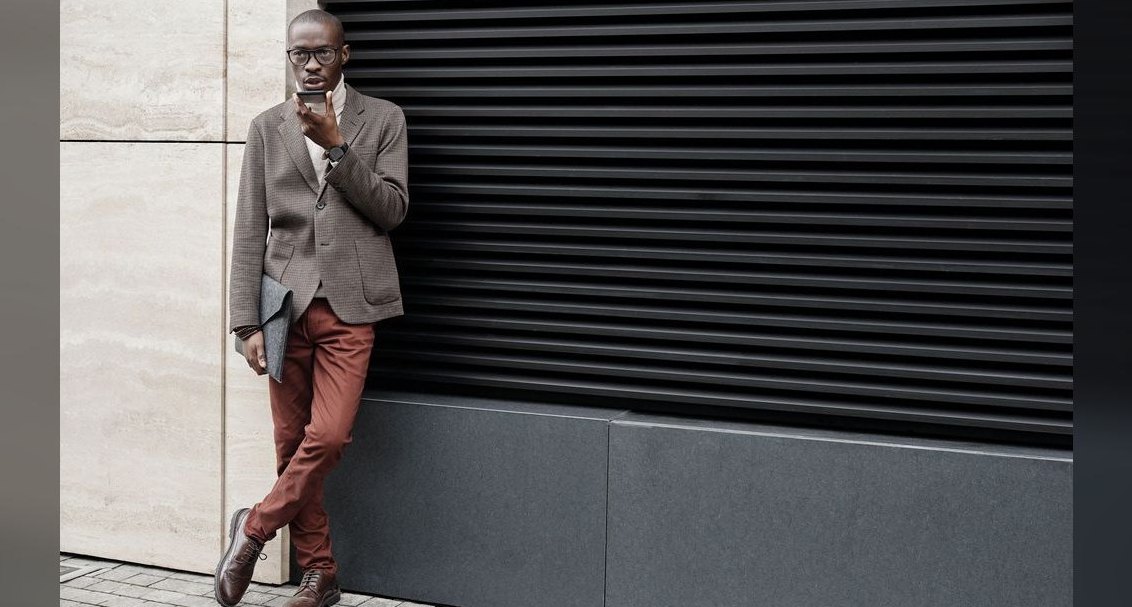
Early career is the one stage where the memorable hook is nearly always correct. You have less track record to be remembered for, so recall has to come from somewhere, and a relaxed soft-shouldered sport coat over a premium tee with dark denim and clean white leather sneakers is both approachable and specific. The mistake at this stage is overcorrecting into a stiff full suit that neither fits the room nor fits you, which reads as borrowed rather than chosen.
Mid career is where a single structured blazer does the most work. Wool or a wool blend, real shoulder construction, a proper shirt underneath, tailored trousers, polished loafers. The standout piece moves up in quality but stays singular — a burgundy silk square, an emerald or deep green jacket where the room wore navy, one good piece of jewelry. This is also the stage where you most often occupy both roles at once, selling to some people in the room and recruiting from others, which argues for a baseline outfit plus one hook rather than either extreme.

Later career earns a more classical palette and better fabric, and the hook shifts from novelty toward distinction: a well-cut jacket in an unusual but quiet color, a slim dress watch, a single strong pendant. Fabric quality becomes visible at this level in a way it is not at $150 — the drape of a good wool reads across a room even when nobody can name what they are seeing.
Industry overrides all of it. Finance, law, and regulated enterprise sit a full notch more formal than the general advice — sneakers are still a real risk there, and the invisible baseline is usually correct. Tech, startups, and creative fields sit a notch less formal, and showing up in a full dark suit can actively signal that you do not know the room. Healthcare and academia tend toward the conservative middle. Trades and owner-operator events run more casual still, where a clean button-down and good boots outperform any blazer. When you genuinely cannot read the industry norm, the safe move is one step above the floor you expect, in the plainest version of that step.
Adjacent formats change the math again. For a virtual event, everything below the chest is irrelevant and everything in the frame is amplified: a solid mid-tone blazer or structured top, minimal jewelry that will not clatter on a lavalier, no busy pattern that strobes on compression, and the standout piece moves to the neckline where the camera can see it. For a conference where you are working a booth for eight hours, comfort wins decisively and you should plan two shoe options. For a small dinner of eight people, the hook matters less because there is no discovery problem — everyone will talk to everyone regardless — and fit and fabric matter more because people are looking at you closely for two hours.
Related questions
Are sneakers actually acceptable now?
Only clean, minimalist leather sneakers in white, black, or dark brown, worn with tailored trousers or dark denim and a blazer. Athletic trainers, visible logos, and bright accents remain wrong. In finance, law, or regulated enterprise rooms, skip them entirely and wear leather.
What if I misread the dress code and I am overdressed?
Overdressed is recoverable and underdressed is not. Remove the tie, unbutton the collar, and if the jacket is clearly too much, check it. Doing this within the first five minutes reads as adaptable; doing it at hour two reads as uncomfortable.
Should I match my outfit to my LinkedIn photo?
Roughly, yes. Your profile photo is now part of the handoff, since most contact exchange happens by scan rather than card. A photo showing a look you would never wear creates a small recall break exactly when continuity matters most.
What is the one thing worth spending real money on?
Shoes, then tailoring. One versatile pair at $200 to $400 outperforms three cheap pairs, and $40 to $80 of alterations on a mid-priced blazer beats an untailored expensive one in every room. Fabric quality is the third priority, not the first.
How do I handle a bag without losing a hand?
Use a crossbody or a small structured clutch you can tuck under one arm. Totes and laptop bags force you to set them down or occupy a hand permanently, which interferes with handshakes, drink-holding, and the phone handoff that ends most conversations.
FAQ
What should I wear to a networking event if the invitation says cocktail attire?
Move up one notch from business casual. Swap denim for tailored trousers, a dark skirt, or a knee-length dress, and choose closed-toe leather footwear. Men can trade the tee for a crisp shirt and add a tie if the room supports it. The one-standout-piece rule still holds — it just shifts toward something with a bit more shine, like a silk square or a stronger pendant, rather than a casual watch.
How do I know what to wear when the event page says nothing about a dress code?
Look at photos from the host's previous events rather than guessing from the description. Those photos show what attendees actually wore, which is more reliable than any stated code. Failing that, read the venue: hotel ballrooms and conference centers pull formal, breweries and coworking spaces pull casual. When still uncertain, dress one step above the floor you expect, in the plainest version of that step.
Is it worth buying clothing with built-in heating, batteries, or smart fabric?
Generally no. The premium is substantial, the failure modes are annoying, and anything with a visible battery bulge or an external smart-fabric label works against you in a professional room. Buy fabric instead — merino and merino blends regulate temperature across a wide band, resist odor through a long evening, and never need charging. The only technology worth carrying is invisible: a slim power bank in an interior pocket.
How many accessories should I actually wear?
Exactly one that is meant to be noticed. Functional items — a belt, a plain watch if it is not the standout, stud earrings — do not count against that total. The test is whether a stranger could name more than one thing about your outfit afterward. If yes, you are in costume territory; remove items until only one remains distinctive.
What is the most common mistake people make with networking event attire?
New shoes. A three-hour standing event in unbroken-in leather produces real pain by hour two, and pain is legible on your face during exactly the conversations you came for. Buy shoes two weeks ahead and wear them three to five times first. The second most common mistake is unpolished footwear, which quietly undermines an otherwise sharp outfit.
Does any of this change for a virtual networking event?
The frame changes everything. Only what appears above the chest matters, so put the budget there: a solid mid-tone blazer or structured top, a clean uncluttered background, and no busy pattern that shimmers under video compression. Move the standout piece up to the neckline where the camera can see it, and avoid jewelry that will knock against a microphone.
Sources
- https://hbr.org/ — Harvard Business Review, research and commentary on professional presence and workplace norms
- https://www.shrm.org/ — Society for Human Resource Management, corporate dress code and professional conduct guidance
- https://www.bls.gov/ — U.S. Bureau of Labor Statistics, occupational and industry data useful for reading industry norms
- https://www.wsj.com/ — The Wall Street Journal, business culture and workplace fashion reporting
- https://www.voguebusiness.com/ — Vogue Business, industry reporting on apparel, materials, and event styling
- https://www.gq.com/ — GQ, menswear fit, tailoring, and footwear guidance
- https://www.thefashionspot.com/ — coverage of professional and event dressing across categories
- https://www.linkedin.com/blog/ — LinkedIn Official Blog, networking practice and event etiquette
Related on PULSE
- [What to Wear to a Networking Event in Fall in 2027](/knowledge/sy0676)
- [How to Style a Cardigan for a Networking Event in 2027](/knowledge/sy2593)
- [How to Style Tailored Shorts for a Networking Event in 2027](/knowledge/sy2569)
- [How to Style a Wrap Dress for a Networking Event in 2027](/knowledge/sy2545)
- [How to Style a Puffer Jacket for a Networking Event in 2027](/knowledge/sy2521)
- [How to Style Combat Boots for a Networking Event in 2027](/knowledge/sy2497)
@Kory-White- · if Venmo asks, the last 4 of my number are 2012
 pulse-styleWhat to Wear on Your First Day at a New Job in 2027
 pulse-styleWhat Should You Wear to a Work Sports Game in 2027?
 pulse-styleTop 10 Men’s Dress Shoes for Work in 2027
 pulse-styleWhat to Wear to a Client Meeting in 2027
 pulse-styleWhat Is Smart Casual in 2027?
 pulse-styleTop 10 Dress Socks for Work in 2027
 syHow do you get started with Style in 2027?
 pulse-styleWhat are the most common mistakes in Style in 2027?
 pulse-styleWhat to Wear in London in Summer in 2027
 pulse-styleWhat to Wear to a Wine Country Trip in 2027