

What to Wear to a Blind Date in 2027
 Curated byKory White · Fractional CRO · Maryland
Quality
Certified
For a blind date in 2027, wear one standout piece — a textured jacket, a sculptural knit, or a single bold accessory — over clean neutral basics in a relaxed, well-fitted cut. Choose tactile fabrics like linen, merino, or silk, comfortable broken-in shoes, and skip logos. Look like you dressed for yourself, not a performance.
The two wardrobe strategies people actually choose between
Almost every blind-date outfit decision collapses into two competing strategies, and naming them makes the choice easier than staring at a closet at 5:40 p.m.
Strategy A — the Anchor Piece. You build the outfit around one visually interesting garment and deliberately mute everything else. A boucle or textured overshirt, an asymmetric ribbed top, a heavyweight linen blazer, a hand-knit cardigan with visible stitch structure. Everything under and around it is quiet: a plain fine-gauge crewneck, straight-leg trousers in charcoal or olive, unremarkable leather shoes. The anchor does the talking; the base coat keeps you from looking styled.
Strategy B — the Uniform. You skip the standout piece entirely and win on fit, fabric, and color harmony. Three or four pieces, all in a tight tonal range — cream, oatmeal, warm tan, or a monochrome charcoal-to-black gradient — but every hem, shoulder seam, and sleeve length is correct. No single item is memorable; the overall impression is "this person has their life together." This is the strategy that photographs poorly and reads beautifully in person, which matters, because a blind date is an in-person medium.
The trade-off is real and it cuts both ways. The Anchor Piece gives your date something to ask about — a conversational handle in the first ninety seconds, which is exactly when a blind date is most fragile. The risk is that the anchor is louder than you are: an intricate jacket in a dim wine bar reads as costume, and you spend the evening explaining a garment instead of talking. The Uniform never embarrasses you and never rescues you either. It also demands more from tailoring; a monochrome outfit with a sloppy trouser break looks worse than a busy outfit with the same flaw, because there's nothing to distract the eye.
There's a third path worth naming even though it's not really a strategy: the Default, meaning whatever you'd wear to work. Roughly speaking, that's fine if your work wardrobe is smart-casual and disastrous if it's either a suit or a hoodie. A suit at a coffee date signals a job interview. A branded company quarter-zip signals you didn't think about it. Neither is fatal, but both burn a little of the goodwill you get for free in the first ten minutes.
Worth noting how this generalizes: the same logic drives what people wear to a first client meeting, a conference floor, or a founder pitch. In every one of those, the "anchor plus quiet base" formula does the same job — it gives the other person a low-stakes opening line. Sales teams have known this for decades; the difference on a blind date is that no one is measuring the interaction against a revenue number, so you can afford to optimize purely for comfort and honesty rather than authority.
How to decide between them
The decision isn't taste, it's constraints. Four inputs settle it in under two minutes: the venue's lighting and formality, the weather, how much you'll be moving, and your own honest read on whether you like being asked about your clothes.
Venue does the heaviest lifting. A daytime café with big windows is unforgiving on fabric quality and forgiving on formality — texture reads well, cheap polyester reads worse than it does at night. A dim restaurant flattens texture and flatters silhouette, which pushes you toward the Uniform, since a boucle jacket in low light just looks lumpy. A walking or activity date kills both strategies unless the anchor piece happens to be outerwear, because you'll be carrying anything you take off.
Weather is the input people ignore and then regret. If the low is under roughly 55°F / 13°C and you're walking anywhere, the outer layer becomes the anchor whether you planned it or not — it's the piece your date sees for the first four minutes and possibly the whole evening. Pick that first and build inward. Above roughly 78°F / 26°C, layered anchors are off the table entirely; the anchor has to be the top itself or an accessory, and fabric weight matters more than color.
Movement duration is the third input. Under ninety minutes seated, you can wear the slightly less comfortable shoe. Over two hours, or anything involving standing, comfort dominates every other consideration. There is no outfit that survives visible foot pain.
The last input is temperamental, not logistical. Some people enjoy being asked "where's that jacket from?" and some find it exhausting. If you're nervous — and most people on blind dates are — the Uniform lowers your cognitive load. You're not managing a garment, you're just dressed. If you're comfortable and want to seed conversation, the anchor earns its keep.
One more decision rule that overrides everything above: if you have to check a mirror more than twice, the outfit is wrong. Not because vanity is bad, but because the checking itself is the signal. Clothes you keep adjusting are clothes you'll adjust at the table, and fidgeting reads as disinterest even when it's just a waistband.
Concrete numbers behind each option
Budgets, timings, and thresholds — the parts that are actually falsifiable.
Cost per strategy. The Anchor Piece is front-loaded: one good textured jacket, unstructured blazer, or heavyweight cardigan typically runs $150–$400 at the accessible end (Uniqlo, Mango, J.Crew, Everlane all sit in this band), and the supporting basics can be things you already own. Total incremental spend: often $150–$400 for one purchase. The Uniform is distributed: three to four pieces that must all be right, generally $80–$200 each, so $300–$700 to build from nothing — but it's reusable across far more occasions, which changes the per-wear math considerably.
Cost per wear. A blind-date-specific anchor piece you wear four times a year at $300 costs $75 per wear in year one. A charcoal merino crewneck at $80 worn forty times a year costs $2 per wear. If you're building a wardrobe rather than solving one evening, the Uniform wins on economics by an order of magnitude. If you're solving one evening in the next 48 hours, the anchor wins on effort.
Fit tolerances that matter. Trouser hem should graze the top of the shoe with a break of roughly zero to half an inch — a full break reads sloppy in photos and in person. Sleeve length on a jacket should show about a quarter to half an inch of shirt cuff. Shoulder seam should land within about half an inch of your actual shoulder point; this is the single alteration most worth paying for, and it's also the one most tailors will tell you is expensive on a jacket (often $75–$150 versus $15–$25 for a hem). Practical consequence: buy for the shoulders, alter everything else.
Fabric weights. Fine-gauge merino at roughly 17–19 microns wears comfortably from about 50°F to 70°F indoors. Midweight linen (around 150–190 gsm) is a warm-weather fabric and will wrinkle within twenty minutes of sitting — that's the trade for breathability, and a linen-cotton or linen-viscose blend cuts the wrinkling substantially while keeping most of the hand-feel. Wool crepe and ponte resist creasing best if you're traveling to the date or sitting in a car for thirty-plus minutes.
Color counts. A workable rule: no more than three colors in the visible outfit, one of which can be an accent. Warm neutrals (cream, oatmeal, tan, olive) and soft blues are the broadest-flattering families. All-black is safe and slightly closed-off; if you wear it, break it with one warm accessory — a tan bag, a rust scarf, brown leather.
Accessory count. Two to three visible pieces total, counting a watch, earrings, a bracelet, a scarf, or a necklace. Four or more starts to read as curated in a way that draws attention away from your face, which is the wrong direction for a first meeting.
Time budget. Grooming and getting dressed should take under about twenty minutes combined, of which under ten is grooming. Fragrance goes on skin at pulse points fifteen minutes before you leave so the top notes burn off before you're sitting three feet from someone. One to two sprays maximum in an enclosed venue — a restaurant table is a much smaller air volume than a street.
Shoe break-in. New leather shoes need a minimum of three to four wears before a two-hour evening. If you bought them this week, wear something else. A scuffed loafer you've had for two years outperforms a pristine one you're negotiating with.
Implementation details and sequencing
Order of operations matters because each decision constrains the next, and doing them out of order is why people end up changing four times.
Step one, two days out: confirm the venue type, not the venue. You don't need the restaurant name, you need the category — coffee, drinks, dinner, activity. If the plan is still vague, ask directly; "should I dress for a coffee thing or a dinner thing?" is a normal question and reads as considerate, not high-maintenance. Vagueness here is the root cause of most bad blind-date outfits.
Step two, the night before: check the forecast for the departure hour and the return hour. These differ by a lot more than people expect, especially in spring and fall. A 7 p.m. dinner date in October can start at 62°F and end at 45°F. Whatever handles the return trip is the layer you're actually committing to.
Step three: pick the shoes. This is counterintuitive but correct. Shoes are the least substitutable item — they set the formality ceiling and floor of the whole outfit, and they're the piece that can genuinely ruin an evening. Everything above the ankle has more give.
Step four: pick the bottom half. Trousers or jeans that work with the chosen shoe, in the right weight for the forecast. Straight-leg and wide-leg both sit comfortably in 2027's range; a dark rinse without heavy distressing is the most venue-flexible denim.
Step five: pick the top and decide the strategy. Now, with shoes and bottoms fixed, you can see whether the outfit wants an anchor or a uniform. If the shoes and trousers are already interesting, go uniform on top. If they're plain, the anchor goes here.
Step six: outer layer. Determined by the forecast from step two. If it's cold enough that the coat stays on, treat the coat as the visible outfit and stop optimizing what's underneath.
Step seven: accessories, capped at three. Add them one at a time and remove the last one you added. This sounds like a joke and it isn't — the "remove one thing" heuristic is old for a reason and it survives contact with reality.
Step eight: the sit test. Sit down in the full outfit for sixty seconds. Cross your legs. Reach for something on a table. Waistbands that dig, shirts that gap, jackets that bind at the shoulder when you reach forward — all of it shows up in this test and none of it shows up standing in front of a mirror. Most of a date is spent seated, so evaluate seated.
Contingency layer. A packable shell in the bag costs almost nothing in bulk and covers rain, wind, and an over-air-conditioned restaurant. It's the single highest-return item you can carry and it never has to come out.
What to do if you get it wrong. You will, occasionally, arrive overdressed or underdressed. Overdressed is easy: remove the jacket, roll the sleeves, and it self-corrects. Underdressed has no fix, which is why the asymmetry argues for erring slightly up. Either way, name it once, lightly, and move on — a person who's visibly uncomfortable about their clothes is more noticeable than the clothes.
How age and body change the calculus without changing the rules
The two strategies hold across ages; what shifts is which one is easier to execute well and which fabrics carry it.
In your twenties, relaxed silhouettes and visible texture do most of the work — a linen-blend camp shirt, wide-leg chinos, and a broken-in derby or a clean low-profile sneaker. The anchor strategy is natural here because casual pieces with interesting construction are cheap and plentiful. The failure mode is over-distressing: rips, heavy fading, and graphic prints read as effort in the wrong direction.
In your thirties and forties, the balance tips toward one genuinely nice fabric plus clean lines — a fine merino crewneck, flat-front wool trousers with no break, suede chukkas or pointed flats, a silk shell tucked into straight-leg crepe trousers. The Uniform becomes easier because you likely already own the components. The failure mode here is defaulting to office clothes; a work blazer over a work shirt looks exactly like what it is.
In your fifties and beyond, structure plus soft color is the reliable formula: an unstructured blazer with patch pockets, an open-collar poplin shirt with no tie, a silk wrap dress, a cashmere cardigan over something simple, quality leather shoes with a low heel. The anchor here is usually the outerwear or the shoes, and the failure mode is over-formality — a full suit or a cocktail dress carries a weight that a first meeting doesn't need.
Body shape adjusts the fit tolerances rather than the plan. Broad shoulders want a softer shoulder line and a slightly relaxed chest so the jacket doesn't amplify what's already there. Athletic builds usually need the waist taken in on anything that fits the chest — that's a $20–$40 alteration and it transforms the garment. Curvy builds do best with a defined waist and a fabric with a little drape rather than stiffness, since stiff fabric bridges rather than follows. Shorter frames benefit from a monochrome column and a hem that hits at the ankle rather than below it. None of these change the eight-step sequence; they change which items pass the sit test.
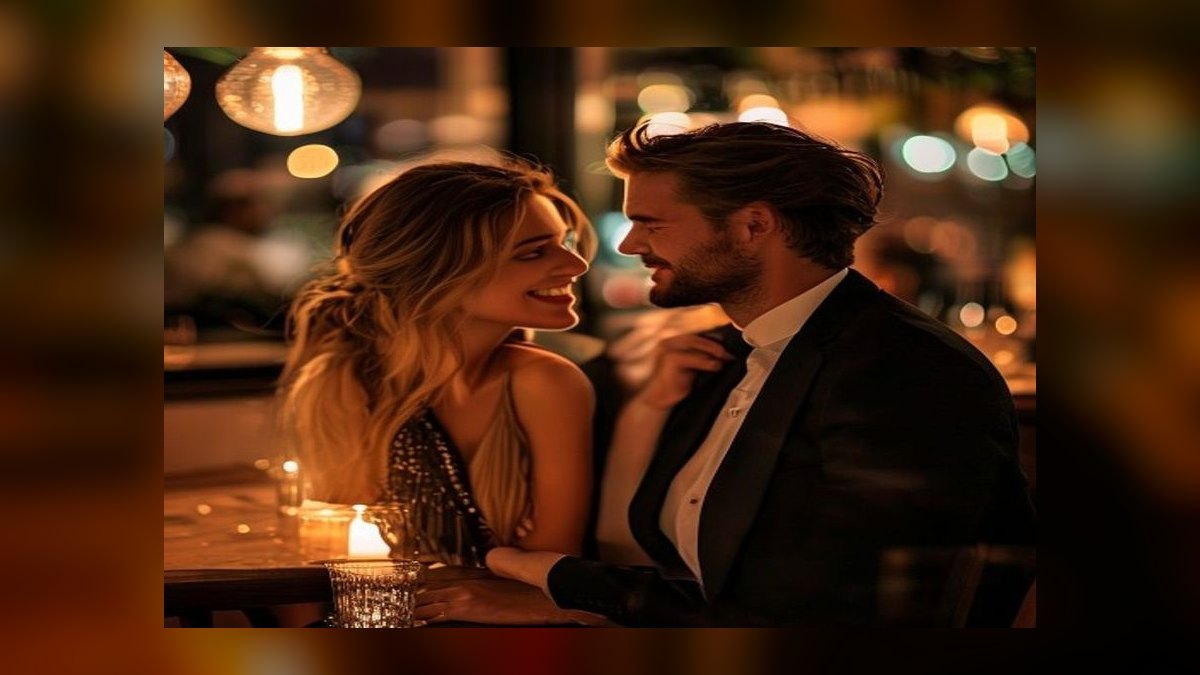
Grooming, scent, and the details that get noticed at close range
A blind date happens at conversational distance — roughly two to four feet across a table — which is much closer than the distance most outfits are evaluated at. That changes what matters.
Fragrance. Single-note or simple compositions outperform complex ones at close range: sandalwood, vetiver, bergamot, cedar, a clean musk. Apply to skin at wrists and the base of the throat, one to two sprays, fifteen minutes before leaving so the sharp opening notes settle. Do not spray clothing — fabric holds scent far longer and much more loudly than skin. If the venue is small or you're sitting at a bar, consider skipping fragrance entirely; nobody has ever ended a date because someone smelled like nothing.
Hair. Texture over structure. A matte clay or paste worked through damp hair and air-dried gives movement without a stiff finish; gels and heavy sprays read dated and feel unpleasant if anyone touches your hair. Loose waves, a low bun with a few pieces pulled free, or a simple clip all work. The ninety-second rule is a decent gate: if styling takes longer than that, it's probably reading as effort.
Skin. Minimal and deliberate. A tinted moisturizer with SPF evens tone without looking like makeup. A lightweight beard oil prevents flaking on facial hair. Tinted lip balm beats gloss. Avoid shimmer and anything with a strong sunscreen smell, which is remarkably noticeable across a small table.
Hands and nails. Genuinely the most-observed detail at a shared table and the most commonly neglected. Trimmed, clean, and unbitten covers ninety percent of it. If you work with your hands, that's fine and reads as honest — dirt under the nails does not.
Breath. Obvious, frequently skipped under nerves. Water throughout the date does more than mints do.
The through-line across all of it: these are subtraction tasks, not addition tasks. The grooming that works on a blind date removes distractions rather than adding features, which is also why the whole routine should fit in ten minutes. Anything longer is usually adding.
Common mistakes and what they actually cost you
Dressing too formally. A full suit or a cocktail dress at a casual venue creates an immediate mismatch, and mismatch is the thing people register before they register style. Smart casual with one elevated piece clears this entirely.
Ignoring the venue. Heels on cobblestones, a tie at a taco place, gym sneakers at a tasting menu — each one costs a small amount of attention that you'd rather spend on conversation.

Over-accessorizing. Past three visible pieces, the eye starts cataloguing objects instead of reading a face. Jewelry that clinks against a table is worse; you'll hear it all night and so will your date.
New shoes. The most preventable mistake on the list. Foot pain is visible in posture within about forty minutes and there's no recovery from it inside a date.
Heavy fragrance. At two feet, a heavy application is genuinely unpleasant and there is no way to undo it mid-evening.
Dressing for the photo instead of the room. Increasingly common and worth naming. Outfits optimized for a phone camera — high contrast, saturated color, dramatic silhouette — often read as costume in a dim room. A blind date is not a photoshoot; optimize for the three-foot view.
Wearing something new head to toe. Unfamiliar clothes make you fidget, and fidgeting is the single most reliable outward sign of discomfort. Keep at least one thing you've worn a dozen times.
Related questions
Should I ask what the venue is before choosing an outfit?
Yes, and ask for the category rather than the address. "Coffee thing or dinner thing?" resolves formality, footwear, and layering in one message. It reads as considerate, not fussy, and it eliminates the most common cause of a mismatched outfit.
Are sneakers acceptable on a blind date in 2027?
Yes, if they're minimal and clean — leather or suede low-tops in a neutral colorway. Running shoes, gym trainers, and anything with prominent branding read as unconsidered. A slightly worn-in sneaker beats a pristine one; brand-new white soles look rented.
What if my date and I end up dressed at completely different formality levels?
Acknowledge it once, lightly, and drop it. Overdressed is fixable — remove the jacket, roll sleeves, lose the tie. Underdressed has no fix, which is the argument for erring slightly upward. Neither outcome matters nearly as much as how comfortably you handle it.
Does any of this change if the date came from an app versus a setup?
Slightly. App matches have seen photos, so an outfit that contradicts your profile creates a small dissonance. Friend-setup blind dates have zero visual baseline, which makes the first impression carry more weight and argues gently for the anchor-piece strategy.
How much should I actually spend on a blind-date outfit?
Ideally nothing new. If you're buying, one versatile piece in the $80–$200 range that works for dates, dinners, and work beats a $400 single-occasion garment. Cost per wear is the only number worth optimizing.
FAQ
Should I dress up or down for a blind date in 2027?
Aim one notch above the venue's baseline. Coffee gets elevated casual — good jeans, a fine knit, clean shoes. Dinner gets trousers or a midi dress with a soft blazer. One notch up signals effort without signaling that you've overthought it, and it leaves you room to dress down by removing a layer.
What colors work best?
Warm neutrals — cream, oatmeal, tan, olive — plus soft and dusty blues are the widest-flattering families across skin tones and lighting conditions. Keep the visible outfit to three colors, one of which can be an accent. All-black is safe but slightly closed-off; break it with a warm accessory in tan, rust, or brown leather.
How do I balance trendy versus timeless?
Pick one trend-forward piece and pair it with classic basics. A wide-leg trouser or an asymmetric knit against a plain crewneck, simple shoes, and minimal jewelry reads current without dating the whole outfit. Two or more trend pieces together start to look like a moodboard rather than a person.
Which fabrics should I avoid?
Pure linen wrinkles within twenty minutes of sitting, and thin synthetic blends look cheap under bright café light. Cotton, wool, merino, silk, and cashmere are consistently safe. Linen blends give you breathability without the immediate creasing, and wool crepe or ponte hold up best if you're sitting in a car on the way.
Is a pattern okay?
A subtle one, yes — a micro-check shirt, a small floral, a tonal stripe. The test is whether it competes with your face at three feet. Large graphics, loud logos, and busy prints pull attention downward and photograph strangely in low light.
What should I carry?
An unbranded bag or cardholder, a packable shell for weather, and nothing that jingles. Keys and loose change in a bag rather than a pocket. The bag itself is a legitimate anchor piece if the rest of the outfit is quiet — texture and construction over logo, every time.
Sources
- https://www.vogue.com/fashion — trend reporting and seasonal styling coverage
- https://www.gq.com/style — men's style guides, fit, and fabric explainers
- https://www.whowhatwear.com — women's outfit formulas and trend forecasting
- https://www.nytimes.com/section/style — cultural reporting on dating norms and dress
- https://www.esquire.com/style/ — men's fashion and grooming guidance
- https://www.thecut.com/fashion — commentary on dressing for social occasions
- https://www.permanentstyle.com — tailoring, fit tolerances, and fabric weight reference
- https://www.realmenrealstyle.com — practical fit and alteration guidance
Related on PULSE
- What to Wear to a First Date if You Have Broad Shoulders in 2027
- What to Wear to a First Date if You Have an Athletic Build in 2027
- What to Wear to a First Date in Your 40s in 2027
- What to Wear to a First Date if You're Curvy in 2027
- How to Style a Cardigan for a First Date in 2027
- How to Style Tailored Shorts for a First Date in 2027
This page will be disappearing soon. Save it to your device for $1 — or read it free while it is here.
@Kory-White- · if Venmo asks, the last 4 of my number are 2012
This page is gone.
This one is off the shelf now. $1 keeps it on your phone for good — the whole page, pictures and diagrams included.
 pulse-styleHow to Style a Wrap Dress for a Graduation in 2027
 pulse-styleWhat to Wear to a Bowling Night in 2027
 pulse-styleWhat to Wear to Yoga Class in 2027
 pulse-styleHow to Style Combat Boots for a Graduation in 2027
 pulse-styleWhat to Wear to a Real Estate Job Interview in 2027
 pulse-styleWhat are the most common mistakes in Style in 2027?
 pulse-styleWhat to Wear to a Wedding if You Have Broad Shoulders in 2027
 pulse-styleWhat to Wear to March Madness Watch Party in 2027
 pulse-styleWhat to Wear to a Work Awards Gala in 2027
 pulse-styleHow to Wear Slate Blue with Chelsea Boots in 2027