

What to Wear to a Temple Visit in 2027
 Curated byKory White · Fractional CRO · Maryland
Quality
Certified

Dress modestly for any temple visit in 2027: shoulders and knees covered, loose opaque fabrics, and shoes you can slip off in seconds. Choose linen, cotton, or Tencel in muted earth tones, skip logos and sheer layers, and carry a scarf for head or shoulder coverage.
The outcome you should expect
The realistic outcome of dressing correctly is that nothing happens. No attendant stops you at the gate, no rented sarong gets wrapped over your outfit, no queue forms behind you while you unlace boots on a hot stone step. That absence of friction is the entire goal, and it is worth naming clearly because most travelers judge temple attire by whether it looks good in photographs rather than by whether it survives the door.
A second, less obvious outcome is thermal. Temples are frequently unconditioned. Stone floors are cold, courtyards are baking, and the interior halls in Southeast Asia or southern India can run humid enough that synthetic fabric becomes miserable within ten minutes. If you wear polyester on a hot day inside a covered hall, you will sweat through it, and sweating through a shirt in a place where you cannot take the shirt off is a self-inflicted problem. Natural fibers — linen, cotton, bamboo viscose, Tencel lyocell — move moisture and dry as you walk. That is not an aesthetic preference; it is the difference between staying an hour and leaving after fifteen minutes.
The third outcome is time. Shoe removal is mandatory at essentially every Hindu, Buddhist, Sikh, and Jain site, and common at Shinto shrines and many mosques. Laced boots cost you sixty to ninety seconds each way, multiplied by however many buildings you enter. On a multi-temple day in Kyoto, Bagan, or Bali, that compounds into real lost time. Slip-ons, loafers, and sandals reduce the transition to a few seconds.

Set expectations at the correct level: dressing well for a temple is not about looking devout. It is about being unremarkable. The best-dressed visitor is the one nobody remembers seeing, because the clothing raised no question at all.
What drives that outcome
Three variables determine whether an outfit passes: coverage, opacity, and removability. Coverage is the one everyone knows — shoulders and knees, for all genders, in essentially every tradition. Opacity is the one people fail on. A knee-length linen skirt held up to bright courtyard sun becomes transparent, and lightweight white cotton over dark underlayers reads sheer at exactly the moment you're standing in an open-air courtyard. Test the garment against a window before you pack it. Removability is footwear plus anything else you'd have to strip at the door.
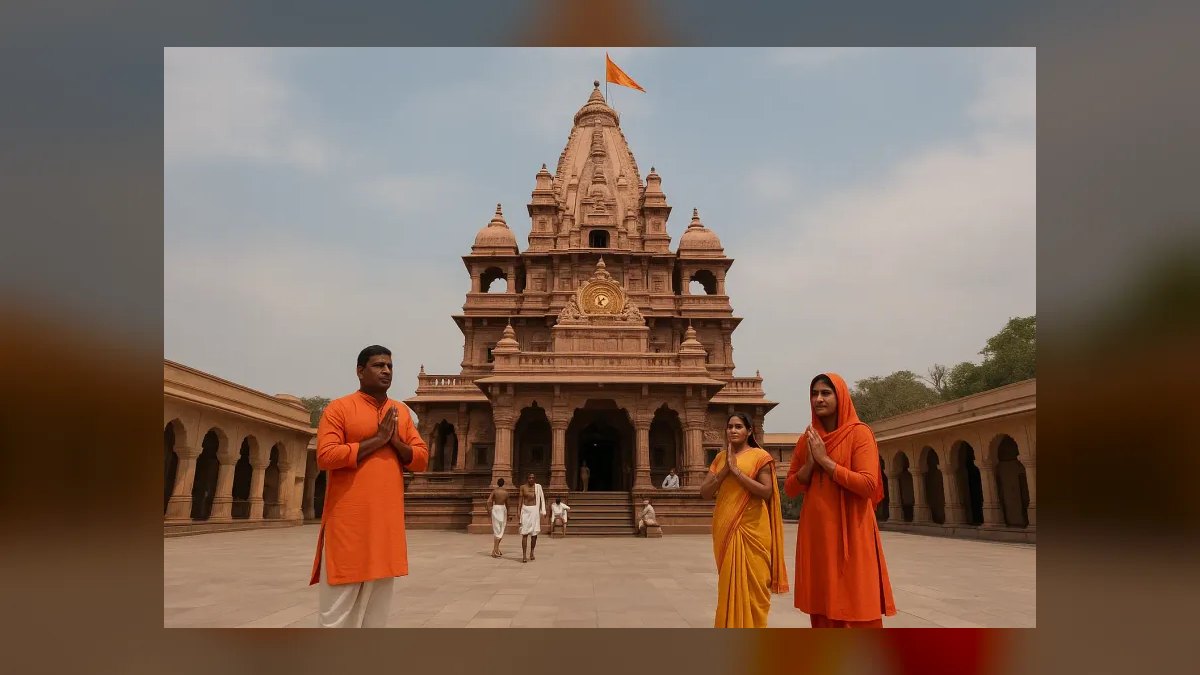
A fourth variable, cultural specificity, sits underneath all three. Head covering is required in Sikh gurdwaras and Orthodox synagogues (for men, a kippah), expected for women in many Eastern Orthodox churches, standard in mosques, and generally optional in Buddhist and Hindu temples. Leather is discouraged at many Jain temples — belts, wallets, and shoes included — because of ahimsa. Some Balinese temples require a sarong and sash regardless of what's underneath. These are not general rules you can infer; they are site-specific facts you look up, which takes about ninety seconds on the temple's official page.
The reason this decision tree matters more than a packing list is that it survives contact with places the list never anticipated. You will end up at a shrine nobody mentioned, or a working village temple with no signage, and running four questions in your head is faster and more reliable than trying to recall a rule for that specific tradition.
There's a useful parallel from a completely different domain: enterprise dress codes for client-facing field work. The same three-variable logic — coverage, durability, removability — governs what a technician wears onto a customer site. In both cases the wardrobe is a compliance instrument, not a self-expression instrument, and in both cases the person who treats it as compliance moves faster than the person who treats it as taste.

Benchmarks and realistic ranges
Here are practical ranges to plan against. A dedicated temple-visit outfit — one pair of loose trousers or a midi/maxi skirt, one long-sleeved or elbow-covering top, one packable scarf, one pair of slip-ons — sits in a wide band depending on where you shop. Fast-fashion and basics retailers put a full set in the low tens to low hundreds of dollars. Mid-market brands, better linen, and leather slip-ons push it higher. Secondhand platforms and local markets near major temple towns are frequently the cheapest path, and rental sarongs or shawls at the temple gate itself are typically nominal — often free as a loaner, sometimes a small deposit.
Fabric weight is a benchmark worth knowing. Linen and cotton in roughly the 150–220 gsm range breathe well and stay opaque; below about 120 gsm, most light-colored wovens go sheer in direct sun. Tencel lyocell drapes better than linen at similar weight and wrinkles far less, which matters when the garment lives in a daypack between sites. Merino base layers in the 150–200 gsm range are the right call for high-altitude monasteries in Bhutan, Ladakh, or the Japanese Alps, where morning temperatures can sit near freezing and midday courtyards hit shirt-sleeve warmth.
Time benchmarks: budget five to ten minutes at the entrance of a major site for shoe storage, ticketing, and any coverage check. At the largest pilgrimage temples during festival season, that stretches considerably. Plan the sequence so you are not arriving with twenty minutes before closing.

Coverage benchmarks in practice: sleeves to the elbow clear nearly every site; sleeveless plus a shawl clears most but not all; spaghetti straps clear almost none. Hemlines below the knee are universally safe; at the knee is usually fine; above the knee is the single most common reason people get handed a rental sarong. Shorts on men are rejected far more often than travelers expect — including at European cathedrals, where the enforcement is real even though the tradition feels familiar.
Color is a softer benchmark. Muted, earthy palettes — beige, tan, olive, slate, cream, soft browns — read as respectful nearly everywhere. White carries specific meaning in several traditions and is standard or preferred at some sites, mourning-associated in others. Black is broadly acceptable but absorbs heat badly in tropical climates. Saffron and deep orange carry monastic significance in Buddhist and Hindu contexts and are best left to the people entitled to wear them. Bright neon and heavy logo prints are the outfits that get looks.

Risks, edge cases, and failure modes
The most common failure is arriving in an outfit that would have passed in cooler weather and failing because you dressed for heat at the last minute. People pack correctly and then change at the hotel. Build the temple outfit as a fixed set and carry it rather than deciding each morning.
The second failure is the borrowed-cover-up trap. Many sites offer loaner sarongs or shawls, and travelers plan around that availability. It works, but the loaner is one-size, frequently in a color that clashes with everything, often shared by hundreds of visitors a day, and occasionally unavailable at smaller sites entirely. Treat gate loaners as a backstop, never as the plan.
Third: footwear theft and mix-ups. At large sites, shoes are left in racks or open shelves. Expensive, distinctive sneakers occasionally walk away. Bringing a cheap, unremarkable pair of slip-ons and a thin bag to carry them solves this. Many major temples now offer lockers or attended storage, but assume you may be leaving shoes on an open shelf.

Fourth: socks. Once shoes are off, you're walking on stone that has been baking in the sun or chilled overnight. Sun-heated stone at midday in Rajasthan or central Myanmar is genuinely painful barefoot. A pair of thin socks in your bag is the cheapest problem-solver on this list, and at Japanese shrines and tea rooms socks are close to expected.
Fifth: photography and phone use interacting with attire. Some inner sanctums prohibit photography, and some prohibit entry with bags. If your outfit relies on a large tote for its cover-up, you may be separated from the tote at the door and from your shawl with it. Wear the layer or carry it on your body, not in a bag you may have to check.

Sixth, and underrated: menstruation-related restrictions exist at a small number of Hindu temples and are enforced inconsistently and controversially. It is worth knowing the site's stated policy before traveling a long distance, purely so you are not surprised.
Seventh: leather at Jain temples. Belts, watch straps, camera straps, wallets, and shoes are all potentially restricted. If Jain sites are on the itinerary, a canvas or synthetic belt and a fabric watch strap remove the whole problem.
Eighth: over-correction. Wearing borrowed religious garments you don't understand, or dressing in a costume version of local traditional wear, lands worse than plain modest Western clothing. Locally purchased kurta sets and sarongs worn straightforwardly are welcome nearly everywhere; ceremonial or monastic garments are not yours to wear.

A practical rollout plan
Treat this like any small operational rollout: define the standard, pilot it, then run it. The upstream planning work is where nearly all the value sits, and the same discipline that protects a company's revenue from avoidable operational friction protects a trip from avoidable delays at a temple gate.
Step one, roughly two weeks before travel: list every religious site you intend to enter and check each one's official visitor page. This is the highest-leverage fifteen minutes of the whole process. Note four things per site — head covering, sarong or sash requirement, leather restriction, and bag or photography rules.
Step two: build one base outfit that satisfies the strictest site on the list. Everything else is then automatically covered. Bottoms that clear the knee comfortably when seated cross-legged, a top with at least elbow-length sleeves and a neckline that doesn't gape when you bow, and a scarf large enough to cover shoulders or head.

Step three: opacity-test every piece against a bright window, including with the underlayers you'll actually wear. This catches the failure that no packing list catches.
Step four: wear the full set for a hot afternoon before you leave. Fabric that itches at hour two will ruin a temple day. This is the pilot, and it is the step people skip.

Step five: pack the accessory kit — thin socks, a lightweight bag for shoes, and a spare hair tie if you'll be covering your head. All of it fits in a daypack pocket.
Step six, on site: put the layer on before you reach the entrance. Arriving already compliant means you walk straight through instead of stopping to arrange yourself in a queue.
Step seven: reset overnight. Linen and cotton air out well; hang the set rather than stuffing it back in the pack, and it will hold up across a week of daily visits.
Related questions
Do I have to remove my shoes at every temple?
At Hindu, Buddhist, Sikh, and Jain sites, almost always — and often before entering the outer grounds, not just the building. At Shinto shrines it depends on whether you enter an interior hall. Christian churches generally do not require it.
Can I wear jeans to a temple?
Usually yes, if they're full-length, opaque, and free of rips. Dark straight-leg or wide-leg jeans read as neutral. The practical downside is heat — denim in a tropical courtyard is uncomfortable and slow to dry.
Is a shawl enough to cover a sleeveless top?
At most sites, yes. At the strictest — some Hindu temples, mosques, and Orthodox churches — a shawl that can slip is not enough. If a site is on the strict end, wear actual sleeves rather than relying on a draped layer.
What should children wear?
Standards for young children are relaxed nearly everywhere, but from roughly adolescence onward the adult rules apply. Comfortable cotton, covered knees, and slip-on shoes work; skip character-print graphics at major or actively worshipped sites.
Does the rule change for a ceremony versus a casual visit?
Yes. Attending a wedding, funeral, ordination, or festival service raises the bar toward formal-modest — closed shoes where permitted, better fabrics, no beachwear cues at all. Ask your host about color, since several traditions attach specific meaning to white.
FAQ
What is the single most important rule for temple attire?
Cover shoulders and knees with opaque fabric. If you do only one thing, do that. It clears the entrance at the overwhelming majority of temples, shrines, mosques, gurdwaras, and churches worldwide, and it is the rule that gate attendants actually enforce.
Are sandals acceptable, or do I need closed shoes?
Sandals are fine and often ideal, because they come off instantly. The exception is a formal ceremony, where closed shoes read as more respectful in the spaces that permit shoes at all. Avoid anything with complicated straps or laces.
Do men and women follow different dress codes?
The coverage baseline is the same — shoulders and knees — but head covering rules differ by tradition. Women cover their heads in mosques, many Orthodox churches, and gurdwaras; men cover their heads in gurdwaras and synagogues. Men should also expect shorts to be refused.
How do I stay cool without breaking the dress code?
Choose loose cuts in linen, cotton, bamboo viscose, or Tencel, in light colors that reflect heat. Looseness matters more than fabric weight — a flowing wide-leg trouser is cooler than a fitted lightweight one. Skip polyester and nylon entirely in hot climates.
What if I show up underdressed?
Most major sites keep loaner sarongs or shawls at the entrance, sometimes free and sometimes for a small fee or deposit. Smaller and rural temples may not. Carrying your own scarf makes the question moot and costs almost nothing in pack space.
Should I buy local traditional clothing to wear?
Buying and wearing locally sold everyday garments — a kurta, a sarong, a salwar kameez — is generally welcomed and practical. Avoid monastic robes, ceremonial dress, and religious symbols from a tradition you don't practice; those read as costume rather than respect.
Sources
- https://www.lonelyplanet.com — destination guides with site-specific etiquette and dress code notes
- https://www.tourismthailand.org — Tourism Authority of Thailand guidance on temple etiquette and attire
- https://www.japan.travel — Japan National Tourism Organization on shrine and temple manners
- https://www.incredibleindia.gov.in — India's official tourism portal, including temple visitor information
- https://www.vatican.va — Vatican official site, including basilica visitor rules
- https://www.goldentempleamritsar.org — Golden Temple Amritsar visitor guidance, including head covering
- https://travel.state.gov — U.S. State Department country information pages covering local customs
- https://www.gov.uk/foreign-travel-advice — UK Foreign Office travel advice with local law and custom sections
- https://whc.unesco.org — UNESCO World Heritage Centre entries for major temple sites
Related on PULSE
This page will be disappearing soon. Save it to your device for $1 — or read it free while it is here.
@Kory-White- · if Venmo asks, the last 4 of my number are 2012
This page is gone.
This one is off the shelf now. $1 keeps it on your phone for good — the whole page, pictures and diagrams included.
 pulse-styleHow to Style a Blazer in Fall in 2027
 pulse-styleWhat to Wear to a Factory Tour in 2027
 pulse-styleHow to Wear Slate Blue with Linen Pants in 2027
 pulse-styleHow to Style a Pleated Skirt for a Gala in 2027
 pulse-styleHow to Wear Lavender in Summer in 2027
 pulse-styleTop 10 Affordable Work Dress Brands in 2027
 pulse-styleHow to Style Combat Boots for a Graduation in 2027
 pulse-styleWhat to Wear to a Concert in 2027
 pulse-styleHow to Style White Sneakers for a Theater Show in 2027
 pulse-styleWhat to Wear to a Graduation if You Have a Long Torso in 2027